Technology no longer sits apart from business. Software teams ship products that must meet business goals, data analysts translate numbers into strategy, and IT decisions increasingly shape company direction. India’s higher-education landscape, guided by bodies such as the Ministry of Education, has been steadily shifting toward more integrated, skills-based learning to match this reality. Students who understand both computing and management enter this environment with an advantage that a purely technical or purely business background cannot offer alone.
Top institutions in India blending computer applications (BCA) with management exposure, tech-driven business modules, or integrated pathways include Regional College of Management (RCM), Bhubaneswar, Symbiosis Institute of Computer Studies and Research (SICSR), Pune, Christ University, Bengaluru, and Amity University, Noida. These programmes integrate technology learning with business intelligence, live corporate projects, and IT-management training, though the depth and structure of this integration differs by institution and should be confirmed directly with each college.
In simple terms, “BCA with management skills” means pairing the technical foundation of a computer applications degree — programming, databases, software development — with business, communication, and decision-making capability. This combination shapes graduates who can build technology and also explain, justify, and apply it within a business context.
What Is BCA with Management Skills?
A Bachelor of Computer Applications (BCA) is a three-year undergraduate programme built around programming, database management, software development, and computer systems. “BCA with management skills” refers to a BCA that also develops business-facing capabilities, such as communication, leadership, project coordination, and an understanding of how organizations operate.
This is not a separate degree category — it is a description of how a programme is delivered. Some institutions build this in through dedicated business modules; others achieve it through live projects, mentoring, and cross-functional coursework. What matters for a prospective student is verifying how, and how much, management exposure a specific programme actually provides.
Why Combine BCA with Management Skills?
Technical skill alone gets a graduate in the door. Business understanding determines how far they progress once inside. A developer who can explain why a feature matters to the business, or a data analyst who can turn a dataset into a recommendation, works more effectively across teams than someone who can only execute technical tasks in isolation.
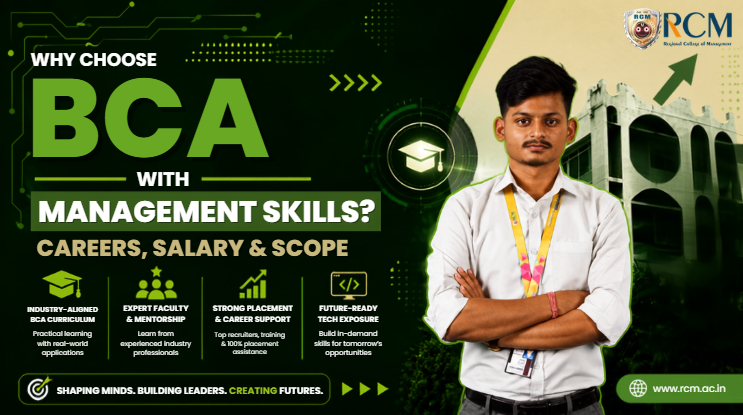
Combining computer applications with management skills builds:
- Cross-functional fluency — the ability to work with both engineering and business teams
- Stronger employability — many technology roles now expect some business awareness by default
- Broader career optionality — graduates can move toward technical, analytical, or business-facing roles
- Better long-term growth — leadership and coordination skills matter more as careers advance
This is why BCA career scope has widened considerably in recent years — it is no longer limited to purely technical designations.
BCA Career Scope
BCA career scope spans conventional technical roles and increasingly technology-business hybrid roles. Conventional paths include software development, web development, database administration, and technical support. Emerging paths — often shaped by management exposure — include business analysis, IT project coordination, and digital business roles.
This shift reflects how organizations now hire: fewer purely technical silos, and more roles that expect graduates to understand both the system they are building and the business problem it solves.
Career Opportunities After BCA with Management Skills
A BCA with management exposure prepares graduates for a range of roles, though eligibility for each depends on the graduate’s specific skills, projects, and experience — not the degree title alone:
- IT Business Analyst — translates business requirements into technical specifications
- Product Management Associate — supports product planning and coordination between technical and business teams
- Technology Consultant — advises organizations on technology adoption and strategy
- Business Intelligence Analyst — turns data into actionable business insight
- IT Project Coordinator — manages timelines, resources, and communication across a technical project
- Digital Business Executive — supports technology-driven business initiatives
- Data/Business Analyst — analyzes data to guide decisions
- Technology Entrepreneur — builds and runs a technology-driven venture
It’s worth being realistic about career progression here: a fresh BCA graduate does not step directly into senior management. These roles represent entry points and early-to-mid-career directions. Reaching management-track positions typically requires additional experience, further study (such as an MBA or MCA), or demonstrated leadership over time.
How Management Skills Complement a BCA
Management skills do not replace technical ability — they extend what a technical graduate can do with it. Relevant capabilities include:
- Leadership — guiding a team or project, even in a junior capacity
- Communication — explaining technical work to non-technical stakeholders
- Project management — planning, sequencing, and delivering work on time
- Business strategy awareness — understanding how a company creates and captures value
- Decision-making — weighing trade-offs, not just executing instructions
- Stakeholder management — coordinating between technical teams, clients, and leadership
- Financial and business understanding — reading budgets, business cases, and basic commercial logic
A software developer with these skills is more likely to be trusted with client-facing work or early leadership responsibility than one without them.
BCA, Business Analytics and IT Management
Business analytics and IT management represent two areas where computer applications knowledge and management thinking directly overlap. Business analytics uses technical tools — spreadsheets, dashboards, query languages, and visualization platforms — to answer business questions like “which product line is underperforming” or “where should marketing spend increase.” A BCA graduate with analytics skills can build and interpret these tools, while management understanding helps them frame the right questions in the first place.
IT management, meanwhile, involves overseeing how technology projects and systems serve business goals — budgeting for infrastructure, prioritizing which features to build, or managing vendor relationships. Graduates who understand both the technical and business sides of these decisions are better positioned to grow into IT management roles over time.
Does BCA Have Good Salary Potential?
BCA salary potential is genuinely promising, but it varies significantly and should not be reduced to a single number. Compensation for BCA graduates in India depends on:
- Role — a developer, analyst, and consultant are typically paid differently
- Location — metro cities generally offer higher packages than smaller cities
- Technical skills — proficiency in in-demand languages, tools, or platforms affects offers
- Experience — entry-level and experienced professionals are compensated very differently
- Employer — large firms, startups, and government roles follow different pay structures
- Specialization — skills in areas like cybersecurity, AI, or cloud computing can command a premium
- Internships and projects — demonstrated, practical experience often influences starting offers
- Communication and business skills — client-facing or coordination-heavy roles can pay differently than purely technical ones
Rather than quoting one figure, students are better served by researching current salary and job-role data for their target role, city, and specialization closer to graduation, since compensation trends shift from year to year. The National Career Service portal, run by India’s Ministry of Labour and Employment, is a useful government-backed starting point for this kind of role- and sector-specific research.
What Skills Should Students Develop During BCA?
To make the most of a BCA with management exposure, students should build competency across both technical and business-facing skills:
- Business understanding — grasping how technology decisions affect business outcomes
- Programming — core coding ability in relevant languages
- Databases — designing, querying, and managing data systems
- Data analytics — interpreting and presenting data-driven insights
- AI/ML fundamentals — foundational understanding of artificial intelligence and machine learning concepts
- Cloud computing — familiarity with cloud platforms and deployment
- Cybersecurity — awareness of security principles and risk management
- Communication — writing and presenting clearly to technical and non-technical audiences
- Leadership — taking initiative in group projects and team settings
- Project management — planning and delivering work within deadlines
How to Choose the Right BCA Programme
Selecting a BCA programme is easier with a structured evaluation rather than relying on marketing claims. Students should review:
- Curriculum — does it balance technical depth with business exposure?
- Technology specializations — are relevant tracks (AI, cybersecurity, full stack, data science) available?
- Practical projects — is coursework applied, or largely theoretical?
- Industry exposure — what kind of real-world exposure does the programme provide?
- Internships — are they built into the structure or left to the student?
- Management/business modules — how, specifically, is business exposure delivered?
- Faculty — what is their background and teaching approach?
- Placement support — what infrastructure exists to help students transition into jobs?
- Certifications — are any industry-recognized certifications included?
- Infrastructure — are labs, technology tools, and learning resources adequate?
- Recognition and approvals — is the programme and institution recognized by bodies such as the UGC for degree validity, and, where applicable, the AICTE for technical education standards?
This checklist applies broadly and is worth using with any institution a student is considering, not just one.
RCM’s BCA+ as an Example of Technology-Focused Learning
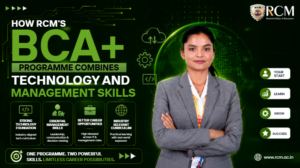
Regional College of Management (RCM), Bhubaneswar, offers its BCA programme through a structure it calls the BCA+ programme, which layers technology specializations — including Full Stack Development, a cybersecurity specialization, and AI, ML and emerging technology tracks — onto the core BCA curriculum. According to RCM’s official programme pages, the structure also includes live projects, internships, and corporate mentoring intended to build industry readiness alongside technical learning.
This is one example of how a BCA can be structured to combine technology depth with applied, industry-facing learning. Students exploring this approach can also review student life at RCM to understand the broader campus experience.
For a wider comparison of institutions offering BCA programmes with different approaches to management and technology integration, see our detailed guide on BCA colleges with management exposure.
BCA Admission: What Students Should Check
Before applying to any BCA programme, students should review eligibility criteria, the admission process, programme curriculum, fee structure, available specializations, and application deadlines. These details vary by institution and by year, so they should always be confirmed directly with the college rather than assumed. Students interested in RCM’s programme can review current details on the official BCA admissions page.
Frequently Asked Questions
Yes, BCA with management exposure is a strong option for students who want both technical and business skills. It broadens career scope beyond purely technical roles into business analysis, IT coordination, and digital business functions, though actual outcomes depend on the student’s skills, specialization, and effort.
BCA graduates can move into management-track roles over time, typically after gaining experience or pursuing further study such as an MBA or MCA. A fresh BCA graduate is unlikely to enter a senior management role directly, but management-oriented skills built during the degree support that progression.
BCA graduates can pursue roles such as software developer, data analyst, IT business analyst, business intelligence analyst, and technology consultant, among others. The specific role available depends on the graduate’s specialization, technical skills, and practical experience gained through internships or projects.
A standard BCA is primarily technical, but many programmes now incorporate business, communication, or project-management elements alongside the core computer applications curriculum. The extent of this integration varies significantly by institution, so students should check a programme’s specific structure before enrolling.
BCA’s future scope remains strong, driven by rising demand for professionals who understand both technology and business context, particularly in digital transformation, business analytics, and IT management. Graduates who combine technical skills with communication and business understanding tend to have wider long-term career options.