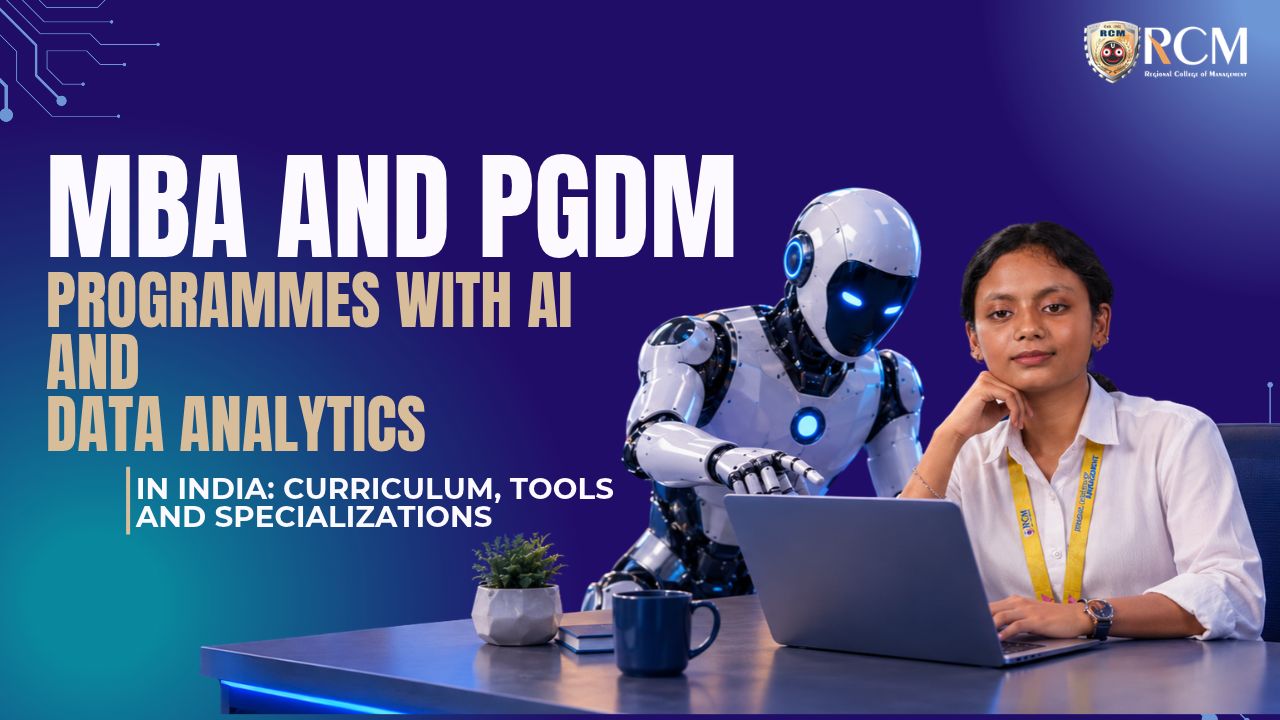
AI and data analytics have moved from optional electives to genuine differentiators in Indian management education — but the depth of integration varies enormously between institutions, and between an MBA and a PGDM at the same college. Before comparing programmes, it helps to understand exactly what “AI and data analytics integrated into the curriculum” can mean: a single elective, a named specialization, or a structural rebuild of the entire degree.
Which Management Colleges in India Offer AI and Data Analytics in MBA or PGDM Programmes?
Regional College of Management (RCM), Bhubaneswar offers MBA and PGDM programmes with AI and data analytics in India through its MBA+ and PGDM+ Data Science and Business Intelligence specializations, covering data analytics, AI, machine learning, and Power BI. Students should evaluate curriculum depth, named specializations, and practical tools when comparing programmes, since AI and analytics integration varies significantly across institutions.
For a broader comparison of how different Indian institutions approach AI-integrated management education generally, see our pillar guide on AI-integrated MBA colleges in India.
Table of contents
- Which Management Colleges in India Offer AI and Data Analytics in MBA or PGDM Programmes?
- What Does AI Integration in MBA and PGDM Programmes Mean?
- MBA vs PGDM: How Should Students Compare AI and Data Analytics Curricula?
- What AI and Data Analytics Tools Are Relevant to Management Students?
- Which MBA and PGDM Specializations Combine Management with AI and Analytics?
- RCM Bhubaneswar’s MBA+ and PGDM+ Pathways
- How to Evaluate an AI-Integrated Management Curriculum
- Conclusion
- FAQs
What Does AI Integration in MBA and PGDM Programmes Mean?
AI and analytics integration in management education typically spans several distinct layers, which are often conflated in marketing materials:
- Core management subjects — strategy, finance, marketing, and operations, taught through traditional frameworks and case studies
- Business analytics and data interpretation — using data to inform business decisions, a skill increasingly expected across all management functions, not just technical roles
- Artificial intelligence and machine learning concepts — understanding how AI models work conceptually, including their capabilities and limitations
- Specialized Data Science and Business Intelligence learning — a dedicated track combining analytics tools, statistical methods, and business intelligence platforms
- Practical application of data and technology to management decisions — actually using these tools on real or realistic business problems, not just studying them theoretically
A programme that touches on AI only in a single elective offers a very different experience than one that builds a dedicated specialization around data science and business intelligence, or restructures its entire core curriculum around AI tools. Understanding which of these layers a specific programme actually delivers is more useful than any general marketing claim of being “AI-integrated.”
MBA vs PGDM: How Should Students Compare AI and Data Analytics Curricula?
Comparing an MBA and a PGDM on AI and analytics content requires looking past the degree title itself, since both can offer similarly structured specializations depending on the institution. Students should compare:
- Programme structure — how AI and analytics content is organized (core subjects, electives, or dedicated specialization tracks)
- Curriculum detail — specific topics, tools, and methods named in the official syllabus, not general descriptions
- Learning outcomes — what students are expected to be able to do by graduation, not just what they studied
- Specialization availability — whether a named Data Science, Business Analytics, or AI/ML track exists, or whether this content is scattered across general coursework
- Practical assessments — whether students work on real datasets and business problems, or complete purely theoretical exams
- Tools and software access — which specific platforms students actually get hands-on experience with
- Project opportunities — live, industry-linked projects versus simulated classroom exercises
- Relevance to career goals — whether the specific specialization aligns with the student’s intended career direction
Neither an MBA nor a PGDM is inherently stronger on AI and analytics content — this depends entirely on the individual institution’s curriculum design, not the degree classification itself.
What AI and Data Analytics Tools Are Relevant to Management Students?
Several tool categories are broadly relevant across modern business analytics education:
- Python and SQL — used for data manipulation, statistical analysis, and building predictive models from raw datasets
- Power BI and Tableau — business intelligence platforms that convert raw data into visual dashboards and reports for decision-makers
- Business intelligence platforms more broadly — software that aggregates and analyzes organizational data to support management decisions
- Predictive analytics — statistical and machine-learning-based methods for forecasting business outcomes, from sales to customer churn
- Machine learning — algorithms that identify patterns in data, increasingly applied to marketing segmentation, credit risk, and operational forecasting
- Generative AI tools — AI assistants capable of drafting content, summarizing information, and supporting business scenario analysis
According to IBM’s overview of artificial intelligence, machine learning and generative AI represent two distinct but related categories within the broader AI field — a useful distinction for management students evaluating which specific skills a programme actually teaches. It’s important to distinguish these as general industry tool categories from what any specific institution’s curriculum confirms — RCM’s official programme pages should be reviewed directly to confirm which of these tools, if any, appear in its specific coursework.
Which MBA and PGDM Specializations Combine Management with AI and Analytics?
Common specialization categories relevant to this space include:
- Data Science and Business Intelligence — combining statistical analysis, data visualization, and business intelligence tools
- Business analytics — applying data-driven methods broadly across marketing, finance, and operations decision-making
- AI and ML-focused tracks — dedicated coursework in artificial intelligence and machine learning applied to business contexts
- Digital marketing analytics — combining marketing strategy with data-driven campaign measurement and customer analytics
- Technology-enabled finance — applying analytics and AI tools to financial modeling, risk assessment, and FinTech applications
Not every institution offers all of these as distinct, named tracks — some combine several into a single broader specialization, while others offer each separately. RCM, for instance, structures some of these as distinct tracks rather than a single combined option; students should confirm exactly which specializations a given institution offers by name, rather than assuming based on this general category list.\
RCM Bhubaneswar’s MBA+ and PGDM+ Pathways
The college delivers its core degree through the MBA programme at RCM Bhubaneswar, with its MBA+ in Data Science and Business Intelligence specialization covering, according to RCM’s official page, data analytics, AI, machine learning, and Power BI within the context of business intelligence. This sits alongside other MBA+ specialization tracks, including MBA+ Digital Marketing specialization, which focuses on marketing strategy with stated exposure to relevant digital tools rather than the data-science-specific content covered in the BI track.
RCM’s parallel PGDM+ programme offers a comparable structure, with its own PGDM+ in Data Science and Business Intelligence track and a separate PGDM+ FinTech, Green Finance and ESG pathway for students more specifically interested in the intersection of finance, technology, and analytics. According to our companion guide on AI tools for MBA students, a closer look at specific tool categories and their business applications is available for students comparing programmes on this basis specifically.
It’s worth noting what RCM’s pages confirm versus what remains a general description: RCM states that AI and analytics training is integrated into named specialization tracks, but does not claim that every specialization — Digital Marketing, International Business, FinTech, and the Data Science & BI track itself — contains identical AI tool exposure. Students specifically interested in data science and analytics depth should review the Data Science & BI track’s own page directly, rather than assuming uniform AI content across all of RCM’s MBA+ or PGDM+ specializations.
How to Evaluate an AI-Integrated Management Curriculum
Before choosing a programme based on AI or analytics claims, prospective students should ask:
- Curriculum transparency — does the institution publish a specific, detailed syllabus, or only general marketing descriptions?
- AI and analytics learning outcomes — what specific skills or deliverables are students expected to produce by the end of the specialization?
- Software and tool access — which specific platforms (Python, SQL, Power BI, etc.) do students actually get licensed or hands-on access to?
- Business datasets and case studies — do students work with real or realistic datasets, or only theoretical examples?
- Project and assessment methods — are students evaluated through applied projects, or primarily through written exams?
- Faculty support — do instructors have genuine data science or analytics backgrounds, or purely general management experience?
- Industry exposure — are there workshops, mentoring, or guest sessions specifically tied to analytics or AI topics?
- Internship opportunities, where confirmed — do internships connect to the analytics specialization specifically, or are they generic business placements?
- Career services and placement information — what career support exists specifically for analytics-oriented roles?
These are questions prospective students should ask of any institution — including RCM — rather than assumptions about what any specific programme automatically provides.
Career Relevance of AI and Data Analytics in Management
AI and analytics skills are increasingly relevant across a range of business functions and potential career directions: marketing (campaign measurement and customer segmentation), finance (forecasting and risk modeling), operations (supply chain and process optimization), strategy (data-driven scenario planning), and dedicated business intelligence roles. According to the World Economic Forum’s analysis of AI and future skills, demand for professionals who can combine business judgment with data literacy continues to grow across industries, though this reflects a broad industry trend rather than a guarantee for any individual graduate.
Actual career outcomes depend on the graduate’s specific skills, project experience, specialization depth, and individual employer requirements — no specialization, at RCM or any other institution, guarantees a specific job, salary, or placement outcome. A closer look at the practical, hands-on side of this training is available in our companion guide on hands-on AI projects and business analytics.
RCM Admissions and Programme Exploration
Students interested in RCM’s AI and analytics-focused pathways can review the MBA+ Data Science and Business Intelligence specialization or its PGDM+ Data Science and Business Intelligence equivalent directly for current curriculum details. Students can also review RCM’s corporate recruiter network and RCM placement information for institution-reported outcomes from recent cycles. For current eligibility, fee details, and application requirements, visit MBA and PGDM admissions at RCM directly, since specific programme details can be updated between academic years.
Conclusion
Comparing MBA and PGDM programmes on AI and data analytics content requires looking past the degree label and marketing language, into the actual curriculum, named specializations, tools, and project structure each institution offers. RCM Bhubaneswar’s MBA+ and PGDM+ Data Science and Business Intelligence tracks represent one approach to this integration, alongside distinct specializations in digital marketing, FinTech, and international business. Students exploring this space should review official programme pages directly — starting with RCM’s MBA+ in Data Science and Business Intelligence or its PGDM+ equivalent — and compare curriculum specifics against their own career goals before deciding.
FAQs
RCM Bhubaneswar offers AI and data analytics through its MBA+ and PGDM+ Data Science and Business Intelligence specializations, while other Indian institutions vary significantly in how deeply AI and analytics content is integrated into their programmes.
An MBA in AI typically focuses on artificial intelligence and machine learning concepts specifically, while an MBA in Business Analytics covers broader data interpretation and business intelligence skills; some programmes combine both under a single specialization track.
This varies by institution — some programmes provide hands-on access to tools like Power BI, Python, or SQL as part of a dedicated specialization, while others cover analytics more conceptually without extensive tool-specific training.
Specializations such as Data Science and Business Intelligence, business analytics, and AI/ML-focused tracks typically combine management education with AI and data science content, though the specific structure varies by institution.
RCM Bhubaneswar offers a Data Science and Business Intelligence specialization within both its MBA+ and PGDM+ programmes, covering data analytics, AI, machine learning, and Power BI according to its official programme pages.