Choosing a BCA programme today means choosing more than a coding degree — it means choosing how much exposure you get to business thinking, industry practice, and emerging technology. This guide breaks down what “management exposure” in a BCA actually means, compares how different institutions approach it, and helps you evaluate programmes on facts rather than marketing claims.
Table of contents
- Which Colleges Offer BCA with Management Exposure?
- What Is a BCA Programme with Management Exposure?
- Why Combine Computer Applications with Management?
- What Makes a BCA Industry-Oriented?
- Top Colleges Offering BCA or Tech-Driven Programmes with Management Exposure
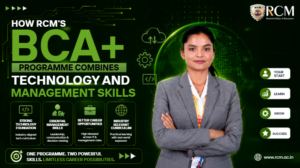
- How RCM’s BCA+ Combines Technology and Management Exposure
- Technology Specializations to Look for in a BCA Programme
- BCA + Management Career Opportunities
- How to Choose the Right BCA College in India
- Is BCA with Management Exposure Right for You?
- Admission to BCA Programmes
- FAQs
Which Colleges Offer BCA with Management Exposure?
Regional College of Management (RCM), Bhubaneswar offers an BCA programme delivered through its BCA+ pathway, which combines core computer applications with technology specializations, live industry projects, and business-oriented learning. Other Indian institutions taking related but distinct approaches include Christ University in Bengaluru, Symbiosis Institute of Computer Studies and Research (SICSR) in Pune, and Amity University in Noida, each of which offers computer applications or technology-management education through its own structure.
These programmes are not identical. Some emphasize computer science depth, others blend in business analytics or IT management, and the extent of “management exposure” varies by institution and by year. The sections below explain how to tell these approaches apart.
What Is a BCA Programme with Management Exposure?
A standard Bachelor of Computer Applications (BCA) is a three-year undergraduate degree focused on programming, databases, software development, and computer systems. A BCA “with management exposure” adds business-oriented learning on top of this technical core — without converting the degree into a management programme.
In practice, this exposure can include:
- Business understanding — how organizations use technology to operate and compete
- Management fundamentals — communication, teamwork, and basic business decision-making
- Business analytics — using data to support decisions, often through tools like Power BI
- Technology management — understanding how IT projects and systems are planned and governed
- Communication and leadership skills — developed through presentations, projects, and mentoring
- Digital business awareness — how technology reshapes business models and operations
It’s important to treat “management exposure” as a descriptive term rather than a formal degree title unless an institution explicitly brands it that way. At RCM, for example, this integration is delivered through the BCA+ programme, which layers technology specializations and industry-oriented learning onto the core BCA structure.
Why Combine Computer Applications with Management?
Modern technology roles rarely exist in isolation from business context. A software developer who understands product goals, or a data analyst who can translate numbers into business recommendations, tends to be more effective in cross-functional teams. Combining computer applications with management-oriented learning helps students connect four areas that increasingly overlap in the workplace:
- Technology — the ability to build, secure, and maintain digital systems
- Business — understanding how organizations set goals and make decisions
- Data — using analytics to support business strategy
- Digital transformation — helping organizations adopt new technology effectively
Examples of technology-business roles that benefit from this combination include IT business analysts, who translate business requirements into technical specifications; digital business professionals, who manage technology-driven initiatives; and technology consultants, who advise organizations on IT strategy. None of these roles depend purely on coding ability or purely on business knowledge — they require both.
What Makes a BCA Industry-Oriented?
Not every BCA programme provides the same level of real-world exposure. An industry-oriented BCA typically includes a combination of the following, though the specific mix varies by institution:
- Practical projects that mirror real business or technical problems
- Internships, where offered, that place students with companies
- Industry exposure through mentoring, guest sessions, or corporate interaction
- Emerging technology coverage, such as AI, cybersecurity, or cloud computing
- Specialization tracks that let students focus on a specific technical direction
- Problem-solving and business-application skills built through applied coursework
- Career-oriented skill-building, including communication and interview preparation
Not all BCA programmes offer every element on this list, and students should verify specifics directly with each institution rather than assuming uniformity across “industry-oriented” claims.
Top Colleges Offering BCA or Tech-Driven Programmes with Management Exposure
The table below summarizes how each institution approaches technology and management integration, based on publicly available information. It is intended as a starting point for research, not a ranking.
| Institution | Programme/Approach | Technology Exposure | Management/Business Exposure | Suitable Career Direction |
|---|---|---|---|---|
| Regional College of Management (RCM), Bhubaneswar | BCA+ (AI-integrated BCA with specialization tracks) | Full Stack Development, Cybersecurity, AI/ML, Data Science & BI | Business-oriented learning, live projects, corporate mentoring, industry exposure | Software development, data analytics, cybersecurity, IT-business roles |
| Christ University, Bengaluru | BCA and related computer applications programmes | Computer applications curriculum | University-level business and liberal-arts ecosystem | Software development, further study in computer applications |
| Symbiosis Institute of Computer Studies and Research (SICSR), Pune | BCA and computer applications programmes | Computer applications and technology curriculum | Institute operates within the broader Symbiosis educational ecosystem | Software development, IT roles |
| Amity University, Noida | BCA and related computer applications programmes | Computer applications curriculum | University-level multidisciplinary exposure | Software development, further study in computer applications |
Each institution structures its BCA offering differently, and prospective students should confirm current curriculum details, specialization options, and management-content depth directly with each college’s admissions office before applying.
How RCM’s BCA+ Combines Technology and Management Exposure
RCM Bhubaneswar, established in 1982 as the first management college in Odisha, delivers its BCA through the RCM BCA+ programme, described by the institution as an AI-integrated BCA that blends core computer applications with industry-focused specializations.
According to RCM’s official programme pages, the BCA+ structure includes:
- Core computer applications foundations — programming, databases, algorithms, and computer systems
- Technology specialization tracks — students can focus on Full Stack Development, Cybersecurity, AI/ML, or Data Science and Business Intelligence
- Industry-oriented learning — live projects, internships, corporate mentoring, and workshops with industry professionals
- Career-readiness components — communication, leadership, and professional skill-building integrated into the programme
RCM’s BCA is a three-year (six-semester) degree affiliated with Utkal University. The institution states it is approved under Sections 2(f) and 12(B) of the UGC Act and holds accreditations including NAAC and ACBSP, alongside NBA recognition for eligible programmes. Students should verify current accreditation status for specific programmes directly with RCM, since recognitions can apply differently across UG and PG offerings.
Technology Specializations to Look for in a BCA Programme
When comparing BCA programmes, it helps to look at which technology specializations are actually offered, since this varies significantly between institutions. Common areas include:
- Full Stack Development — covering front-end, back-end, databases, APIs, and cloud technologies for building web applications. RCM offers this through its Full Stack Development specialization.
- Cybersecurity — covering network security, ethical hacking, threat detection, and risk management. RCM’s Cybersecurity specialization is part of its BCA+ track.
- Artificial Intelligence & Machine Learning — covering AI concepts, machine learning, and related emerging technologies. RCM offers this through its AI and Machine Learning track, which also touches on blockchain and immersive technologies.
- Data/Business Analytics — covering data science, Power BI, and business intelligence tools used to turn data into business insight.
Not every institution offers all four tracks, and the depth of each specialization differs. Students should review the specific curriculum and outcomes for any specialization before enrolling.
BCA + Management Career Opportunities
Graduates who combine computer applications with management or business exposure can pursue a range of technology and technology-adjacent roles, including:
- Software Developer
- Business Analyst
- Data Analyst
- IT Business Analyst
- Digital Business Professional
- Technology Consultant
- Product/Technology Associate
- Cybersecurity Professional
- Full Stack Developer
Actual job eligibility for any of these roles depends on the specific skills developed, prior experience, chosen specialization, and individual employer requirements. A BCA with management exposure can broaden the range of roles a graduate is prepared for, but it does not guarantee placement in any specific role or company.
How to Choose the Right BCA College in India
Use this checklist to evaluate BCA programmes systematically rather than relying on marketing language alone:
- Curriculum — Does it match your interest in technology, business, or both?
- Technology specializations — Are the specific tracks you want (AI, cybersecurity, full stack, data science) actually offered?
- Industry exposure — What kind of exposure is provided, and how is it structured?
- Practical projects — Are live or applied projects part of the coursework?
- Faculty — What is the composition and experience of the teaching faculty?
- Internship opportunities — Are internships built into the programme or optional?
- Placement support — What placement infrastructure exists, and how is it run?
- Infrastructure — Are labs, campus facilities, and learning resources adequate?
- Fees — What is the total cost, and what does it include?
- Student experience — What is campus life like beyond academics?
- Accreditation/recognition — Check relevant approvals such as UGC, AICTE, or university affiliation, where applicable to the specific programme.
- Career alignment — Does the programme structure match your intended career direction?
For comparing institutional rankings and recognitions, resources such as the NIRF framework and the Ministry of Education can offer additional, independently published context.
Is BCA with Management Exposure Right for You?
This pathway tends to suit students who fall into one or more of these categories:
- Students interested in both technology and business, not just one or the other
- Students considering careers in IT management or technology consulting
- Students drawn to data and business analytics roles
- Future entrepreneurs who want technical grounding alongside business fundamentals
- Students interested in digital transformation and how organizations adopt new technology
- Students who want a broader skill set than a purely technical or purely business degree offers
If your interest is narrowly focused on deep computer science or software engineering with no business component, a traditional BCA or B.Tech in Computer Science may be a closer fit. If your interest leans entirely toward business without a technical foundation, a BBA may be more appropriate.
Admission to BCA Programmes
Students considering a BCA or BCA+ programme should check eligibility, admission requirements, programme structure, fees, specialization options, and application deadlines before applying. For students interested in RCM’s BCA programmes, visit the official BCA admissions page for the latest eligibility and application information, or review the BCA fee structure for current cost details. Prospective students can also explore student life at RCM to understand the campus experience alongside academics.
FAQs
Regional College of Management (RCM), Bhubaneswar offers a BCA through its BCA+ programme, which integrates technology specializations with business-oriented and industry-exposure elements. Christ University, SICSR Pune, and Amity University Noida also offer BCA or related computer applications programmes, though their specific approaches to management integration differ and should be verified individually.
A BCA + management programme is a computer applications degree that incorporates business, communication, or management-oriented learning alongside the core technical curriculum. It is not a separate degree but an enhanced structure — such as RCM’s BCA+ — that adds specializations, industry exposure, and career-readiness components to a standard BCA.
For careers that blend technology and business — such as IT business analyst, digital business professional, or technology consultant — a BCA with management exposure can be a relevant preparation because it builds both technical and business-facing skills. Suitability still depends on the specific programme, the student’s specialization choice, and their career goals.
Industry-oriented learning typically includes live projects, internships, mentoring, and specialization tracks. RCM Bhubaneswar states it offers these through its BCA+ programme. Other institutions may offer some or all of these elements differently, so students should confirm specifics with each college directly rather than assuming uniform industry exposure across institutions.
Graduates can pursue roles such as software developer, business analyst, data analyst, IT business analyst, cybersecurity professional, and full stack developer, among others. Actual eligibility depends on the graduate’s skills, specialization, experience, and the requirements of individual employers — a degree alone does not guarantee a specific job outcome.