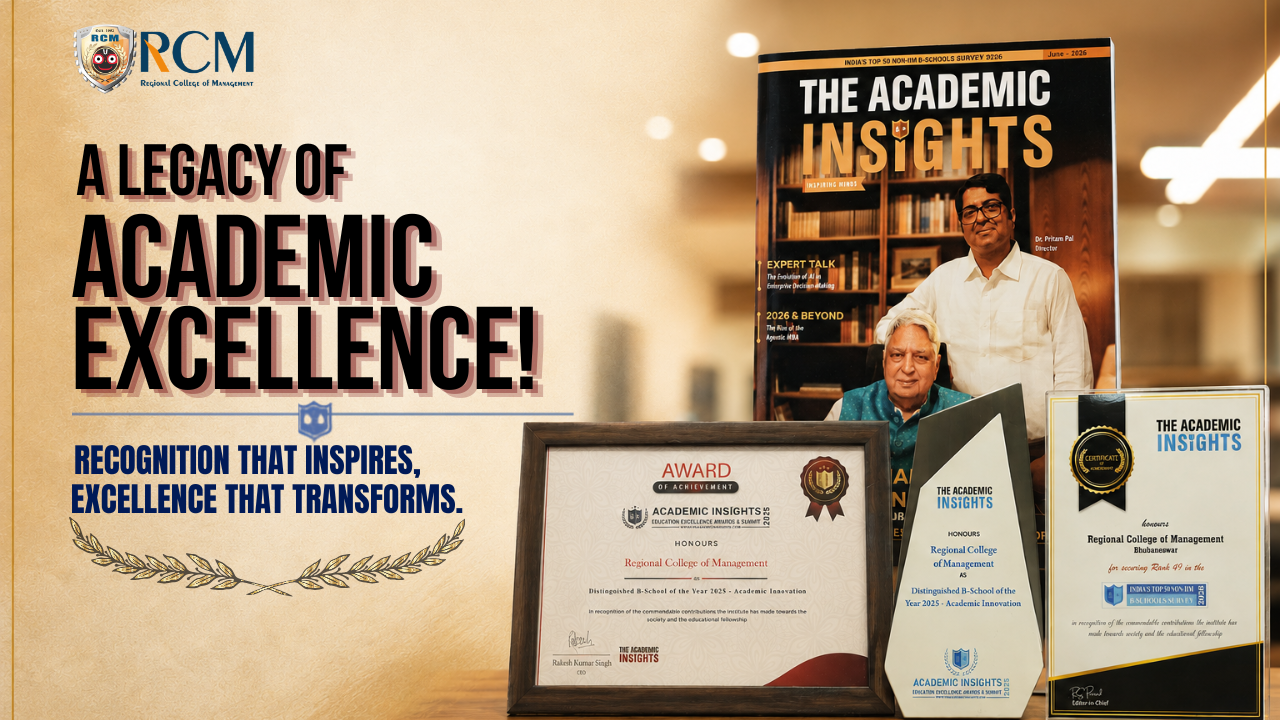
Yes — Regional College of Management (RCM), Bhubaneswar is featured in The Academic Insights’ India’s Top 50 Non-IIM B-Schools Survey 2026. Founded in 1982, RCM holds NAAC, NBA, and ACBSP accreditation, runs AI-integrated MBA+, PGDM+, BBA+, BCA+, and MCA+ programs, and reported a 98% placement rate across 830+ recruiting companies in its 2024–25 cycle.
Odisha’s oldest management institute has just earned a national stamp of recognition. Regional College of Management (RCM), Bhubaneswar, has been named to The Academic Insights’ India’s Top 50 Non-IIM B-Schools Survey 2026, a ranking built to help MBA and PGDM aspirants evaluate strong management colleges beyond the IIM system. For students searching for the best MBA college in Odisha or a top MBA college in Bhubaneswar, this recognition is a useful signal — but the more interesting story is what sits behind it: four decades of institutional history, a faculty base with real research output, and a placement engine that closed its last cycle with an offer as high as ₹22.7 LPA.
This article unpacks that story: how the 2026 survey works, where RCM lands in it, and what actually makes RCM one of the more credible top non-IIM B-schools in India for students building a management career from Eastern India.
Why Non-IIM B-Schools Matter in 2026
The IIM-or-nothing mindset has been fading for a reason. IIM seats are capped, cutoffs are brutal, and a large share of genuinely capable students never get a call despite strong CAT scores. At the same time, a real tier of top non-IIM B-schools in India — from SPJIMR and XLRI to MDI Gurgaon and Symbiosis Pune — now delivers placement outcomes that match or beat several IIMs, particularly the newer ones.
A second, quieter shift matters just as much for regional applicants: students are weighing best ROI management college decisions, not just brand names. A college that combines solid placement access with a fraction of the total fee of a premier private B-school can deliver a stronger return than a big-name institute two states away. That calculus is exactly where a top B-school in Odisha like RCM enters the conversation.
India’s Top 50 Non-IIM B-Schools Survey 2026
The Academic Insights, an independent education research portal and magazine, evaluates institutions for its annual survey using five parameters: academic excellence and faculty pedagogy (including how deeply AI and data analytics are woven into the core curriculum), return on investment, industry interface and global exposure, infrastructure and digital readiness, and diversity and inclusion. The panel combines editorial research with recruiter and academic feedback rather than relying on self-reported placement numbers alone.
In the 2026 edition of the survey, RCM Bhubaneswar appears at rank 49 of 50, with a composite score of 724.97 out of 1000 — placing it alongside institutions such as Al-Ameen Institute of Management Studies, Institute of Engineering & Management Kolkata, and Sahyadri College of Engineering & Management. The list is led by SPJIMR Mumbai, MDI Gurugram, and XLRI Jamshedpur. Being named among India’s Top 50 Non-IIM B-Schools — out of the hundreds of business schools operating outside the IIM system nationwide — is itself a meaningful distinction for a single-campus, Odisha-based institute competing against national multi-campus groups.
Why RCM Earned National Recognition
Separately from the survey ranking, The Academic Insights’ institutional profile named RCM the Distinguished B-School of the Year 2025 for Academic Innovation at its Education Excellence Awards & Summit. The recognition traces back to specific institutional firsts rather than general prestige.
RCM was founded in 1982 by Prof. (Dr.) Prabir Pal with just 32 students in a rented building, making it Odisha’s first techno-management institute. In 2009, it became the first management institute in Eastern India to receive UGC conferment under sections 2(f) and 12(b) of the UGC Act. RCM also says it was the first Indian B-school to structurally fuse core business education with computing and technology disciplines, and the first to introduce enterprise platforms such as Salesforce, Microsoft 365, and Zoho directly into its academic delivery — long before “AI-integrated” became a standard marketing phrase in Indian management education.
Today, the institute counts more than 17,000 alumni and holds triple accreditation from NAAC, NBA, and ACBSP (USA), along with international recognition from CHEA (USA) — a combination that few private B-schools outside the metro circuit can claim simultaneously.
AI-Integrated MBA & PGDM Curriculum
RCM delivers its core academic programs through what it calls the Plus Advantage framework — MBA+, PGDM+, BBA+, BCA+, and MCA+ — layering every conventional degree with applied, technology-forward specializations rather than treating “AI” as a bolt-on elective.
MBA+ and PGDM+ specializations span Artificial Intelligence & Machine Learning, Business Analytics, Data Science & Business Intelligence, Digital Marketing, FinTech & FMVA, Blockchain & Crypto, HR Analytics & Operations, ESG & Green Finance Analyst, Finance, Marketing, Operations, and International Business.
BBA+ specializations include Artificial Intelligence & Machine Learning, Digital Marketing, Business Analytics, FinTech, ESG & Green Finance Analyst, and Entrepreneurship.
BCA+ and MCA+ specializations include Artificial Intelligence & Machine Learning, Data Science & Business Intelligence, Cybersecurity, Cloud Computing, and Full Stack Development.
This curriculum has evolved deliberately over four decades: RCM’s teaching model began as lecture-based instruction, incorporated case-study methods in the 1990s, and now runs on what it calls the Collaboration-Effective Learning (CEL) framework — a pedagogy built around applied problem-solving rather than passive coursework. For students specifically comparing an AI Integrated MBA College or an industry-oriented PGDM, this progression is what separates a genuinely updated curriculum from a rebranded one.
You can review the complete, current program list on RCM’s official Academia page.
Industry Certifications and Corporate Learning
RCM treats corporate exposure as a structural part of the academic calendar rather than an optional add-on, through what it calls its Corporate Immersion Framework. Every MBA, MCA, and BCA student works through the CEL initiative, which requires solving real, evaluated corporate problems as part of coursework — not simulated case studies.
The Summer Internship Programme assigns each student two mentors: a faculty mentor tracking academic alignment and an industry supervisor evaluating real-time performance. Beyond internships, RCM runs Company Programs and Management Development Programs (MDPs) through MoUs with corporate partners, where senior executives contribute directly to curriculum delivery rather than delivering one-off guest lectures. Ahead of placements, the institute’s Road to Excellence series runs targeted coaching in aptitude testing, group discussions, and mock interviews — the kind of structured preparation that supports RCM’s positioning as a genuine MBA College with Placements, not just a degree-granting institute with a placement cell in name only.
Placement Ecosystem and Career Outcomes
RCM’s most recent recruitment cycle (2024–25) is the clearest evidence of its placement engine at work. The institute partnered with more than 830 companies, reported a 98% placement success rate, and recorded a peak offer of ₹22.7 LPA.
| Placement Metric (2024–25) | Reported Figure |
|---|---|
| Recruiting companies | 830+ |
| Placement success rate | 98% |
| Highest package (peak offer) | ₹22.7 LPA |
Recruiters named for that cycle include Deloitte, L&T, Axis Bank, American Express, Genpact, Tech Mahindra, Piramal, Muthoot Finance, ITC, Tata Steel, Wipro, HCL, HSBC, ICICI Bank, SBI, Godrej, Reliance, Bata, Asian Paints, Nestlé, Coca-Cola, and Dr. Reddy’s Laboratories, spanning finance, consulting, IT, manufacturing, and FMCG. Full year-wise and batch-wise placement data is available on RCM’s official Placements page.
Faculty and Research Excellence
Faculty depth is where RCM’s EEAT case is strongest, and where prospective students should look closely before comparing any two colleges on price alone. RCM maintains more than 60 senior faculty members, achieving a student-to-faculty ratio of 16:1 institute-wide and as tight as 9:1 in select programs — both ahead of typical national benchmarks for private management colleges. The faculty’s combined research output includes more than 53 patents, an unusually high figure for a management-focused institute in Eastern India.
To keep pace with evolving teaching methods, RCM runs its own in-house Training of Trainers (TOT) Reading Programme, functioning as a continuous faculty-renewal mechanism rather than a one-time onboarding exercise. This structure aligns closely with NEP 2020’s emphasis on outcome-oriented, interdisciplinary, industry-linked learning.
Global Recognition, Accreditation & Autonomy
RCM’s accreditation stack is layered rather than singular: NAAC accreditation (since 2010), NBA recognition for its PGDM program, ACBSP accreditation (USA), international recognition from CHEA (USA), and AICTE approval, alongside affiliation with BPUT and Utkal University. Prospective students can independently verify AICTE’s national approval framework for technical and management institutions through the All India Council for Technical Education, the statutory body responsible for approving management and technical programs across India.
This multi-body recognition is a large part of why RCM is described — by itself and by third-party rankings — as a Top Autonomous B-School rather than a college operating on a single state-level approval.
Leadership, Ethics & Entrepreneurship at RCM
RCM’s Director, Dr. Pritam Pal, frames leadership development as embedded in the curriculum rather than confined to electives, centered on what the institute calls its Decision Making Orientation (DMO) framework — exposing students to high-stakes, ambiguous business scenarios through case analysis rather than theory alone. The college also maintains an Ethics and Spiritual Training Centre and student-led governance bodies, including a Grievance Cell, Anti-Ragging Committee, and Internal Complaints Committee.
On the entrepreneurship side, RCM partnered with IIT Kharagpur’s E-Cell for its 2025 Entrepreneurship Awareness Drive and hosted AA KA MA 2025, which it describes as India’s largest student entrepreneurship expo — reflecting the institute’s push to produce founders as well as employees at a time when India’s DPIIT-recognized startup count has crossed 1.4 lakh.
Campus Life and Student Experience
Campus life at RCM’s 10-acre Bhubaneswar campus centers on two flagship events. Brahmastra, the institute’s annual fest, drew more than 10,000 participants across 200-plus events in its 2026 edition, spanning cultural competitions, sports arenas, and business-strategy rounds. Ashwamedha, positioned as a Global Management Conclave, is built around academic-industry dialogue and mentorship rather than pure entertainment programming. Full details on hostel life, clubs, and the academic calendar are available on RCM’s official Life @ RCM page.
Who Should Choose RCM
RCM fits a specific applicant profile rather than every MBA or BBA aspirant:
Cost-conscious applicants comparing total fees against placement access, for whom RCM’s positioning as a best ROI management college in Odisha is directly relevant.
- Students from Odisha and Eastern India seeking a top MBA college in Bhubaneswar without relocating to a metro city.
- Applicants who narrowly missed IIM or premier-institute cutoffs but still want a multi-accredited, industry-linked program.
- Students specifically targeting an AI Integrated MBA or a technology-layered PGDM, BBA, BCA, or MCA rather than a purely theoretical degree.
MBA & PGDM Admission 2026 at RCM
RCM’s Admissions 2026 cycle covers its full portfolio — BBA, BCA, MBA, MCA, PGDM, and MATA (tourism administration). Admission to postgraduate management programs is typically based on OJEE, CAT, XAT, CMAT, MAT, or ATMA scores, followed by a group discussion and personal interview. Merit-based and OJEE-rank scholarships are available for qualifying applicants, and the current fee structure and application form are accessible directly through the official admissions portal.
FAQs
RCM features in The Academic Insights’ 2026 survey for its academic pedigree, AI-integrated curriculum, faculty research output, and consistent placement performance.
For students prioritizing an autonomous, multi-accredited college with AI-integrated specializations and strong ROI, RCM is a genuinely competitive regional option.
RCM pairs core management theory with applied AI, analytics, and technology tracks (MBA+, PGDM+) delivered through its Collaboration-Effective Learning framework.
Yes — RCM reported a 98% placement rate across 830+ recruiting companies and a peak offer of ₹22.7 LPA in its 2024–25 cycle.
Many non-IIM B-schools, including RCM, offer stronger ROI, specialized AI-driven curricula, and solid corporate access without the extreme cutoffs or costs of top IIMs.
Final Thoughts
RCM’s appearance in the Top 50 Non-IIM B-Schools Survey 2026 isn’t the headline on its own — it’s the confirmation of a pattern that’s been building since 1982: an autonomous, multi-accredited institute that reinvested four decades of legacy into AI-integrated curricula, a research-active faculty base, and a placement engine now working with 830-plus recruiters. For students in Odisha and Eastern India weighing a top non-IIM B-school against the cost, location, and ROI trade-offs of a metro-city MBA, RCM is a name that now belongs firmly in that shortlist conversation