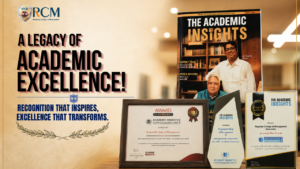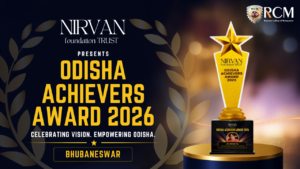
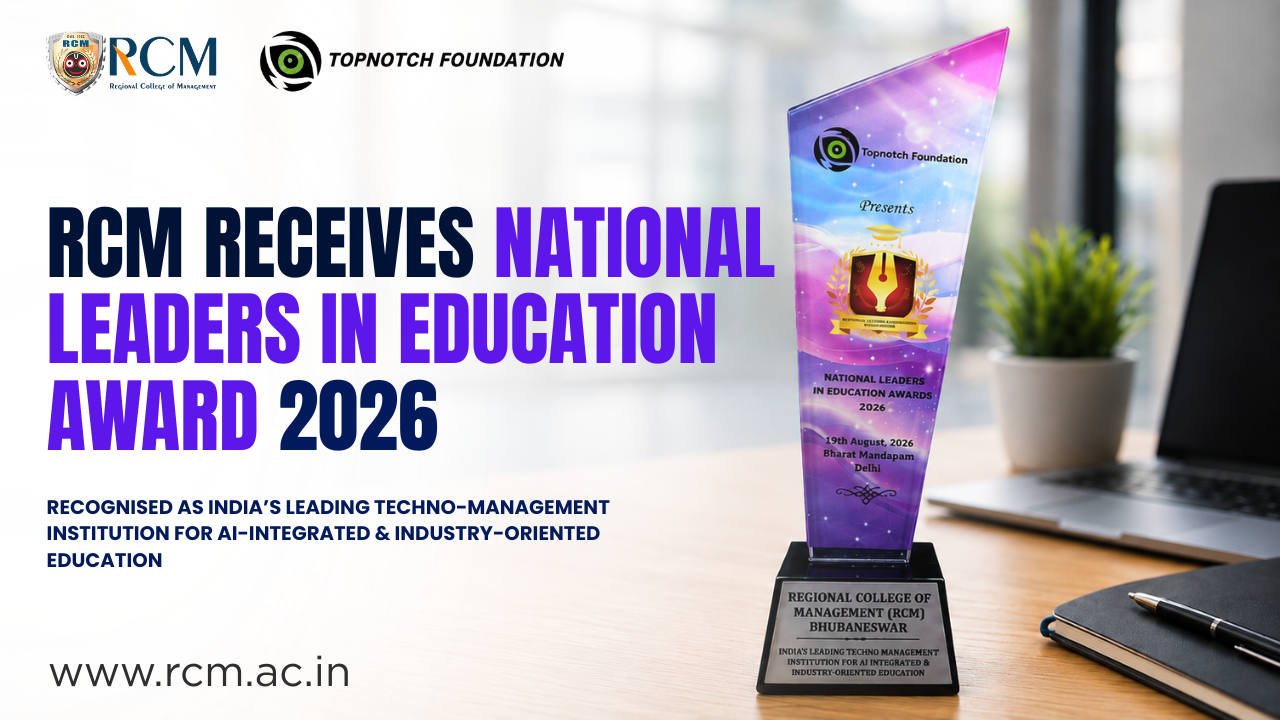
Regional College of Management (RCM), Bhubaneswar, has been honoured at the National Leaders in Education Awards 2026, under the category “India’s Leading Techno Management Institution for AI-Integrated & Industry-Oriented Education.” The recognition, first communicated by Topnotch Foundation in a letter dated 21 July 2026 addressed to Dr. Pritam Pal, was formalised at the awards ceremony held on 19 August 2026 at Bharat Mandapam, New Delhi.
The category name itself is worth pausing on, because it names something genuinely happening across Indian higher education right now: a shift toward AI-integrated, industry-facing learning. This article looks at both sides of that — what the recognition means for RCM, and what AI-integrated, industry-oriented education actually looks like for a student deciding where to study.
RCM Receives Recognition from Topnotch Foundation
Topnotch Foundation’s initial communication to RCM, dated 21 July 2026, named the institution for the award and outlined the process for finalising it, including the accompanying ceremony — the National Leaders in Education Awards 2026 — held on 19 August 2026 at Bharat Mandapam, New Delhi, with India Today UAE and AAJ Tak International as media partners, and Medgate Today and Lifestyle Magazine as print partners.
What the recognition reflects, in plain terms, is external attention landing on exactly the themes RCM has been building around: AI integration and industry exposure. Those happen to be the same themes shaping where Indian higher education is heading more broadly — which is really the more useful story here, award aside.
What Are the National Leaders in Education Awards 2026?
The National Leaders in Education Awards 2026 is a recognition programme run by Topnotch Foundation for institutions and individuals contributing to India’s education sector, with its ceremony scheduled for 19 August 2026 at Bharat Mandapam, New Delhi.
Beyond that, there isn’t much that can be verified publicly — no published judging criteria, jury list, or count of institutions considered — so this article won’t guess at any of it. That’s not a knock on this particular programme specifically; it’s just good practice with any sector award. A student or parent evaluating what a college’s award actually signals is generally better served by looking past the trophy to the organiser’s track record, how the category was defined, and whether recognition is tied to a fee — alongside, of course, what the institution is actually doing in its classrooms.
Why AI-Integrated Education Matters in 2026
AI-integrated education means weaving artificial intelligence tools, concepts, and workflows directly into how a subject is taught — not bolting on a single AI elective and calling it done. What makes this matter now, specifically, is that AI literacy has quietly stopped being a specialised technical skill and become a baseline expectation, in roles that have nothing to do with computer science.
A few forces are driving that shift:
- Generative AI in daily work — tools for writing, analysis, coding, and design have moved from novelty to routine use in most workplaces.
- Data-driven decision-making — employers increasingly expect graduates to interpret data and use AI-assisted analytics, not just business theory.
- Changing workplace expectations — roles across marketing, finance, operations, and IT now assume some comfort with AI-enabled tools.
- Responsible AI use — understanding the limits, biases, and ethical boundaries of AI systems is becoming as important as knowing how to use them.
India’s policy direction backs this up rather than just reflecting a business trend. The Ministry of Education has already been integrating AI into school curricula through CBSE and NCERT under the National Education Policy (NEP) 2020 and the National Curriculum Framework (NCF) 2023, with AI skill modules starting from the middle school years and AI available as a subject at the senior secondary level (Press Information Bureau). In other words, AI fluency is being built in as a foundational competency well before students reach college — which puts the burden on higher education to carry that forward, not introduce it from scratch.
How AI Is Transforming Higher Education in India
No single tool or platform explains this shift — it’s happening through curriculum redesign, new specialisations, and policy support arriving at multiple levels at once. Lower down the pipeline, AI and computational thinking modules and platforms like DIKSHA are already using AI to make school-level learning more inclusive and accessible (PIB). Further up, at the level that actually shapes hiring, NITI Aayog’s National Strategy for Artificial Intelligence treats AI as central to India’s economic and skilling future, with education named as one of its core pillars (NITI Aayog).
There’s a useful check on all this ambition, too. UNESCO’s guidance on generative AI in education pushes institutions toward a human-centred approach — using AI to strengthen learning outcomes and educator capacity, while still protecting data privacy, equity, and academic integrity (UNESCO). Put together, the practical lesson for Indian colleges is simple enough: AI integration works when it’s built into the core of a course, not stapled on as a single add-on subject.
hat Is Industry-Oriented Education?
Industry-oriented education connects academic coursework to real workplace practice — through internships, live projects, and direct contact with industry professionals — instead of leaving students to bridge that gap on their own after graduation. It asks students to apply what they’ve learned to problems businesses are actually solving, not hypothetical ones from a textbook.
In practice, that usually looks like:
- Structured internships with defined learning outcomes
- Live projects set by companies or based on real business data
- Guest sessions and mentorship from industry practitioners
- Practical, assignment-based assessment alongside theory
- Ongoing industry-academia collaboration on curriculum design
None of this replaces academic rigour — it pairs with it, so a graduate walks in having already practised, in some form, the kind of problem-solving an employer expects on day one rather than week twelve.
Why AI + Industry Exposure Is Important for Future-Ready Graduates
No single specialisation covers what a future-ready graduate needs anymore — it’s a blend: technical and AI literacy, business fundamentals, practical exposure, communication, and problem-solving, all working together rather than in isolation. Consider two students: one who understands AI tools well but has never applied them to an actual business problem, and another with strong domain knowledge but no comfort with AI-enabled workflows. Both are starting from a narrower base than a peer who has practised both sides at once.
To be clear, this isn’t a claim that any particular combination guarantees a job offer or a specific salary — too many individual factors are at play for that. What can be said, more modestly, is that pairing AI-integrated coursework with structured industry exposure gives a student more chances to practise the adaptable, cross-functional thinking that employers across sectors are increasingly asking for.
How RCM Is Building AI-Integrated and Industry-Oriented Learning
This is where the two threads of this article meet: RCM’s own programme design leans into exactly the combination discussed above — AI integration paired with applied, industry-facing learning — across both its business and technology tracks.
On the business side, RCM’s BBA programme runs alongside the BBA+ programme at RCM, which lets students build specialised depth on top of their core degree rather than choosing one or the other. The AI/ML, Blockchain & Metaverse track within BBA+ is the clearest example of AI-integrated education in practice here — it treats emerging technology as core coursework for business students, not an elective on the side. Students drawn more to analytics have Data Science and Business Intelligence instead, built around the data-driven decision-making skills business roles increasingly expect.
The computing side follows the same logic. RCM’s BCA programme offers a parallel BCA+ track, with AI/ML, Blockchain & Metaverse and Data Science and Business Intelligence specialisations sitting alongside options like full stack development and cyber security, for students who want to go deeper on the technical side specifically.
That same emphasis carries through to postgraduate study. The MCA+ programme extends the technology focus to the master’s level, while the PGDM+ programme and MBA+ programme apply the same pairing — core management education plus applied, industry-relevant specialisation — for students headed toward management roles.
None of this happens in a vacuum, either. It connects to how RCM approaches placements, which is built around linking classroom learning to industry-facing outcomes, and to the day-to-day reality of student life at RCM, which is where the collaborative, hands-on environment this kind of learning depends on actually plays out.
Explore AI-Integrated & Industry-Oriented Programmes at RCM.
FAQs
The National Leaders in Education Awards 2026 is a recognition programme organised by Topnotch Foundation for individuals and institutions in India’s education sector. RCM Bhubaneswar was honoured under this programme, in the category of India’s Leading Techno Management Institution for AI-Integrated & Industry-Oriented Education, at a ceremony held on 19 August 2026 at Bharat Mandapam, New Delhi.
AI-integrated education is a learning approach that embeds artificial intelligence tools, concepts, and workflows directly into coursework, rather than teaching AI as an isolated subject. It typically covers areas like data-driven decision-making, generative AI tools, and responsible AI use, aimed at building practical AI literacy alongside subject expertise
AI is important in Indian higher education because it is becoming a baseline workplace expectation, not a specialised skill. India’s Ministry of Education has already introduced AI modules into school curricula under NEP 2020 and NCF 2023, signalling that AI fluency is expected to carry through into higher education and employability.
Industry-oriented education connects academic learning to real workplace practice through internships, live projects, and direct interaction with industry professionals. It supplements theoretical coursework with applied, assignment-based learning designed to mirror the problems students will face in actual jobs.
Combining AI-integrated learning with industry exposure helps students build a broader, more adaptable skill set — technical literacy, business fundamentals, and practical problem-solving together, rather than any one in isolation. This does not guarantee specific job or salary outcomes, but it gives students more opportunities to practise the kind of cross-functional thinking employers increasingly look for.