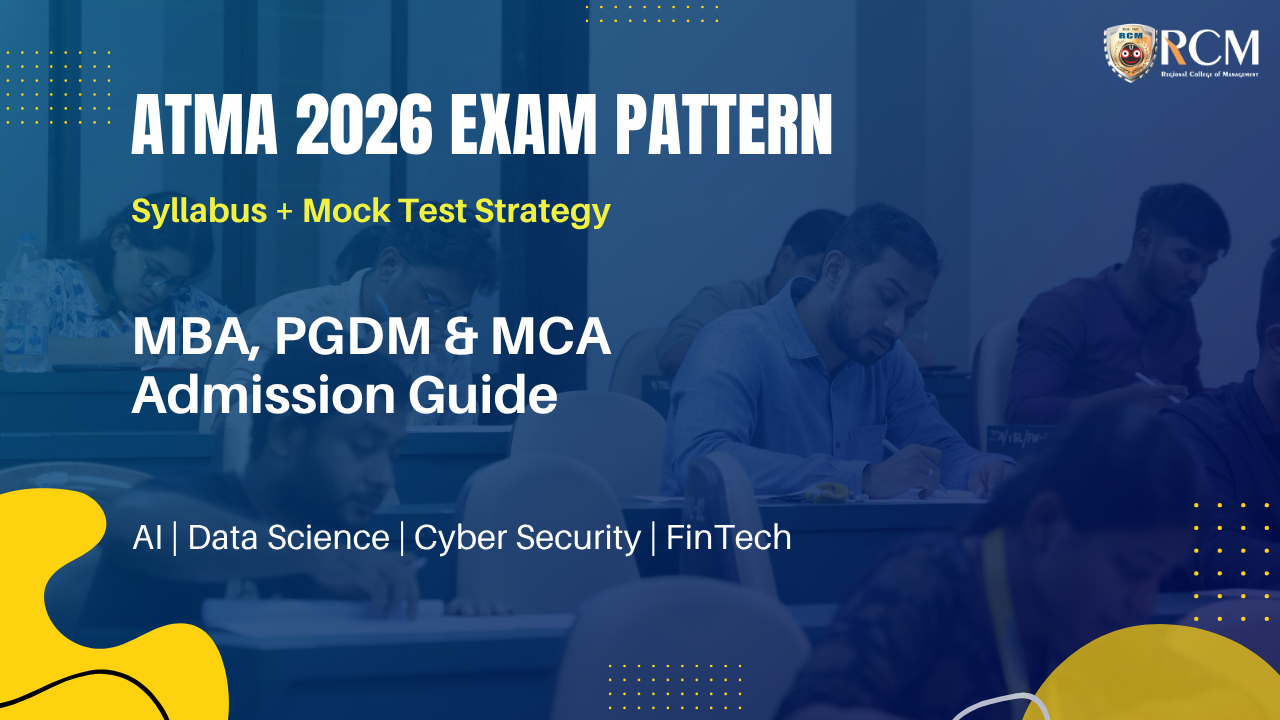
What is the ATMA Exam Pattern 2026?
ATMA 2026 is a 180-minute computer-based test comprising 180 questions across six sections: Analytical Reasoning Skills (x2), Verbal Skills (x2), and Quantitative Skills (x2). Each correct answer earns +1 mark, while incorrect answers attract a -0.25 negative mark. Conducted by AIMS across multiple sessions per year, ATMA is accepted by 300+ colleges for MBA, PGDM, and MCA admissions, including top institutions like RCM Bhubaneswar.
Key Takeaways
- ATMA 2026 has 180 questions across 6 sections in 180 minutes — each section gets exactly 30 questions and 30 minutes.
- Negative marking applies: -0.25 per wrong answer — accuracy matters as much as speed.
- ATMA runs multiple sessions in 2026 — giving aspirants several attempts unlike CAT’s single annual window.
- A focused 30-day preparation plan with section-specific mock tests can significantly boost your ATMA percentile.
RCM Bhubaneswar accepts ATMA scores for MBA, MCA, and PGDM admissions with specialisations in AI, Data Science, FinTech, and Cyber Security.
Introduction
You have decided to take ATMA 2026. Smart move. But here is the uncomfortable truth most students discover too late: knowing that ATMA has six sections is not the same as understanding how to crack each one.
This guide goes beyond the basics. We break down the ATMA Exam Pattern 2026 section by section, map out the complete ATMA syllabus, give you a realistic 30-day preparation strategy, and show you how a strong ATMA score opens the door to transformative MBA, PGDM, and MCA programs in institutions like Regional College of Management (RCM), Bhubaneswar.
Whether you are preparing from scratch or refining your strategy a few weeks before exam day, this is the only guide you need.
What is ATMA Exam Pattern 2026?
ATMA 2026 is a 3-hour, 180-question computer-based test conducted by AIMS. It has six timed sections — two each of Analytical Reasoning, Verbal Skills, and Quantitative Skills. Each section contains 30 questions with a 30-minute time limit. Correct answers earn +1; incorrect answers lose -0.25 marks.
ATMA 2026 Exam Highlights
| Exam Name | ATMA 2026 — AIMS Test for Management Admissions |
| Conducting Body | Association of Indian Management Schools (AIMS) |
| Mode | Computer-Based Test (CBT) — Online |
| Duration | 180 Minutes (3 Hours) |
| Total Questions | 180 Multiple Choice Questions |
| Total Marks | 180 Marks (+1 per correct answer) |
| Negative Marking | -0.25 per incorrect answer |
| Number of Sections | 6 Sections |
| Sessions Per Year | Multiple — approx. 5–6 times in 2026 |
| Accepted For | MBA | PGDM | MCA Admission 2026 |
| Colleges Accepting | 300+ institutions across India |
| Official Website | atmaaims.com |
ATMA 2026 Exam Pattern — Explained Section by Section
Understanding the structure of each section is the foundation of a smart preparation strategy. Here is what you are actually dealing with:
| Section No. | Subject Area | Questions | Time Allotted |
| Section 1 | Analytical Reasoning Skills | 30 | 30 Minutes |
| Section 2 | Verbal Skills | 30 | 30 Minutes |
| Section 3 | Quantitative Skills | 30 | 30 Minutes |
| Section 4 | Verbal Skills (Advanced) | 30 | 30 Minutes |
| Section 5 | Analytical Reasoning (Advanced) | 30 | 30 Minutes |
| Section 6 | Quantitative Skills (Advanced) | 30 | 30 Minutes |
| TOTAL | — | 180 | 180 Minutes |
How many questions are there in ATMA 2026?
ATMA 2026 has exactly 180 questions divided equally across six sections. Each section has 30 questions to be answered in 30 minutes. The exam is time-bound per section, so you cannot carry over unused time to the next section.
One critical point many aspirants miss: ATMA sections are individually time-locked. Once the 30 minutes for Section 1 expire, you move to Section 2 regardless of whether you finished. This makes time management per section a core exam skill, not an afterthought.
ATMA 2026 Section-Wise Weightage
| Section | Marks Contribution | Relative Weight |
| Analytical Reasoning (S1 + S5) | 60 Marks | 33.3% |
| Verbal Skills (S2 + S4) | 60 Marks | 33.3% |
| Quantitative Skills (S3 + S6) | 60 Marks | 33.3% |
| Total | 180 Marks | 100% |
Key Insight: All three domains carry equal weight. Many students over-invest in Quantitative Skills because of its perceived difficulty and underperform in Verbal Skills. A balanced preparation approach is statistically more effective for maximising total percentile.
ATMA Syllabus 2026 — Complete Section-Wise Breakdown
The ATMA syllabus is not formally published as a rigid list by AIMS — but based on past papers and expert analysis from education platforms like Shiksha and Careers360, here is what each domain consistently tests:
Analytical Reasoning Skills (Sections 1 & 5)
This is where logical precision meets pattern recognition. Questions test your ability to derive conclusions from given data, identify logical flaws, and solve structured puzzles under time pressure.
- Data Sufficiency: Is the given information enough to answer the question?
- Logical Reasoning: Syllogisms, statements and conclusions, cause and effect
- Series Completion: Number series, letter series, mixed series
- Analogies and Classifications: Word and number analogies
- Puzzles and Seating Arrangements: Linear, circular, floor-based
- Blood Relations and Directions
- Critical Reasoning: Strengthen/weaken arguments, assumption-based questions
- Input-Output patterns
Preparation Tip: Analytical Reasoning rewards systematic thinking over speed. Practice building logical frameworks for each question type before attempting timed sets. Start with 15 minutes of untimed practice per day, then move to 30-minute timed drills.
Quantitative Skills (Sections 3 & 6)
Quantitative ability in ATMA tests application-level mathematics at Class 10–12 standard. The questions are designed to test calculation efficiency and conceptual understanding rather than advanced mathematical theory.
- Arithmetic: Percentages, profit & loss, simple & compound interest, ratios, time & work
- Number System: HCF, LCM, divisibility, remainders
- Algebra: Linear and quadratic equations, inequalities
- Geometry: Triangles, circles, coordinate geometry, mensuration
- Statistics: Mean, median, mode, standard deviation
- Data Interpretation: Bar graphs, pie charts, line graphs, tables
- Permutation & Combination, Probability
- Speed, Distance, and Time problems
Preparation Tip: Data Interpretation typically appears in Section 6 (Advanced) and is the most scoring sub-topic if practised consistently. Spend at least 20 minutes daily on DI sets from reputed mock test platforms.
Verbal Skills (Sections 2 & 4)
Verbal ability in ATMA is not just about grammar rules. It tests reading speed, comprehension depth, vocabulary range, and the ability to identify the most logical conclusion from a passage. This is a high-differentiator section for serious aspirants.
- Reading Comprehension: 3–5 passages per section, mixed topics (business, science, social issues)
- Grammar and Usage: Error spotting, sentence correction
- Vocabulary: Synonyms, antonyms, contextual word usage
- Fill in the Blanks: Single and double blanks
- Para Jumbles: Rearranging sentences to form a coherent paragraph
- Sentence Completion and Inference
- Critical Reasoning: Argument evaluation, assumption identification
Preparation Tip: Reading Comprehension improves fastest through daily newspaper reading. Spend 20 minutes reading The Hindu Business Line or The Economic Times editorial sections. This simultaneously builds vocabulary, comprehension speed, and business awareness — useful in GD/PI rounds too.
ATMA 2026 Preparation Strategy — The 30-Day Study Plan
What is the best way to prepare for ATMA 2026?
The most effective 30-day ATMA preparation combines concept revision (Week 1), section-wise practice (Week 2), full-length mock tests (Week 3), and targeted revision plus error analysis (Week 4). Consistency of 4–6 hours daily, combined with dedicated ATMA mock tests, typically yields a 15–25 percentile improvement over a focused month.
| Week | Focus Area | Daily Target |
| Week 1 (Days 1–7) | Concept Revision — all 3 domains | 4–5 hours: 2hrs QA + 1.5hrs VA + 1hr AR |
| Week 2 (Days 8–14) | Section-wise timed practice | 5 hrs: Attempt 2 full sections per day |
| Week 3 (Days 15–21) | Full mock tests + error analysis | 1 full mock daily + 90 min error review |
| Week 4 (Days 22–28) | Targeted revision of weak areas | Focus on lowest-scoring topics + 1 mock |
| Days 29–30 | Light revision + rest | Revise formula sheets; no new topics |
Day-by-Day Week 1 Breakdown
- Day 1–2: Number System + Arithmetic fundamentals (QA); Grammar rules + Error Spotting (VA)
- Day 3–4: Data Interpretation basics (QA); Syllogisms + Logical Reasoning types (AR)
- Day 5–6: Reading Comprehension strategies (VA); Algebra + Geometry revision (QA)
- Day 7: First diagnostic mock test — identify your strongest and weakest sections
Best ATMA Mock Test Strategy — How to Practice Smart
Most aspirants make the mistake of treating mock tests as performance evaluations rather than learning tools. The real power of ATMA mock tests lies in what happens after you submit the test.
Here is a battle-tested mock test strategy:
- Attempt one full ATMA mock under real exam conditions — 180 minutes, no interruptions, no phone.
- After submission, spend 90 minutes on error analysis. For every wrong answer, write down why you got it wrong: was it a knowledge gap, a calculation error, or a time panic decision?
- Categorise your errors: Knowledge Errors (need to revise the concept), Application Errors (understood the concept but applied it wrong), Careless Errors (knew the answer but rushed).
- For Knowledge Errors — revisit the concept that day. For Careless Errors — slow down your next mock’s first 10 questions in that section.
- Track your section-wise scores across 7 mocks. If Verbal Skills shows a consistent downward trend, shift 30% of your daily practice hours to that section immediately.
Where to Find ATMA Mock Tests: AIMS releases official sample papers on atmaaims.com. Additional high-quality mock tests are available on platforms like Hitbullseye, IMS, and Career Launcher. Aim for a minimum of 8–10 full-length mocks before exam day.
Common Mistakes Students Make While Preparing for ATMA
These are the preparation errors that cost aspirants 10–20 percentile points — and almost all of them are avoidable:
- Ignoring the negative marking rule: Attempting all 180 questions without a guessing filter is a percentile-killer. Only attempt questions where you are at least 70% confident.
- Skipping section-wise time practice: Practising without the 30-minute per section constraint creates a false sense of competency. Always time your practice.
- Over-focusing on Quantitative Skills: All sections carry equal weight. Students who polish QA but neglect Verbal Skills leave easy marks on the table.
- Starting mock tests too late: Week 3 is not the time to attempt your first mock. Start mock tests at the end of Week 1 to build exam temperament early.
- Not reviewing errors: Attempting 15 mocks without error analysis is less effective than attempting 8 mocks with rigorous post-mock review.
Underestimating RC passages: Reading Comprehension passages in Sections 2 and 4 are often drawn from complex academic and business topics. Speed reading without comprehension depth leads to wrong answers on inference-based questions.
ATMA 2026 Preparation Timeline — Based on Your Starting Point
| Time Available | Starting Level | Realistic Target Percentile | Strategy Focus |
| 60+ Days | Beginner | 80–85 percentile | Full syllabus coverage + 12+ mocks |
| 30–60 Days | Moderate | 75–82 percentile | Concept revision + 8–10 mocks |
| 15–30 Days | Good base | 70–78 percentile | Mock-heavy + targeted weak-area focus |
| 7–14 Days | Strong base | 65–74 percentile | Mock tests only + error analysis |
| Under 7 Days | Any level | 60–68 percentile | Sample papers + formula sheets revision |
ATMA vs CAT vs MAT — Difficulty & Suitability Comparison
Is ATMA easier than CAT?
Yes — ATMA is significantly less difficult than CAT. CAT tests advanced quantitative reasoning and abstract verbal ability at a level designed to filter IIM candidates. ATMA’s difficulty is moderate, comparable to Class 12 to graduation-level logical and mathematical ability, making it accessible to a much broader aspirant pool.
MBA Admission 2026 Through ATMA
ATMA scores are accepted for MBA, PGDM, and MCA admissions at 300+ colleges across India.
Different institutions have different cutoff requirements. Explore the latest ATMA Cut Off 2026 for MBA, PGDM & MCA Colleges to identify colleges matching your expected percentile. Candidates who qualify ATMA 2026 can apply to institutions like Regional College of Management (RCM), Bhubaneswar, for its industry-integrated MBA, placement-focused PGDM, and AI-powered MCA programs. RCM offers specialisations in Artificial Intelligence, Data Science, FinTech, Cyber Security, and Digital Marketing — with dedicated placement support and corporate mentorship baked into the curriculum.
The ATMA score is not the only factor in MBA admissions. Most colleges, including RCM, evaluate a composite profile:
- ATMA percentile score
- Academic record (10th, 12th, graduation percentage)
- Group Discussion (GD) performance
- Personal Interview (PI) score
- Work experience (if any)
To explore the MBA Admission 2026 process at RCM and understand the complete selection criteria, visit the official admissions page.
Future-Ready MBA & MCA Specialisations in 2026
Getting into a top college through ATMA is Step 1. Step 2 — perhaps more important — is choosing the right specialisation. In 2026, the gap in salary and career growth between a standard MBA and a technology-integrated MBA is widening rapidly. Here is what the data shows:
MBA in Artificial Intelligence
Artificial Intelligence is no longer an elective — it is the language of modern business. Companies across sectors are embedding AI into operations, product development, customer service, and strategic planning. An MBA in Artificial Intelligence prepares graduates to lead these initiatives from the management layer: understanding what AI can and cannot do, translating technical outputs into business strategy, and managing AI-powered teams.
Starting salaries: Rs. 14–30 LPA at AI-first product companies, consulting firms, and enterprise technology organisations.
MBA in Data Science & Business Analytics
Data Science is the engine; Business Analytics is the steering wheel. Together, they are reshaping how organisations make decisions. An MBA with a Data Science or Business Analytics focus teaches students to work with real datasets, build dashboards, interpret statistical models, and present insights to non-technical stakeholders. In 2026, every major employer from Deloitte to Amazon to State Bank of India is actively hiring business-savvy data professionals.
Starting salaries: Rs. 10–22 LPA depending on industry and role.
MBA in FinTech
India’s financial technology sector is processing billions of transactions annually and is forecast to grow to USD 150 billion by 2025–26. An MBA in FinTech positions graduates at the intersection of banking, investment strategy, and emerging technologies like Blockchain, cryptocurrency platforms, and digital lending infrastructure. It is consistently among the highest-paying MBA specialisations entering 2026.
MBA in Cyber Security
Cybersecurity is not just an IT department problem anymore — it is a board-level strategic concern. With global cybercrime costs surpassing USD 8 trillion annually, organisations need managers who understand security risks, regulatory compliance, and business continuity. An MBA in Cyber Security combines management theory with applied security knowledge, opening doors in BFSI, healthcare, defence contracting, and tech consulting.
MBA in Digital Marketing
Digital Marketing in 2026 is a full-stack discipline. From AI-driven content generation and programmatic advertising to SEO strategy and performance analytics, digital marketers who understand both the creative and data layers are extraordinarily valuable. An MBA in Digital Marketing is ideal for students who blend analytical and creative thinking.
PGDM in Business Analytics & FinTech
The PGDM program at RCM with Business Analytics and FinTech tracks is particularly well-suited for students who want a shorter, more industry-intensive postgraduate route. PGDM programs are often more agile in curriculum design than traditional MBA degrees, integrating live projects and corporate certifications that immediately translate to employability.
MCA with AI & ML Specialisation
The MCA with AI & ML program at RCM is designed for students who want to be on the technology delivery side of the AI revolution rather than just the strategy side. Graduates work as Machine Learning Engineers, Data Scientists, AI Developers, and Cloud Architects — roles with starting salaries between Rs. 10 LPA and Rs. 22 LPA in 2026.
MCA in Data Science & Cyber Security
Two of the fastest-growing technology career tracks in India are Data Science and Cyber Security. An MCA with these specialisations provides deep technical fluency — Python, SQL, TensorFlow for Data Science; ethical hacking, network forensics, and cloud security for Cyber Security — combined with practical project experience that makes graduates immediately hireable in a talent-scarce market.
Why Students Choose RCM Bhubaneswar After ATMA
Among MBA colleges in Odisha, Regional College of Management (RCM) Bhubaneswar has carved a specific identity: it is the institution that takes ATMA-admitted students and prepares them to compete at a national level. Here is how:
| RCM Advantage | What It Means | Student Outcome |
| Industry Integrated MBA | Live projects, real corporate briefs, case-based learning from Semester 1 | Day-1 workplace readiness |
| AI Integrated MBA Programs | Generative AI, ML tools, Data Science modules woven into MBA curriculum | Future-proof skill portfolio |
| MCA with AI & ML | AI-first MCA — coding labs, real datasets, industry certifications | Top-tier tech placements |
| PGDM with Business Analytics | Analytics-heavy PGDM with FinTech and Digital Marketing tracks | High-demand analytics roles |
| Industry Certifications | AWS, Google Analytics, Tableau, HubSpot, and more | Resume differentiation |
| Corporate Exposure | Guest lectures, industry mentors, corporate immersion programs | Professional network from Day 1 |
| Placement Cell | Year-round placement activity, pre-placement training, mock GD/PI | Consistently high placement rate |
| Emerging Tech Specialisations | AI, Data Science, FinTech, CyberSec, Digital Marketing, Blockchain | Access to highest-growth sectors |
Explore the full MBA program at RCM Bhubaneswar and the PGDM program to understand how RCM is building tomorrow’s managers today.
FAQs
ATMA 2026 consists of 180 questions across 6 sections — two each of Analytical Reasoning, Verbal Skills, and Quantitative Skills — each with 30 questions and a 30-minute individual time limit, totalling 180 minutes with +1/-0.25 marking.
Yes — ATMA is considerably more moderate in difficulty than CAT, making it an accessible and popular management entrance option for students who want quality college admissions without the extreme competitiveness of the IIM entrance route.
In 30 days, follow a structured week-by-week plan: Week 1 for concept revision, Week 2 for section-wise timed practice, Week 3 for daily full-length mocks with error analysis, and Week 4 for targeted weak-area revision plus final mock tests
Yes — ATMA 2026 carries a negative marking penalty of -0.25 marks for every incorrect answer, so aspirants should attempt questions only when reasonably confident and avoid random guessing.
In 2026, MBA in Artificial Intelligence, MBA in Data Science, MBA in FinTech, and MBA in Cyber Security are the highest-ROI specialisations — offering the strongest salary growth, widest employer demand, and most future-proof career trajectories in India’s evolving job market
Conclusion
Cracking ATMA 2026 is a learnable skill, not a lottery. The exam has a clearly defined pattern, a manageable syllabus, and a structure that rewards consistency over genius. If you follow a disciplined 30-day study plan, use ATMA mock tests intelligently, and address your weak sections systematically, a strong percentile is absolutely within reach.
But clearing ATMA is just the beginning. The institution you choose after ATMA, and the specialisation you pick, will define your career trajectory for the next decade. In a world being reshaped by Artificial Intelligence, Data Science, FinTech, and Digital Transformation, a future-focused management degree is not a luxury — it is a strategic necessity.
Regional College of Management (RCM), Bhubaneswar, is built precisely for this moment: an industry-integrated, AI-powered, placement-focused institution that turns ATMA scores into meaningful careers.
Prepare hard. Choose smart. Your next chapter starts here.
Your ATMA Score Deserves the Right College
RCM Bhubaneswar is accepting MBA, PGDM & MCA applications for 2026. Limited seats. Early applicants get priority.
Explore MBA Admission 2026 at RCM
Explore PGDM Admission 2026 at RCM
Explore MCA Admission 2026 at RCM