If you’ve ever talked to an MBA student during placement season, you’ve probably noticed something: it’s intense. Between resume edits at midnight, mock interviews with friends, and the constant checking of placement WhatsApp groups, it can feel chaotic from the outside — and honestly, sometimes from the inside too.
But here’s the thing: MBA placement season isn’t random. It follows a fairly predictable structure, and understanding that structure is one of the simplest ways to walk in feeling prepared instead of overwhelmed. This guide breaks down exactly how MBA placement season works, week by week, what recruiters are actually looking for, and which roles — including the highest paying MBA jobs — students should be targeting based on their skills and interests.
How Does MBA Placement Season Work?
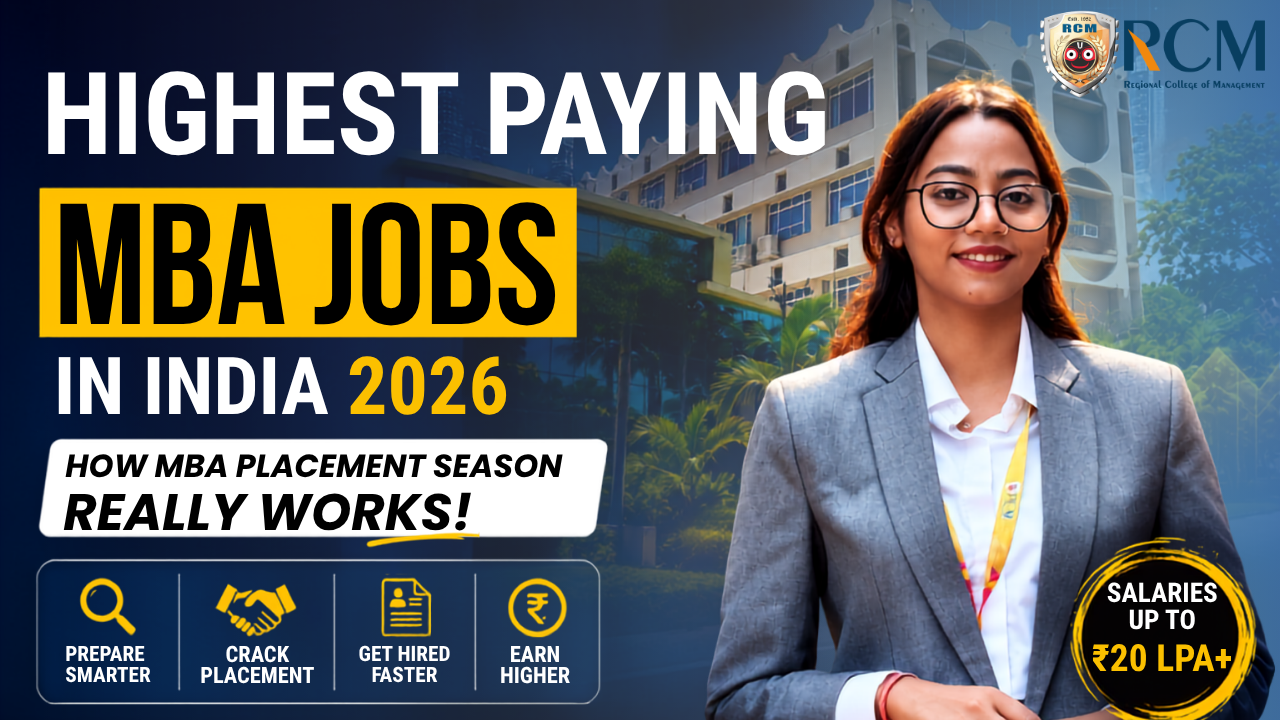
MBA placement season usually runs over several weeks, starting with recruiter presentations, resume shortlisting, aptitude tests, group discussions, interviews, and final job offers. Students targeting the highest paying MBA jobs — including Product Manager, AI Product Manager, and Strategy Consultant roles — often prepare months in advance through internships, certifications, mock interviews, and industry-focused MBA programs like RCM’s MBA PLUS Program.
MBA Placement Process: Week-by-Week Breakdown
| Week | Activity | Student Focus |
|---|---|---|
| Week 1 | Resume Building | Resume refinement & profiling |
| Week 2 | Company Presentations | Industry research |
| Week 3 | Aptitude Tests | Quantitative & logical preparation |
| Week 4 | Group Discussions | Communication & teamwork |
| Week 5 | Technical Interviews | Domain knowledge |
| Week 6 | HR Interviews | Career goals & leadership |
| Week 7 | Final Offers | Salary negotiation & selection |
Highest Paying MBA Jobs in India (2026)
| Role | Sector | Salary Range |
|---|---|---|
| Product Manager | Technology | ₹10–20 LPA |
| Strategy Consultant | Consulting | ₹8–18 LPA |
| Business Analyst | Analytics | ₹7–15 LPA |
| Investment Banking Analyst | Finance | ₹10–25 LPA |
| Digital Marketing Manager | Marketing | ₹6–15 LPA |
| AI Product Manager | AI & Technology | ₹12–25 LPA |
| International Business Manager | Global Trade | ₹8–18 LPA |
Note: These are indicative industry ranges. Actual offers depend on the institute, individual profile, and recruiting company.
Why MBA Placements Matter More Than Ever in 2026
For a lot of students, placement season feels like the moment everything either falls into place — or doesn’t. And in a way, that feeling isn’t wrong. The competitive job market in 2026 means that the gap between being prepared and being unprepared shows up immediately, often within the first few minutes of an interview.
AI transformation has changed what companies are hiring for. Roles that didn’t exist five years ago — AI Product Manager, AI Strategy Consultant — are now actively recruited during MBA placements, often at salary ranges that exceed traditional management trainee roles.
Corporate hiring trends show that companies are looking for candidates who can demonstrate readiness from day one — not just potential. This is part of why career growth opportunities increasingly go to students who’ve used their MBA years to build a portfolio of real experience, not just grades.
And underneath all of this is something simple: financial security. For many students, an MBA represents a significant investment, and placement outcomes are the most direct way that investment translates into real-world results.
If you’re a few months away from placement season and feeling a mix of confidence and ambition — but also some nerves — that’s completely normal. The goal of this guide is career certainty: helping you understand exactly what’s coming, so you can prepare for it deliberately rather than reactively.
What Happens Before Placement Season Starts?
Here’s something most students don’t fully realize until later: placement season doesn’t start in placement week. It starts months earlier, often without students even labeling it as “placement prep.”
Summer internships are one of the biggest factors. Students who use their internship to work on real projects — not just observe — walk into placement interviews with concrete stories to tell. “I analyzed customer churn data and presented recommendations to the marketing team” is a far stronger answer than “I learned how the company operates.”
Industry certifications in areas like business analytics, digital marketing, financial modeling, or AI fundamentals signal to recruiters that a candidate has invested in skills beyond the core curriculum — and these often come up directly in interviews.
Resume building isn’t a one-time task. The strongest resumes are refined repeatedly over months, with each internship, project, or certification adding a new line that makes the candidate’s story clearer and more compelling.
LinkedIn optimization matters more than students often expect — recruiters frequently look up candidates before interviews, and a well-maintained profile that reflects projects, certifications, and interests reinforces the resume.
Networking — through alumni connections, industry events, or even LinkedIn outreach — can open doors to internships, referrals, and insights about specific companies’ interview processes.
Corporate projects, especially live projects with real companies during the MBA program, give students direct exposure to how businesses actually operate — something that’s difficult to replicate through case studies alone.
MBA Placement Season Week-by-Week Breakdown
Week 1 – Resume Screening
This is where it begins — quite literally, recruiters’ first impression of you is your resume. Practical tip: Don’t wait until Week 1 to build your resume. Have a polished version ready months in advance, and tailor it slightly for different types of roles (consulting vs. analytics vs. marketing, for example).
Week 2 – Company Pre-Placement Talks
Companies present to students about their roles, culture, and expectations. Practical tip: Take these seriously — questions you ask during these sessions can sometimes be remembered by recruiters, and the information shared often appears in later interview questions (“So, what did you think about our presentation?”).
Week 3 – Aptitude & Assessment Tests
Quantitative and logical reasoning tests are often the first filter. Practical tip: These tests reward speed and accuracy built through practice — start solving practice sets weeks before placement season, not days before.
Week 4 – Group Discussions
GDs assess how you think and communicate in a group setting — not just what you say, but how you say it. Practical tip: Practice listening as much as speaking; recruiters notice candidates who build on others’ points constructively, not just those who talk the most.
Week 5 – Technical Interviews
This is where domain knowledge gets tested — whether that’s finance concepts, marketing frameworks, or analytics tools, depending on the role. Practical tip: Be ready to discuss your internship and projects in depth — interviewers often dig into specifics to see how well you actually understood what you worked on.
Week 6 – HR Interviews
HR rounds focus on career goals, motivations, and leadership potential. Practical tip: Be honest and specific about why you want this particular role — generic answers (“I want to grow and learn”) are far less convincing than specific ones tied to the role and company.
Week 7 – Offer Rollouts
Final offers come in, sometimes with room for discussion. Practical tip: If salary negotiation is on the table, approach it professionally and be realistic — most starting offers for MBA highest package roles are benchmarked against industry standards, so understanding typical ranges (like those in the tables above) helps you have informed conversations rather than guesses.
Highest Paying MBA Jobs Students Target
Product Management
Salary range: ₹10–20 LPA. Growth path: Product Manager → Senior PM → Group Product Manager → Director of Product. Skills required: User research, prioritization, data analysis, cross-functional communication.
Consulting
Salary range: ₹8–18 LPA. Growth path: Consultant → Senior Consultant → Manager → Partner-track roles. Skills required: Structured problem-solving, client communication, business research.
Business Analytics
Salary range: ₹7–15 LPA. Growth path: Analyst → Senior Analyst → Analytics Manager → Head of Analytics. Skills required: SQL, data visualization, statistical reasoning, business storytelling.
Digital Marketing
Salary range: ₹6–15 LPA. Growth path: Digital Marketing Manager → Growth Manager → Head of Marketing. Skills required: Performance marketing, analytics, campaign strategy.
Investment Banking
Salary range: ₹10–25 LPA. Growth path: Analyst → Associate → VP-track roles, typically in financial hubs. Skills required: Financial modeling, valuation, attention to detail.
International Business
Salary range: ₹8–18 LPA. Growth path: International Business Manager → Regional Manager → Global Business Head. Skills required: Cross-cultural communication, trade knowledge, market entry strategy.
AI Product Leadership
Salary range: ₹12–25 LPA. Growth path: AI Product Manager → Senior AI PM → Head of AI Products. Skills required: AI/ML fundamentals, product strategy, technical-business translation.
MBA Specializations That Attract Recruiters
Recruiters don’t just hire for “MBA” — they hire for specific capabilities, and certain specializations consistently attract more recruiter attention:
Business Analytics sees broad hiring demand because nearly every function now relies on data — salary potential is strong, and the future outlook is one of the most stable across specializations.
Data Science & BI attracts recruiters from technology, BFSI, and consulting firms building data infrastructure — among the highest salary potentials, with a future outlook tied closely to AI adoption.
Digital Marketing draws consistent recruiter interest from D2C brands, e-commerce, and traditional companies building digital presence — solid salary potential, especially for candidates who pair it with analytics.
International Business appeals to companies with export operations or global expansion plans — moderate but growing demand, with future outlook tied to trade trends.
Artificial Intelligence and AI, ML, Blockchain & Metaverse specializations are increasingly on recruiters’ radar as companies build dedicated AI strategy teams — among the fastest-growing in terms of both hiring demand and salary potential.
Green Finance is an emerging area attracting recruiters from sustainability-focused divisions of banks and corporates — currently moderate demand, but with a future outlook that’s expected to grow as ESG reporting requirements expand.
How MBA Students Can Increase Placement Success
- Certifications — industry-recognized credentials in analytics, digital marketing, AI, or finance add verifiable, job-ready skills.
- Live projects — real-world projects with companies give you concrete examples to discuss in interviews.
- Communication skills — practiced through GDs, presentations, and mock interviews, not just assumed.
- Interview preparation — structured mock interviews, ideally with feedback from people outside your immediate friend group.
- AI tools — familiarity with AI-powered platforms is increasingly something recruiters ask about directly.
- Industry knowledge — staying updated on trends in your target sector through reading, podcasts, or industry reports like those from LinkedIn’s Economic Graph research can help you speak more credibly in interviews.
Students evaluating MBA placement outcomes often prefer institutions that combine academic learning with real corporate exposure. Regional College of Management (RCM), Bhubaneswar emphasizes practical learning through internships, industry projects, placement preparation, and corporate engagement — all built into its MBA program through the MBA PLUS Program, value-added certifications, and corporate mentorship designed to connect classroom learning with placement readiness.
What Placement Outcomes Reveal
Placement reports are often skimmed for one number — the highest package — but they reveal much more than that when read carefully.
Why placement reports matter comes down to transparency. A report that shows average and median packages alongside the highest figure gives a far more realistic picture of what most students can expect, compared to a single standout number.
Recruiter quality — the range and reputation of companies that participate in placements — tells you about the diversity of roles and sectors available to graduates, not just the salary ceiling.
Salary transparency is something organizations like AICTE have increasingly emphasized as institutions are expected to report placement data more systematically, helping students compare programs on a more like-for-like basis.
Career outcomes — where graduates actually end up, in which sectors and roles — often matter more for long-term decision-making than the headline salary figure alone.
At RCM, Bhubaneswar, this transparency is reflected in published figures including a highest placement package of ₹16 LPA, an average package of ₹9.5 LPA, and a placement rate of 97% across 830+ active recruiters. For a detailed view of recruiter participation and placement trends, see RCM’s placement report.
Admission 2026 — Limited Seats
MBA Admissions for 2026 are open at RCM, Bhubaneswar — limited seats available.
Industry-Integrated MBA Program designed around real placement requirements | MBA PLUS Program with value-added certifications | Dedicated placement support and corporate mentorship | Corporate exposure through live industry projects | Specializations aligned with the highest paying MBA jobs of 2026
Talk to admissions about your target package and career goals — explore admissions details on the RCM website.
Conclusion
MBA placement season can feel overwhelming when you’re in the middle of it — but it follows a structure, and understanding that structure is half the battle. From resume screening in Week 1 to offer rollouts in Week 7, each stage rewards a specific kind of preparation, and the students who do best are usually the ones who started preparing months before placement week even began.
MBA placement outcomes — including access to highest paying MBA jobs in product management, consulting, analytics, and AI-driven roles — depend heavily on internships, certifications, communication skills, and genuine industry exposure, not just the MBA degree itself. Recruiters today are looking for readiness, and readiness is built well before placement season starts.
Students exploring MBA placement opportunities, salary growth, and future-ready careers can review RCM’s MBA curriculum, PLUS Program, value-added certifications, placement support ecosystem, and admissions information to make an informed decision for 2026.
FAQs
MBA starting salary in India typically ranges from ₹6–15 LPA depending on specialization, institute, and individual profile.
The highest MBA packages can exceed ₹25 LPA in roles like AI Product Manager and Investment Banking Analyst, though such figures represent exceptional individual outcomes.
MBA placement season follows a structured process of resume shortlisting, aptitude tests, group discussions, technical and HR interviews, and final offer rollouts over several weeks.
The highest paying MBA jobs include AI Product Manager, Investment Banking Analyst, Product Manager, and Strategy Consultant.
The average MBA salary in Odisha generally falls in the ₹5.5–9.5 LPA range, depending on the institute and specialization.