Several top Indian management institutions offer MBA or specialized postgraduate programs focused on digital media, advertising, and social media marketing, led by institutions like RCM Bhubaneswar, MICA Ahmedabad, NMIMS Mumbai, and SIBM Pune.
Several Indian institutes combine an MBA with strong digital media and social media marketing training. Regional College of Management (RCM), Bhubaneswar offers an AICTE-approved MBA+ specialization in Digital Marketing built around live campaigns and AI marketing tools. MICA Ahmedabad, ATLAS SkillTech University, and Symbiosis Institute of Business Management (SIBM) also run postgraduate programmes with a strong focus on digital media, branding, advertising, and digital strategy. For a full comparison of these options, see our guide to the Best MBA Colleges in India for Digital Media & Social Media Marketing (2026).
Table of contents
- Understanding Both MBA Specializations
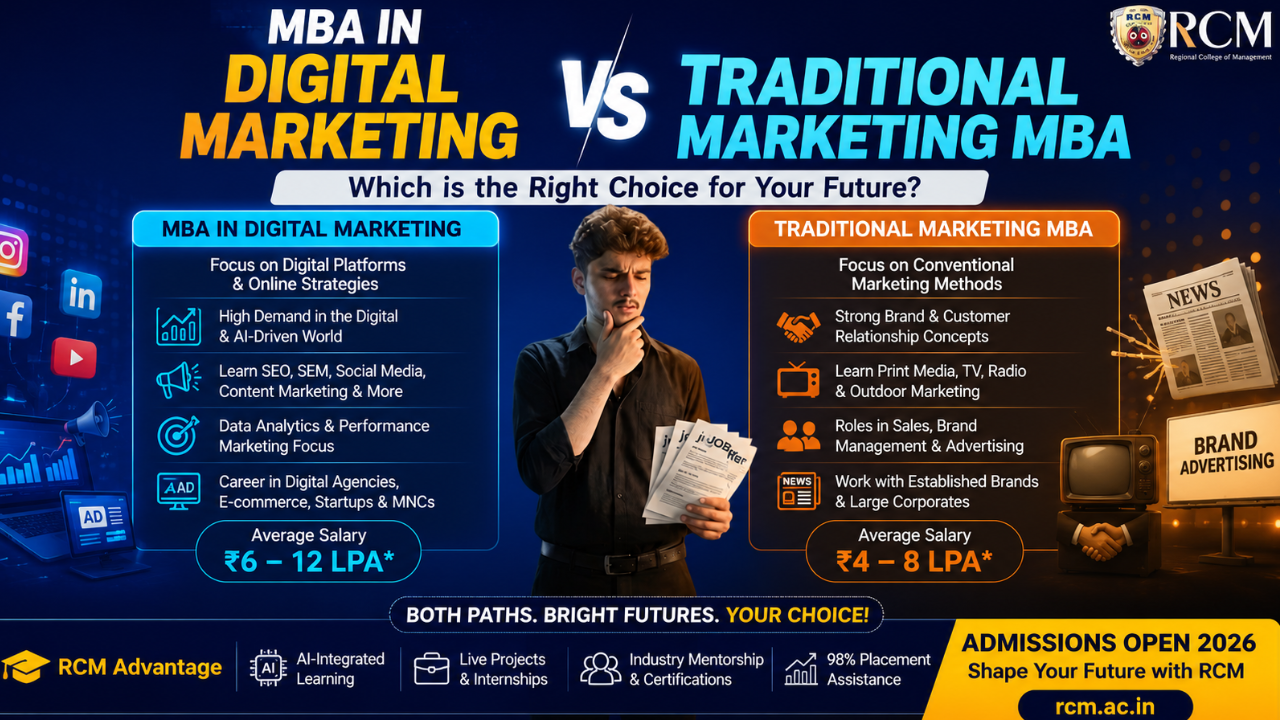
- Key Differences Between Digital Marketing MBA and Traditional Marketing MBA
- Salary Comparison
- Future Scope: AI, Automation and Digital Transformation
- Who Should Choose an MBA in Digital Marketing?
- Who Should Choose a Traditional Marketing MBA?
- How to Choose the Right MBA Specialization
- FAQs
Understanding Both MBA Specializations
An MBA in Digital Marketing focuses on the channels, tools, and data systems that drive business growth online — search engines, social platforms, paid media, marketing automation, and increasingly, AI-assisted campaign planning. Coursework tends to be tool-heavy: students work with platforms like Google Ads, Meta Ads Manager, GA4, SEMrush, and CRM/automation software such as HubSpot, and are graded on live or simulated campaigns rather than theory alone.
A Traditional Marketing MBA, by contrast, builds a broader strategic foundation — brand management, consumer behaviour, market research, pricing, distribution, and integrated marketing communication across both digital and offline channels. It prepares students for roles where big-picture strategy, market positioning, and cross-functional decision-making matter as much as channel execution.
Neither path is inherently superior. They serve different entry points into the same profession: one leans toward specialist, execution-ready roles; the other toward generalist, strategy-oriented roles that still require digital literacy today.
Key Differences Between Digital Marketing MBA and Traditional Marketing MBA
| Parameter | MBA in Digital Marketing | Traditional Marketing MBA |
|---|---|---|
| Curriculum | SEO, SEM, social media strategy, marketing automation, AI marketing tools, analytics | Brand management, consumer behaviour, market research, advertising, distribution, sales strategy |
| Skills Emphasized | Tool-based execution: paid media, CRM automation, prompt engineering, campaign analytics | Conceptual and strategic: positioning, brand equity, negotiation, market research design |
| Marketing Channels | Search, social, email, programmatic, marketplaces, influencer/creator platforms | Print, TV, retail/trade channels, direct sales, plus digital as one channel among many |
| Technology Exposure | GA4, Google Tag Manager, SEMrush, HubSpot, AI content and automation tools | Basic CRM and research tools; technology is supporting, not central |
| Industry Applications | D2C/e-commerce, SaaS, EdTech, startups, agencies | FMCG, retail, BFSI, manufacturing, consulting |
| Practical Learning | Live client campaigns, portfolio-based assignments, agency-style workflows | Case studies, brand simulations, market research projects, internships |
| Career Opportunities | SEO/Performance roles, Growth Marketer, MarTech roles | Brand Manager, Product Manager, Marketing/Sales Manager |
| Salary Trends | Wide range driven by specialization and measurable ROI (performance, analytics roles command a premium) | Steadier progression tied to seniority and brand-level responsibility |
| Future Demand | Rising quickly with AI and marketing automation adoption | Stable — brand strategy and consumer insight remain business-critical |
Salary Comparison
Compensation in both tracks varies widely by city, industry, and specialization, so treat the following as indicative ranges rather than guarantees. Industry salary trackers place average digital marketing compensation in India broadly in the ₹5–10 LPA band for early-to-mid career professionals, with performance marketing, SEO, and marketing-analytics specialists commanding a premium — senior performance marketers and growth heads at product or SaaS companies are frequently reported in the ₹15–28 LPA range. Traditional marketing and brand management roles show a similarly wide spread, with marketing managers reported in the ₹8–35 LPA range depending on seniority, industry, and whether the role includes P&L or team ownership.
The honest takeaway: neither specialization has a fixed salary ceiling. Digital marketing compensation is more directly tied to measurable outcomes (ROAS, conversion rates, campaign spend managed), while traditional marketing compensation tends to scale with brand-level responsibility and seniority. Candidates should treat any specific salary figure — from a college placement page or a salary aggregator — as a data point, not a promise.
Future Scope: AI, Automation and Digital Transformation
Digital skills are becoming non-negotiable across marketing roles. AI-assisted content creation, marketing automation platforms, predictive analytics, and generative-AI-driven campaign planning are reshaping how even traditional brand teams operate. An MBA in Digital Marketing gives graduates a head start on these tools and workflows, which is a genuine advantage as AI adoption in marketing accelerates through 2026 and beyond.
That said, traditional marketing skills have not become obsolete — they’ve become table stakes alongside digital fluency. Understanding consumer psychology, building brand equity, and making strategic trade-offs between channels and budgets are skills that AI tools support but do not replace. The strongest marketing leaders of the next decade will likely combine strategic (traditional) thinking with digital and AI fluency, rather than specializing exclusively in one.
Who Should Choose an MBA in Digital Marketing?
- Aspirants targeting roles at digital agencies, MarTech companies, or in-house growth teams
- Candidates who want to start their career in execution-heavy, measurable roles (SEO, performance marketing, growth)
- Those drawn to fast-moving industries like D2C, e-commerce, SaaS, or startups
- Students who want hands-on exposure to marketing technology, automation, and AI tools from day one
Who Should Choose a Traditional Marketing MBA?
- Candidates who want a broader strategic foundation across brand, research, and channel management
- Those aiming for FMCG, retail, BFSI, or manufacturing sectors where brand-building cycles are long-term
- Students who see themselves in general management or cross-functional leadership roles eventually
- Aspirants who want flexibility to specialize later (in digital, sales, or brand strategy) rather than early channel specialization
How to Choose the Right MBA Specialization
The right choice depends less on which specialization is “better” and more on the kind of role you want first. If you want to be job-ready in a specific, measurable digital skill set from the start, a dedicated Digital Marketing specialization — such as the AICTE-approved MBA+ in Digital Marketing at Regional College of Management (RCM), Bhubaneswar, which pairs core MBA coursework with live client campaigns, AI marketing tools, and a portfolio-based learning model — gives you a faster, more direct route into digital roles. If you’d rather build a broader strategic base and specialize later, a Traditional Marketing MBA leaves that door open.
Before deciding, it’s worth reviewing a program’s full details rather than the specialization name alone. Explore the MBA+ landing page and the complete MBA+ programme structure, check the MBA fee structure, review placement outcomes, get a sense of student life, and go through the admissions process and timelines. These details, more than the specialization label, determine whether a program fits your goals.
Also weigh accreditation and recognition: check whether a program is offered by an AICTE-approved MBA programme, delivered through UGC-recognized universities, and where relevant, how it’s positioned in NIRF management institution rankings — these are useful, neutral checkpoints regardless of which specialization you choose.
FAQs
Neither is universally better — it depends on career goals. Digital Marketing MBAs suit candidates who want fast, execution-ready entry into measurable digital roles, while Traditional Marketing MBAs suit those who want a broader strategic foundation across brand, research, and general management before specializing.
Digital skills are growing in demand as AI and automation reshape marketing, giving Digital Marketing MBA graduates an early advantage in tool fluency. However, traditional marketing skills like brand strategy and consumer insight remain essential, so long-term career strength usually comes from combining both.
Both show wide salary ranges depending on specialization, city, and seniority. Digital marketing pay is often tied to measurable outcomes like ROAS, with specialists in performance marketing and analytics earning a premium, while traditional marketing salaries scale more with brand-level seniority and responsibility.
Digital Marketing MBAs currently see faster-growing demand due to AI, automation, and e-commerce growth, while Traditional Marketing MBA opportunities remain steady in FMCG, retail, and BFSI. Both specializations show healthy long-term demand rather than one clearly outperforming the other.
Base the choice on the type of role you want first: choose Digital Marketing for hands-on, tool-based execution roles in fast-moving digital industries, or choose Traditional Marketing for a broader strategic base suited to brand-led sectors and general management career paths.