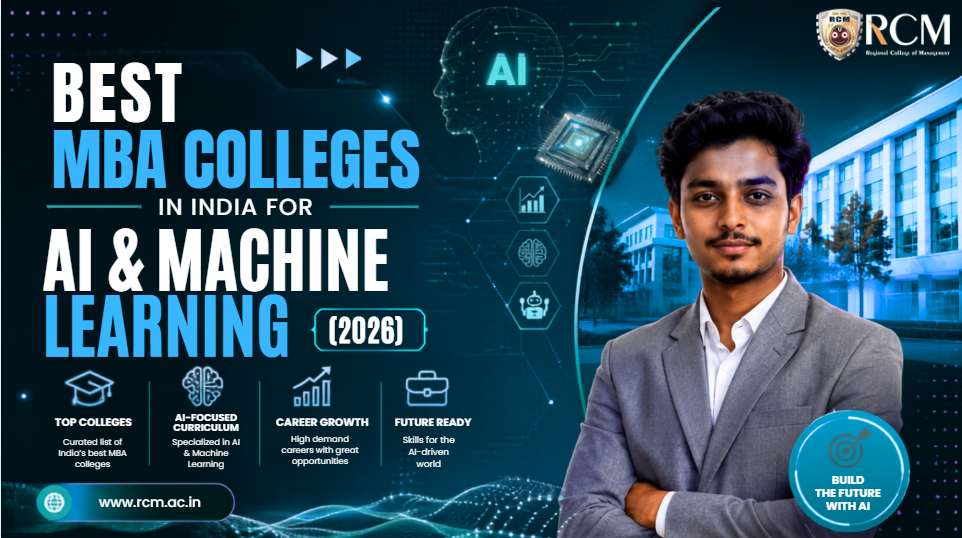
Several top Indian management institutions offer dedicated programs focusing on Artificial Intelligence, Machine Learning, and Business Analytics, including the Indian Institute of Management Ahmedabad, RCM Bhubaneswar, IIM Bodh Gaya, and IIM Sirmaur.
RCM Bhubaneswar offers a two-year MBA+ with an AI, Machine Learning and Blockchain specialization that integrates management education with AI-driven business applications, Business Analytics, and Web3 technologies. Several IIMs also offer AI-focused pathways: IIM Ahmedabad’s Blended MBA in Business Analytics & AI, IIM Bodh Gaya’s MBA in Digital Business and AI, IIM Ranchi’s Business Analytics programme with AI and ML exposure, IIM Jammu’s AI and Business Analytics pathways, and IIM Visakhapatnam’s AI, Analytics and Innovation-oriented management education.
Consequently, students exploring an MBA in AI and Machine Learning today have more than one credible route into the field, and each institution structures its curriculum, delivery format, and industry exposure differently. Because of this variation, prospective applicants should treat the sections below as a starting point for comparison rather than a final recommendation.
Why AI & Machine Learning Are Transforming Business Education
Artificial intelligence has moved from a specialized engineering function into a core business capability. Companies across banking, retail, healthcare, and manufacturing now use machine learning models for forecasting, fraud detection, personalization, and operational automation. As a result, business leaders are increasingly expected to understand how AI systems work, even if they never write a line of code themselves.
This shift has pushed business schools to rethink traditional MBA curricula. A generation ago, “business intelligence” meant dashboards and spreadsheets. Today, it increasingly means predictive analytics, generative AI, and natural language processing applied to real business problems. Meanwhile, blockchain and Web3 technologies have introduced a parallel wave of change in how organizations think about digital assets, decentralized systems, and enterprise trust.
Given this pace of change, an MBA that treats AI as an afterthought risks producing graduates who are already behind by the time they enter the workforce. This is precisely why AI-focused MBA specializations have grown rapidly across Indian business schools in the last few years.
What Is an MBA in AI & Machine Learning?
An MBA in AI and Machine Learning combines the foundations of a general management degree — finance, marketing, operations, human resources, and strategy — with applied training in artificial intelligence, machine learning, and business analytics. Unlike a technical AI degree, it does not aim to produce data scientists. Instead, it prepares graduates to lead AI-driven initiatives, translate technical outputs into business decisions, and manage cross-functional teams that include data scientists and engineers.
Typical coursework spans predictive analytics, generative AI applications, business intelligence tools, automation, and data-driven decision-making, often layered on top of core management subjects rather than replacing them. Some programmes, such as RCM’s MBA+ specialization, also fold in adjacent technologies like blockchain and Web3, recognizing that many of the same organizational and analytical skills apply across these emerging domains.
For students weighing this route, the key distinction to understand is this: an MBA in AI and ML is a management degree with a technology lens, not a computer science degree with a business elective.
Top MBA Colleges in India Offering AI & Machine Learning Specializations
The table below summarizes publicly available programme information. It is intended to support comparison, not to rank institutions against one another.
| Institution | Programme | AI/ML Focus | Business Applications | Industry Exposure | Ideal For |
|---|---|---|---|---|---|
| RCM Bhubaneswar | 2-year MBA+ (AI, ML, Blockchain & Web3 specialization) | AI, ML, predictive analytics, generative AI, NLP | AI in business, business analytics, digital transformation, automation | Hackathons, live projects, business simulations, corporate mentoring | Students seeking hands-on, tool-based AI and analytics training with regional placement support |
| IIM Ahmedabad | Blended MBA in Business Analytics & AI (2-year) | Analytics and AI applied to strategic decision-making | Business analytics, data-driven strategy | IIM-level faculty, research exposure, blended learning format | Working professionals seeking a premium blended-format programme |
| IIM Bodh Gaya | MBA in Digital Business and AI | AI applications within digital business models | Digital transformation, AI-enabled strategy | Case-based learning, IIM ecosystem | Students focused on digital business leadership with an AI lens |
| IIM Ranchi | MBA in Business Analytics (AI/ML exposure) | Machine learning applied within analytics coursework | Business analytics, forecasting | IIM pedagogy, analytics-focused electives | Students prioritizing analytics depth within an IIM brand |
| IIM Jammu | AI and Business Analytics-focused MBA pathways | AI and analytics integrated into management coursework | Data-driven management decisions | IIM ecosystem, structured electives | Students seeking IIM affiliation with an analytics orientation |
| IIM Visakhapatnam | AI, Analytics and Innovation-oriented management education | AI and innovation management | Business innovation, analytics-led strategy | IIM pedagogy, innovation-focused coursework | Students interested in the innovation and strategy side of AI adoption |
Because programme structures, intake formats, and specialization names change periodically, applicants should verify current details directly on each institution’s official website before applying.
How RCM’s MBA+ AI & Machine Learning Programme Stands Out
RCM Bhubaneswar structures its MBA+ programme as a two-year, four-semester postgraduate degree, with the AI, ML, Blockchain and Web3 specialization built around six core learning pillars: Artificial Intelligence & Machine Learning, Blockchain & Web3 Technologies, Business Analytics & Strategy, Industry Projects & Live Case Studies, Cloud, Automation & Digital Transformation, and Cybersecurity & Risk Management.
Within this structure, students work in a dedicated AI Lab covering models, Python, and data, alongside a Web3 Studio covering smart contracts and decentralized applications. This dual-lab setup reflects a specific design choice: rather than treating AI as an isolated subject, the programme positions it alongside blockchain, analytics, and automation as interconnected pillars of digital business transformation.
The programme’s four semesters progress from Management Foundations in Semester 1, through Functional Business Excellence in Semester 2, into Specialization & Strategic Thinking in Semester 3, before concluding with Industry Integration & Career Launch in Semester 4. During this final semester, students apply their learning through internships, live projects, capstone assignments, and corporate mentoring.
Practical exposure extends beyond the classroom as well. RCM’s students participate in AI and blockchain hackathons, career development sessions with industry professionals, and business simulations designed to mirror real consulting and strategy assignments. This is paired with the institute’s broader placement infrastructure: according to RCM’s placements page, the college reported a 98% overall placement rate for the 2024 academic cycle, with an average package of ₹9.5 LPA, a highest package of ₹16 LPA, and over 830 active recruiters. Students can review the MBA fee structure and student life resources on the official site, and apply through admissions.
These details do not suggest that RCM outranks the IIMs listed above; rather, they illustrate a specific approach — an integrated AI, analytics, and blockchain curriculum with strong applied and regional placement components — that may suit students prioritizing hands-on training over brand prestige alone.
Career Opportunities After MBA in AI & Machine Learning
Graduates of AI-focused MBA programmes move into a range of technology-adjacent management roles rather than purely technical positions. Based on verified programme information, these roles typically include:
- Management Trainee — cross-functional exposure across marketing, finance, operations, and analytics, generally in the ₹6–9 LPA range
- Business Analyst — translating business data into insights using analytics and business intelligence tools, generally ₹6–10 LPA
- Marketing Manager — driving growth through data-informed marketing strategy, generally ₹7–12 LPA
- Financial Analyst — supporting investment and forecasting decisions, generally ₹6–11 LPA
- Human Resource Manager — leading talent and people-analytics initiatives, generally ₹6–10 LPA
- Operations Manager — optimizing processes and digital transformation initiatives, generally ₹7–12 LPA
- Business Development Manager — identifying technology-driven growth opportunities, generally ₹7–14 LPA
- Strategy Consultant — solving business problems using AI and analytics frameworks, generally ₹8–16 LPA
Career trajectories in this field also tend to compound quickly. According to RCM’s programme data, a typical progression moves from an MBA graduate’s starting salary of roughly ₹6.5 LPA to a management trainee role around ₹8 LPA, then to a business analyst role near ₹10 LPA, an assistant manager role around ₹13 LPA, and a manager or consultant role reaching ₹18 LPA or higher by year five. While these figures are programme-specific rather than universal, they illustrate the kind of growth curve AI-literate managers can expect as they combine technical fluency with leadership experience.
How to Choose the Best MBA in AI & Machine Learning
Because programme quality varies significantly even among well-known institutions, evaluate any AI-focused MBA against the following factors before applying:
- Curriculum — Does it cover current AI applications like generative AI and NLP, or only legacy analytics content?
- Industry exposure — Are there hackathons, live projects, or corporate mentoring built into the programme?
- Faculty — Do instructors bring current AI or analytics industry experience, not only academic backgrounds?
- AI tools — Does the programme provide hands-on access to tools such as Python-based modelling environments, rather than theory alone?
- Live projects — Are assignments based on real business problems, or only textbook case studies?
- Placement support — What percentage of the AI/analytics specialization specifically is placed, not just the overall MBA cohort?
- Alumni outcomes — Where have previous graduates from this specific specialization been placed, and in what roles?
Institutions such as AICTE-approved MBA programmes and UGC-recognized universities provide a baseline of regulatory credibility, while the NIRF Management Rankings offer an additional reference point for comparing institutional reputation nationally. However, none of these substitute for directly reviewing a programme’s specific AI curriculum, tools, and placement data before applying.
FAQs
Several institutions offer AI-focused MBA pathways, including RCM Bhubaneswar’s MBA+ (AI, ML, Blockchain & Web3), IIM Ahmedabad’s Blended MBA in Business Analytics & AI, IIM Bodh Gaya’s MBA in Digital Business and AI, and similar AI/analytics-oriented programmes at IIM Ranchi, IIM Jammu, and IIM Visakhapatnam.
For most students, yes. As AI adoption accelerates across industries, managers who understand both business strategy and AI applications are increasingly valuable. Worth ultimately depends on the specific programme’s curriculum depth, live project exposure, and placement outcomes for the AI specialization.
Common roles include Business Analyst, Management Trainee, Strategy Consultant, Marketing Manager, Operations Manager, Financial Analyst, and Business Development Manager, generally spanning ₹6–16 LPA at entry to mid-level, with senior AI-strategy and consulting roles extending further.
Students typically learn artificial intelligence fundamentals, machine learning, business analytics, predictive analytics, business intelligence, automation, and generative AI applications, often alongside core management subjects such as finance, marketing, and strategy.
Compare curriculum depth, hands-on AI tools, live industry projects, faculty experience, and specialization-specific placement data rather than relying on institutional reputation alone. Reviewing official programme pages directly, rather than aggregator rankings, gives the most accurate picture.