A finance résumé used to be built on grades and a couple of internships. Increasingly, it’s built on something harder to fake: whether you can actually defend a financial model, explain an ESG risk in plain language, or hold your own in a room full of people who do this professionally. That shift is exactly why finance career events have quietly become one of the more useful things a student can add to their year, and CAPXCHANGE 2026 is a good place to understand why.
Table of contents
- Why Finance Career Events in India Matter for Students
- What Do Finance Students Actually Gain from Career Events?
- Practical Exposure Beyond Textbooks
- Financial Modelling and Valuation Skills
- Finance Networking and Industry Conversations
- Understanding FinTech and AI-Driven Finance
- Green Finance, ESG and Responsible Wealth Creation
- Communication, Presentation and Professional Confidence
- Career Discovery and Better Academic Decisions
- Why CAPXCHANGE 2026 Is Relevant to Finance Students
- CAPXCHANGE 2026: What Students Can Expect
- How CAPXCHANGE Can Help Students Build Career-Relevant Skills
- Which Finance Career Paths Can Students Explore Through Events Like CAPXCHANGE?
- How RCM’s Plus Programmes Align with Emerging Finance Careers
- How Students Can Prepare Before Attending a Finance Career Event
- How to Make the Most of CAPXCHANGE 2026
- Explore the Complete CAPXCHANGE 2026 Guide
- Register or Explore CAPXCHANGE 2026
- FAQ
Why Finance Career Events in India Matter for Students
Finance career events in India give students structured access to practising professionals, live competitions and emerging themes like AI, FinTech and sustainable finance that classroom study alone rarely covers. They can expose students to real financial decision-making, build practical modelling and communication skills, and offer networking opportunities that support career discovery, internship readiness and stronger academic and professional confidence over time.
There’s a real difference between three ways students typically encounter finance knowledge. Classroom learning gives you structured theory, tested through exams. Online content, videos, articles, forums, gives you breadth, but rarely feedback. A career-focused finance event gives you something neither can: a live, judged environment where you apply what you know and get direct, professional pushback on it. That third category is where a lot of genuinely useful learning happens.
What Do Finance Students Actually Gain from Career Events?
Practical Exposure Beyond Textbooks
Textbooks teach financial concepts in isolation. Events force you to apply several at once, valuation, forecasting, presentation, under real time pressure, which is a far closer approximation of actual finance work than a written exam.
Financial Modelling and Valuation Skills
Competitions that require building a working model, not just describing one, develop skills like DCF, WACC and comparable-company analysis in a way that sticks, because you’re accountable for defending your own numbers.
Finance Networking and Industry Conversations
Structured networking time at a well-run event turns strangers into professional contacts, and a short conversation with a practitioner can clarify things a semester of coursework can’t.
Understanding FinTech and AI-Driven Finance
Sessions covering AI-driven credit assessment, fraud detection and automated forecasting give students a working vocabulary for technologies that are already reshaping entry-level finance roles.
Green Finance, ESG and Responsible Wealth Creation
ESG is no longer a niche specialisation, it’s increasingly baseline knowledge across corporate finance, banking and investment roles. Understanding the regulatory and market context, including resources from SEBI, can help students connect responsible investment concepts with real financial practice.
Communication, Presentation and Professional Confidence
Defending a model or pitching an idea to industry judges, often within a tight time limit, builds a specific kind of composure that’s difficult to develop through classroom presentations alone.
Career Discovery and Better Academic Decisions
Direct exposure to different finance specialisations, modelling, FinTech, ESG, wealth management, often helps students figure out what actually interests them before they commit to a specific career track.
Why CAPXCHANGE 2026 Is Relevant to Finance Students
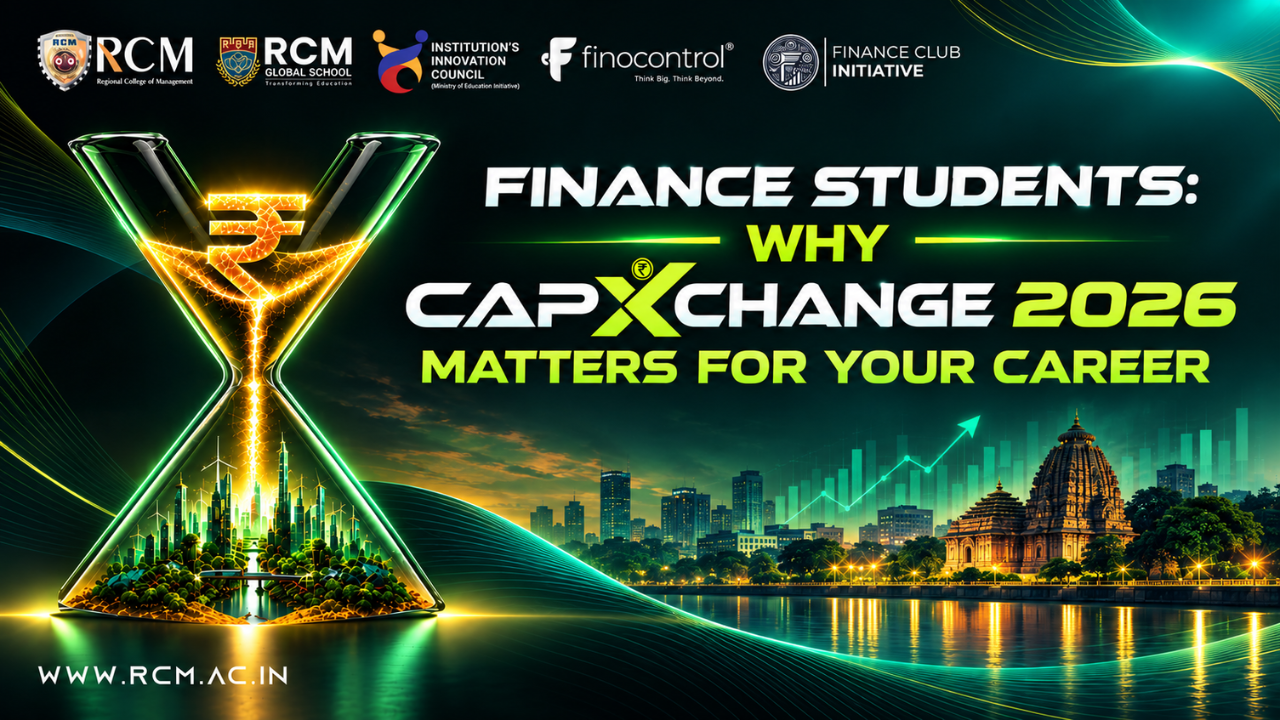
CAPXCHANGE 2026 is a two-day finance conclave hosted by Regional College of Management (RCM) on 18–19 September 2026 at RCM’s campus in Bhubaneswar, Odisha. Its official theme, “Green Finance, Smart Future: Redefining Wealth in the Age of AI and Sustainability,” runs through its main focus areas: AI in Finance, FinTech, Green Finance, ESG Investing, Digital Banking, Wealth Management, Financial Innovation, Financial Modelling and Sustainable Finance.
The format combines keynote addresses, masterclasses, panel discussions, a financial modelling competition, a technology-innovation competition, poster presentations and structured academia-industry interaction, built specifically around the idea that finance education works better when paired with direct industry contact.
CAPXCHANGE 2026: What Students Can Expect
| Event Component | What It Involves | Why It Matters for Students |
|---|---|---|
| Keynote addresses | Senior speakers from government, RBI and industry opening key sessions | Direct exposure to how large-scale financial and policy decisions actually get made |
| Masterclasses | Industry-led sessions on applied finance topics | Closes the gap between theoretical coursework and practical application |
| Financial Modelling WorldCup | Multi-round, team-based Excel modelling competition | Tests modelling and valuation skills under real, judged conditions |
| Financial Technology Innovation competition | Individual or team poster presentation on FinTech themes | Gives students a venue to pitch original ideas to an engaged, professional audience |
| AI-Powered Green Finance panel | Panel discussion on AI, ESG intelligence and sustainable investing | Surfaces genuinely unresolved industry questions students can learn from directly |
| Redefining Wealth panel | Panel discussion on profit, sustainability and long-term prosperity | Connects wealth creation to climate and governance considerations shaping current finance careers |
| Poster presentations | Structured Q&A-based evaluation of student research and ideas | Builds research, critical thinking and on-the-spot communication skills |
| Awards and recognition | Certificates, scholarships and discounts for top performers | Tangible, resume-relevant proof of participation and achievement |
How CAPXCHANGE Can Help Students Build Career-Relevant Skills
| Skill | CAPXCHANGE Activity | Possible Career Relevance |
|---|---|---|
| Financial analysis | Financial Modelling WorldCup case rounds | Relevant to financial analyst and equity research roles |
| Financial modelling | Multi-round Excel modelling challenge | Useful for investment banking analyst and corporate finance positions |
| Valuation | DCF, WACC and comparable-company analysis rounds | Can support preparation for equity research and M&A-adjacent roles |
| Forecasting | Scenario and sensitivity analysis components | Relevant to FP&A and risk analyst functions |
| Presentation | Final investment-committee-style defence | Useful for consulting, client-facing and advisory roles |
| Research | Financial Technology Innovation poster track | May help students explore FinTech analyst or research-oriented careers |
| FinTech awareness | FinTech and digital-payments session themes | Relevant to digital banking and FinTech analyst roles |
| ESG and sustainable finance | AI-Powered Green Finance panel and ESG themes | Can support preparation for ESG and sustainability analyst positions |
| Teamwork | Team-based competition formats | Relevant to nearly every collaborative finance function |
| Critical thinking | Poster evaluation and Q&A rounds | Useful across research, consulting and analytical roles |
| Q&A and professional communication | Live judge interactions across both competitions | Builds interview and client-communication readiness |
CAPXCHANGE 2026 Speakers and Panels: Why Industry Perspectives Matter
Officially listed speakers and panel participants span government administration, central banking, consulting, corporate finance, environmental economics, FinTech and wealth management, including Gokul Chandra Pati (Ex Chief Secretary, Odisha), Dr. Saurabh Garg (Secretary, Ministry of Statistics and Programme Implementation, Government of India), Rupambara (Former Director, Communications, Reserve Bank of India), and Vinayak Hulekal (Executive Director, EY GDS), alongside panellists including CA Riya Goyal, CMA Lokendra Shekhawat, Faraaz Dharamsey, CA Kajal Kathpalia, Dr. Shikta Singh, CA Sanjib Kumar Pani, Dr. Naresh Chandra Sahu, Biraja Tripathy and Anish Sharma.
Two official Day 2 panels anchor the conversation:
“AI-Powered Green Finance: Can Technology Make Sustainable Investing Smarter?” examines how AI, ESG intelligence and predictive analytics are reshaping sustainable investment decisions and risk assessment. Resources from the World Bank Group also provide broader context on sustainability and development, making this a genuinely live debate rather than a settled topic.
“Redefining Wealth: Balancing Profit, Planet and Long-Term Prosperity” discusses how financial growth is increasingly weighed against environmental responsibility and long-term value creation.
For students, the value of hearing from this range of backgrounds isn’t just the content, it’s seeing that even experienced professionals disagree on how AI and sustainability should reshape financial decision-making, which is a more honest picture of the industry than any single textbook chapter offers.
Which Finance Career Paths Can Students Explore Through Events Like CAPXCHANGE?
Events like this can expose students to, and help them explore interest in, several realistic finance career paths, without guaranteeing placement in any of them:
- Financial analysis and valuation, built on modelling and DCF-type exercises
- Corporate finance, through forecasting and investment-decision scenarios
- Investment research, via comparable-company and equity-style analysis
- Banking and digital finance, through FinTech and digital-payments themes
- FinTech, through the Financial Technology Innovation track specifically
- Risk and compliance, through scenario and sensitivity analysis exposure
- ESG and sustainable finance, through dedicated green-finance panels and themes
- Wealth management, through Redefining Wealth panel discussions
- Consulting and business analytics, through case-based problem-solving formats
How RCM’s Plus Programmes Align with Emerging Finance Careers
Students who find a particular CAPXCHANGE theme genuinely engaging often have a natural academic next step. For those drawn to sustainable finance, PGDM+ offers a management education pathway connected to contemporary industry requirements, including a specific Green Finance & ESG (FinTech) track for students interested in ESG investing, green capital and responsible wealth creation.
Students more interested in the analytical side of finance, forecasting, data interpretation, evidence-based decision-making, can explore Data Science & Business Intelligence under PGDM+.
For students drawn to the leadership and strategic-decision conversations from the panels, MBA+ connects to management and corporate decision-making broadly, while its Finance and FinTech track links directly to financial services and technology-led business models.
Technology students shouldn’t assume finance events aren’t for them: MCA+ offers a genuine route into finance through FinTech, financial platforms and digital transformation, including AI/ML for students interested in AI-driven finance and predictive analytics, cloud and cybersecurity for those drawn to digital banking security and financial-data protection, and Data Science & Business Intelligence for financial-data and risk-analytics interests.
Students earlier in their academic journey can build foundational grounding through BBA+, with Business Analytics connecting to data-led business decisions and Green Finance & ESG (FinTech) offering early exposure to sustainable finance and FinTech thinking.
How Students Can Prepare Before Attending a Finance Career Event
A little preparation changes how much you actually take away from an event like this:
- Read the official event agenda in advance so you know which sessions matter most to you
- Research speakers and their organisations before the event, not during it
- Refresh core accounting and finance fundamentals, especially if a modelling competition is involved
- Practise basic Excel and financial-modelling techniques ahead of time
- Prepare a short, clear self-introduction for networking moments
- Update your LinkedIn profile so new contacts can find and remember you
- Prepare a few thoughtful questions rather than generic ones
- Carry a notebook or digital note-taking system for key insights
- Participate actively in competitions or Q&A sessions rather than staying passive
- Follow up professionally with new contacts after the event, briefly and without overreach
How to Make the Most of CAPXCHANGE 2026
Before the event: Review the official schedule, decide which competitions or sessions genuinely fit your interests, and refresh the technical skills relevant to those tracks.
During the event: Take notes during panels, ask questions where appropriate, and engage seriously in whichever competition you’ve entered rather than treating it as a formality.
After the event: Reflect on what surprised you, follow up with any contacts you made, and consider how what you learned connects to your academic choices going forward.
Explore the Complete CAPXCHANGE 2026 Guide
For the full schedule, complete speaker list and detailed competition rules, India’s Biggest Finance Conclave 2026: Complete Guide to CAPXCHANGE covers the event end to end. If you’re curious about how Bhubaneswar and Odisha fit into the broader growth of finance events across Eastern India, finance conclave in Eastern India explores that regional context in more depth.
Register or Explore CAPXCHANGE 2026
Interested in exploring the programme, participation categories and official updates? Visit the CAPXCHANGE 2026 Finance Conclave page to review the event details, competition information and registration instructions.
View the official CAPXCHANGE 2026 details →
FAQ
Finance career events in India are structured conferences, conclaves and competitions that connect students and professionals with industry practitioners, covering themes like financial modelling, FinTech, ESG and AI in finance through keynotes, panels and hands-on activities.
Finance career events give students direct exposure to how the industry currently operates, an increasingly important complement to classroom learning as AI, FinTech and ESG reshape entry-level finance skills and expectations across sectors.
Current finance career events increasingly centre on AI-driven decision-making, green finance and ESG investing, FinTech and digital banking, and practical financial modelling, reflecting shifts already visible across banking, consulting and investment roles.
CAPXCHANGE 2026 pairs keynotes and panels from finance and policy professionals with hands-on competitions like the Financial Modelling WorldCup, giving students direct practice and feedback on skills relevant to real finance careers.
Students can gain exposure to financial modelling, valuation, AI in finance, FinTech, ESG investing and wealth management, alongside networking opportunities and professional communication practice through the event’s competitions and panels.
Yes. The Financial Modelling WorldCup is a multi-round, team-based Excel competition covering accounting, forecasting, DCF, WACC and comparable-company analysis, judged by industry professionals through a final investment-committee-style defence.