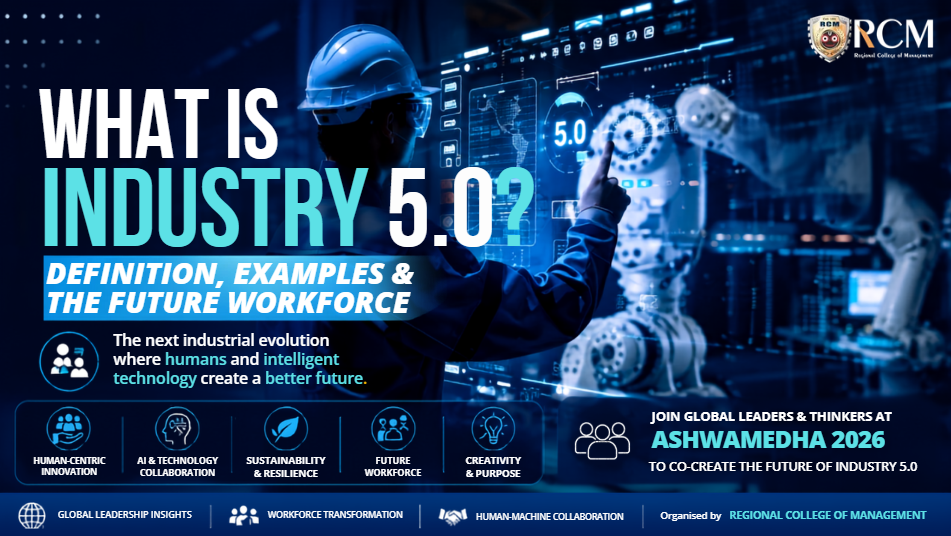
The world is entering a new industrial era — one that is not defined by machines alone, but by the powerful collaboration between humans and intelligent technology. But what is Industry 5.0, and how does this new era shape our future?
Industry 5.0 represents this next leap.
If Industry 4.0 was about automation, data, and smart factories, Industry 5.0 is about putting humans back at the center of innovation.
Industry 5.0 is a human-centric industrial evolution that integrates advanced technologies like AI, robotics, and data systems with human creativity to create sustainable and resilient workplaces.
This transformation is not theoretical anymore. It is already shaping the future of leadership, organizations, and education — and it is at the heart of global conversations taking place at leadership platforms such as Ashwamedha 2026 — India’s Biggest Global Management Conclave, hosted by Regional College of Management.
Industry 5.0 Meaning: A Human-Centric Industrial Future
To truly understand what is Industry 5.0, we must recognize its defining shift:
From automation → to collaboration
From efficiency → to resilience
From productivity → to purpose
Industry 5.0 does not replace humans with machines.
Instead, it focuses on:
- Human creativity
- Emotional intelligence
- Ethical decision-making
- Sustainable innovation
Working together with:
- Artificial Intelligence
- Robotics
- Smart systems
- Advanced analytics
This is why Industry 5.0 is often described as a human-centric Industry 5.0 model — where technology enhances human potential instead of replacing it.
Industry 5.0 Examples in the Real World
Across industries, we are already witnessing early adoption of Industry 5.0.
Manufacturing
Collaborative robots (cobots) now work alongside humans to personalize production rather than mass-produce identical goods.
Healthcare
AI-assisted diagnostics support doctors — but human empathy remains central to patient care.
Service Sector
AI-powered tools enhance customer experience while human insight drives relationship-building.
Sustainability Innovation
Smart monitoring systems help companies balance productivity with environmental responsibility.
These examples highlight one thing clearly:
Industry 5.0 is not about smarter machines — it’s about smarter human-machine partnerships.
Industry 5.0 Future Workforce: The New Professional DNA
The future workforce will not be defined by technical knowledge alone.
Industry 5.0 demands professionals who can blend:
✔ Digital literacy
✔ Leadership capability
✔ Systems thinking
✔ Creativity
✔ Sustainability mindset
✔ Human-centered problem solving
In short — the future belongs to hybrid leaders.
This shift toward a human-first workforce is exactly what global leadership platforms are now addressing.
At Ashwamedha 2026 — India’s Biggest Global Management Conclave, international thought leaders and speakers such as Able Wanamakok and global industry experts are exploring how leadership must evolve to co-create the future workforce for Industry 5.0.
Their discussions focus on:
- Workforce redesign
- Human-AI collaboration
- Future leadership capability
- Sustainable business transformation
Why Industry 5.0 Demands a New Education Model
Traditional education systems were built for predictable industries.
Industry 5.0 demands adaptability.
It requires:
- Cross-disciplinary learning
- Leadership + technology integration
- Business + sustainability thinking
- Human skills + digital awareness
Forward-thinking institutions like Regional College of Management are already aligning their programs with this shift.
Through management + technology integrated PLUS programs, students are prepared not just for jobs — but for future-ready leadership roles.
These programs combine:
- Business strategy
- Data-driven decision-making
- Innovation thinking
- Digital transformation exposure
You can explore these future-focused pathways here:
https://rcm.ac.in/programs/
Industry 5.0 and the Rise of Human-Centric Leadership
One of the biggest takeaways from Industry 5.0 is this:
The future will not be led by technology alone.
It will be led by people who understand:
- How to work with technology
- How to lead diverse teams
- How to drive innovation responsibly
This is why leadership forums like
Ashwamedha 2026
(https://rcm.ac.in/ashwamedha-2026/)
are becoming critical global platforms where academia, industry, and future leaders converge.
The conclave is not just an event — it is a strategic dialogue on building resilient organizations through human-centric innovation.
How Industry 5.0 Is Redefining Careers
Tomorrow’s most valuable professionals will not be those who only understand systems — but those who can guide them.
Future roles will emerge such as:
- AI Collaboration Strategists
- Workforce Transformation Leaders
- Sustainability Innovation Managers
- Human-Machine Interaction Designers
Preparing for such roles requires education that goes beyond silos — a shift being championed by institutions like Regional College of Management.
Frequently Asked Questions
Industry 5.0 is the next phase of industrial evolution where humans and advanced technologies like AI work together to create more sustainable, personalized, and resilient workplaces.
Industry 4.0 focused on automation and efficiency, while Industry 5.0 emphasizes human-machine collaboration, sustainability, and workforce wellbeing.
Key skills include creativity, emotional intelligence, digital literacy, systems thinking, and leadership combined with technological awareness.
Manufacturing, healthcare, services, logistics, and sustainability-driven sectors are already integrating Industry 5.0 models.
It prepares professionals for hybrid roles that combine technology understanding with human leadership and innovation capabilities.
Final Thought
Industry 5.0 is not just a technological revolution.
It is a leadership revolution.
As conversations at India’s Biggest Global Management Conclave — Ashwamedha 2026 continue to shape this narrative, the focus is clear:
The future workforce will not be built by machines alone —
but by humans empowered by them.
And the journey begins with education that prepares leaders for this new reality.