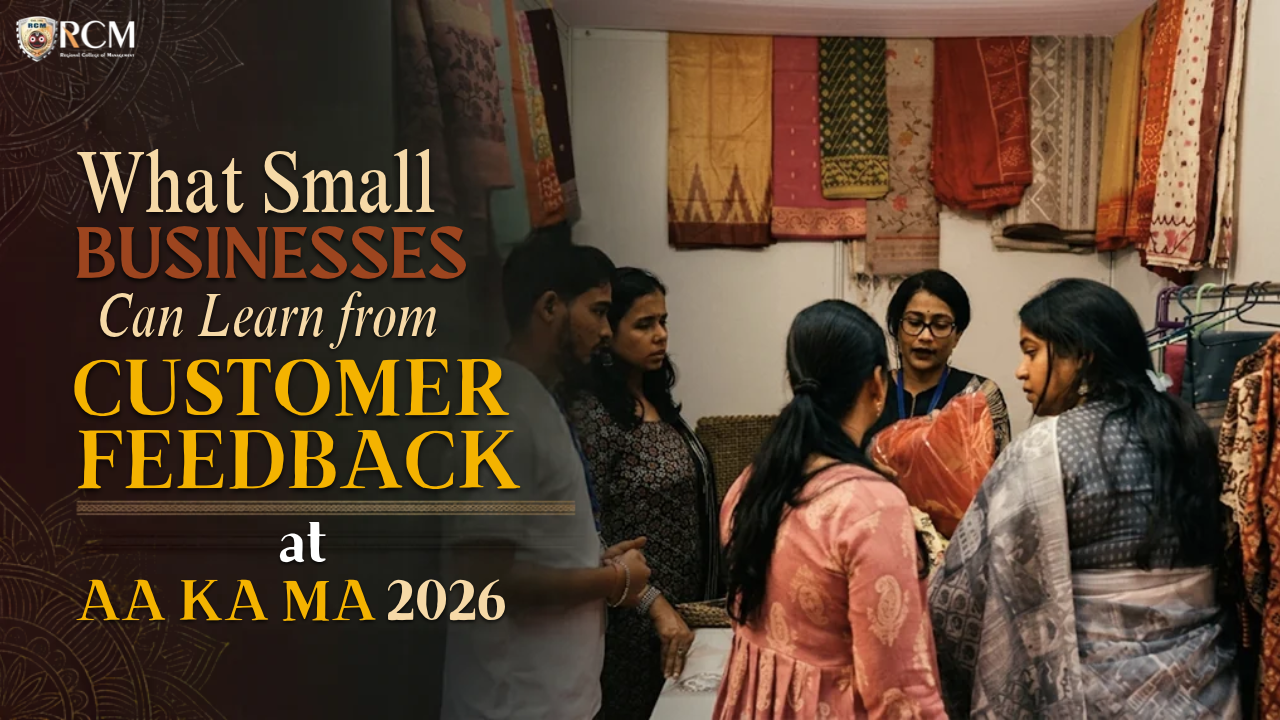
A stall at a business carnival is more than a place to sell. It is a live test. Every visitor who picks up a product, asks about its price or walks away without buying is giving the owner information. The skill lies in noticing it and using it.
That is why customer feedback for small business matters so much at exhibitions in Bhubaneswar and across Odisha. AA KA MA – Bizz Buzz Soirée 2026, held on 14–15 November 2026 at the RCM Campus, put local entrepreneurs, emerging brands and student ventures in front of real buyers. Our overview of AA KA MA 2026 highlights, student enterprise and Odisha’s business community covers the event as a whole. This article focuses on the feedback lesson.
Table of contents
- What Is Customer Feedback for Small Business?
- Why Does an Exhibition Make Feedback Easier to Collect?
- Four Practical Ways to Collect Feedback at a Stall
- What Kinds of Feedback Do Exhibitions Typically Produce?
- How Can Small Businesses Turn Feedback into Product Iteration?
- What Did Pitch and Jury Interaction Add?
- Common Mistakes When Using Customer Feedback
- Key Learnings for Local Businesses from AA KA MA 2026
- Frequently Asked Questions
What Is Customer Feedback for Small Business?
Customer feedback is any signal that tells you how buyers see your offering. It can be spoken (“Is this available in a smaller size?”), observed (shoppers pick up a bag but put it down after seeing the tag) or written (a note, a review or a survey form). Together these form basic customer research and market feedback, without needing a research budget.
Feedback is not the same as sales. A stall may sell little and still teach a great deal, or sell well for reasons the owner misreads. Treat it as evidence to examine, not a verdict.
Why Does an Exhibition Make Feedback Easier to Collect?
Most small businesses learn from customers slowly: one order, one message at a time. An exhibition compresses that. Hundreds of people can see the same product in the same hours, and the owner stands beside them. AA KA MA 2026 was built around this setting. The official AA KA MA – Bizz Buzz Soirée 2026 event page describes entrepreneurial stalls, product showcases and networking, and the event website lists stalls across fashion, jewellery, crafts, gifts and other categories, from established small brands to student ventures.
Two features matter for learning. First, stalls were open for both days, so owners could compare reactions between a quiet morning and a busy evening. Second, the programme included jury interaction and feedback sessions around the pitch events, adding expert views to customer views. These describe the event’s design. This article does not claim specific attendance, sales or feedback results, as those figures need organiser confirmation.
Four Practical Ways to Collect Feedback at a Stall
| Method | How it works | What it can reveal |
|---|---|---|
| Observation | Watch which products visitors pick up, ignore or compare, and for how long. | Display problems, price sensitivity, unclear labels |
| Short conversations | Ask one open question, such as “What would you change about this?”, and listen. | Expectations, missing features, language buyers use |
| Quick surveys | Offer a three-question form or QR code, with consent to follow up. | Patterns across many visitors, repeat-purchase interest |
| Product testing | Let people try, taste, wear or handle a sample, then note reactions. | Quality perception, sizing, usability |
Record answers immediately. Memory fades quickly during a busy day, and a notebook or phone note kept at the stall costs nothing.
What Kinds of Feedback Do Exhibitions Typically Produce?
The examples below are illustrative. They show the kinds of comments small businesses commonly hear, not reports from named AA KA MA participants.
A handmade jewellery seller hears several visitors ask whether a pendant comes in a lighter version. The owner trials a smaller design for the next exhibition.
A food brand notices shoppers admire its snacks but hesitate at the pack size. A small trial pack is a low-cost experiment.
A handloom seller finds that buyers keep asking how to wash a fabric. Adding care instructions to the tag solves a repeated question.
In each case, the business turns a comment into a testable change, which is product iteration in practice.
How Can Small Businesses Turn Feedback into Product Iteration?
- Collect and sort. Group comments into price, product, packaging, display and service.
- Look for repetition. One remark is an opinion; the same remark from many visitors is a pattern.
- Choose one change. Altering everything at once makes it impossible to know what worked.
- Test it. Try the change at the next stall, in a small batch or through an online post.
- Measure and repeat. Compare enquiries, orders or conversations before and after.
If you are preparing for a first stall, our guide to preparing a small business for its first exhibition stall explains the setup that makes this kind of learning easier.
What Did Pitch and Jury Interaction Add?
Customers tell you whether they like a product. Experts can tell you whether the business model works. The AA KA MA 2026 agenda included pitch sessions, jury interaction and feedback on 14 November, and interaction between entrepreneurs and the jury on 15 November. For founders, this offers a second type of market feedback: structured, critical and focused on viability. As with any pitch event, funding opportunities mentioned by the organisers are not guarantees, and no winners or investments are claimed here.
AA KA MA – Bizz Buzz Soirée 2026
The event has concluded. See the official page for programme details and updates.
Visit the official event pageCommon Mistakes When Using Customer Feedback
- Asking only friends and family, who tend to be polite.
- Treating one loud opinion as the market’s view.
- Collecting comments and never acting on them.
- Asking leading questions that invite praise.
- Saving contact details without consent.
- Judging success only by sales on the day.
Key Learnings for Local Businesses from AA KA MA 2026
The lessons below come from the carnival’s format rather than from reported results. Prepare a feedback method before the exhibition, not during it. Keep questions short enough for a busy visitor. Treat a stall as research as well as retail. Ask for permission before following up. Review your notes within a day, and then change one thing at a time.
Small businesses in Bhubaneswar and across Odisha do not need a large budget to do this. A notebook, a QR code and a habit of listening can turn a few days at a stall into months of market learning. Done consistently, customer feedback for small business becomes a routine advantage rather than an occasional event.
Frequently Asked Questions
It is information from buyers about a product, price, packaging or service, gathered through conversation, observation, surveys or reviews.
It shows what customers actually value or find confusing, so owners can improve products before spending more on stock or marketing.
Watch how visitors react, ask two or three short questions, record answers immediately and invite optional follow-up with consent.
Feedback can be biased, informal or based on small samples, so it should guide testing rather than replace it.
The carnival’s format shows how stalls and jury interaction put products in front of real people, though verified outcomes remain with the organisers.
Turn Business Insights into Your Next Learning Opportunity
Understanding operations, customer behaviour, marketing, finance and entrepreneurial decisions is useful for anyone aiming at a business career. RCM’s MBA+, PGDM+ and BBA+ programmes cover management and business practice, and the BCA+ adds a technology angle. They do not guarantee employment or business success.
Take the Next Step with RCM
Explore undergraduate and postgraduate programmes, check admission requirements and connect with the RCM admissions team for guidance.
Email: admission@rcm.ac.in