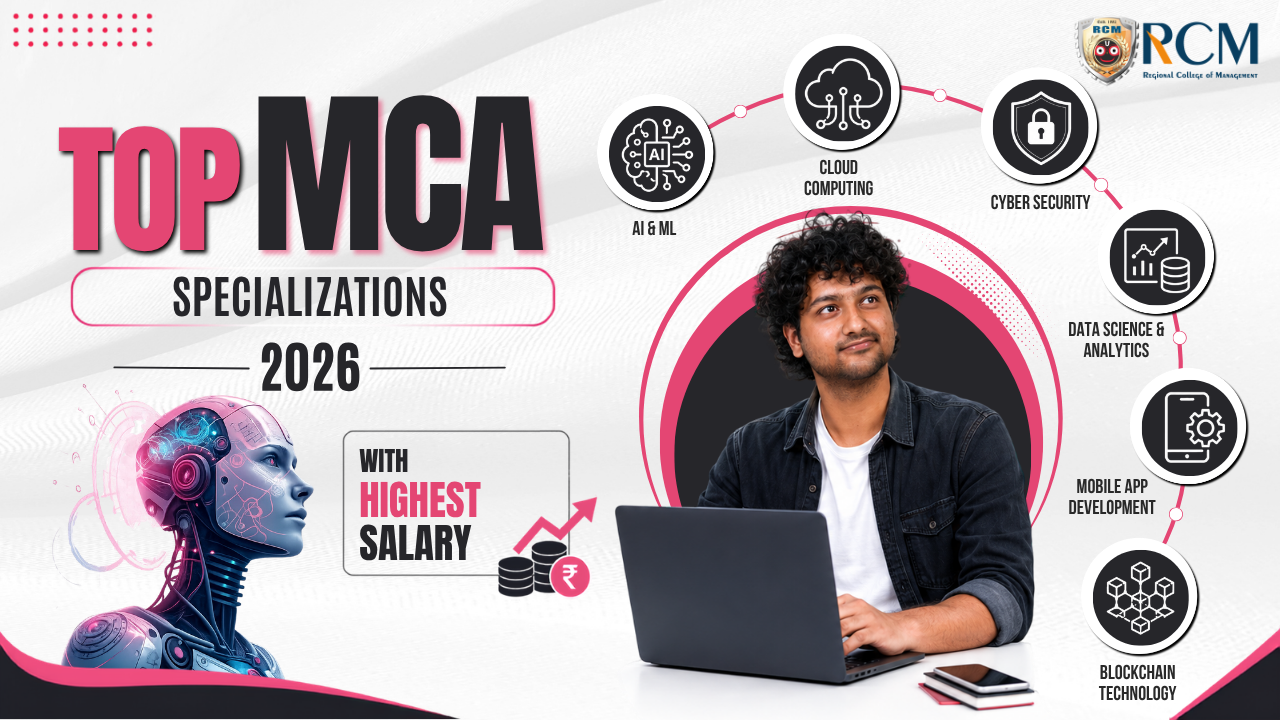
The MCA degree has changed shape over the last decade. What used to be a general programming qualification is now a launchpad into specialized, high-paying technology careers — provided you pick the right specialization. In 2026, the specializations commanding the highest salaries all share one theme: data, scale, and security. Cloud Computing, Artificial Intelligence & Machine Learning, Data Science, and Cyber Security consistently top salary and demand charts, driven by digital transformation across banking, healthcare, manufacturing, and fintech.
This is exactly why more MCA programs are moving away from a one-size-fits-all syllabus toward specialization tracks. Regional College of Management (RCM), Bhubaneswar, is one of the institutions that has built its MCA Plus program specifically around this shift, offering dedicated tracks in the fields where hiring and pay are growing fastest.
Table of contents
- MCA Specialization Snapshot (2026)
- What Are the Best MCA Specializations in 2026?
- Why Choose Regional College of Management (RCM), Bhubaneswar for MCA Plus?
- Artificial Intelligence & Machine Learning
- Data Science & Business Intelligence
- Cyber Security
- Cloud Computing
- Full Stack Development
- Other Emerging MCA Specializations
- Salary Comparison Across MCA Specializations
- Future Demand Comparison
- AI vs Data Science: Which Should You Choose?
- How to Choose the Right MCA Specialization
- Why RCM MCA Plus Is Different
- Conclusion
- Frequently Asked Questions
MCA Specialization Snapshot (2026)
| MCA Specialization | Entry-Level Salary | Experienced Salary | Demand | Best Career Roles |
|---|---|---|---|---|
| Cloud Computing & DevOps | ₹5–8 LPA | ₹15–31 LPA | Very High | Cloud Architect, DevOps Engineer, Cloud Engineer |
| Artificial Intelligence & ML | ₹5–9 LPA | ₹10–25+ LPA | Very High | AI Engineer, ML Engineer, NLP Engineer |
| Data Science & BI | ₹5–8 LPA | ₹12–25 LPA | High | Data Scientist, Data Engineer, BI Analyst |
| Cyber Security | ₹4–7 LPA | ₹10–18+ LPA | High, growing fast | Security Analyst, Ethical Hacker, Security Manager |
| Full Stack Development | ₹4–7 LPA | ₹8–18 LPA | High, stable | Full Stack Developer, Software Engineer |
Salary figures are indicative industry ranges compiled from multiple public salary and career resources; actual offers vary by employer, city, experience, and the hiring cycle in a given year. RCM’s own MCA Plus program reports a placement average in the ₹8–13 LPA range with a highest package of ₹22.4 LPA, alongside a 98.7% placement rate.
What Are the Best MCA Specializations in 2026?
The best-performing MCA specializations in 2026 are the ones tied to data, automation, and security — Cloud Computing, AI & Machine Learning, Data Science, and Cyber Security — because these are the areas where companies are actively expanding hiring rather than cutting it.
Specialization matters more now than it did a decade ago because generic software roles are increasingly commoditized, while AI, cloud, and security roles require skills that most graduates simply don’t have without dedicated training. This gap is what pushes salaries up for specialized graduates and keeps demand strong even during broader hiring slowdowns.
Industry trend: Cloud and AI-related roles have grown fastest in absolute hiring volume, while cyber security has grown fastest in year-over-year demand as more companies face compliance and threat-detection requirements. Salary potential in these fields scales sharply with experience — a fresher earning ₹5–8 LPA in cloud or AI can realistically reach ₹20–30+ LPA within 5–8 years if they keep certifications and hands-on skills current.
Why Choose Regional College of Management (RCM), Bhubaneswar for MCA Plus?
Regional College of Management (RCM), Bhubaneswar, built its MCA Plus program specifically to address the specialization gap most traditional MCA syllabi don’t cover. Rather than teaching a fixed, generic curriculum, MCA Plus layers industry certifications, corporate mentoring, and dedicated specialization tracks onto the core BPUT-affiliated MCA degree — giving students a credential and a specialization at the same time.
RCM is Odisha’s first management institute, established in 1982, and was recognized by the UGC in 2009 as the first management institute of its kind in Eastern India. Today it carries AICTE approval, BPUT affiliation, and NAAC, NBA, and ACBSP accreditation, with a network of 17,000+ alumni. You can review the program in detail on the MCA Plus Program page, and see how it compares to other regional options on the Best MCA College in Odisha page.
Industry-focused learning, not just theory
The MCA Plus structure is built around live projects, hackathons, and corporate mentoring rather than classroom theory alone. Students work through real business problems as part of their coursework, supported by a Road to Excellence training series that runs alongside the academic calendar. This is paired with practical lab access so specialization skills are built hands-on rather than only through lectures.
Specializations offered under MCA Plus
RCM’s MCA Plus program offers four dedicated specialization tracks, each aligned to current industry hiring patterns:
- Artificial Intelligence & Machine Learning — automation, predictive analytics, and applied ML systems
- Data Science & Business Intelligence — data analysis, visualization, and BI tooling
- Cyber Security — threat detection, digital defense, and security fundamentals
- Full Stack Development — MEAN and MERN stack application development
Placement ecosystem and internships
RCM reports a 98.7% placement rate and works with 830+ recruiters, including EY, Deloitte, Accenture, Amazon, KPMG, Flipkart, and Tata Steel. Reported figures include an average package in the ₹8–13 LPA range and a highest package of ₹22.4 LPA. Internship access is built into the MCA Plus structure so students gain real-world exposure before graduating rather than only after. Current, detailed figures are available on the Placements page.
Industry certifications and future-ready curriculum
Because MCA Plus bundles industry certifications directly into the degree, students graduate with both an academic qualification and a credential recognized outside the classroom. This interdisciplinary structure — spanning AI, analytics, cloud-adjacent topics, cybersecurity, and full stack development — is designed to prepare students for digital transformation roles across multiple industries, not just traditional IT services.
Admission to RCM’s MCA Plus program is entrance-based, not merit-only. Eligibility requires a graduation degree (or 12th with Mathematics, depending on the pathway), and a seat is confirmed only after a valid NIMCET or OJEE score, followed by a personal interview, seat booking, and final admission — five clear steps. Full eligibility, fees, and current deadlines are on the MCA Fee Structure page and the Admissions portal; you can start an application directly through Apply Now.
Artificial Intelligence & Machine Learning
AI & Machine Learning is one of the highest-paying MCA specializations in 2026, with product-based companies offering premium salaries for engineers who can design and train learning systems. It suits students comfortable with mathematics, statistics, and programming who want to work on automation and predictive systems rather than traditional software maintenance.
- Skills required: Python, statistics, linear algebra, neural network fundamentals, and familiarity with ML frameworks like TensorFlow or PyTorch.
- Career roles: AI Engineer, Machine Learning Engineer, and NLP (Natural Language Processing) Engineer are the most common entry points, with roles expanding into applied research and AI product management at senior levels.
- Salary: Industry sources place AI/ML salaries roughly between ₹5–9 LPA at entry level, scaling to ₹10–25+ LPA with experience, with product companies typically paying at the higher end of this range.
- Future demand: AI adoption is expanding across nearly every industry — banking, healthcare, retail, and manufacturing — which keeps demand for AI/ML talent growing faster than most other tech specializations.
- Top recruiters: Product and technology companies, along with IT services firms building AI practices, including Amazon, Accenture, and a growing base of AI-focused startups.
RCM’s AI & Machine Learning specialization under MCA Plus covers these foundations through applied coursework rather than theory alone.
Data Science & Business Intelligence
Data Science and Business Intelligence convert large, unstructured datasets into decisions companies can act on, making it one of the most consistently in-demand MCA specializations across industries. It’s a strong fit for students who enjoy statistics, pattern recognition, and translating numbers into business insight.
- Analytics and Machine Learning: Data scientists use statistical modeling and machine learning together to identify trends and build predictive models, often working closely with business teams to interpret results.
- Visualization and BI tools: Skills in dashboarding tools and BI platforms are what separate a data analyst from a data scientist — visualization is how insights actually reach decision-makers.
- Big Data: Exposure to big data frameworks becomes increasingly relevant as companies scale, since traditional spreadsheet-based analysis can’t handle enterprise-level data volumes.
- Salary: Reported ranges place Data Science salaries between roughly ₹5–8 LPA at entry level and ₹12–25 LPA with experience, depending on the employer and specialization depth (pure analytics versus applied ML).
- Career roles: Data Scientist, Data Engineer, and Business Intelligence Analyst are the most common roles, with strong long-term demand across banking, e-commerce, and healthcare analytics.
RCM’s Data Science & Business Intelligence track combines these analytical and visualization skills within the MCA Plus curriculum.
Cyber Security
Cyber Security has become one of the fastest-growing MCA specializations by demand, as companies face increasing regulatory pressure and threat exposure that requires dedicated security expertise rather than generalist IT support. It suits students interested in problem-solving under pressure and a more investigative, defensive style of technical work.
- Ethical Hacking: Learning to think like an attacker — identifying vulnerabilities before they’re exploited — is core to most cyber security specializations.
- Cloud Security: As companies move infrastructure to the cloud, securing cloud environments has become a specialization within the specialization.
- SOC (Security Operations Center) skills: Monitoring, detecting, and responding to live threats is a common entry-level function in corporate security teams.
- Digital Forensics and Threat Intelligence: More advanced roles involve investigating breaches after they occur and tracking emerging attack patterns.
- Salary: Reported figures place Cyber Security salaries around ₹4–7 LPA at entry level, rising to ₹10–18+ LPA with experience, with security managers and consultants earning at the top of that range.
- Career roles: Cyber Security Analyst, Ethical Hacker, and Information Security Manager are common progression points.
RCM’s Cyber Security specialization under MCA Plus builds these skills through hands-on training rather than theoretical security concepts alone.
Cloud Computing
Cloud Computing currently sits among the highest-paying MCA specializations, since virtually every company running digital infrastructure needs engineers who can design, scale, and manage cloud environments. It’s a strong choice for students who enjoy systems-level thinking and infrastructure work over pure application development.
- Core platforms: Familiarity with Amazon Web Services (AWS), Microsoft Azure, or Google Cloud is effectively a baseline requirement for most cloud roles. Independent training resources like Microsoft Learn and AWS Training & Certification are commonly used to build these platform-specific certifications alongside a formal MCA specialization.
- DevOps and Kubernetes: Cloud roles increasingly overlap with DevOps practices — automating deployment pipelines and managing containerized workloads using tools like Kubernetes.
- Salary: Industry sources report Cloud Computing and DevOps salaries in the ₹5–8 LPA range at entry level, scaling to ₹15–31 LPA with experience — among the widest and highest salary bands of any MCA specialization.
- Career roles: Cloud Architect, DevOps Engineer, and Cloud Engineer are the most common roles, with strong demand across nearly every industry running digital infrastructure.
Full Stack Development
Full Stack Development remains one of the most stable, high-volume hiring categories for MCA graduates, even as AI and cloud specializations grow faster in percentage terms. It suits students who want broad, versatile software engineering skills applicable across almost any company.
- Core stacks: MERN (MongoDB, Express, React, Node.js) and Java-based stacks remain the most commonly hired-for combinations, alongside Python for backend-heavy roles.
- APIs and software engineering fundamentals: Building and integrating APIs, understanding software architecture, and writing maintainable code are core to full stack roles regardless of the specific stack used.
- Salary: Reported ranges place Full Stack Development salaries around ₹4–7 LPA at entry level, rising to ₹8–18 LPA with experience, depending on company size and stack specialization.
RCM’s Full Stack Development specialization under MCA Plus covers MEAN and MERN stack development as a core MCA Plus track.
Other Emerging MCA Specializations
Beyond the five core tracks above, several emerging specializations are gaining traction, though hiring volume for these remains smaller than for AI, cloud, data science, and cyber security:
- Robotics — smaller niche, concentrated in manufacturing and research environments
- Blockchain — distributed ledger applications, increasingly relevant in fintech and supply chain
- IoT (Internet of Things) — connected-device systems, relevant in manufacturing and smart infrastructure
- DevOps — often overlapping with cloud computing roles, focused on deployment automation
- AR/VR — growing slowly, concentrated in gaming, retail, and training simulation
- UI/UX — design-adjacent, valuable when paired with front-end development skills
- FinTech — combines software development with financial-systems knowledge
Salary Comparison Across MCA Specializations
| Specialization | Entry Salary | Mid-Level Salary | Experienced Salary | Demand Score |
|---|---|---|---|---|
| Cloud Computing & DevOps | ₹5–8 LPA | ₹10–18 LPA | ₹15–31 LPA | Very High |
| AI & Machine Learning | ₹5–9 LPA | ₹10–18 LPA | ₹10–25+ LPA | Very High |
| Data Science & BI | ₹5–8 LPA | ₹10–16 LPA | ₹12–25 LPA | High |
| Cyber Security | ₹4–7 LPA | ₹8–14 LPA | ₹10–18+ LPA | High, growing fast |
| Full Stack Development | ₹4–7 LPA | ₹7–12 LPA | ₹8–18 LPA | High, stable |
Key takeaway: Experience matters more than specialization choice alone — entry-level MCA graduates across specializations typically start around ₹3–8 LPA, and it’s certifications, real coding ability, and college placement strength that drive salary growth from there, not the specialization label by itself.
Future Demand Comparison
| Specialization | Growth Rate | Hiring Demand | Global Scope | Remote Jobs | Career Stability |
|---|---|---|---|---|---|
| Cloud Computing | Very High | Very High | Very High | High | High |
| AI & Machine Learning | Very High | High | Very High | Moderate-High | High |
| Data Science | High | High | High | High | High |
| Cyber Security | High, accelerating | High | High | Moderate | Very High |
| Full Stack Development | Moderate | Very High (volume) | High | High | High |
AI vs Data Science: Which Should You Choose?
| Factor | Artificial Intelligence & ML | Data Science |
|---|---|---|
| Core skills | Algorithms, neural networks, model training | Statistics, data analysis, visualization |
| Coding depth | Heavier (frameworks, model architecture) | Moderate (Python/SQL-focused) |
| Typical jobs | AI Engineer, ML Engineer, NLP Engineer | Data Scientist, Data Engineer, BI Analyst |
| Industry fit | Product companies, R&D-heavy firms | Nearly every data-driven industry |
| Salary band (experienced) | ₹10–25+ LPA | ₹12–25 LPA |
Who should choose AI/ML: Students who enjoy deep mathematics, algorithm design, and want to build systems that learn and predict rather than just describe what’s already happened.
Who should choose Data Science: Students who prefer working closely with business questions, translating data into decisions, and enjoy statistical analysis over deep algorithmic design.
Neither is strictly “better” — AI/ML tends to have a narrower, more technical hiring bar, while Data Science has broader applicability across industries with slightly more accessible entry requirements.
How to Choose the Right MCA Specialization
Choosing a specialization comes down to matching your interests and skills to where industry demand is heading, rather than picking the single highest advertised salary figure.
Checklist:
- Are relevant future technologies (cloud-native AI, security automation) covered in the syllabus?
- Does the specialization match your interests (systems vs. data vs. security vs. development)?
- Are you comfortable with the underlying skill demands (math-heavy for AI/ML, analytical for Data Science, investigative for Cyber Security)?
- Does the salary range align with your long-term career goals?
- Is industry demand for this specialization growing or plateauing in your target city/sector?
- Do you have access to hands-on labs, certifications, and live projects in this track?
Why RCM MCA Plus Is Different
RCM’s MCA Plus program differs from a standard MCA in a few concrete, verifiable ways: an industry-integrated curriculum built around AI, data, and cybersecurity rather than a fixed generic syllabus; certifications embedded directly into the program; corporate mentoring and live-project work built into the academic structure; and a placement ecosystem spanning 830+ recruiters. It is not a certification-free or entrance-free shortcut — admission still requires a valid NIMCET or OJEE score plus a personal interview — but the specialization depth and placement infrastructure are what distinguish it from a purely theoretical MCA program.
Career Opportunities After MCA Specialization
- AI Engineer — designs and trains machine learning models; requires Python, ML frameworks, and math fundamentals; strong future scope as AI adoption expands.
- Data Scientist — builds predictive models and analyzes large datasets; requires statistics, Python/SQL, and visualization tools; consistently strong demand across industries.
- Cyber Security Analyst — monitors and defends against digital threats; requires networking fundamentals and security tools; very high job stability given rising compliance needs.
- Cloud Engineer — designs and manages cloud infrastructure; requires AWS/Azure/GCP skills; among the highest-paying roles at senior levels.
- Full Stack Developer — builds end-to-end web applications; requires front-end and back-end frameworks; high-volume, stable hiring category.
- DevOps Engineer — automates deployment pipelines; requires cloud and scripting skills; strong overlap with cloud computing demand.
- Software Engineer — general-purpose development role; requires strong coding fundamentals; broadest hiring base across all company types.
- ML Engineer — deploys and scales machine learning models in production; requires software engineering plus ML skills; growing demand as AI moves from research to production.
- Security Consultant — advises organizations on security strategy; requires deep security expertise and communication skills; senior-level, high-paying role.
- Business Intelligence Analyst — builds dashboards and reporting systems for business decisions; requires BI tools and SQL; steady demand across nearly every industry.
Industries Hiring MCA Graduates
MCA graduates with specialized skills are hired across a wide range of sectors, including IT services, banking and financial services, healthcare, manufacturing, government technology projects, FinTech, consulting, startups, e-commerce, and SaaS companies. Cloud and AI specializations tend to see the broadest cross-industry demand, while cyber security hiring is particularly strong in banking, healthcare, and government due to compliance requirements.
Conclusion
There’s no single “best” MCA specialization for everyone — the right choice depends on whether you’re drawn to algorithm-heavy AI work, data-driven decision-making, security and defense, cloud infrastructure, or broad software development. Cloud Computing, AI & Machine Learning, and Cyber Security currently offer the strongest combination of salary growth and future demand, while Data Science and Full Stack Development remain reliably in-demand across nearly every industry.
If you’re evaluating specializations for 2026, RCM Bhubaneswar’s MCA Plus program is worth exploring for its industry-integrated approach — dedicated tracks in AI & Machine Learning, Data Science & Business Intelligence, Cyber Security, and Full Stack Development, backed by a placement ecosystem of 830+ recruiters. Explore the MCA Plus Program, review the MCA Fee Structure, check current Placements data, and start your application through Apply Now when you’re ready.
Frequently Asked Questions
Cloud Computing and DevOps roles currently report the widest experienced-level salary range, up to roughly ₹31 LPA, followed closely by AI & Machine Learning; both consistently outpace general software roles in senior-level pay across most industry salary reports
Cloud Computing, AI & Machine Learning, and Cyber Security are best positioned for future growth, since digital infrastructure, automation, and security compliance needs are expanding faster than traditional software-maintenance hiring across most industries.
Neither is objectively better — AI/ML suits students who prefer deep algorithmic and math-heavy work, while Data Science suits those who prefer statistical analysis and business-facing insight; both offer strong, comparable salary potential at senior levels.
Full Stack Development typically sees the highest placement volume due to consistent, broad-based hiring demand, while AI, Data Science, and Cyber Security specializations, such as those offered under RCM’s MCA Plus program, often command higher individual starting packages.
Choose based on your interests and skills first — math and algorithms point toward AI/ML, analytical thinking points toward Data Science, investigative interest points toward Cyber Security — then weigh salary and demand data before finalizing your decision.