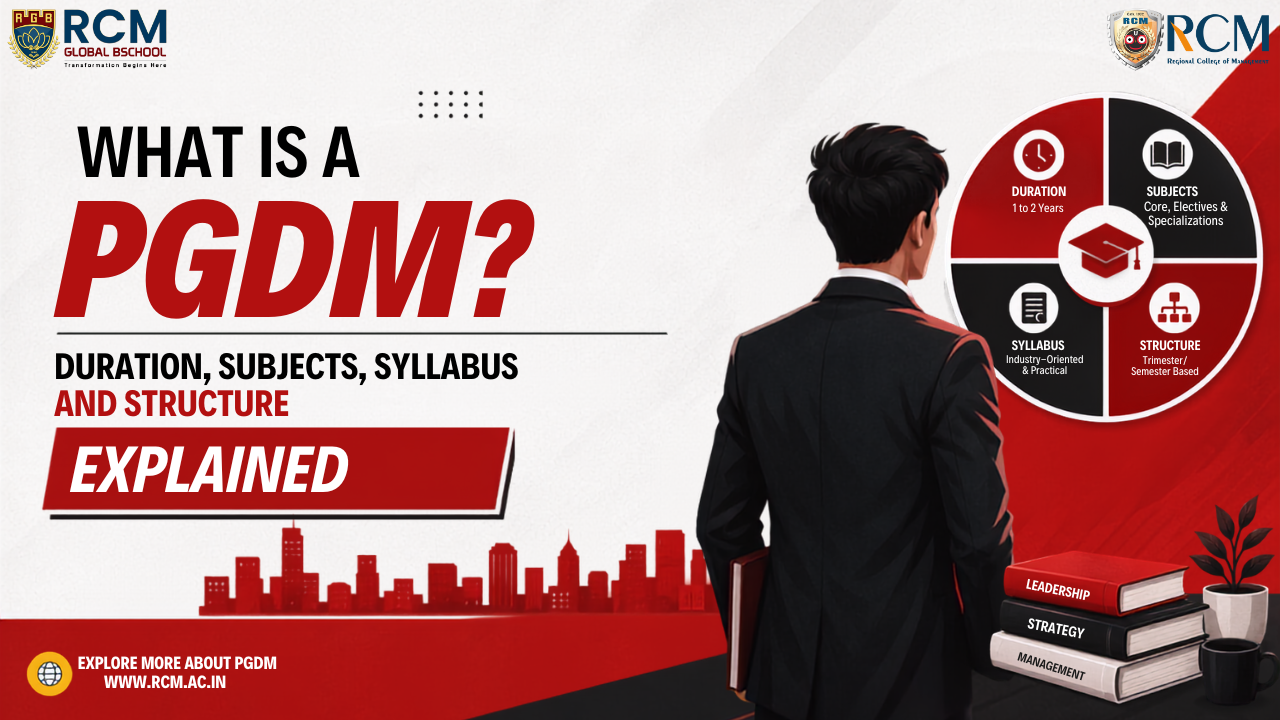
A PGDM (Post Graduate Diploma in Management) is a two-year, full-time postgraduate management programme run by autonomous, AICTE-approved institutes that design their own syllabus. It covers core business subjects in Year 1 and a chosen specialisation in Year 2, and with AIU equivalence it carries the same career value as an MBA.
If you have started looking at management courses after graduation, you have almost certainly run into two sets of letters: MBA and PGDM. They sound like rivals. They are not. A PGDM is a serious, widely respected route into management careers, and at many of India’s best business schools it is the only qualification on offer. This guide explains exactly what a PGDM course is, how long it runs, what you study, and how to tell a strong programme from a weak one before you commit two years and a sizeable fee.
What is a PGDM course, in brief?
PGDM stands for Post Graduate Diploma in Management. It is a postgraduate qualification in business and management, awarded not by a university but by an autonomous institute approved by the All India Council for Technical Education (AICTE). That single difference explains nearly everything that confuses people about PGDM.
An MBA is a degree, and a university degree must follow the syllabus and approval cycles of that university. A PGDM is a diploma, and an autonomous institute is free to design and revise its own curriculum. In practice this means a good PGDM institute can update what it teaches when the market shifts, without waiting for a university committee to sign off. The qualification you walk away with is a diploma in name, but in the job market, for higher studies, and for most government purposes, an AICTE-approved PGDM judged equivalent to an MBA by the Association of Indian Universities (AIU) is treated on par with the degree.
For a deeper comparison, read our companion pieces on what PGDM means and PGDM vs MBA.
PGDM eligibility and admission
The baseline eligibility for a PGDM is straightforward:
- A bachelor’s degree in any discipline from a recognised university, usually with around 50% marks (often relaxed to about 45% for SC/ST candidates). [VERIFY: confirm exact minimum percentage and reserved-category relaxation currently used at RCM Bhubaneswar]
- A valid national entrance exam score, commonly CAT, MAT, XAT, CMAT or ATMA.
- Clearing the institute’s group discussion and personal interview (GD-PI) round.
Final-year graduation students can usually apply, subject to producing their degree before the programme begins. Because exact cut-offs and accepted exams vary by institute and by year, always check the current admission page rather than relying on what was true two intakes ago. You can review the latest RCM PGDM admission criteria before you apply.
Year 1: the core PGDM subjects
The first year is deliberately broad. The idea is to build a common management vocabulary so that, whatever your undergraduate background, everyone can read a balance sheet, frame a marketing problem and understand how an operation runs. Typical Year 1 PGDM subjects include:
If you come from an engineering or science background and the accounting feels heavy, that is normal. If you come from commerce and the statistics feels heavy, that is also normal. The first year is designed to level everyone out, not to play to your strengths.
The summer internship: where theory meets a real desk
Between the two years, you take up a summer internship of roughly six to ten weeks with a company. This is one of the most underrated parts of the PGDM course structure.
A good internship does three things
It lets you apply Year 1 concepts to a live problem.
It gives you something concrete to talk about in final placements.
It occasionally turns into a pre-placement offer.
Treat it as a long interview, because that is often exactly what it is.
Year 2: specialisations, electives and live projects
The second year is where a PGDM stops being generic and starts being yours. You choose a specialisation and stack electives around it, while continuing to work on live projects and, usually, a capstone or dissertation. Common specialisation tracks include marketing, finance, human resources, operations and supply chain, business analytics, and increasingly hybrid areas that blend two of these.
RCM’s PGDM programme provides a range of industry-oriented specialisations to help students build expertise in their chosen domain. Explore the complete list of PGDM specialisations, curriculum, and career pathways before making your choice.
Do not lock your specialisation to whatever sounds glamorous this year. Choose based on the work you actually enjoy, because you will spend two terms deep inside it and then, ideally, a career.
A sample PGDM course structure
Every institute arranges things slightly differently, but a typical full-time, semester-based PGDM looks something like this:
| STAGE | TIMING | FOCUS |
|---|---|---|
| Semester 1 | Year 1, term 1 | Accounting, economics, statistics, organisational behaviour, communication |
| Semester 2 | Year 1, term 2 | Marketing, finance, operations, HR, research methods |
| Summer Internship | Between Year 1 and Year 2 | 6–10 weeks of live industry work, graded |
| Semester 3 | Year 2, term 1 | Specialisation core + electives + live projects |
| Semester 4 | Year 2, term 2 | Advanced electives, capstone/dissertation, placements |
Trimester systems compress the same content into six shorter terms, with more frequent assessment. The substance — core first, specialisation second — stays the same.
Skills you actually build during a PGDM
Subjects are the syllabus. Skills are what you leave with. Over two years, a well-run PGDM should build:
- Structured problem-solving through the case method and live projects.
- Numerical fluency — reading financials, sizing markets, interpreting data.
- Communication under pressure, from GD-PI rounds to client-facing presentations.
- Teamwork with people who disagree with you, which is most of working life.
- Decision-making with incomplete information — the single most management-specific skill there is.
How to choose a good PGDM programme
Because PGDM institutes set their own curriculum, quality varies more than it does between university MBAs. That freedom is a strength in good hands and a warning sign in bad ones. Here is what to actually check:
- Approvals and recognition.Confirm AICTE approval first. Then look for AIU equivalence, which is what gives the diploma its MBA-equivalent standing for jobs, government roles and PhD eligibility.
- Curriculum freshness.Ask when the syllabus was last revised. The whole point of a PGDM is the freedom to update; an institute that has not touched its curriculum in years is wasting that advantage.
- Accreditation.NBA accreditation of the programme and NAAC accreditation of the institute are meaningful quality signals.
- Faculty and industry contact.Live projects, guest practitioners and a real internship pipeline matter more than glossy brochures.
- Track record.An institute with a long history has weathered more market cycles than a new
PGDM at RCM Bhubaneswar
Regional College of Management (RCM), Bhubaneswar, was established in 1982 and is the oldest management institute in Odisha. It offers both MBA and PGDM programmes, is AICTE-approved, and is recognised by the UGC and the Government of Odisha. The institute holds NAAC and NBA accreditation.
RCM’s PGDM programme is designed to equip students with industry-relevant knowledge, leadership skills, and practical business exposure. The programme offers a contemporary curriculum, experienced faculty, corporate engagement, and strong placement support to prepare students for successful management careers. For the latest information on programme specialisations, eligibility criteria, accepted entrance exams, fee structure, and admission guidelines, please visit the official RCM Admissions and PGDM pages or contact an RCM admission counsellor.
Mistakes to avoid when picking a PGDM
- Assuming PGDM is “lesser” than MBA. It is not, provided it carries AICTE approval and AIU equivalence. Some of India’s most selective B-schools award only the PGDM.
- Ignoring approvals to chase a low fee. An unapproved diploma can cost you eligibility for government jobs and higher studies. Verify first, compare fees second.
- Choosing a specialisation for its label. Pick the work, not the buzzword.
- Skating through the internship. It is graded, it is a recruiting funnel, and recruiters ask about it. Take it seriously.
- Never asking when the syllabus was last updated. For a PGDM, curriculum freshness is the headline benefit. Make the institute prove it.
FAQs
A PGDM is a two-year postgraduate management programme offered by an autonomous AICTE-approved institute that designs its own syllabus. It is a diploma rather than a university degree, but with AIU equivalence it is treated on par with an MBA.
A full-time PGDM is two years long, usually split into four semesters or six trimesters, with a summer internship of six to ten weeks between the two years.
Yes, for practical purposes. An AICTE-approved PGDM with AIU equivalence is treated as equivalent to an MBA for employment, government roles and PhD eligibility. The main difference is who awards it: a university awards the MBA degree, while an autonomous institute awards the PGDM diploma.
Year 1 covers core subjects: accounting, economics, marketing, finance, operations, organisational behaviour, HR, business statistics and communication. Year 2 moves into your chosen specialisation plus electives and live projects.
You need a bachelor’s degree in any discipline (typically around 50% marks, with relaxation for SC/ST candidates), a valid entrance exam score such as CAT, MAT, XAT, CMAT or ATMA, and you must clear the institute’s group discussion and personal interview.
The most commonly accepted national exams are CAT, MAT, XAT, CMAT and ATMA. The exact list and cut-offs vary by institute and by year, so confirm with the specific programme you are applying to.
At most institutes, yes. The internship is built into the course structure, runs for roughly six to ten weeks between Year 1 and Year 2, and is usually graded. It often feeds directly into final placements.
Yes, provided your PGDM is AICTE-approved and holds AIU equivalence, which makes it eligible for higher studies including a PhD on the same footing as an MBA.