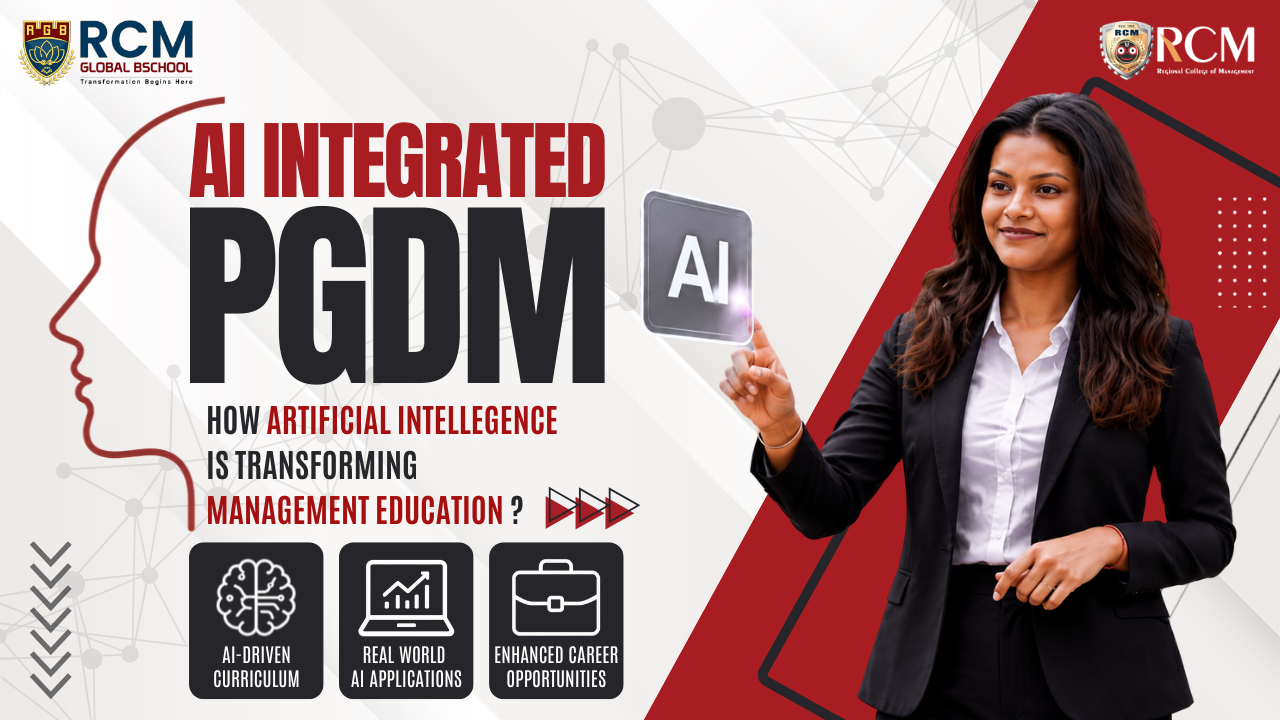
Artificial intelligence is transforming Post Graduate Diploma in Management (PGDM) education by replacing static textbooks with real-time data, embedding core analytics across disciplines, and shifting focus from intuition-based decisions to algorithmic insights. This evolution prepares future business leaders to collaborate directly with intelligent automation. Regional College of Management (RCM), Bhubaneswar — Odisha’s first management institute, established in 1982 — sits at the front of this shift, with AI tools, business analytics, and data-driven decision-making woven directly into its PGDM+ curriculum, producing graduates who are corporate-ready from their first day in any organisation.
Table of contents
- What Is an AI-Integrated PGDM?
- How AI Is Changing Management Education
- RCM PGDM+ Admissions 2026 — Now Open
- Why Every PGDM Student Should Learn Artificial Intelligence
- AI Skills Every Future Manager Needs
- AI Business Analytics and Data-Driven Decision Making
- How AI Is Transforming Different Business Functions
- Management Careers That Require AI Skills
- Why RCM’s PGDM+ Programme Is Future-Ready
- AI-Focused PGDM Specialisations at RCM
- Student Life and Industry Exposure at RCM
- PGDM Fees and Return on Investment
- PGDM+ Admissions 2026 — Regional College of Management
- FAQs
- Conclusion
- Ready to begin?
Something has shifted in the boardrooms of India’s most competitive companies. Decisions that once relied on experience and instinct are now backed by predictive models. Marketing strategies are built on live data, not quarterly reports. Finance teams use machine learning to forecast risk before it appears in the numbers. The manager who cannot read a dashboard, interpret an AI output, or supervise an automated workflow is already operating at a disadvantage.
This is not a distant future scenario. It is the everyday reality of management in 2026 — and it is precisely why AI in PGDM has moved from an interesting addition to an essential foundation. The students entering management education today will spend most of their careers working alongside AI systems. The question is whether their training prepares them to lead those systems, or simply react to them.
Regional College of Management (RCM), Bhubaneswar made this shift deliberately. Rather than treating AI as an elective or a workshop, RCM has built it into the fabric of its PGDM+ programme — across specialisations, live projects, and industry partnerships — so that graduates emerge fluent in both management fundamentals and the AI-powered tools that define the modern workplace.
What Is an AI-Integrated PGDM?
An AI-integrated PGDM is a two-year Post Graduate Diploma in Management programme in which artificial intelligence, data analytics, and digital tools are embedded throughout the curriculum — not treated as optional add-ons but built into core subjects, live projects, and specialisation tracks.
The difference from a traditional PGDM is meaningful. A conventional programme may include a single elective on data analytics or digital marketing. An AI-integrated programme — like RCM’s PGDM+ — builds these capabilities into every discipline. A Finance student learns AI-assisted forecasting alongside financial modelling. A Marketing student runs live campaigns through AI-powered platforms. An HR student uses people analytics rather than intuition alone to study workforce behaviour.
Industry demand is driving this shift directly. The World Economic Forum’s Future of Jobs Report 2025 found that AI and big data skills are expected to grow in use across more than 90% of industries, and that 39% of core job skills will change by 2030. The employers surveying for those roles are already hiring graduates with these capabilities — and passing over those without them.
An AI-integrated PGDM answers that demand by producing graduates who can think analytically, deploy digital tools confidently, and make data-informed decisions from their first week on the job.
How AI Is Changing Management Education
The changes AI is bringing to management education are not cosmetic. They are structural — affecting what is taught, how it is taught, and what graduates are expected to be able to do when they leave.
- Personalised learning paths. AI-powered learning platforms adapt course material to each student’s pace, strengths, and gaps — giving management students a more targeted development experience than a single fixed curriculum can offer.
- Business simulations with real data. Instead of theoretical case studies, students work through AI-powered simulations using live market data, allowing them to practise decision-making under realistic conditions before entering the workplace.
- Predictive analytics in the classroom. Students learn to use predictive models for sales forecasting, risk assessment, consumer behaviour analysis, and financial planning — the same tools their future employers use daily.
- AI-assisted decision-making frameworks. Rather than teaching intuition alone, modern AI management courses teach students how to structure a decision using both human judgement and algorithmic support — knowing when to trust the model and when to override it.
- Automation and workflow intelligence. Students learn how business processes are automated through AI agents, robotic process automation, and intelligent workflow tools, and how managers supervise these systems effectively.
- Business intelligence dashboards. Data visualisation tools like Power BI and Tableau are now standard in well-run AI management programmes, giving students the ability to build and read dashboards that communicate complex information clearly.
- Data-driven management thinking. The broader shift is a cultural one — from managers who ask “what does my experience tell me?” to managers who ask “what does the data tell me, and how do I interpret it responsibly?”
According to the Microsoft Work Trend Index, 66% of leaders say they would not hire a candidate without AI skills, and 71% say they prefer a less experienced candidate with demonstrated AI ability over a more experienced one without it.
RCM PGDM+ Admissions 2026 — Now Open
Learn AI-Integrated Management at India’s First PGDM Institute in Odisha
AICTE-approved, industry-integrated PGDM+ at RCM Bhubaneswar — with AI tools, live analytics projects, dual specialisations, and a 830+ recruiter network. 98.7% placement rate.
Why Every PGDM Student Should Learn Artificial Intelligence
The question used to be whether management students should learn AI. That debate is largely settled. The question now is how deeply, and through which pathways.
The employability argument is the most immediate. The NASSCOM AI and Digital Transformation Insights estimate that AI-related job demand in India will cross one million roles by 2026 — yet only around 16% of India’s IT professionals are currently AI-skilled. The gap between what companies need and what the talent market can supply is one of the clearest career opportunities for any graduate who builds these skills now.
Beyond employability, there is the competitive advantage argument. When two candidates with similar academic backgrounds compete for the same role, the one with demonstrated experience in AI tools, business analytics, and data-driven decision-making wins. Recruiters at companies like Deloitte, ICICI Securities, and Amazon — all active at RCM’s placement drives — are evaluating these capabilities explicitly, not just as nice-to-haves.
There is also the leadership argument. Tomorrow’s senior managers will be making decisions about AI adoption, vendor selection, automation strategy, and ethical AI governance. You cannot lead something you do not understand. A PGDM student who learns AI during their programme is building the literacy to make those decisions confidently, not inherit them blindly.
At RCM, this belief has shaped the PGDM+ design from the ground up. Artificial Intelligence literacy is treated not as a separate module but as a lens applied across specialisations — so a Finance student, a Marketing student, and an HR student all graduate with AI fluency relevant to their chosen field.
AI Skills Every Future Manager Needs
AI literacy for managers is not about writing code. It is about developing the ability to use, supervise, interpret, and evaluate AI-powered tools within real business contexts. These are the eight capabilities that employers are actively looking for in 2026.
- Prompt Engineering
Framing effective queries for AI tools to produce accurate, actionable business outputs. - Business Analytics
Reading, interpreting, and acting on data to drive strategy and operations. - AI Tool Fluency
Proficiency with AI platforms used in marketing, finance, HR, and operations. - Data Interpretation
Translating complex datasets into clear management decisions and stakeholder narratives. - Workflow Automation
Designing and managing automated business processes using AI agents and RPA tools. - AI Ethics
Understanding bias, accountability, and governance frameworks for responsible AI deployment. - Decision Intelligence
Combining human judgement with algorithmic models to make high-quality business decisions. - Digital Leadership
Leading teams and organisations through digital transformation with confidence and clarity.
These are not theoretical competencies. Each one corresponds to a real task that management professionals perform in sectors ranging from banking and consulting to e-commerce and healthcare. Building them during a PGDM programme, through live projects and AI-integrated coursework, is what separates graduates who describe themselves as tech-aware from those who can demonstrate it.
AI Business Analytics and Data-Driven Decision Making
Business analytics is arguably the most direct expression of AI in everyday management. Every marketing budget, every hiring decision, every pricing strategy, and every supply chain adjustment is now accompanied by a data layer that a skilled manager is expected to understand and use.
AI business analytics goes beyond spreadsheets. It includes predictive analytics — using historical data to forecast future demand, revenue, or risk — as well as prescriptive analytics, which recommends specific actions based on those forecasts. It includes real-time dashboards that consolidate data from multiple systems into a single view, and customer insight tools that segment audiences and personalise experiences at scale.
In finance, AI analytics powers fraud detection, credit risk modelling, and portfolio optimisation. In marketing, it drives campaign attribution, customer lifetime value modelling, and conversion rate optimisation. So In HR, it underpins workforce planning, attrition prediction, and hiring funnel analysis. In operations, it enables predictive maintenance, inventory forecasting, and logistics optimisation.
The Data Science and Business Intelligence specialisation at RCM is built around these applications. Students learn to use tools like Power BI and Python-based analytics frameworks in the context of real business problems — producing graduates who can build a dashboard, interpret a predictive model, and present findings to a leadership team with equal confidence.
Interested in RCM’s Data Science & BI specialisation? See the full PGDM+ curriculum and apply for the 2026 intake.
Explore Data Science & BI →
How AI Is Transforming Different Business Functions
AI is not a single department’s concern. It is reshaping how every business function operates — which means every management graduate, regardless of specialisation, needs to understand its impact on their chosen domain.
| Business Function | How AI Is Applied | Emerging Skill |
|---|---|---|
| Marketing | Personalised content, predictive campaign targeting, AI-generated creative, attribution modelling, customer segmentation at scale | AI-driven campaigns |
| Human Resources | Automated resume screening, sentiment analysis for employee engagement, attrition forecasting, AI-assisted onboarding | People analytics |
| Finance | Real-time fraud detection, AI-powered financial modelling, automated reporting, investment risk scoring, regulatory compliance automation | Algo-assisted decisions |
| Operations | Predictive maintenance, AI-optimised production scheduling, intelligent quality control, energy efficiency management | Process intelligence |
| Sales | Lead scoring, AI-driven pricing recommendations, sales pipeline forecasting, conversational AI for customer engagement | Predictive sales |
| Supply Chain | Demand forecasting, inventory optimisation, route planning automation, supplier risk assessment using AI models | Supply intelligence |
| Customer Experience | AI chatbots, sentiment analysis from feedback, personalised service recommendations, real-time issue resolution at scale | AI-first CX |
For a PGDM student, this table is not an academic exercise. It is a map of the specific tools and capabilities that employers will expect you to bring to each of these roles when you join. The more your PGDM programme has exposed you to these applications in real business contexts, the more prepared you will be to contribute immediately.
Management Careers That Require AI Skills
The roles available to PGDM graduates in 2026 increasingly require at least baseline AI literacy, and in many cases, deep proficiency. Here are the management careers where AI skills are not optional:
- Business Analyst. Translating data insights into strategic recommendations. AI tools for data querying, visualisation, and predictive modelling are central to this role at companies across every sector.
- Marketing Analyst. Building and managing AI-driven campaigns, analysing customer data pipelines, and optimising spend across digital channels using attribution models and real-time reporting.
- AI Strategy Consultant. Helping organisations identify where and how to deploy AI to achieve specific business outcomes. One of the fastest-growing and highest-compensated roles in consulting.
- Product Manager. Overseeing the development of AI-powered products or features. Requires the ability to translate user needs into algorithmic specifications and evaluate AI outputs for quality and safety.
- Financial Analyst. Using AI-assisted modelling tools for forecasting, risk assessment, and investment analysis. Increasingly, financial firms expect analysts to understand the models generating their outputs, not just read the results.
- HR Analytics Manager. Using AI-driven people analytics platforms to support hiring, engagement, retention, and workforce planning decisions at a data-led organisation.
- Operations Manager. Supervising AI-automated workflows, managing intelligent supply chain systems, and making data-informed decisions about process efficiency and resource allocation.
- Digital Transformation Consultant. Guiding businesses through the adoption of AI tools, automation platforms, and digital operating models — requiring both management expertise and deep AI literacy.
What unites these roles is that none of them can be performed well by someone who treats AI as a black box. The managers who will thrive are those who understand what these tools can and cannot do — and who have practised using them in realistic settings during their management education.
Why RCM’s PGDM+ Programme Is Future-Ready
Regional College of Management, Bhubaneswar, has been shaping management professionals since 1982 — longer than most of its students have been alive. What it has built over four decades is not just a curriculum. It is an ecosystem: faculty, industry partnerships, alumni, recruiters, and a placement machinery that consistently converts preparation into careers.
| 98.7% Placement Rate | 830+ Active Recruiters | ₹22.4L Highest Package | ₹8.6L Average Package |
The PGDM+ programme is the expression of how RCM has evolved that ecosystem for the AI era. Its distinguishing features are worth understanding in detail:
- AI-integrated curriculum. Artificial intelligence tools, analytics platforms, and data-driven frameworks are embedded within core management subjects — not offered as isolated electives. A Marketing student encounters AI tools while studying consumer behaviour. A Finance student uses machine learning concepts while studying financial modelling.
- Live consulting projects. Students work on real company briefs from Semester 3, generating actual business outputs for industry partners. These projects provide verified experience that makes a meaningful difference in placement interviews.
- Dual specialisations. The PGDM+ model allows students to pursue two specialisation tracks, enabling career positioning across adjacent fields — for example, Finance combined with FinTech, or Marketing combined with Data Science & BI.
- Industry certifications. Students graduate with recognised third-party certifications alongside their PGDM+ diploma, giving their profile the verification that recruiters look for beyond academic grades.
- Corporate mentoring. Professionals from partner companies provide ongoing mentoring, guest sessions, and feedback on live project work throughout both years — building a professional network before graduation.
- Over 17,000 alumni. Across BFSI, consulting, e-commerce, and manufacturing sectors, RCM’s alumni community creates a referral pipeline and inside-knowledge resource for each incoming batch.
Want to compare RCM’s full PGDM+ curriculum and fees? Our admissions team will walk you through everything — no obligation.
View PGDM+ Programme →
AI-Focused PGDM Specialisations at RCM
The choice of specialisation is one of the most consequential decisions a PGDM student makes. At RCM, four PGDM+ specialisation tracks are designed with AI integration at their core, each preparing students for high-demand careers in sectors where AI is already a standard operating requirement.
Data Science & Business Intelligence
Students learn to build analytics pipelines, interpret machine learning outputs, and create BI dashboards that drive business decisions. The curriculum covers Power BI, Python fundamentals for analytics, and real data projects with industry partners.Explore specialisation →
FinTech
Combining financial management with technology strategy, this track covers AI in financial services, digital payments, blockchain applications in trade finance, and algorithmic risk management — aligned with the highest-paying roles in India’s booming FinTech sector.Explore specialisation →
Digital Marketing
RCM’s Full Stack Digital Marketing track trains students to build and run live Google Ads campaigns, deploy AI content automation workflows, create GA4 analytics dashboards, and optimise performance through A/B testing and attribution modelling — building a real portfolio, not just a certificate.Explore specialisation →
International Business
Prepares students for global management roles with modules on AI-powered trade analytics, cross-border supply chain intelligence, and digital strategies for international market entry — paired with cross-cultural management and global business communication skills.Explore specialisation →
Each of these tracks includes live projects with real companies, third-party certifications, and industry mentoring in the relevant domain. The dual-specialisation model within PGDM+ means students can combine, for example, FinTech with Data Science and BI, or Digital Marketing with International Business — giving their career positioning a sharper, more differentiated edge.
Student Life and Industry Exposure at RCM
Management education that only exists in the classroom is only half an education. At RCM, the environment beyond the lecture hall is designed to extend and consolidate what students are learning in the programme itself. Life at RCM reflects a belief that professional character, communication confidence, and the ability to perform under pressure cannot be taught through textbooks alone.
- Industry workshops and hackathons. Regular workshops run by professionals from partner companies expose students to real-world problem-solving, AI tool demonstrations, and sector-specific case challenges before they enter the job market.
- Business competitions. Participation in national and inter-institute management competitions builds the ability to work under pressure, present ideas clearly, and defend recommendations against expert panels.
- Student clubs. Domain-specific clubs in Finance, Marketing, Analytics, HR, and Entrepreneurship give students structured practice in their chosen specialisation throughout both years.
- Guest lectures and industry interaction. Senior professionals from RCM’s recruiter network visit regularly for guest sessions, panel discussions, and informal mentoring — creating direct connections between students and future employers.
- Leadership development activities. From team projects to student council roles to external competitions, RCM builds the leadership experience that management employers look for alongside academic credentials.
The combined effect is a two-year environment that develops well-rounded professionals — technically capable, analytically confident, and professionally polished — rather than simply well-trained exam candidates.
PGDM Fees and Return on Investment
The return on investment from a management education programme is not determined by the fees alone. It is determined by the ratio between what you invest and what your career generates over the years that follow. A programme that builds AI skills, data literacy, and industry connections consistently delivers stronger ROI than one that charges similar fees but offers generic content and limited placement support.
The logic is straightforward. A graduate with AI management skills and verified analytics experience enters the job market at a stronger starting point — with a higher likelihood of receiving competitive offers, converting internships into roles, and advancing faster in the early years of their career. The same graduates who might otherwise compete on the same terms as thousands of others are differentiated from day one.
For RCM’s PGDM+, the investment case is supported by the placement outcomes: an average package of ₹8.6 LPA, a highest package of ₹22.4 LPA, and a 98.7% placement rate across 830+ active recruiters. Current fees, scholarship availability, and fee structure details are available on the PGDM fee structure page — confirm with the admissions team for the current academic cycle.
PGDM+ Admissions 2026 — Regional College of Management
Apply for an AI-Integrated PGDM+ at RCM Bhubaneswar
AICTE-approved • NAAC & NBA accredited • UGC recognised • ISO certified • Dual specialisations • AI-integrated curriculum • 830+ recruiters • Est. 1982, Odisha’s first management institute
FAQs
AI is transforming management education through real-world analytics, automation, and data-driven learning, with institutes like RCM integrating AI into industry-focused PGDM curricula.
Yes, AI skills are becoming essential for modern management careers, and RCM’s PGDM+ prepares students with practical AI and business analytics expertise.
An AI-integrated PGDM combines core management education with AI, analytics, and digital business skills, as offered through RCM’s PGDM+ programme.
Roles such as Business Analyst, Marketing Manager, Product Manager, Financial Analyst, and HR Analytics Manager increasingly value AI skills developed through programmes like RCM PGDM+.
Yes, AI-enabled management careers offer strong growth, higher earning potential, and future-ready opportunities, making RCM’s AI-integrated PGDM a valuable career choice.
AI helps future managers make smarter, data-driven decisions, and RCM equips students with the AI capabilities needed to lead in today’s digital business environment.
Conclusion
The transformation of management education by artificial intelligence is not a trend to watch. It is already underway — in the tools companies use, the skills they hire for, and the decisions they expect their managers to make every day. PGDM students who are trained within AI-integrated programmes are entering this landscape prepared. Those who are not will spend their early careers catching up.
The good news is that the right programme, from the right institute, closes that gap before graduation. Regional College of Management (RCM), Bhubaneswar, has built its PGDM+ curriculum specifically to meet this moment — with AI tools woven through every specialisation, live analytics projects grounded in real business problems, and a 830+ recruiter network actively looking for the graduates this environment produces.
If you are planning a management career and want to build it on the skills that matter most in 2026 and beyond, RCM is a strong place to start. Speak with the admissions team, explore the specialisations, and make your decision with full information.
Ready to begin?
Explore AI-Integrated PGDM+ at RCM and Apply for 2026
Free counselling available. Speak with RCM’s admissions team about specialisations, eligibility, and the AI-integrated PGDM+ programme — with no pressure to commit before you are ready.