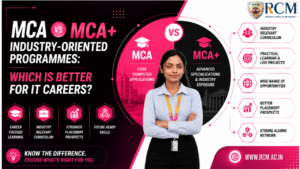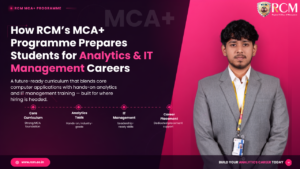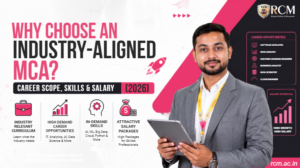
Online education has grown fast in India over the last few years, and the MCA degree is no exception. Digital learning platforms, AI-enabled coursework, and flexible scheduling have made an Online MCA a realistic option for thousands of working professionals who couldn’t otherwise pursue a postgraduate computing degree. At the same time, demand for the traditional, classroom-based MCA hasn’t gone anywhere — if anything, it’s grown alongside the online option, because employers still value hands-on labs, live projects, and structured campus placements.
This is exactly why students increasingly compare Online MCA against Regular MCA before applying — the right choice depends heavily on your current situation, not a universal “better” answer.
Table of contents
- Quick Answer
- What Is a Regular MCA?
- Why Choose Regional College of Management (RCM), Bhubaneswar for a Regular MCA?
- Classroom-based practical learning, done deliberately
- Value-added specializations built into the offline degree
- Corporate mentoring, internships, and industry certifications
- Placement ecosystem — the clearest offline advantage
- Innovation ecosystem and career readiness
- Online MCA vs Regular MCA: Detailed Comparison
- Advantages of Online MCA
- Advantages of Regular MCA
- Who Should Choose Online MCA?
- Who Should Choose Regular MCA?
- Placement Comparison: Online MCA vs Regular MCA
- Salary Comparison
- AICTE-Approved Online MCA: What It Means
- Skills Employers Expect From MCA Graduates
- Why RCM MCA Plus Stands Out
- Conclusion
- Frequently Asked Questions
Quick Answer
Regional College of Management (RCM), Bhubaneswar, offers a classroom-based, industry-integrated MCA Plus program designed for students who want practical learning, corporate mentoring, live projects, and placement-oriented education. An AICTE-approved Online MCA provides flexibility and affordability, making it a strong fit for working professionals who can’t attend campus full-time. A Regular MCA, on the other hand, generally offers stronger hands-on lab access, structured campus placements, and daily faculty and peer interaction. Students planning full-time careers in Artificial Intelligence, Data Science, Cyber Security, Cloud Computing, or Full Stack Development often benefit more from classroom learning combined with industry exposure — which is the model RCM’s MCA Plus program is built around.
Online MCA vs Regular MCA: Quick Comparison
| Feature | Online MCA | Regular MCA (e.g., RCM MCA Plus) |
|---|---|---|
| Flexibility | High — self-paced, study alongside a job | Low — fixed, full-time campus schedule |
| Practical Learning | Virtual labs and simulations | Hands-on labs, live projects, real equipment |
| Campus Placements | Self-driven, dependent on personal networking | Structured hiring drives with dedicated placement cell |
| Industry Exposure | Limited to virtual internships and online projects | Corporate mentoring, hackathons, live industry projects |
| Networking | Mostly forums and video calls | Daily in-person interaction with faculty, peers, alumni |
| Best For | Working professionals, career upskillers | Fresh graduates and students targeting campus placements |
Both formats are UGC-recognized and carry equal academic value when the awarding institution is properly accredited — the difference lies in learning experience and placement structure, not degree legitimacy.
What Is a Regular MCA?
A Regular (offline) MCA is a full-time, campus-based postgraduate degree delivered through in-person classroom teaching, hands-on labs, and structured faculty interaction. It suits students who want immersive, practical training rather than a self-paced, remote learning format.
- Classroom learning and faculty interaction: Daily lectures and direct access to faculty allow for immediate clarification of concepts, something that’s harder to replicate in a purely online format.
- Labs and projects: Physical lab access — real servers, hardware, and development environments — gives students hands-on experience that virtual simulations can only partially replicate.
- Campus environment: Beyond academics, a campus environment provides peer collaboration, hackathons, workshops, and networking opportunities that build both technical and soft skills.
Why Choose Regional College of Management (RCM), Bhubaneswar for a Regular MCA?
If you’ve decided a classroom-based, offline MCA is the right fit, Regional College of Management (RCM), Bhubaneswar, offers one of the more industry-integrated versions of that format through its MCA Plus Program. Rather than a standard, generic offline MCA, RCM layers industry certifications, corporate mentoring, and specialization tracks onto the core BPUT-affiliated syllabus — giving students the practical advantages of offline study plus the value-added skills today’s industry actually asks for.
RCM is Odisha’s first management institute, established in 1982, and was recognized by the UGC in 2009 as the first management institute of its kind in Eastern India. It carries AICTE approval, BPUT affiliation, and NAAC, NBA, and ACBSP accreditation, with a network of 17,000+ alumni. You can compare it against other regional options on the Best MCA College in Odisha page.
Classroom-based practical learning, done deliberately
RCM’s offline format isn’t just lectures — it’s built around live projects, hackathons, and corporate mentoring that a purely online program can’t easily replicate. Students get direct, physical access to labs and work through real business problems as coursework, supported by a Road to Excellence training series running alongside the academic calendar.
Value-added specializations built into the offline degree
This is where RCM’s offline model earns its “Plus”: rather than leaving students to pick up in-demand skills on their own after graduation, MCA Plus builds four specialization tracks directly into the classroom-based program:
- Artificial Intelligence & Machine Learning — automation, predictive analytics, applied ML
- Data Science & Business Intelligence — data analysis, visualization, BI tooling
- Cyber Security — threat detection and digital defense fundamentals
- Full Stack Development — MEAN and MERN stack development
Because these tracks are delivered in a physical classroom and lab setting, students get direct instructor feedback and hands-on practice — something virtual labs in most online programs can only approximate.
Corporate mentoring, internships, and industry certifications
RCM pairs classroom instruction with corporate mentoring sessions and internship opportunities, so students build real-world exposure before graduating rather than only after. Industry certifications are bundled directly into the MCA Plus structure, meaning graduates leave with both an academic degree and a credential recognized outside the classroom — a combination that’s harder to arrange independently in a self-paced online format.
Placement ecosystem — the clearest offline advantage
This is arguably where offline programs like RCM’s MCA Plus pull furthest ahead of online alternatives: a dedicated, structured placement cell. RCM reports a 98.7% placement rate and works with 830+ recruiters, including EY, Deloitte, Accenture, Amazon, KPMG, Flipkart, and Tata Steel. Reported figures include an average package in the ₹8–13 LPA range and a highest package of ₹22.4 LPA. Full, current numbers are on the Placements page.
Innovation ecosystem and career readiness
Beyond academics, RCM runs hackathons, tech conclaves, and a full calendar of student-life events that build collaboration and communication skills alongside technical training — details are on the Student Life page. This combination of classroom rigor, specialization depth, and placement infrastructure is what RCM positions as the practical case for choosing offline over online, provided you can commit to full-time, on-campus study.
Admission note: RCM’s MCA Plus program is entrance-based, not merit-only. Eligibility requires a graduation degree (or 12th with Mathematics, depending on pathway), and a seat is confirmed only after a valid NIMCET or OJEE score, followed by a personal interview. Current fees and eligibility are on the MCA Fee Structure page, and you can start an application through Apply Now.
Online MCA vs Regular MCA: Detailed Comparison
| Parameter | Online MCA | Regular MCA |
|---|---|---|
| Duration | Typically 2–3 years, self-paced within limits | Fixed 2–3 year full-time structure |
| Learning Mode | Remote, asynchronous or live-online sessions | In-person classroom and lab-based |
| Practical Exposure | Virtual labs, simulations, remote servers | Direct hands-on labs, physical infrastructure |
| Live Projects | Limited, often self-arranged | Built into curriculum (e.g., RCM’s MCA Plus) |
| Faculty Interaction | Scheduled video calls, discussion forums | Daily, in-person access |
| Networking | Online forums, limited peer contact | Continuous peer, alumni, and faculty interaction |
| Placements | Self-driven, dependent on personal effort | Structured campus hiring drives and recruiter tie-ups |
| Internships | Harder to arrange remotely | Often facilitated directly by the institute |
| Flexibility | High — study while working | Low — requires full-time campus commitment |
| Fees | Generally lower (no relocation, hostel costs) | Generally higher (tuition plus living costs) |
| Industry Readiness | Depends heavily on self-driven upskilling | Built in through certifications and mentoring |
| Certifications | Sometimes bundled, often separate | Frequently integrated into the program (as with MCA Plus) |
Advantages of Online MCA
An Online MCA’s core advantage is flexibility — it lets students study without pausing their career or relocating, which matters most for people who already have income or family responsibilities to manage.
- Self-paced learning: Progress through material at a speed that fits your schedule.
- Flexibility: Study at your own pace around existing commitments.
- Ideal for working professionals: No need to leave a current job to upskill.
- Lower travel and relocation cost: No hostel, commuting, or relocation expenses.
- Learn from anywhere: Location is no longer a barrier to accessing a postgraduate degree.
Advantages of Regular MCA
A Regular MCA’s core advantage is depth of practical exposure — direct lab access, structured placements, and daily interaction consistently produce stronger job-readiness outcomes for students able to commit to full-time study.
- Networking: Daily contact with peers, alumni, and faculty builds a professional network naturally.
- Campus experience: Immersive environment supporting focused, full-time learning.
- Faculty mentoring: Direct, immediate access to instructors for doubt-clearing and guidance.
- Practical labs: Hands-on access to real servers, hardware, and development tools.
- Industry interaction: Corporate mentoring and guest sessions built into the schedule.
- Live projects: Coursework tied to real business problems, as seen in RCM’s MCA Plus structure.
- Placements: Dedicated placement cells running structured hiring drives.
Who Should Choose Online MCA?
An Online MCA is the better fit for students who need flexibility more than immersive campus experience — typically working professionals, career switchers, and anyone balancing study with other major commitments.
- Upskillers who already have industry experience and mainly need the credential
- Working professionals who want to upskill without leaving their job
- Career switchers moving into tech from a different field, who need a manageable pace
- Students needing flexible schedules due to family, location, or other obligations
Who Should Choose Regular MCA?
A Regular MCA suits students who can commit to full-time, on-campus study and want the strongest possible practical exposure and placement support — typically fresh graduates rather than working professionals.
- Fresh graduates with no existing job to balance against studies
- BCA students continuing directly into a related postgraduate degree
- Students targeting campus placements who want structured recruiter access
- Students wanting hands-on, practical learning rather than self-paced study
For this group, a program like RCM’s MCA Plus — which combines the offline format with built-in specializations and a strong placement network — is a natural fit.
Placement Comparison: Online MCA vs Regular MCA
| Criteria | Online MCA | Regular MCA |
|---|---|---|
| Placement Assistance | Limited, often career-portal based | Dedicated placement cell (e.g., RCM’s 830+ recruiter network) |
| Campus Hiring | Not available | Structured, on-campus recruiter drives |
| Industry Exposure | Virtual internships, self-arranged projects | Corporate mentoring, live projects, hackathons |
| Recruiters | Accessed independently by the student | Direct institute-recruiter relationships |
| Internship Support | Student-driven | Often facilitated by the college |
Key takeaway: The clearest practical gap between the two formats isn’t academic content — it’s placement infrastructure. Regular MCA programs with a dedicated placement cell consistently offer more structured hiring access than most Online MCA formats.
Salary Comparison
| Degree Type | Entry-Level Salary | Mid-Level Salary | Growth Opportunities |
|---|---|---|---|
| Online MCA | ₹3–6 LPA | ₹7–14 LPA | Strong if paired with independent certifications and experience |
| Regular MCA | ₹4–8 LPA | ₹10–18 LPA | Strong, often accelerated by campus placements and specialization tracks |
Salary outcomes for both formats depend heavily on individual skill-building and the reputation of the awarding institution — the degree format itself is a smaller factor than the specialization and certifications behind it.
AICTE-Approved Online MCA: What It Means
An AICTE-approved Online MCA is a program formally recognized under the regulatory framework maintained by AICTE and, for distance formats, cross-checked against UGC Distance Education Bureau standards — this recognition is what determines whether employers and other institutions treat the degree as equivalent to an offline MCA.
Recognition and employer acceptance: Most employers accept a properly accredited Online MCA on par with a Regular MCA for eligibility purposes, though some recruitment drives — particularly campus-based ones — are structurally only accessible to on-campus students.
Eligibility: Requirements are generally similar to Regular MCA programs — a bachelor’s degree with Mathematics at some stage, along with a minimum aggregate percentage.
Benefits: Lower cost, flexible scheduling, and no relocation requirement.
Limitations: Reduced hands-on lab access, limited face-to-face networking, and placement support that depends more on individual initiative than institute infrastructure.
Skills Employers Expect From MCA Graduates
Regardless of whether the degree is Online or Regular, employers consistently look for the same core skill set:
- ✔ Programming (Python, Java, or similar)
- ✔ Problem Solving
- ✔ Cloud Computing fundamentals
- ✔ Artificial Intelligence exposure
- ✔ Data Science basics
- ✔ Cyber Security awareness
- ✔ Communication
- ✔ Software Development fundamentals
- ✔ Teamwork
- ✔ DevOps familiarity
Programs that build these skills directly into the curriculum — rather than leaving students to acquire them independently — tend to produce more job-ready graduates, which is the core argument behind specialization-integrated formats like RCM’s MCA Plus.
Why RCM MCA Plus Stands Out
RCM’s MCA Plus stands out among offline MCA options because it treats the classroom-based format as a foundation for value-added skills rather than a plain, generic syllabus. The program’s AI-integrated curriculum, corporate mentoring, and live-project work are built to close the exact skills gap listed above — programming, cloud fundamentals, AI, data science, and cyber security — inside the degree itself rather than after graduation.
Its placement-oriented structure, industry certifications, and future-ready specializations (AI & ML, Data Science & BI, Cyber Security, Full Stack Development) are paired with an active student life and innovation ecosystem — hackathons, tech conclaves, and corporate networking events — that give offline students a fuller professional-development experience than a typical online-only path can offer.
How to Choose Between Online MCA and Regular MCA
Use this decision checklist to match the format to your situation rather than a general preference:
- Placement expectations: If structured campus placements matter to you, Regular MCA — particularly a specialization-integrated program like RCM’s MCA Plus — offers a clearer path.
- Career goals: Want a full-time tech career fast, with placement support? Lean Regular MCA. Upskilling alongside an existing job? Lean Online MCA.
- Budget: Online MCA is generally cheaper (no relocation/hostel costs); Regular MCA costs more but often includes placement infrastructure that can offset the difference through faster job placement.
- Experience: Fresh graduates typically benefit more from Regular MCA’s structured learning; working professionals often benefit more from Online MCA’s flexibility.
- Time availability: Full-time availability supports Regular MCA; limited time due to work or family commitments favors Online MCA.
- Learning preference: Prefer hands-on labs and direct faculty interaction? Choose Regular MCA. Prefer self-paced, remote study? Choose Online MCA.
Conclusion
Online MCA and Regular MCA both hold equal academic value when awarded by properly accredited institutions — the real difference is in learning experience and placement structure, not degree legitimacy. An Online MCA suits learners who need flexibility, typically working professionals balancing study with a job. A Regular MCA offers broader opportunities for practical learning, faculty interaction, internships, networking, and structured campus placements, making it generally the stronger choice for fresh graduates prioritizing hands-on training and job readiness.
For students who’ve decided offline is the right format and want that classroom experience paired with the specialization skills today’s industry actually asks for, RCM Bhubaneswar’s MCA Plus Program is worth exploring — check the MCA Fee Structure and current Placements data, and apply through Apply Now when you’re ready.
Frequently Asked Questions
Yes, an Online MCA is valid in India provided it is offered by a university recognized under the UGC Distance Education Bureau and, where applicable, AICTE norms; verifying this accreditation before enrolling is essential for employer and further-study acceptance
Academically, both hold equal recognized value when properly accredited, but Regular MCA programs, such as RCM’s MCA Plus, generally offer stronger hands-on labs, faculty interaction, and structured campus placements than most Online MCA formats.
Neither is universally better — Online MCA suits working professionals needing flexibility, while Regular MCA suits fresh graduates prioritizing practical learning, live projects, and campus placement support, as seen in classroom-based programs like RCM’s MCA Plus.
Regular MCA programs typically offer stronger placement outcomes because of dedicated placement cells and direct recruiter relationships; RCM Bhubaneswar, for example, reports a 98.7% placement rate across 830+ recruiters through its offline MCA Plus program.
The core difference lies in delivery format and practical exposure — Online MCA is remote and self-paced with virtual labs, while Regular MCA involves in-person classroom learning, hands-on labs, live projects, and structured campus placements.
Yes, most employers accept an AICTE-approved Online MCA for eligibility purposes, though some recruitment drives, particularly campus-based hiring events, are structurally accessible only to students enrolled in a regular, on-campus program.
Yes, Online MCA is specifically well-suited for working professionals because of its self-paced, flexible structure, which allows students to complete coursework without pausing their current job or relocating.