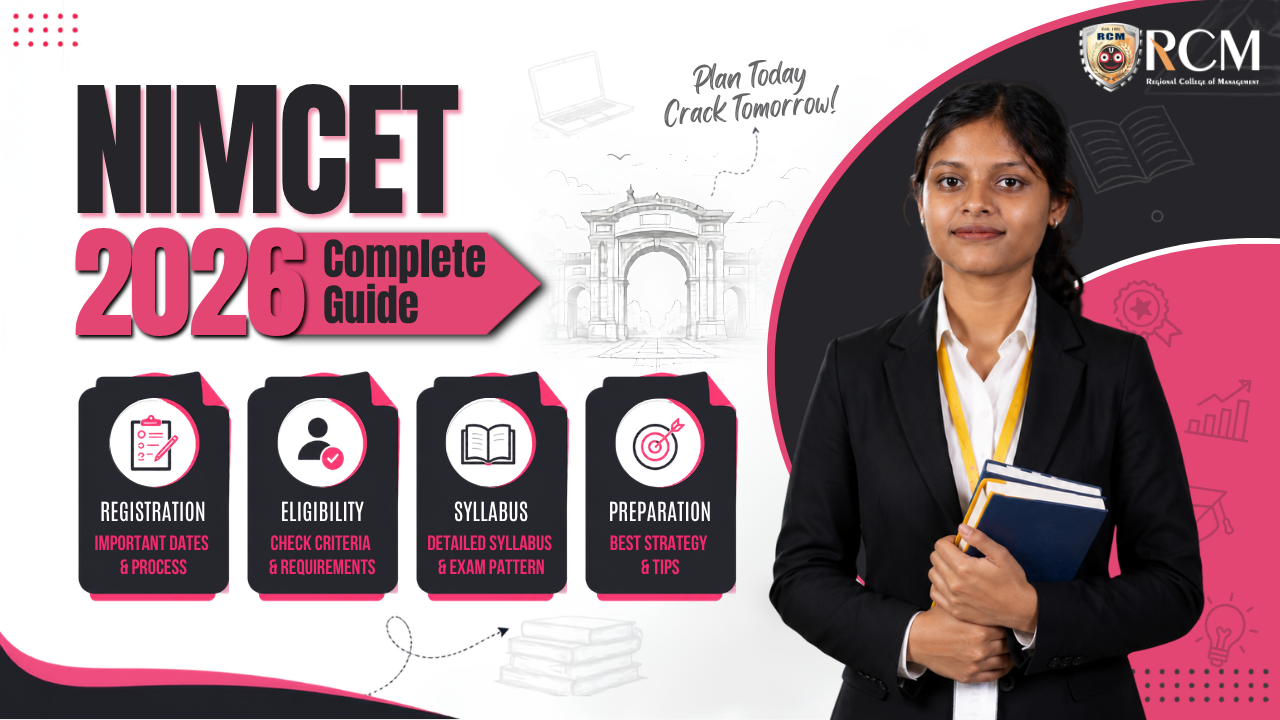
MCA entrance exams decide far more than a college name on your degree — they shape which specialisations you can access, how strong your placement support will be, and how quickly you start earning after graduation. NIMCET (NIT MCA Common Entrance Test) is the toughest of these routes, and for the 2026 cycle, the exam is already behind us: it was conducted on June 6, 2026, results were declared on June 29, 2026, and seat allotment counselling is now in its final rounds. If you’ve already got your NIMCET 2026 result, this guide covers what happens next — and what your options look like whether or not your rank got you into your preferred NIT.
Table of contents
- Quick Answer
- What Is NIMCET? A Quick Recap
- NIMCET Eligibility 2026 (For Reference)
- NIMCET Registration Process (For 2027 Aspirants)
- NIMCET 2026 Exam Pattern
- NIMCET Syllabus 2026 (Reference for Reattempts)
- Best Books for NIMCET Preparation (For Future Attempts)
- NIMCET Preparation Strategy (For 2027 Aspirants)
- Colleges Accepting NIMCET Scores
- RCM Bhubaneswar: An Industry-Focused Alternative for NIMCET Candidates
- Why Choose RCM After NIMCET?
- Career Opportunities After NIMCET (or Any MCA Route)
- Common Mistakes to Avoid (For Future NIMCET Attempts)
- Conclusion
- Frequently Asked Questions
Quick Answer
NIMCET 2026 was conducted by NIT Tiruchirappalli on June 6, 2026, with results declared on June 29, 2026; seat allotment counselling is now in its final rounds, with Round 1 results released in the first week of July. The exam qualifies candidates for around 1,300 MCA seats across 11 NITs and 2 IIITs. Regional College of Management (RCM), Bhubaneswar accepts NIMCET scores for admission to its AI-integrated MCA Plus program, giving candidates who didn’t secure their preferred NIT seat — or who want an industry-focused alternative — a pathway into careers in Artificial Intelligence, Data Science, Cyber Security, and Full Stack Development, backed by placement support and corporate mentoring.
| College | Accepts NIMCET | Admission Process | AI Specialisations | Best For |
|---|---|---|---|---|
| RCM Bhubaneswar | Yes | NIMCET/OJEE score + Personal Interview | AI & ML, Data Science & BI, Cyber Security, Full Stack | Industry-integrated MCA for candidates outside the NIT cutoff |
| NIT Tiruchirappalli | Yes | Centralised NIMCET counselling | Core CS with limited AI electives | Top-rank NIMCET candidates |
| NIT Warangal | Yes | Centralised NIMCET counselling | Core CS with limited AI electives | Strong-rank NIMCET candidates |
| NIT Surathkal | Yes | Centralised NIMCET counselling | Core CS with limited AI electives | Strong-rank NIMCET candidates |
| NIT Allahabad (MNNIT) | Yes | Centralised NIMCET counselling | Core CS with limited AI electives | Mid-rank NIMCET candidates |
| NIT Kurukshetra | Yes | Centralised NIMCET counselling | Core CS with limited AI electives | Mid-rank NIMCET candidates |
NIMCET seat allotment happens strictly by rank and choice-filling order, so candidates outside the cutoff for their preferred NIT are generally weighing state exams or private institutes as their next step — this guide covers both the exam recap and those alternatives.
What Is NIMCET? A Quick Recap
NIMCET (NIT MCA Common Entrance Test) is a national-level entrance exam that decides admission to MCA programs at NITs. It’s conducted once a year, on a rotating basis, by one of the participating NITs — NIT Tiruchirappalli ran the 2026 edition.
The exam tests candidates across four sections — Mathematics, Analytical Ability & Logical Reasoning, Computer Awareness, and General English — and is the single gateway into roughly 1,300 MCA seats spread across 11 NITs and 2 IIITs. Because seats are limited and competition is national in scope, NIMCET consistently ranks among the more difficult postgraduate entrance exams in the computer applications space.
NIMCET 2026 Highlights (Recap)
| Detail | Information |
|---|---|
| Exam Mode | Computer-Based Test (CBT), online |
| Exam Date | June 6, 2026 |
| Result Date | June 29, 2026 |
| Duration | 2 hours |
| Total Questions/Marks | 120 questions, 480 marks |
| Qualifying Marks | 240/480 (50%) General/OBC-NCL/EWS; 216/480 (45%) SC/ST; 192/480 (40%) PwD |
| Conducting Body | NIT Tiruchirappalli (2026 cycle), on behalf of NTA/participating NITs |
| Courses Offered | MCA (2-year program) |
| Official Website | nimcet.admissions.nic.in |
Key takeaway: If you’ve already checked your scorecard, your All India Rank — not just your raw score — is what determines your seat options during counselling, so compare your rank against last year’s closing ranks for your target NITs before finalising your choices.
NIMCET Eligibility 2026 (For Reference)
Even with the exam behind us, understanding the eligibility criteria matters — both for verifying your own seat during document checks, and for anyone planning to reattempt in 2027.
Educational qualification: A three-year bachelor’s degree with Mathematics/Statistics as a subject, or a B.E./B.Tech from a recognised university.
Minimum marks: Generally 60% aggregate (55% for SC/ST/PwD candidates), though the exact threshold can vary slightly by participating institute.
Mathematics requirement: Candidates without Mathematics at some stage of their education — 10+2 or graduation — are not eligible.
Final-year students: Those in their final year of graduation could apply provisionally, subject to proof of having passed before admission.
Age criteria: NIMCET does not impose a strict upper age limit, unlike some other entrance exams.
NIMCET Registration Process (For 2027 Aspirants)
For students who missed this cycle or are already planning ahead for NIMCET 2027, the registration process typically follows this sequence:
- Registration — Create an account on the official NIMCET portal using basic personal details and a valid email/mobile number.
- Application Form — Fill in academic history, category details, and communication address carefully, since corrections later are limited.
- Upload Documents — Submit scanned copies of your photograph, signature, and category certificate (if applicable) as per the specified format.
- Fee Payment — Pay the application fee online through the payment gateway on the portal.
- Final Submission — Review the completed form thoroughly before final submission, since edits are restricted after the deadline.
- Admit Card — Download the admit card during the release window, generally about 7–10 days before the exam date.
Key takeaway: The correction window for NIMCET applications is short and typically opens only once, so double-check every entry — especially category and Mathematics eligibility details — before final submission.
NIMCET 2026 Exam Pattern
NIMCET 2026 consisted of 120 multiple-choice questions worth 480 marks, completed within a two-hour window, split across four sections with unequal weightage.
| Section | Questions | Marks | Weightage |
|---|---|---|---|
| Mathematics | 50 | 200 | ~42% |
| Analytical Ability & Logical Reasoning | 40 | 160 | ~33% |
| Computer Awareness | 20 | 80 | ~17% |
| General English | 10 | 40 | ~8% |
The exam uses a marking scheme that awards marks for correct answers and deducts a fraction for incorrect ones, so guessing without elimination generally hurts more than it helps — a detail worth remembering for anyone reattempting next year.
NIMCET Syllabus 2026 (Reference for Reattempts)
Mathematics carries the heaviest weightage and covers set theory, algebra, trigonometry, coordinate geometry, calculus, probability, and statistics — broadly aligned with a strong 10+2 and early graduation-level foundation.
Analytical Ability & Logical Reasoning tests pattern recognition, series completion, coding-decoding, blood relations, and data sufficiency — skills that improve mainly through structured practice rather than memorisation.
Computer Awareness covers basic computer organisation, number systems, data representation, programming fundamentals, and elementary data structures — foundational material, not advanced coding.
General English tests comprehension, vocabulary, grammar, and sentence correction, weighted lightly but still capable of tipping close calls in a competitive field.
Best Books for NIMCET Preparation (For Future Attempts)
For candidates planning to reattempt NIMCET in 2027, or juniors starting early, a focused book list by section works better than scattered self-study:
- Mathematics: NCERT Mathematics (Classes 11–12) for fundamentals, followed by a dedicated NIMCET/engineering entrance mathematics guide for advanced problem sets.
- Analytical Ability & Logical Reasoning: A standard reasoning book (e.g., R.S. Aggarwal’s reasoning series) covering pattern recognition, coding-decoding, and data sufficiency.
- Computer Awareness: A basic computer fundamentals or “computer awareness for competitive exams” title covering number systems, data representation, and elementary programming concepts.
- General English: A competitive-exam English guide focused on comprehension, vocabulary, and sentence correction — not literature-level material.
- Practice: Previous years’ NIMCET question papers are arguably more valuable than any single book, since they reveal the actual difficulty level and question style the other resources can only approximate.
NIMCET Preparation Strategy (For 2027 Aspirants)
A structured timeline matters more than raw study hours for an exam like NIMCET, where Mathematics alone carries nearly half the weightage.
6-month plan: Spend the first three months building section-wise fundamentals — Mathematics and Reasoning first, since they carry the most weight, with Computer Awareness and English woven in alongside. Use months four and five for topic-wise mock tests, and reserve the final month purely for full-length timed mocks and error analysis.
3-month revision plan: If starting later, compress fundamentals into six weeks, then spend the remaining time almost entirely on previous years’ papers and full-length mocks, since revision at this stage should prioritise speed and accuracy over new topics.
Daily study routine: A rough 40-30-20-10 split across Mathematics, Reasoning, Computer Awareness, and English (in minutes-per-hour terms) reflects the exam’s actual weightage better than equal time across all four sections.
✔ Preparation checklist: ✔ Mathematics fundamentals from Class 11–12 syllabus revised thoroughly ✔ At least 10 previous years’ papers attempted under timed conditions ✔ Weak sections identified through mock-test error analysis, not guesswork ✔ Time management practised specifically for the two-hour format ✔ Negative marking factored into every mock-test strategy, not just the real exam
Colleges Accepting NIMCET Scores
Your NIMCET score doesn’t only open doors at NITs and IIITs — several other institutions, including RCM Bhubaneswar, also factor it into their own admission processes.
| College | Admission Basis | Specialisations | Best For |
|---|---|---|---|
| RCM Bhubaneswar | NIMCET/OJEE score + Personal Interview | AI & ML, Data Science & BI, Cyber Security, Full Stack | Candidates seeking an industry-integrated MCA outside the NIT cutoff |
| NIT Tiruchirappalli | Centralised NIMCET counselling | Core CS | Top-rank NIMCET candidates |
| NIT Warangal | Centralised NIMCET counselling | Core CS | Top-rank NIMCET candidates |
| NIT Surathkal | Centralised NIMCET counselling | Core CS | Strong-rank NIMCET candidates |
| Other participating NITs/IIITs | Centralised NIMCET counselling | Core CS | Candidates across the rank spectrum, seat-dependent |
RCM Bhubaneswar: An Industry-Focused Alternative for NIMCET Candidates
Regional College of Management (RCM), Bhubaneswar, is a private institute established in 1982, affiliated with Biju Patnaik University of Technology (BPUT) and Utkal University, and accredited by NAAC with AICTE and UGC recognition. RCM accepts NIMCET scores (as well as OJEE) for admission to its MCA program, which means candidates who sat for NIMCET 2026 but didn’t secure a seat at their preferred NIT still have a direct, score-based route into an industry-integrated MCA rather than starting over with a fresh application cycle.
RCM’s admission process, as listed on its official admissions page, runs through five steps:
- Enquiry — A guidance session to help candidates understand the admission process and select the right specialisation track.
- Application Form — Candidates apply using their NIMCET (or OJEE) rank card along with the required academic documents.
- Personal Interview — An assessment round to evaluate a candidate’s overall suitability for the program.
- Seat Booking — Candidates reserve their seat after clearing the interview and completing documentation.
- Admission — Enrolment is finalised, confirming the candidate’s seat in the MCA Plus program.
This five-step flow moves faster than NIMCET’s own multi-round centralised counselling, since it’s run directly by the institute — a practical consideration for candidates who want to lock in a seat quickly rather than wait through additional allotment rounds.
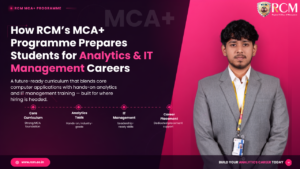
What sets RCM’s MCA program apart is its MCA Plus structure, which layers specialisation tracks onto the core two-year curriculum:
- Artificial Intelligence & Machine Learning — covering automation, predictive analytics, and applied AI use cases.
- Data Science & Business Intelligence — training students to work with real datasets and build BI dashboards.
- Cyber Security — hands-on preparation for identifying and responding to digital threats.
- Full Stack Development — covering MEAN/MERN stack skills for building and deploying web applications.
- Blockchain — offered as an elective for students interested in distributed-ledger technologies.
Beyond the specialisation tracks, a few structural elements define the MCA Plus experience. Industry certifications are built into the coursework rather than sold separately, so students graduate with recognised credentials alongside their degree. Corporate mentoring connects students directly with working professionals across both years of the program, and live projects replace purely theoretical assignments with real datasets and business problems.
RCM also runs innovation labs and hackathons, giving students a structured space to build a project portfolio — useful for interviews in AI or full-stack roles where practical work often matters more than grades alone. Placement support begins early rather than in the final semester, backed by a placement cell that the institute reports engages with over 830 recruiting companies, including names like EY, Amazon, Accenture, Flipkart, and Deloitte. RCM’s own published figures cite a 98.7% overall placement rate across programs; as with any institution-reported statistic, it’s worth confirming current, program-specific numbers directly with the admissions office, since figures shift by batch and year.
Career readiness at RCM is treated as an ongoing process — soft-skills training, mock interviews, and aptitude preparation run through both years rather than being concentrated at the end. Student life extends beyond academics too, with cultural fests, sports events, tech conclaves, and industry collaborations that bring recruiters onto campus for training sessions, not only final placement drives.
Why Choose RCM After NIMCET?
For candidates whose NIMCET rank didn’t secure a preferred NIT seat, the comparison between a traditional MCA and RCM’s MCA Plus model often comes down to how much industry integration you get built into the degree itself.
| Aspect | Traditional MCA | RCM MCA Plus |
|---|---|---|
| Curriculum | Core programming, DBMS, OS, software engineering | Core subjects plus applied AI, data science, cybersecurity, and full-stack modules |
| Certifications | Usually pursued separately, at extra cost | Bundled into the program fee |
| Projects | Limited to a single internship or capstone | Live projects and hackathons across both years |
| AI Integration | Often absent or elective-only | Built into multiple specialisation tracks |
| Placements | Varies by institute; often generic training | Structured, ongoing placement preparation with 830+ engaged recruiters |
| Career Readiness | Concentrated in the final semester | Continuous mentoring and training throughout the program |
This isn’t a claim that RCM outperforms every NIT — government institutes carry strong brand recognition and typically lower fees. But for candidates who didn’t make the NIT cutoff this cycle, or who specifically want a specialisation-led curriculum, RCM’s model is a legitimate option worth evaluating rather than defaulting to a lower-tier traditional MCA elsewhere.
Career Opportunities After NIMCET (or Any MCA Route)
Regardless of which institute you finally enrol in, an MCA — particularly one with a specialisation track — opens up a similar set of roles:
- Software Engineer
- AI Engineer
- Machine Learning Engineer
- Data Scientist
- Cyber Security Analyst
- Cloud Engineer
- Full Stack Developer
- Business Intelligence Analyst
- DevOps Engineer
Starting packages vary by specialisation, individual skill level, and employer — AI, cybersecurity, and cloud-focused roles generally command higher entry-level packages than generalist software roles, based on current hiring trends tracked by bodies like AICTE.
Common Mistakes to Avoid (For Future NIMCET Attempts)
- Treating counselling choice-filling casually — the order in which you list institute preferences directly affects your final allotment, so it deserves as much care as exam prep itself.
- Ignoring the negative marking scheme — guessing blindly on Mathematics or Reasoning questions often costs more than it gains.
- Over-preparing English and under-preparing Mathematics — since Mathematics carries the highest weightage, time allocation should reflect that.
- Not tracking previous years’ closing ranks — many candidates misjudge their chances by comparing raw scores instead of All India Rank against historical cutoffs.
- Delaying alternative applications — waiting too long to explore options like RCM’s NIMCET/OJEE-based admission can mean missing a seat-booking window elsewhere.
Conclusion
NIMCET 2026 is now complete — the exam was held on June 6, results came out on June 29, and seat allotment counselling is wrapping up its final rounds. If your rank secured a seat at your preferred NIT, congratulations; if it didn’t, or if you’re weighing an industry-integrated alternative, your NIMCET score still counts at institutes like RCM Bhubaneswar, whose MCA Plus program pairs AI, data science, cybersecurity, and full-stack specialisations with structured placement support.
You can explore the MCA Plus Program in detail, review the Placement Records, check the MCA Fee Structure, browse Student Life, or head to the Apply Now page to begin your admission process today. Whatever you decide, verify current fees, seat availability, and admission timelines directly with the institute, since these details can shift quickly during an active admission cycle.
Frequently Asked Questions
NIMCET (NIT MCA Common Entrance Test) is a national-level entrance exam conducted annually for admission to MCA programs at NITs and select IIITs. NIMCET 2026 was held on June 6, 2026, with results declared on June 29.
Candidates need a three-year bachelor’s degree with Mathematics/Statistics as a subject, or a B.E./B.Tech, with around 60% aggregate marks (55% for SC/ST/PwD). Mathematics at either 10+2 or graduation level is mandatory.
Focus heavily on Mathematics, since it carries the highest weightage, followed by consistent practice in Analytical Ability and Computer Awareness. Regular mock tests and previous years’ papers help build speed and accuracy under the two-hour time limit.
NIMCET scores are primarily used for admission to 11 NITs and 2 IIITs through centralised counselling. Some other institutions, including RCM Bhubaneswar, also accept NIMCET scores as part of their own admission process, followed by a personal interview.