AI is no longer a side skill — it’s becoming the core of how software gets built. As Industry 5.0 pushes automation and digital transformation into every sector, demand for professionals who understand both software development and applied AI keeps climbing. That’s exactly the gap MCA in Artificial Intelligence and Machine Learning is designed to fill.
Table of contents
- Quick Answer
- What is MCA in Artificial Intelligence and Machine Learning?
- Why Choose MCA Artificial Intelligence and Machine Learning?
- MCA AI Course Curriculum
- Why Choose Regional College of Management (RCM), Bhubaneswar for MCA AI?
- Skills You Learn in MCA AI
- Career Opportunities After MCA AI
- MCA AI Salary in India
- Industries Hiring AI Professionals
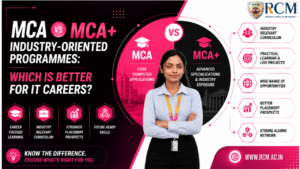
- MCA AI vs Traditional MCA
- Future Scope of MCA AI
- Why AI is Becoming the Best MCA Specialization
- Conclusion
- Frequently Asked Questions
Quick Answer
Regional College of Management (RCM), Bhubaneswar offers an AI-integrated MCA Plus program designed for students preparing for careers in Artificial Intelligence, Machine Learning, Data Science, Cyber Security, and Full Stack Development. MCA in Artificial Intelligence and Machine Learning is one of the fastest-growing postgraduate specializations because it combines advanced computer application skills with AI technologies used across healthcare, finance, manufacturing, e-commerce, cybersecurity, and automation. Graduates can pursue careers as AI Engineers, Machine Learning Engineers, Data Scientists, Software Developers, Business Intelligence Analysts, and AI Solution Architects, making this specialization one of the strongest career choices for 2026 and beyond.
| Specialization | Industry Demand | Average Salary | Future Scope | Best For |
|---|---|---|---|---|
| RCM MCA Plus (AI & ML) | Very High | ₹10–18 LPA | Strong — AI, automation, Industry 5.0 | Students wanting AI built into core curriculum, not just an elective |
| MCA (Data Science) | High | ₹9–16 LPA | Strong, growing with enterprise data adoption | Students focused on analytics and BI |
| MCA (Cyber Security) | High | ₹7–14 LPA | Strong, expanding across all sectors | Students interested in security-focused roles |
| Traditional MCA (no specialization) | Moderate | ₹6–10 LPA | Stable but slower-growing | Students preferring a general software career |
What is MCA in Artificial Intelligence and Machine Learning?
MCA in AI and Machine Learning is a two-year postgraduate degree that combines core software development with advanced AI technologies like deep learning. Students learn to build systems that analyze data, recognize patterns, and automate tasks — going beyond the programming-only focus of a traditional MCA.
- Difference from Traditional MCA: A traditional MCA covers core software engineering; MCA AI/ML adds deep learning, neural networks, NLP, and computer vision as core subjects rather than electives.
- Course Objective: Train graduates to design, build, and deploy AI-powered software applications.
- Skills Learned: Programming, database management, machine learning algorithms, and applied AI model deployment.
Why Choose MCA Artificial Intelligence and Machine Learning?
Choosing MCA AI/ML positions graduates at the center of the current hiring wave, as AI adoption accelerates across nearly every industry. The specialization pairs strong career demand with future-ready skills that don’t age out as quickly as narrow programming knowledge.
- AI Revolution: Enterprises are embedding AI into products faster than they can hire for it, widening the talent gap.
- Automation: AI-driven automation is replacing manual processes across finance, manufacturing, and logistics.
- Career Demand: AI-skilled MCA graduates are competing for a growing, not shrinking, pool of roles.
- Global Opportunities: AI and ML skills transfer well across borders, opening international job prospects.
- Future-Ready Skills: Deep learning, NLP, and computer vision remain relevant as AI adoption deepens rather than plateaus.
MCA AI Course Curriculum
The MCA AI/ML curriculum builds core computer science first, then layers in AI-specific subjects like deep learning and NLP from semester 2 onward.
| Semester | Core Subjects |
|---|---|
| Semester 1 | Python Programming, Mathematics & Statistics for AI, Data Structures, Computer Organization |
| Semester 2 | Machine Learning, Database Management, Cloud Computing, Neural Networks |
| Semester 3 | Deep Learning, Natural Language Processing (NLP), Computer Vision, Big Data Analytics |
| Semester 4 | Generative AI Fundamentals, AI Ethics, Data Science Project Work, Major Capstone Project |
Eligibility: A bachelor’s degree (BCA, B.Sc., B.Tech, or equivalent) with a minimum of 50% marks and Mathematics studied at either 10+2 or graduation level.
Why Choose Regional College of Management (RCM), Bhubaneswar for MCA AI?
RCM Bhubaneswar’s MCA Plus program is built to prepare students for AI careers through applied learning, not just classroom theory. The program pairs a 44-year-old, AICTE-approved, NAAC-accredited institutional foundation with a curriculum designed around current AI hiring demand.
AI-Integrated MCA Plus Curriculum: The program layers Artificial Intelligence & Machine Learning directly into the core BPUT MCA curriculum, alongside Data Science & Business Intelligence, Cyber Security, and Full Stack Development, with Blockchain offered as an elective module.
Industry-Focused Education: Rather than treating AI as a single elective, RCM builds it across multiple semesters, giving students repeated, applied exposure instead of a one-time introduction.
Corporate Mentoring: Students work directly with industry professionals across both years of the program, keeping AI training aligned with how companies actually deploy these tools.
Live AI Projects: Real datasets and business problems replace theory-only assignments, so students build a working AI project portfolio before graduation — something interviewers increasingly expect to see.
Industry Certifications: Certifications are bundled into the coursework itself, so students graduate with recognised credentials alongside their degree rather than pursuing them as a separate, extra-cost step.
Innovation Ecosystem: Structured hackathons and innovation-lab sessions give students a dedicated space to test AI ideas outside regular coursework.
Practical Learning with AI Tools: Coursework emphasizes hands-on use of AI frameworks and tools rather than purely theoretical instruction, reinforcing the applied-learning model throughout the MCA Plus structure.
Internship Support: Structured internship placement is built into the program timeline rather than left for students to arrange independently.
Placement Ecosystem: RCM’s placement cell engages 830+ recruiters, including Amazon, Accenture, EY, Deloitte, KPMG, Tech Mahindra, Flipkart, Genpact, and Airtel, with a reported 98.7% placement rate, average package of ₹13.2 LPA, and highest package of ₹22.4 LPA.
Career Guidance: Placement preparation — soft skills, mock interviews, aptitude training — runs throughout the program rather than concentrating in the final semester, backed by a base of 17,000+ alumni.
Together, these elements are designed to prepare students for real AI careers rather than academic learning alone — the difference between knowing AI theory and being able to ship an AI-powered feature on day one of a job.
Skills You Learn in MCA AI
- Problem Solving
- Python
- Machine Learning
- Deep Learning
- SQL
- TensorFlow
- Data Analytics
- Natural Language Processing (NLP)
- Computer Vision
- Cloud Computing
- Prompt Engineering
- AI Ethics
Career Opportunities After MCA AI
AI Engineer
Job Description: Builds and deploys AI-driven applications. Skills Required: Python, ML frameworks, model deployment. Average Salary: ₹10–18 LPA. Career Growth: High, tied to enterprise AI adoption.
Machine Learning Engineer
Job Description: Builds and tests smart algorithms that learn from data. Skills Required: ML algorithms, Python, data pipelines. Average Salary: ₹9–17 LPA. Career Growth: High across product and AI-focused companies.
Data Scientist
Job Description: Finds hidden patterns in large datasets to guide business decisions. Skills Required: Statistics, Python/R, visualization. Average Salary: ₹9–16 LPA. Career Growth: High, especially in consulting and product firms.
AI Research Associate
Job Description: Supports applied research on new AI models and techniques. Skills Required: Deep learning, research methodology. Average Salary: ₹8–15 LPA. Career Growth: Moderate to high, strongest at research-driven firms.
NLP Engineer
Job Description: Builds systems that process and understand human language. Skills Required: NLP libraries, transformers, Python. Average Salary: ₹10–17 LPA. Career Growth: High, driven by generative AI adoption.
Computer Vision Engineer
Job Description: Builds systems that interpret images and video. Skills Required: OpenCV, deep learning, image processing. Average Salary: ₹10–17 LPA. Career Growth: High in manufacturing, automotive, and retail.
Robotics Software Engineer
Job Description: Writes software controlling robotic systems and automation. Skills Required: Programming, control systems, AI integration. Average Salary: ₹9–16 LPA. Career Growth: Moderate to high, growing in manufacturing.
AI Product Engineer
Job Description: Builds AI features into consumer or enterprise products. Skills Required: Programming, product thinking, ML basics. Average Salary: ₹9–15 LPA. Career Growth: Rising with product-led AI companies.
Cloud AI Engineer
Job Description: Deploys and scales AI models on cloud infrastructure. Skills Required: AWS/Azure, MLOps, automation. Average Salary: ₹12–20 LPA. Career Growth: Very high, among the best-paying AI roles.
Business Intelligence Analyst
Job Description: Turns AI-generated insights into business dashboards and decisions. Skills Required: SQL, BI tools, data storytelling. Average Salary: ₹7–13 LPA. Career Growth: Growing steadily with enterprise data adoption.
Full Stack AI Developer
Job Description: Builds complete applications with AI features embedded end to end. Skills Required: MEAN/MERN stack, ML integration, APIs. Average Salary: ₹9–16 LPA. Career Growth: Strong across startups and product firms.
MCA AI Salary in India
| Job Role | Entry Salary | Experienced Salary | Growth Potential |
|---|---|---|---|
| AI Engineer | ₹8 – ₹10 LPA | ₹18 – ₹30 LPA | High |
| Machine Learning Engineer | ₹8 – ₹10 LPA | ₹17 – ₹28 LPA | High |
| Data Scientist | ₹7 – ₹10 LPA | ₹16 – ₹28 LPA | High |
| Cloud AI Engineer | ₹9 – ₹12 LPA | ₹20 – ₹32 LPA | Very High |
| NLP Engineer | ₹8 – ₹11 LPA | ₹17 – ₹27 LPA | High |
Industries Hiring AI Professionals
AI professionals are hired well beyond traditional IT companies, with demand spread across sectors adopting automation and predictive analytics.
- Startups — AI-first product development
- Healthcare — diagnostic tools, predictive analytics
- Banking — fraud detection, risk modeling
- FinTech — automated trading, credit scoring
- EdTech — personalized learning systems
- Manufacturing — predictive maintenance, robotics
- Automobile — autonomous systems, computer vision
- Retail — recommendation engines, demand forecasting
- E-commerce — personalization, chatbots
- Cyber Security — threat detection, anomaly analysis
- Government — public-service automation initiatives
MCA AI vs Traditional MCA
| Factor | Traditional MCA | MCA AI/ML |
|---|---|---|
| Curriculum | Core programming, DBMS, OS, software engineering | Core subjects plus deep learning, NLP, computer vision |
| Practical Learning | Limited to a single capstone project | Live AI projects and hackathons throughout |
| AI Skills | Elective or absent | Built into the core curriculum |
| Career Opportunities | General software roles | AI Engineer, ML Engineer, Data Scientist, and more |
| Salary | ₹6–10 LPA average | ₹9–18 LPA average |
| Industry Demand | Moderate | Very high |
| Future Scope | Stable but slower-growing | Strong, tied to AI and automation growth |
Future Scope of MCA AI
The future scope of MCA AI is expanding well beyond current job titles, as Generative AI, Cloud AI, and predictive analytics become standard tools across enterprise software. Robotics and intelligent applications are extending AI demand into manufacturing and physical automation, not just digital products. This shift, aligned with what’s often called Industry 5.0, means MCA AI graduates are entering a job market that’s still widening rather than plateauing.
Why AI is Becoming the Best MCA Specialization
AI is emerging as the strongest MCA specialization because it combines the highest market demand with the fastest salary growth among current tech roles. Emerging technologies — from generative AI to computer vision — continue to open new job categories that didn’t exist five years ago, and global opportunities remain wide for AI-skilled graduates. Programs like RCM Bhubaneswar’s MCA Plus, which build AI directly into the core curriculum rather than as an elective, position graduates to compete for these roles from day one.
Conclusion
MCA in Artificial Intelligence and Machine Learning stands out in 2026 because it pairs a recognised postgraduate degree with the exact skill set companies are racing to hire for. Choosing a program with practical, hands-on AI exposure — not just theoretical coursework — makes a measurable difference in long-term career readiness. RCM Bhubaneswar’s MCA Plus Program builds exactly that through its AI & Machine Learning specialization. Explore Placements, check the Fee Structure, and apply now to start your MCA AI journey.
Frequently Asked Questions
Yes — MCA in AI pairs strong industry demand with faster salary growth than a traditional MCA, and programs like RCM Bhubaneswar’s AI-integrated MCA Plus improve career readiness through live projects and corporate mentoring.
MCA AI graduates can pursue roles including AI Engineer, Machine Learning Engineer, Data Scientist, NLP Engineer, Computer Vision Engineer, and Cloud AI Engineer, across industries from healthcare to FinTech.
Entry-level salaries after MCA in AI typically range from ₹8–12 LPA, rising to ₹17–30 LPA with experience, depending on specialization, role, and employer.
RCM Bhubaneswar offers a strong MCA AI option through its MCA Plus program, which integrates Artificial Intelligence and Machine Learning into the core curriculum alongside industry certifications and a placement ecosystem of 830+ recruiters.
AI is among the strongest MCA specializations currently, given its high industry demand and salary growth, though the right choice ultimately depends on individual interest and career goals compared to Data Science or Cyber Security tracks.