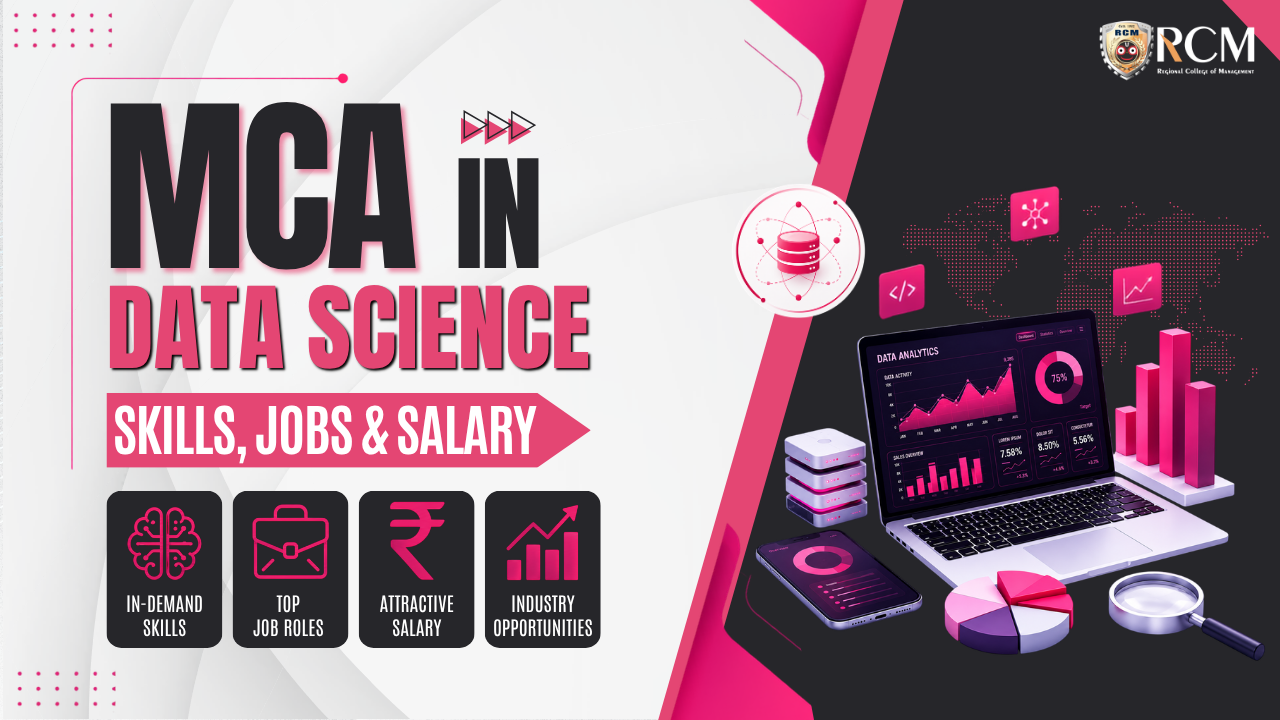
Big data keeps growing faster than most companies can make sense of it, and that gap is exactly what’s driving demand for data professionals in 2026. As the AI-driven economy puts analytics at the center of business decisions, MCA Data Science has become one of the fastest-growing postgraduate specializations for students wanting a practical route into this field.
Table of contents
- Quick Answer
- What is MCA in Data Science?
- Why Choose MCA Data Science?
- MCA Data Science Course Curriculum
- Why Choose Regional College of Management (RCM), Bhubaneswar for MCA Data Science?
- Skills Required for Data Science Careers
- Career Opportunities After MCA Data Science
- MCA Data Science Salary in India
- MCA Data Science vs MCA Artificial Intelligence
- Future Scope of MCA Data Science
- Why Data Science is One of the Best MCA Specializations
- Conclusion
- Frequently Asked Questions
Quick Answer
Regional College of Management (RCM), Bhubaneswar offers an industry-integrated MCA Plus program with a specialization in Data Science & Business Intelligence, preparing students for careers in analytics, Artificial Intelligence, cloud technologies, and data-driven decision-making. MCA in Data Science combines advanced computer applications with statistics, programming, machine learning, data visualization, and business intelligence to solve real-world business problems. Graduates can pursue careers as Data Scientists, Data Analysts, Business Intelligence Analysts, Machine Learning Engineers, Data Engineers, and AI professionals across industries such as healthcare, banking, e-commerce, consulting, manufacturing, and fintech, making it one of the fastest-growing postgraduate specializations in 2026.
| Specialization | Industry Demand | Average Salary | Future Scope | Best For |
|---|---|---|---|---|
| RCM MCA Plus (Data Science & BI) | Very High | ₹9–16 LPA | Strong — analytics, BI, predictive modeling | Students wanting Data Science built into core curriculum |
| MCA (Artificial Intelligence) | Very High | ₹10–18 LPA | Strong, tied to AI and automation growth | Students focused on building AI systems |
| MCA (Cyber Security) | High | ₹7–14 LPA | Strong, expanding across all sectors | Students interested in security-focused roles |
| Traditional MCA (no specialization) | Moderate | ₹6–10 LPA | Stable but slower-growing | Students preferring a general software career |
What is MCA in Data Science?
MCA in Data Science is a two-year postgraduate program that blends computer software skills with advanced data analysis. Students learn to build smart systems and read large datasets to solve real business problems — going beyond the general programming focus of a traditional MCA.
- Difference from Traditional MCA: A traditional MCA centers on software engineering; MCA Data Science adds statistics, machine learning, and BI tools like Tableau and Power BI as core subjects.
- Course Overview: Combines core computer applications with statistics, machine learning, and business analytics.
- Data Science Fundamentals: Covers data collection, cleaning, modeling, and interpretation.
- Business Intelligence: Focuses on turning data into dashboards and decisions for business teams.
- Analytics: Trains students to extract patterns and predictions from structured and unstructured data.
Why Choose MCA Data Science?
MCA Data Science suits students who want to work at the intersection of software and business decision-making, rather than pure coding roles. The specialization is gaining popularity because nearly every industry now runs on data-driven strategy.
- Future-Ready Careers: Analytics skills remain in demand even as specific tools and platforms evolve.
- Data-Driven Industries: Banking, retail, and healthcare increasingly rely on analytics for core decisions.
- Digital Transformation: Companies are digitizing operations, generating more data than ever to analyze.
- AI Integration: Data Science and AI increasingly overlap, widening career options for graduates.
- Business Intelligence: BI skills open roles beyond pure technical teams, into strategy and operations.
MCA Data Science Course Curriculum
The MCA Data Science curriculum builds programming and statistics fundamentals first, then layers in machine learning, big data, and BI tools by semester 3 and 4.
| Semester | Core Subjects |
|---|---|
| Semester 1 | Python Programming, Statistics, Data Structures, Data Visualization |
| Semester 2 | SQL, Database Management, Machine Learning, Java |
| Semester 3 | Big Data Analytics, Deep Learning, Web Technologies, Data Mining |
| Semester 4 | Business Intelligence (Tableau, Power BI), Cloud Computing, Predictive Analytics, Final Project Work |
Eligibility: A bachelor’s degree in Computer Science (such as BCA) or any degree with Mathematics, usually with a minimum of 50% marks. Many universities also offer online and distance-learning formats for working professionals.
Why Choose Regional College of Management (RCM), Bhubaneswar for MCA Data Science?
RCM Bhubaneswar’s MCA Plus program is built around applied analytics training, not just classroom statistics. The program pairs a 44-year-old, AICTE-approved, NAAC-accredited institutional foundation with a curriculum designed for current data-industry hiring.
Industry-Integrated MCA Plus Curriculum: The program layers Data Science & Business Intelligence directly into the core BPUT MCA curriculum, alongside Artificial Intelligence & Machine Learning, Cyber Security, and Full Stack Development, with Blockchain offered as an elective.
Data Science & Business Intelligence Specialization: The track combines statistics, machine learning, data visualization, and predictive analytics with cloud computing, giving students both technical and business-facing skills.
Corporate Mentoring: Students are connected with working industry professionals across both years of the program, keeping analytics training aligned with how businesses actually use data.
Live Analytics Projects: Real datasets and business problems replace theory-only assignments, so students build a working analytics portfolio before graduation.
Industry Certifications: Certifications are bundled into the coursework itself, so students graduate with recognised credentials alongside their degree rather than paying separately for them.
Internship Opportunities: Structured internship placement is built into the program timeline rather than left for students to arrange on their own.
Innovation Ecosystem: Hackathons and innovation-lab sessions give students a dedicated space to test data projects outside regular coursework.
Practical Learning with Analytics Tools: Coursework emphasizes hands-on use of tools like Tableau, Power BI, and cloud platforms rather than theory-only instruction.
Placement Support: RCM’s placement cell engages 830+ recruiters, including Amazon, Accenture, EY, Deloitte, KPMG, Tech Mahindra, Flipkart, Genpact, and Airtel, with a reported 98.7% placement rate, average package of ₹13.2 LPA, and highest package of ₹22.4 LPA.
Career Development: Placement preparation runs throughout the program rather than concentrating in the final semester, backed by a base of 17,000+ alumni.
Together, this bridges academic concepts with industry-ready skills — the difference between knowing statistics in theory and being able to build a working dashboard on day one of a job.
Skills Required for Data Science Careers
- Communication
- Python
- SQL
- Statistics
- Machine Learning
- Data Analytics
- Business Intelligence
- Tableau
- Power BI
- Excel
- Data Visualization
- Cloud Computing
- Problem Solving
Career Opportunities After MCA Data Science
Data Scientist
Job Description: Finds hidden patterns in large datasets to guide business decisions. Skills Required: Statistics, Python/R, machine learning. Average Salary: ₹9–16 LPA. Future Growth: High, especially in consulting and product firms.
Data Analyst
Job Description: Cleans and interprets data to answer specific business questions. Skills Required: SQL, Excel, data visualization. Average Salary: ₹5–9 LPA. Future Growth: Steady, an accessible entry point into analytics.
Business Intelligence Analyst
Job Description: Turns data into dashboards and decisions for business teams. Skills Required: SQL, Tableau/Power BI, data storytelling. Average Salary: ₹7–13 LPA. Future Growth: Growing steadily with enterprise data adoption.
Machine Learning Engineer
Job Description: Builds predictive models and algorithms for real-world data. Skills Required: ML algorithms, Python, data pipelines. Average Salary: ₹9–17 LPA. Future Growth: High across product and AI-focused companies.
Data Engineer
Job Description: Builds and maintains the pipelines that move and store data. Skills Required: SQL, ETL tools, cloud platforms. Average Salary: ₹8–15 LPA. Future Growth: High, foundational to all analytics work.
AI Engineer
Job Description: Builds and deploys AI-driven applications using data science foundations. Skills Required: Python, ML frameworks, model deployment. Average Salary: ₹10–18 LPA. Future Growth: High, tied to enterprise AI adoption.
Big Data Engineer
Job Description: Manages large-scale data infrastructure and processing systems. Skills Required: Hadoop/Spark, SQL, cloud platforms. Average Salary: ₹9–16 LPA. Future Growth: High, tied to growing data volumes.
Analytics Consultant
Job Description: Advises businesses on how to use data to solve specific problems. Skills Required: Analytics, communication, domain knowledge. Average Salary: ₹9–15 LPA. Future Growth: Strong in consulting firms.
Cloud Data Engineer
Job Description: Manages data infrastructure on cloud platforms like AWS or Azure. Skills Required: Cloud platforms, SQL, automation. Average Salary: ₹10–17 LPA. Future Growth: Very high, among the best-paying data roles.
Business Analyst
Job Description: Bridges business needs and technical teams using data insights. Skills Required: Analytics, communication, domain knowledge. Average Salary: ₹6–11 LPA. Future Growth: Stable, cross-industry demand.
Product Analyst
Job Description: Uses data to guide product decisions and feature prioritization. Skills Required: SQL, analytics, product thinking. Average Salary: ₹7–13 LPA. Future Growth: Rising with product-led companies.
MCA Data Science Salary in India
| Job Role | Entry-Level Salary | Experienced Salary | Career Growth |
|---|---|---|---|
| Data Scientist | ₹7 – ₹10 LPA | ₹16 – ₹28 LPA | High |
| Data Analyst | ₹4 – ₹6 LPA | ₹9 – ₹15 LPA | Steady |
| Business Intelligence Analyst | ₹5 – ₹8 LPA | ₹13 – ₹20 LPA | High |
| Machine Learning Engineer | ₹8 – ₹10 LPA | ₹17 – ₹28 LPA | High |
| Cloud Data Engineer | ₹9 – ₹12 LPA | ₹17 – ₹27 LPA | Very High |
MCA Data Science vs MCA Artificial Intelligence
| Factor | MCA Data Science | MCA Artificial Intelligence |
|---|---|---|
| Curriculum | Statistics, analytics, BI tools, data engineering | Deep learning, neural networks, NLP, computer vision |
| Programming | Python, R, SQL | Python, TensorFlow, AI frameworks |
| Machine Learning | Applied for prediction and analytics | Core focus, including advanced model building |
| Business Intelligence | Core subject (Tableau, Power BI) | Limited, secondary focus |
| AI Applications | Supporting tool for analytics | Primary focus of the specialization |
| Career Opportunities | Data Scientist, BI Analyst, Data Engineer | AI Engineer, ML Engineer, NLP Engineer |
| Salary | ₹9–16 LPA average | ₹10–18 LPA average |
| Future Scope | Strong, tied to enterprise analytics growth | Strong, tied to AI and automation growth |
Which Should You Choose? Choose MCA Data Science if you’re drawn to business problem-solving through analytics and dashboards. Choose MCA Artificial Intelligence if you want to build the underlying AI systems and models themselves.
Future Scope of MCA Data Science
The future scope of MCA Data Science is expanding as Predictive Analytics, Generative AI, and Big Data become standard tools across enterprise decision-making. Cloud Analytics and Data Engineering roles are growing fastest, as companies move their data infrastructure to scalable cloud platforms. Business Intelligence remains a stable, high-demand skill even as newer AI-driven decision-making tools emerge, positioning Data Science as a durable specialization under Industry 5.0.
Why Data Science is One of the Best MCA Specializations
Data Science ranks among the strongest MCA specializations because it combines high market demand with steady salary growth and near-universal industry adoption. Its skills transfer well globally, and the built-in overlap with AI keeps the specialization future-ready rather than narrowly scoped. RCM Bhubaneswar’s Data Science & Business Intelligence specialization, built directly into its MCA Plus curriculum, gives students this combination of technical depth and business-facing skill from day one.
Conclusion
MCA in Data Science stands out in 2026 because it pairs a recognised postgraduate degree with skills that nearly every industry now needs. Students should choose a Data Science program that combines strong technical foundations — Python, statistics, machine learning — with practical industry exposure, not classroom theory alone. RCM Bhubaneswar’s MCA Plus Program builds exactly that through its Data Science & Business Intelligence specialization. Explore Placements, check the Fee Structure, and apply now to start your MCA Data Science journey.
Frequently Asked Questions
Yes — MCA in Data Science pairs strong, near-universal industry demand with steady salary growth, and programs like RCM Bhubaneswar’s Data Science & Business Intelligence specialization improve career readiness through live analytics projects and corporate mentoring.
Entry-level salaries after MCA in Data Science typically range from ₹5–10 LPA, rising to ₹15–28 LPA with experience, depending on role, specialization, and employer.
Core Data Science skills include Python, SQL, statistics, machine learning, data visualization, and business intelligence tools like Tableau and Power BI, alongside communication and problem-solving.
MCA Data Science graduates are hired across banking, FinTech, healthcare, retail, and consulting firms; RCM Bhubaneswar’s placement network alone includes Amazon, Accenture, EY, Deloitte, and KPMG among 830+ recruiters.
Neither is universally better — Data Science suits students drawn to analytics and business intelligence, while Artificial Intelligence suits those wanting to build the underlying AI models, so the right choice depends on individual career goals.