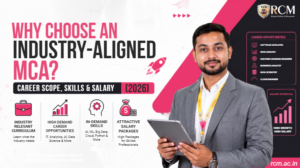
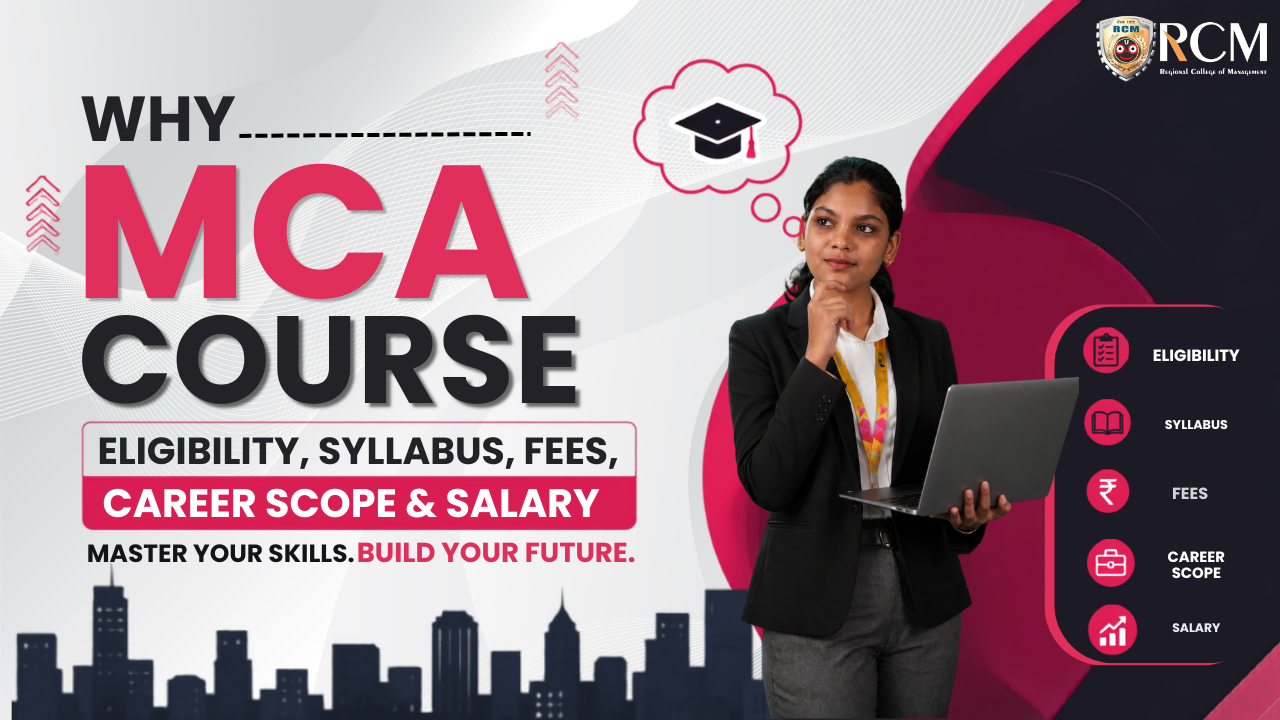
Software hiring in 2026 is tilting hard toward AI, data, and cybersecurity roles, and that shift has made the MCA Course one of the most practical postgraduate routes into technology careers. Unlike a B.Tech, an MCA welcomes graduates from almost any stream — BCA, B.Sc., B.Com — and turns them into industry-ready IT professionals in two years. This guide covers everything about the MCA Course: eligibility, syllabus, fees, career scope, and salary, including how an AI-integrated program like RCM Bhubaneswar’s MCA Plus changes the outcome equation.
Table of contents
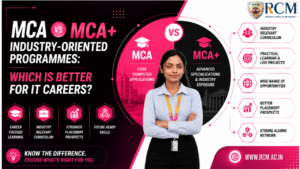
Traditional MCA vs RCM MCA Plus: Which Is Better for 2026?
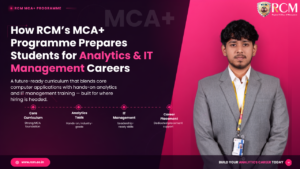
Regional College of Management (RCM), Bhubaneswar offers an industry-integrated MCA Plus program that combines the core Master of Computer Applications curriculum with Artificial Intelligence, Data Science, Cyber Security, Full Stack Development, and bundled industry certifications. The Master of Computer Applications (MCA) itself is a two-year postgraduate degree that builds advanced computer science, software development, database management, and IT skills, making it one of the strongest choices for students targeting technology careers in 2026. Locally, MCA can also be pursued at institutions like Odisha University of Technology and Research (OUTR) and Utkal University, with admission through OJEE, NIMCET, or Odisha CPET, and fees across Bhubaneswar colleges ranging roughly from ₹50,000 to ₹5.63 Lakhs depending on the institute.
| Feature | Traditional MCA | RCM MCA Plus |
|---|---|---|
| Duration | 2 years (4 semesters) | 2 years (4 semesters) |
| Curriculum | Core programming, DBMS, OS, software engineering | Core subjects plus AI, Data Science, Cyber Security, Full Stack tracks |
| AI Integration | Often elective-only or absent | Built into multiple specialization tracks |
| Industry Certifications | Pursued separately, extra cost | Bundled into program fee |
| Live Projects | Single internship/capstone | Live projects and hackathons across both years |
| Placement Support | Concentrated in final semester | Structured training throughout the program, 830+ recruiters |
| Career Readiness | Theory-first | Corporate mentoring, innovation labs, applied learning |
What is an MCA Course?
An MCA Course is a two-year, full-time postgraduate program in Master of Computer Applications that trains graduates in programming, data structures, database management, and software engineering. It is open to students from any bachelor’s stream, provided Mathematics was studied at some stage.
MCA Full Form: Master of Computer Applications. Duration: Two years, split across four semesters. Objectives: Build strong programming logic, systems thinking, and applied software development skills within a structured academic framework. Skills Developed: Coding proficiency, database design, software architecture, and — depending on the college — AI, data science, or cybersecurity capability. Industry Demand: Rising steadily as India’s IT and digital economy sectors expand hiring for AI-literate, full-stack-capable software professionals, per trends tracked by industry bodies like NASSCOM.
MCA Course Details
The MCA Course structure is fairly consistent across Indian universities, though specialization depth varies by institute. Duration, semester pattern, and internship/project components follow AICTE and university-affiliation guidelines.
| Aspect | Details |
|---|---|
| Duration | 2 years / 4 semesters |
| Eligibility | Bachelor’s degree (any stream) with Mathematics at 10+2 or graduation, 50% aggregate |
| Course Structure | Core subjects each semester, electives/specializations from semester 3 onward |
| Semester Pattern | 4 semesters — 2 per academic year |
| Internship | Typically in semester 3 or 4, industry-facing |
| Projects | Capstone project in final semester; live/industry projects at specialization-integrated colleges |
MCA Eligibility 2026
MCA eligibility centers on a bachelor’s degree with Mathematics background — this single requirement disqualifies more applicants than any other criterion, so it’s worth confirming first.
- Educational Qualification: A three-year bachelor’s degree (BCA, B.Sc., B.Com, BA, or B.Tech/BE) from a recognised university.
- Minimum Marks: Typically 50% aggregate (45–55% depending on exam and category).
- Mathematics Requirement: Mathematics or Statistics studied at either the 10+2 level or during graduation is mandatory for almost every MCA entrance exam.
- Reserved Category Relaxation: A 5% relaxation in minimum marks is common for SC/ST/PwD/OBC (non-creamy layer) candidates.
- Final-Year Students: Can generally apply, subject to proof of passing before admission/counselling.
- Entrance Exams: NIMCET (NITs/IIITs), CUET-PG (central universities), and state exams like OJEE (Odisha), MAH MCA CET (Maharashtra), and TANCET (Tamil Nadu).
MCA Syllabus
The MCA syllabus builds from foundational programming in semester 1 to specialization and project work by semester 4. Advanced, industry-focused curricula — such as RCM’s MCA Plus — additionally integrate emerging technologies and practical certifications alongside this core structure.
| Semester | Core Subjects |
|---|---|
| Semester 1 | Programming Fundamentals (C/Python), Discrete Mathematics, Computer Organization, Data Structures |
| Semester 2 | Object-Oriented Programming, Database Management Systems, Operating Systems, Software Engineering |
| Semester 3 | Computer Networks, Web Technologies, Elective 1 (AI/ML, Data Science, or Cyber Security), Internship |
| Semester 4 | Cloud Computing, Elective 2 (Full Stack Development or Blockchain), Major Project / Capstone Work |
Colleges running an AI-integrated model layer Artificial Intelligence & Machine Learning, Data Science & Business Intelligence, Cyber Security, and Full Stack Development directly into this core structure, rather than offering them as standalone electives.
MCA Fees in India
MCA fees vary sharply by institution type, and this gap directly shapes your ROI calculation once placement outcomes are factored in.
| College Type | Typical Total Fee (2-year MCA) | Notes |
|---|---|---|
| Government Colleges | ₹15,000 – ₹1.5 Lakhs | Lowest cost, highly competitive entrance exams (NIMCET, CUET-PG) |
| Private Colleges | ₹2.5 – ₹6 Lakhs | Varies by brand and specialization; often bundles labs and placement training |
| Industry-Integrated Colleges (e.g., RCM MCA Plus) | ₹2,53,000 (RCM total program fee) | AI/Data Science/Cyber Security/Full Stack specializations and certifications bundled into fee; scholarships up to ₹30,000 and education-loan tie-ups available |
Within Bhubaneswar specifically, MCA tuition across colleges — including OUTR and Utkal University — ranges roughly from ₹50,000 to ₹5.63 Lakhs depending on the institute, with admission generally through OJEE, NIMCET, or Odisha CPET.
RCM Bhubaneswar: MCA Plus Program
Regional College of Management (RCM), Bhubaneswar is a 44-year-old, AICTE-approved, NAAC-accredited institute affiliated with Biju Patnaik University of Technology (BPUT). Its MCA Plus program is built around specialization tracks layered onto the standard BPUT MCA curriculum, rather than treating advanced skills as optional add-ons.
- MCA Plus Curriculum: The program integrates Artificial Intelligence & Machine Learning, Data Science & Business Intelligence, Cyber Security, and Full Stack Development (MEAN/MERN), with Blockchain offered as an elective module for students interested in distributed-ledger technologies.
- Industry Integration: Rather than positioning certifications as a separate purchase, RCM bundles industry certifications directly into the coursework, so students graduate with recognised credentials alongside their degree — a structural difference from most traditional MCA programs where certification prep happens outside the syllabus.
- AI-Driven Learning: AI and Machine Learning concepts run through multiple specialization tracks rather than sitting in a single introductory module, giving students repeated, applied exposure across semesters instead of a one-time theoretical unit.
- Corporate Mentoring: Students are connected directly with working industry professionals across both years of the program, not just in a placement-prep phase near graduation. This continuous mentoring model is designed to keep career guidance relevant to current hiring practices rather than static academic advice.
- Live Projects: Real datasets and business problems replace purely theoretical assignments in the MCA Plus structure, giving students a working portfolio well before their final semester — something that matters disproportionately for AI and full-stack roles, where interview panels often ask for demonstrable project work.
- Innovation Labs: Structured hackathons and innovation lab sessions give students a dedicated outlet to build and test ideas outside regular coursework, reinforcing the applied, project-based learning style that underlies the MCA Plus format.
- Placement Ecosystem: RCM’s placement cell engages with a reported 830+ recruiters, including Amazon, Accenture, EY, Deloitte, KPMG, Tech Mahindra, Flipkart, Genpact, and Airtel. The institute cites a 98.7% placement rate, with an average package of ₹13.2 LPA and a highest package of ₹22.4 LPA for its programs, alongside a base of more than 17,000 alumni.
- Career Readiness: Soft-skills training, mock interviews, and aptitude preparation are woven through the program rather than concentrated in the final semester, so placement preparation effectively begins from year one.
- Student Life: Beyond academics, RCM’s campus runs cultural fests, sports events, tech conclaves, and alumni networking sessions, rounding out the two-year MCA Plus experience.
- Admission: RCM accepts scores from OJEE and NIMCET, followed by a personal interview, through a five-step process — Enquiry, Application, Personal Interview, Seat Booking, and Admission — run directly by the institute. You can review the full MCA Plus Program details, check the MCA Fee Structure, or browse Student Life before applying.
Why Choose RCM MCA Plus?
| Factor | Traditional MCA | RCM MCA Plus |
|---|---|---|
| AI Curriculum | Elective or absent | Integrated across AI/ML, Data Science, and Cyber Security tracks |
| Certifications | Separate, extra cost | Bundled into program fee |
| Industry Projects | Single internship/capstone | Live projects and hackathons across both years |
| Mentoring | Faculty-led, classroom-based | Continuous corporate mentoring |
| Placements | Varies by institute | 98.7% placement rate, 830+ recruiters |
| Innovation | Limited extracurricular scope | Dedicated innovation labs and hackathons |
Scope of MCA in India
The scope of MCA in India is expanding as digital transformation and Industry 5.0 push companies across sectors — not just IT services — to hire software and data talent. Current demand centers on full-stack development, cloud engineering, and cybersecurity, while future demand is expected to skew further toward applied AI and machine learning roles as automation adoption grows. India’s digital economy expansion, tracked by bodies like NASSCOM, continues to widen the pool of technology career openings for MCA graduates, particularly those with specialization training layered onto core software engineering skills.
Career Opportunities After MCA
- Software Engineer
- AI Engineer
- Machine Learning Engineer
- Data Scientist
- Cyber Security Analyst
- Cloud Engineer
- Business Intelligence Analyst
- DevOps Engineer
- Full Stack Developer
- Blockchain Developer
- Product Engineer
Average Salary After MCA
| Job Role | Average Salary | Growth Potential | Skills Required |
|---|---|---|---|
| Software Engineer | ₹6–10 LPA | Moderate to high | Programming, DSA, system design |
| AI Engineer | ₹10–18 LPA | High | Python, ML frameworks, model deployment |
| Data Scientist | ₹9–16 LPA | High | Statistics, Python/R, data visualization |
| Cyber Security Analyst | ₹7–14 LPA | High | Network security, threat analysis, compliance |
| Cloud Engineer | ₹8–15 LPA | High | AWS/Azure, DevOps, infrastructure automation |
| Full Stack Developer | ₹6–12 LPA | Moderate to high | MEAN/MERN stack, APIs, databases |
Salary figures are indicative industry ranges for early-to-mid-career roles in India and vary by employer, city, and individual skill level.
Is MCA Worth It in 2026?
Yes — for students seeking a technology career without an engineering undergraduate degree, MCA remains a strong ROI choice in 2026. Its two-year duration, moderate fees relative to a fresh B.Tech, and direct alignment with software, AI, and data hiring trends make it a practical route into the industry. Career growth is strongest for graduates who add a specialization — AI, cybersecurity, or cloud — on top of the core curriculum, and the degree also supports entrepreneurship for students building their own software products. Future demand looks stable to rising as the software industry continues to integrate AI more deeply into product development.
How to Choose the Right MCA College
- Curriculum: Check whether it’s updated for AI, cloud, and cybersecurity, not just legacy programming languages.
- Faculty: Look for faculty with active industry or research engagement.
- AI Integration: Confirm whether AI/ML is a core track or a single elective.
- Industry Exposure: Live projects, hackathons, and corporate mentoring indicate stronger job-readiness.
- Placements: Compare average package and number of active recruiters, not just the highest package.
- Internships: Check whether internships are structured and industry-facing.
- Certifications: See if certifications are bundled into the fee or sold separately.
- Infrastructure: Labs, innovation centers, and campus facilities matter for applied learning.
- ROI: Weigh total fees against average package and available scholarships.
- Alumni Network: A large, active alumni base strengthens referrals and long-term mobility.
Conclusion
The MCA Course remains one of the most accessible and practical postgraduate routes into a technology career in 2026, especially for non-engineering graduates. Choosing between a traditional MCA and a specialization-integrated model like RCM’s MCA Plus comes down to how much weight you place on AI-driven curriculum, bundled certifications, and structured placement support. With a 98.7% placement rate, 830+ recruiters, and tracks spanning AI, Data Science, Cyber Security, and Full Stack Development, RCM Bhubaneswar’s MCA Plus Program is worth shortlisting. Review the MCA Fee Structure, explore Placements, and apply now to begin your MCA journey.
FAQs
Yes — MCA offers a practical, two-year route into technology careers for graduates from any stream, with strong ROI when paired with an AI, cybersecurity, or cloud specialization such as RCM Bhubaneswar’s MCA Plus program.
The scope of MCA in India is expanding across software development, AI, data science, and cybersecurity roles, driven by digital transformation and rising demand for AI-literate software professionals across sectors.
Core MCA subjects include programming, data structures, database management, operating systems, and software engineering, with specializations like AI, Data Science, Cyber Security, and Full Stack Development available at colleges such as RCM Bhubaneswar.
Average salaries after MCA range from ₹6–10 LPA for software engineering roles up to ₹10–18 LPA for AI and data-focused roles, depending on specialization, skills, and employer.
Yes — MCA is a natural progression after BCA, deepening technical skills and adding specializations like AI or cybersecurity that improve placement outcomes compared to stopping at a bachelor’s degree alone.
RCM Bhubaneswar’s MCA Plus program integrates Artificial Intelligence and Machine Learning directly into its core curriculum, alongside Data Science, Cyber Security, and Full Stack Development specializations.