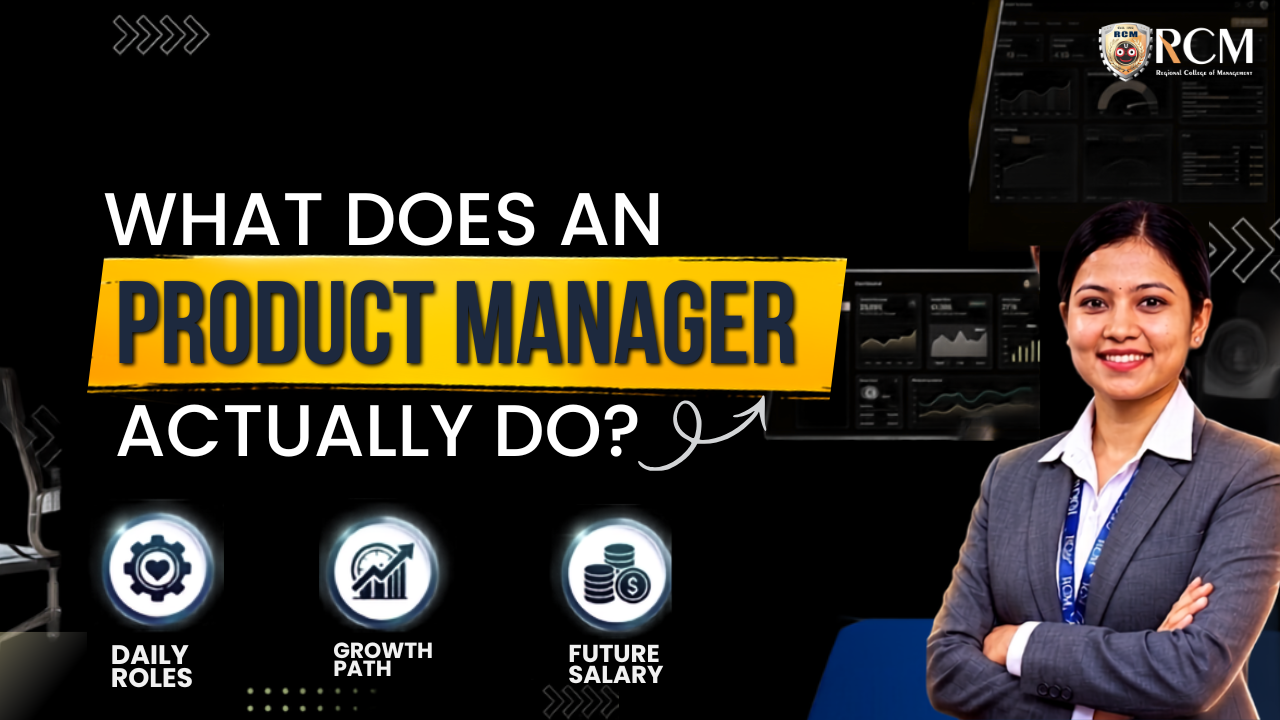
What do MBA Product Managers do?
An MBA Product Manager leads product strategy, customer research, business growth, and cross-functional teams. In India, Product Managers typically earn ₹10–15 LPA initially, with experienced professionals earning ₹25–50+ LPA. It is among the best career options after MBA in 2026 due to strong demand across technology, fintech, e-commerce, healthcare, and AI-driven industries — and career ceiling extends to ₹200 LPA+ at the CPO level.
What Is a Product Manager?
Before we dive deep, here is a quick reference snapshot for anyone evaluating Product Management as their target MBA job role:
| Attribute | Detail |
| Role | Product Manager (MBA) |
| Typical Starting Salary | ₹10–15 LPA (APM/PM at tech companies) |
| Mid-Career Salary (5–8 yrs) | ₹25–45 LPA |
| Senior Leadership Salary | ₹50–100 LPA (Director/VP of Product) |
| Executive Salary (CPO) | ₹100–200 LPA+ |
| Key Skills | Analytics, Strategy, Communication, AI Fluency, Leadership |
| Industries Hiring | Tech, FinTech, E-Commerce, EdTech, AI Startups, Healthcare |
| Growth Potential | One of the highest among all MBA job roles |
| Future Demand (2030) | Very High — driven by AI, SaaS, and digital transformation |
What Is a Product Manager?
Think about the last time you ordered food on Swiggy, booked a flight on MakeMyTrip, or browsed a deal on Flipkart. Every feature you interacted with — from the search bar to the checkout flow to the delivery tracking screen — was shaped by a Product Manager.
A Product Manager is the person who decides what a product should do, why it should do it, and how it will create value for users and the business. They do not write code. They do not design graphics. But they are the central force that ties together engineering, design, marketing, data, and business strategy into a coherent product experience.
When Zomato introduced the Gold loyalty programme, or when Amazon India launched one-day delivery for Prime members, or when Netflix rolled out its mobile-only plan for Indian users — a Product Manager was behind each of those decisions. They researched the customer need, identified the business opportunity, built the case, rallied the teams, and drove it to launch.
For MBA graduates, Product Management is particularly well-suited because it sits at the intersection of strategy, operations, and customer thinking — exactly what a good MBA trains you for.
What Does an MBA Product Manager Actually Do Every Day?
One thing that surprises many MBA aspirants about Product Management: no two days look the same. Here is a realistic snapshot of a typical day for a Product Manager at a mid-sized tech or e-commerce company in India:
A Realistic Day in the Life of a PM
| Time | Activity | What It Actually Involves |
| 9:00 AM | Daily Standup | 10-min sync with the engineering team — what’s done, what’s blocked, what ships today |
| 9:30 AM | Customer Reviews & Support Tickets | Reading user feedback, app reviews, and escalated complaints for product signals |
| 11:00 AM | Market & Competitor Analysis | Benchmarking against competitors — what features are they shipping, what gaps exist |
| 12:30 PM | Product Backlog Grooming | Reviewing and prioritising the feature queue with business context and effort estimates |
| 2:00 PM | Product Planning / Roadmap Review | Stakeholder meeting to align on Q3 priorities — Marketing, Sales, Leadership present |
| 3:30 PM | Design Review / Prototype Walkthrough | Working with UI/UX designers on wireframes and user flows for upcoming features |
| 5:00 PM | Business Metrics Deep-Dive | Analysing retention, conversion, NPS, revenue, and activation data in dashboards |
| 6:00 PM | Writing PRD / Spec Document | Documenting requirements for the next sprint for the engineering team |
Students can better understand product strategy, roadmapping, and agile development through resources such as the Product Management Guide.
Breaking Down the Core PM Activities
Customer Research: PMs spend significant time talking to real users, reviewing surveys, and analysing feedback to understand genuine needs — not just assumed ones. At companies like Flipkart or PharmEasy, this might involve user interviews, usability studies, and NPS analysis.
Market Analysis: Understanding industry trends, competitor moves, and market sizing helps PMs identify where to invest product resources. This directly leverages MBA skills in strategic thinking and competitive analysis.
Product Strategy & Roadmapping: Translating business objectives into a product roadmap — what features to build, in what order, and why — is a core PM responsibility. This is where business judgment and data combine.
Working With Developers: PMs write product requirement documents (PRDs), participate in sprint planning, unblock engineering teams, and make trade-off decisions when scope conflicts arise.
Data Analysis: Every PM decision is backed by data. Conversion rates, retention cohorts, A/B test results, funnel drop-offs — PMs live inside dashboards and use data to validate or challenge assumptions.
Feature Launch & Go-To-Market: Coordinating with Marketing, Sales, and Support for feature launches — including messaging, rollout strategy, and success metrics — is a high-visibility PM activity.
Stakeholder Management: Aligning leadership, managing conflicting priorities across teams, and communicating product decisions clearly to diverse audiences is what separates great PMs from average ones.
Skills Required for MBA Product Managers
The skill set of a successful Product Manager blends technical awareness, business
strategy, people leadership, and increasingly — AI fluency. Here is a structured breakdown:
| Technical Skills | Business Skills | Leadership Skills | AI Skills |
| Product Analytics (Mixpanel, Amplitude) | Market Research & Competitor Analysis | Stakeholder Management & Influence | Prompt Engineering & AI Tool Fluency |
| SQL Basics & Data Querying | Business Strategy & P&L Understanding | Cross-Functional Team Leadership | AI-Driven Product Roadmapping |
| A/B Testing & Experimentation | Customer Experience (CX) Design | OKR Setting & Performance Management | Using Copilot/ChatGPT for Research & Docs |
| Wireframing (Figma, Balsamiq basics) | Pricing & Revenue Modelling | Conflict Resolution & Decision Making | ML Feature Understanding (no coding) |
You do not need to be a developer to become a Product Manager. But you do need to speak the developer’s language — understanding engineering constraints, sprint cycles, APIs, and system trade-offs builds trust and makes you a far more effective PM.
Why Product Management Is One of the Best Career Options After MBA in 2026
If you are asking ‘is MBA good for a high-paying career?’ — Product Management is one of the clearest answers you will find. Here is why 2026 and beyond represent the golden window for MBA Product Managers in India:
1. India’s Tech and AI Economy Is Creating Massive Demand
India now has 100+ unicorns, 1,200+ funded startups, and a SaaS sector that crossed $13 billion in revenue in 2024. Each of these companies needs PMs to build, scale, and evolve their products. The demand for MBA graduates who can bridge business and technology has never been higher.
2. FinTech Is the Largest PM Employer in India
Companies like Razorpay, PhonePe, Groww, CRED, and Paytm are some of the most active MBA recruiters for Product roles. With UPI transactions crossing 13 billion per month, the product complexity — and the talent demand — is extraordinary.
3. AI Is Not Killing PM Roles — It Is Supercharging Them
Many MBA aspirants worry about AI replacing jobs. In Product Management, the reality is the opposite. AI tools are being integrated into products everywhere — and companies need product leaders who understand AI capabilities, can define AI-powered features, and can manage AI product roadmaps. MBA graduates with AI literacy are commanding premium salaries.
4. Salary Growth Is Among the Steepest in Any MBA Career Path
The salary trajectory in Product Management — from ₹10–15 LPA at entry level to ₹100–200 LPA at CPO level — represents one of the steepest growth curves in management careers. MBA career growth in this path is both fast and financially significant.
5. The Role Rewards MBA Thinking Directly
Unlike roles that require heavy technical or domain expertise built over years, Product Management actively rewards the strategic thinking, communication skills, data literacy, and cross-functional perspective that MBA programmes develop. It is arguably the MBA job role most naturally aligned with what a good MBA teaches.
Product Manager Career Ladder After MBA
Here is the full progression from MBA graduate to Chief Product Officer — with salary benchmarks, typical timelines, and the skills that matter at each stage:
| Career Stage | Typical Job Title | Salary Range (India 2026) | Years of Experience |
| Entry Level | Associate Product Manager | ₹10–15 LPA | 0–2 years |
| Early Career | Product Manager | ₹15–25 LPA | 2–4 years |
| Mid-Level | Senior Product Manager | ₹25–40 LPA | 4–8 years |
| Leadership | Director of Product | ₹50–80 LPA | 10–14 years |
| Executive | VP Product / CPO | ₹80–200 LPA+ | 15+ years |
And here is the detailed career ladder with role-by-role context:
| Management Trainee / MBA Graduate Salary: ₹6–10 LPA | Timeline: 0–6 months | Focus: Business acumen, data literacy, communication |
| Associate Product Manager (APM) Salary: ₹10–15 LPA | Timeline: 0–2 years | Focus: Customer research, requirement gathering, sprint planning |
| Product Manager Salary: ₹15–25 LPA | Timeline: 2–4 years | Focus: Roadmap ownership, stakeholder management, analytics |
| Senior Product Manager Salary: ₹25–40 LPA | Timeline: 4–7 years | Focus: Strategy, cross-functional leadership, P&L ownership |
| Group Product Manager / Lead PM Salary: ₹35–55 LPA | Timeline: 7–10 years | Focus: Team leadership, business strategy, platform vision |
| Director of Product Salary: ₹50–80 LPA | Timeline: 10–14 years | Focus: Org design, investor relations, product portfolio |
| VP of Product Salary: ₹70–110 LPA | Timeline: 14–18 years | Focus: Company-wide product vision, executive influence |
| Chief Product Officer (CPO) Salary: ₹100–200 LPA+ | Timeline: 18+ years | Focus: Full product org ownership, board-level strategy |
Key insight: The move from Senior PM to Director of Product is where most people plateau. The differentiator is not technical skill — it is the ability to operate strategically, develop other PMs, and influence company direction. This is precisely the leadership capacity that a strong MBA programme cultivates.
Industries Hiring MBA Product Managers in India (2026–2030)
Product Management careers span virtually every sector. Here is where the most significant hiring and growth is happening:
| Industry | Top Companies Hiring | PM Focus Area | 2030 Outlook |
| Technology / SaaS | Google, Microsoft, Salesforce, Zoho | Platform & API products | Very High |
| FinTech | Razorpay, Paytm, PhonePe, CRED | Payments, lending, wealth | Very High |
| E-Commerce | Flipkart, Amazon, Meesho, Nykaa | Growth, logistics, discovery | High |
| EdTech | Byju’s, Unacademy, Physics Wallah | Learning product, engagement | High |
| Healthcare / HealthTech | Apollo, Practo, PharmEasy | Patient journey, compliance | High |
| AI Startups | Multiple funded startups | AI product features | Explosive |
| Manufacturing / Industry 4.0 | Tata, Mahindra, Siemens India | Digital & IoT product | Growing |
| Consulting (as PM Advisor) | McKinsey, BCG, Accenture | Digital transformation | Stable-High |
By 2030, AI-first product companies, healthcare technology platforms, and India’s expanding GCC (Global Capability Centre) ecosystem will create thousands of senior PM openings for MBA graduates with the right skill combination.
According to the Future of Jobs Report, AI, digital transformation, and data-driven decision-making are expected to create strong demand for product leadership roles through 2030.
How MBA Students Can Prepare for Product Management Careers
The good news is that Product Management is one MBA career path where intentional preparation during your degree can significantly accelerate your entry trajectory. Here is an eight-step action plan:
| Step | Action | Why It Matters |
| 1 | Build business fundamentals | PMs must speak the language of strategy, finance, and operations |
| 2 | Learn product analytics tools | Amplitude, Mixpanel, Google Analytics — data drives every PM decision |
| 3 | Practice PM case studies | Improves structured thinking for product interviews (design, metrics, strategy) |
| 4 | Take a PM certification | Google PM Certificate, Reforge, or similar adds credibility to your profile |
| 5 | Do a product-oriented internship | Hands-on exposure with an actual product team is irreplaceable |
| 6 | Learn AI tool fundamentals | ChatGPT, Copilot, and AI workflow tools are now expected in PM roles |
| 7 | Build a product portfolio / teardown blog | Demonstrates initiative and product thinking to recruiters |
| 8 | Develop leadership and communication skills | PMs succeed through influence, not authority |
The Role of MBA Curriculum Design in PM Readiness
The practical reality is that not all MBA programmes prepare students equally for Product Management careers. The gap between classroom theory and corporate product practice is real — and the institutions that close it most effectively are those that embed industry projects, live problem-solving, and technology exposure directly into the curriculum.
Many MBA students actively seek programmes that combine rigorous management education with applied learning. Institutions such as Regional College of Management (RCM), Bhubaneswar are designed around exactly this philosophy — emphasising experiential learning through live industry projects, corporate mentorship, and an AI-ready curriculum that prepares graduates for the realities of roles like Product Manager, Business Analyst, and Strategy Consultant.
RCM’s PLUS Program is particularly relevant here. Designed to bridge the gap between academic learning and corporate readiness, the PLUS Program equips students with value-added certifications, analytics exposure, employability skills, and practical tools that are directly applicable to product-facing roles. For aspirants targeting after-MBA jobs in Product Management, this kind of programme integration can be a meaningful differentiator in placement outcomes.
Students interested in exploring how this curriculum maps to Product Management and other MBA career growth paths can review programme details at rcm.ac.in/programs/best-mba-college-in-orissa/.
MBA Admissions 2026 — Now Open
Regional College of Management (RCM), Bhubaneswar
Industry-Ready | AI-Enabled | Career-Focused MBA Education
1. PLUS Program — Certifications, Analytics & Corporate Readiness
2.Value-Added Certifications in Product Management & Data Analytics
3.Live industry projects, mentorship & campus placement support
4.Eastern India’s established MBA institution for future leaders
Explore Admissions: rcm.ac.in/admissions
FAQs
The best jobs after MBA in 2026 include Product Manager, AI Strategy Consultant, Investment Banker, Management Consultant, Data Analytics Manager, and Marketing Manager — all offering strong salary growth, leadership progression, and long-term relevance in India’s evolving economy.
Yes — an MBA in 2026 is a strong career investment, particularly for roles in product management, consulting, and analytics, as India’s expanding technology, fintech, and services sectors continue to generate high demand for management-trained talent with analytical and leadership skills.
The highest positions MBA graduates typically reach include Chief Executive Officer (CEO), Chief Product Officer (CPO), Chief Financial Officer (CFO), Chief Marketing Officer (CMO), and Managing Director — with compensation at these levels ranging from ₹80 LPA to ₹200 LPA and above.
Yes — Product Management is one of the highest-paying MBA job roles in India, with entry salaries of ₹10–15 LPA, mid-career earnings of ₹25–45 LPA, and CPO-level compensation reaching ₹100–200 LPA+ at leading technology, fintech, and e-commerce companies.
MBA students can transition into Product Management by building analytics skills, practising PM case studies, completing a product-oriented internship, earning a recognised PM certification, developing AI tool fluency, and choosing an MBA programme that offers industry projects and corporate exposure relevant to product roles.
Conclusion: Is Product Management the Right MBA Career Path for You?
Product Management stands out as one of the most strategically aligned, financially rewarding, and future-proof career paths available to MBA graduates in 2026. It demands exactly what a strong MBA builds — strategic thinking, data literacy, stakeholder management, and business acumen — and it rewards continuous growth across a career ladder that reaches from Associate PM all the way to Chief Product Officer.
The salary trajectory is compelling (₹10 LPA to ₹200 LPA+ across a career), the industries hiring are among India’s fastest-growing, and the role’s importance is only increasing as AI, SaaS, and digital transformation reshape every sector. The question is not whether Product Management is a good MBA career. The question is whether you are preparing for it with the right skills, exposure, and curriculum.
Students exploring future-ready MBA job roles can review the career-focused MBA curriculum, PLUS Program, and industry-integrated learning opportunities available at RCM to understand how modern management education aligns with emerging product leadership careers. Exploring MBA admissions at rcm.ac.in/admissions/ is a practical first step for 2026 aspirants serious about building a product management career.