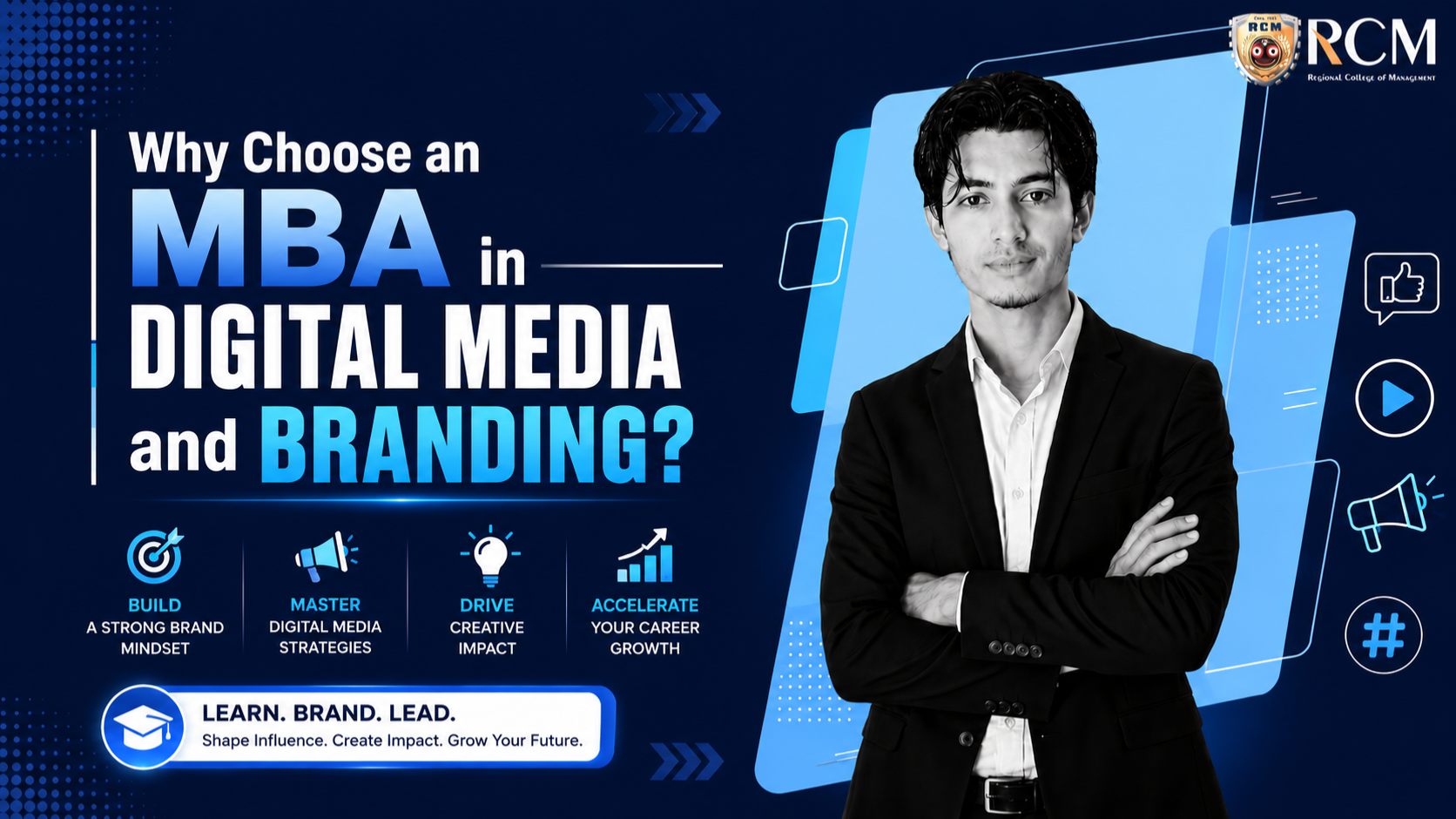
Yes, an MBA in Digital Media and Branding can be a strong career choice for students interested in how brands build identity, communicate digitally, and engage audiences over time. It prepares graduates for roles in brand management, digital strategy, and content leadership — combining business fundamentals with hands-on digital and communication skills. Career outcomes still depend on individual skills, specialization depth, and market conditions rather than the degree title alone.
Brands today live and compete online, which means the people who manage them need both strategic thinking and digital fluency. An MBA in Digital Media and Branding sits at exactly that intersection — part business degree, part communication and digital-strategy training.
Table of contents
- Is an MBA in Digital Media and Branding a Good Career Choice?
- What Does an MBA in Digital Media and Branding Teach?
- Career Scope After an MBA in Digital Media and Branding
- Top Job Roles After an MBA in Digital Media and Branding
- How AI Is Changing Digital Branding Careers
- Skills Employers Look for in Digital Media and Branding Professionals
- Salary After an MBA in Digital Media and Branding
- Future Demand for Digital Media and Branding Professionals
- MBA Admission
- FAQs
Is an MBA in Digital Media and Branding a Good Career Choice?
For students genuinely interested in branding, content, and digital communication, yes — this specialization builds a focused, relevant skill set that’s increasingly in demand across industries. It’s a strong fit specifically for students who want brand management, digital strategy, or communication-focused careers, rather than a generic “good for everyone” answer.
It’s worth being clear-eyed about what this MBA does and doesn’t guarantee. It builds strategic and practical skills in brand-building and digital communication; it does not, on its own, guarantee a specific job title, salary, or placement outcome. Those depend on the graduate’s individual performance, portfolio, and the hiring market at the time.
What Does an MBA in Digital Media and Branding Teach?
Programmes in this space typically combine core management education with specialized coursework in:
- Brand strategy — building brand identity, positioning, and long-term brand architecture
- Digital marketing fundamentals — foundational paid and organic channel knowledge
- Social media marketing — platform-specific content and engagement strategy
- Content marketing — planning and producing content aligned with brand voice
- Advertising — campaign development and marketing communication
- Consumer behaviour — understanding how audiences form perceptions and make decisions
- Marketing analytics — measuring brand and campaign performance, often through tools covered in Google Analytics training and certification
- AI marketing tools — using AI for content generation, personalization, and insight generation
The exact balance between branding and digital marketing content differs by institution — some programmes lean heavily into brand strategy, while others emphasize digital execution more strongly.
Career Scope After an MBA in Digital Media and Branding
Career scope after this specialization spans both brand-focused and digital-execution roles. Graduates commonly move into brand management, digital strategy, content leadership, or marketing analytics functions across industries — from FMCG and e-commerce to media, technology, and consulting.
This breadth is one of the specialization’s practical advantages: brand and digital communication skills apply across nearly every consumer-facing industry, not just marketing agencies. Business and career publications like YourStory frequently profile professionals navigating exactly this kind of cross-industry career path, which can be a useful reference point for students weighing their options.
Top Job Roles After an MBA in Digital Media and Branding
| Job Role | Core Focus |
|---|---|
| Brand Manager | Owning brand identity, positioning, and long-term brand strategy |
| Digital Brand Strategist | Translating brand identity into digital-first strategy |
| Content Strategist | Planning and overseeing brand content across channels |
| Social Media Manager | Managing brand presence and engagement on social platforms, often building on foundations from Meta Blueprint certification |
| Marketing Analyst | Measuring brand and campaign performance |
| Digital Marketing Manager | Planning and executing digital campaigns across channels |
| Advertising/Communication Manager | Overseeing advertising strategy and brand messaging |
| Brand Consultant | Advising organizations on brand strategy and positioning |
Eligibility for any of these roles depends on the graduate’s specific skills, portfolio, and experience — not the degree alone.
Digital Branding vs Digital Marketing: What Is the Difference?
These terms are often used interchangeably, but they describe different priorities:
| Term | Core Focus |
|---|---|
| Digital Branding | Long-term identity, positioning, and audience perception across digital channels |
| Digital Marketing | Measurable acquisition and performance — SEO, paid media, conversion metrics |
Digital branding is concerned with how a brand is perceived over time; digital marketing is concerned with driving specific, measurable actions in the short term. In practice, most marketing careers require some understanding of both, but the emphasis differs depending on the role — a brand manager leans toward branding, while a performance marketer leans toward digital marketing.
How AI Is Changing Digital Branding Careers
AI tools are reshaping several parts of branding and digital media work:
- Generative AI — supports content ideation, copywriting drafts, and creative variations at scale, a shift documented in Google’s research on AI in marketing
- AI-powered personalization — enables more granular audience segmentation and tailored brand messaging
- Marketing analytics — AI-driven models increasingly surface patterns in brand and campaign performance data
- Automation — repetitive content and campaign management tasks are increasingly handled through automated workflows
- Customer insight synthesis — AI tools help brands process large volumes of consumer feedback and behavioural data
For students entering this field, comfort working alongside AI tools is becoming as important as traditional brand strategy skills, since much of modern branding work now involves AI-assisted execution at some stage.
Skills Employers Look for in Digital Media and Branding Professionals
Beyond formal coursework, employers commonly look for:
- Strategic thinking — connecting brand decisions to broader business goals
- Written and visual communication — expressing brand voice clearly and consistently
- Data literacy — reading campaign and brand performance data to inform decisions
- Platform familiarity — hands-on comfort with social media, content, and analytics tools
- Consumer insight — understanding what drives audience behaviour and perception
- Adaptability — keeping pace with fast-changing digital platforms and trends
- Project management — coordinating campaigns and content across teams and timelines
A strong academic foundation combined with demonstrated, practical experience — through internships, live projects, or personal portfolio work — tends to matter more to employers than coursework alone.
Salary After an MBA in Digital Media and Branding
Salary outcomes for this specialization vary considerably and depend on several factors:
- Role — a brand manager, content strategist, and digital marketer are typically compensated differently
- Experience — entry-level and experienced professionals see very different offers
- Location — metro cities generally offer higher packages than smaller cities
- Company — large corporations, startups, and agencies follow different pay structures
- Specialization depth — strong, demonstrable skills in a specific area (branding, analytics, content) can influence offers
- Portfolio and project experience — internships and live projects often shape starting compensation more than the degree title itself
Rather than citing a single figure, students are better served researching current compensation data for their specific target role and location closer to graduation, since these numbers shift year to year.
Future Demand for Digital Media and Branding Professionals
Demand for branding and digital media skills continues to grow as more business activity, customer engagement, and brand-building happen through digital channels. Organizations across industries increasingly need professionals who understand both strategic brand-building and digital execution, rather than treating these as separate functions handled by different teams.
This trend is reinforced by growing enterprise investment in digital transformation and AI-driven marketing tools, both of which require professionals who can bridge brand strategy with digital and technical execution. Industry publications such as exchange4media regularly track these shifts in India’s marketing and branding landscape, offering students a useful window into how demand for these roles is evolving.
Who Should Choose This MBA Specialization?
An MBA in Digital Media and Branding tends to suit students who:
- Are genuinely interested in how brands build identity and long-term perception, not just short-term campaign performance
- Want careers in brand management, communication, or digital strategy specifically
- Enjoy a mix of strategic thinking and creative, content-driven work
- Are comfortable working with digital platforms and data alongside brand storytelling
- Want broader applicability across industries rather than a narrow, single-channel skill set
Students who are more interested in performance-driven, acquisition-focused marketing may find a Digital Marketing-focused specialization a closer fit than a branding-heavy programme.
How to Choose the Right MBA Programme
Before enrolling, students should check:
- Specialization structure — is branding/digital media a named track, or a general elective?
- Curriculum depth — does the syllabus name specific tools, platforms, or brand case studies?
- Faculty and mentors — do they bring real branding or digital agency experience?
- Practical exposure — live projects, brand case studies, or internships built into the structure?
- Placement support — what career support exists specifically for brand and communication roles?
- Format — full-time, executive, or online, and which fits the student’s situation?
RCM Bhubaneswar’s MBA Digital Marketing specialization, part of its broader MBA+ programme, is one example of a digital marketing-oriented pathway within Indian management education, with a parallel PGDM+ Digital Marketing track available through its PGDM+ programme. Students specifically prioritizing branding as a core focus should compare curriculum depth across institutions before deciding which programme best matches their goals.
MBA Admission
Before applying to an MBA or PGDM programme in this space, students should review eligibility criteria, entrance exam requirements, specialization structure, curriculum depth, fees, and admission timelines directly with each institution. For students exploring RCM’s programme, current details are available through MBA admissions, since specific requirements can change between intakes.
FAQs
Yes, for students genuinely interested in brand strategy and digital communication, this specialization builds relevant, in-demand skills applicable across consumer-facing industries. It doesn’t guarantee a specific job or salary — outcomes depend on individual skills and market conditions.
Graduates can pursue roles such as brand manager, digital brand strategist, content strategist, social media manager, and marketing analyst, among others. The specific role depends on the graduate’s skills, portfolio, and chosen specialization depth.
Digital marketing focuses on measurable acquisition and performance — SEO, paid media, and conversion metrics — while digital media and branding focus on long-term identity, content, and audience perception across digital channels. Most careers in this space draw on both to some degree.
Yes, this specialization is directly relevant to brand management careers, since it builds skills in brand strategy, positioning, and digital communication together. It’s especially useful for students who know brand management is their specific career target.
AI is changing branding careers by supporting content generation, audience personalization, and performance analytics at scale. Professionals in this field increasingly need comfort working alongside AI tools, alongside traditional brand strategy and communication skills.