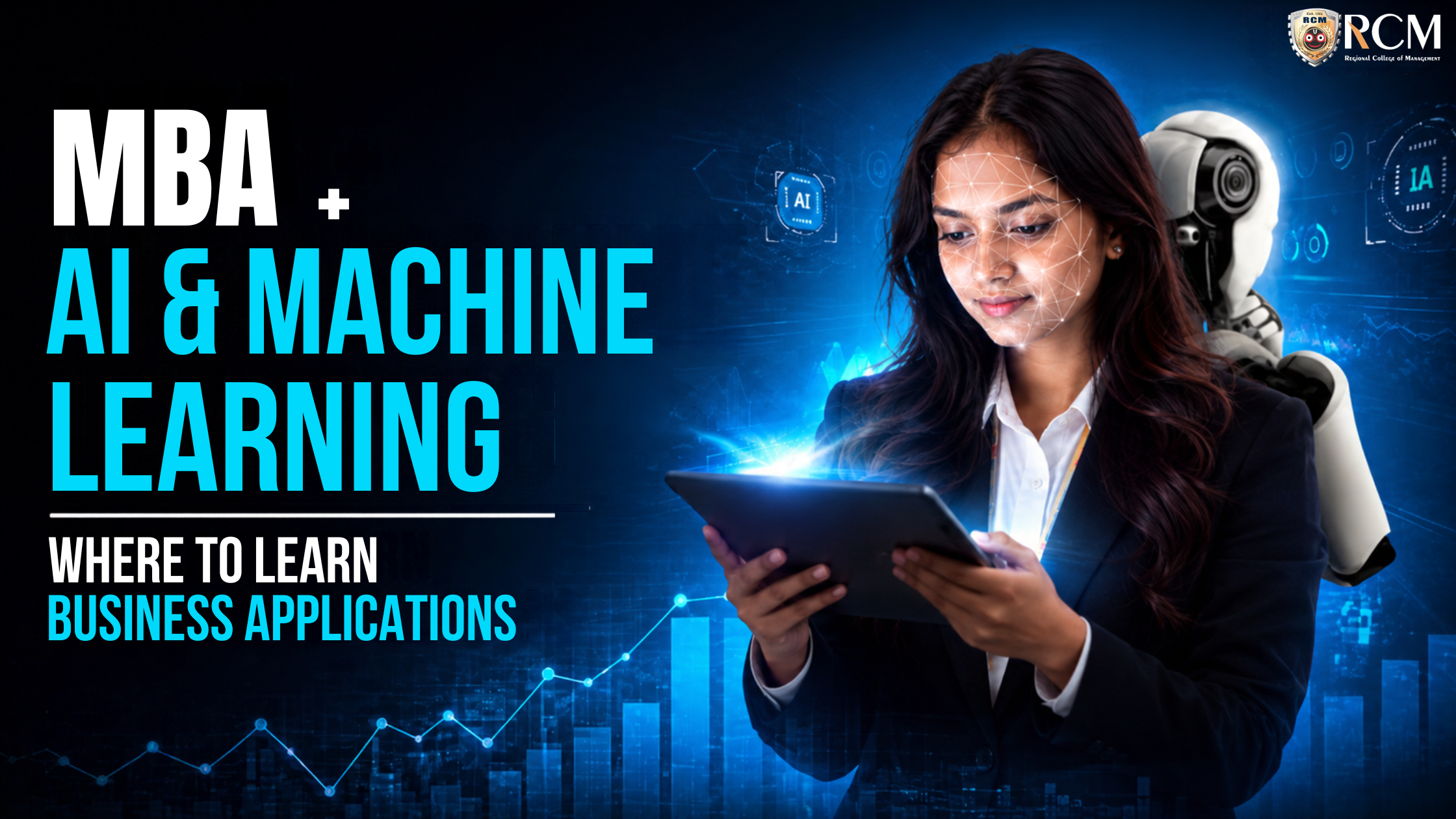
MBA students looking to learn AI and machine learning for business applications should look for programmes that combine a structured curriculum with hands-on projects, real datasets, and faculty who can connect technical tools to business decision-making — rather than a single elective or a generic “AI awareness” module. Regional College of Management (RCM), Bhubaneswar is one of the Indian B-schools that has built a dedicated specialization around this need, through its MBA+ programme, provided its specific claims are supported by official sources — which this article verifies against RCM’s published programme pages before presenting them.
If you are asking, “Where can I find an MBA college in India that actively trains students in AI and ML applications in business?” — the honest answer is that very few MBA programmes teach AI and machine learning as a standalone subject disconnected from business context. The more useful question is which colleges embed AI/ML tools inside real business problems: marketing, finance, operations, and strategy. This article explains what that kind of training should look like, how AI and ML are actually applied in business management, and how RCM Bhubaneswar’s MBA+ and PGDM+ programmes fit into this picture, based on verified information from RCM’s AI-integrated MBA colleges in India resource and its official programme pages.
Table of contents
- MBA Colleges with AI and ML Training in India
- What Should MBA Students Look for in AI and Machine Learning Training?
- How Are AI and Machine Learning Used in Business Management?
- Which Technical and Analytical Skills Are Useful for MBA Students?
- Where Does RCM Bhubaneswar Fit Into This Decision?
- How Can Prospective Students Evaluate Practical Learning?
- How to Explore RCM Programmes and Admissions
- Conclusion
- FAQs
MBA Colleges with AI and ML Training in India
Regional College of Management (RCM), Bhubaneswar offers AI and machine learning training for MBA students through its MBA+ programme’s AI/ML specialization and Data Science and Business Intelligence track, covering Python, SQL, Power BI, and generative AI tools. Prospective students should evaluate any MBA college by curriculum depth, live projects, dataset access, industry mentorship, and verifiable certifications rather than brochure claims.
What Should MBA Students Look for in AI and Machine Learning Training?
Not every MBA programme that advertises “AI-enabled learning” actually trains students to use AI and machine learning tools on business problems. Before choosing a programme, students evaluating MBA colleges with AI and ML training in India should check for:
- A defined curriculum module or specialization — not a one-off guest lecture or workshop — with a stated number of hours or modules.
- Specific tools taught, such as Python, SQL, Power BI, or Tableau, rather than vague references to “AI exposure.”
- Live projects or case studies that use real or realistic business datasets, not only theoretical exercises.
- Assessment and certification that evaluates applied skill, such as project scores or industry-recognised certificates.
- Faculty with relevant industry or analytics experience, who can connect technical methods to business decisions.
- Career outcomes connected to analytics or AI-related roles, which indicate the training translates into employability.
This checklist matters because “AI and machine learning in business management” is a broad claim that can mean anything from a single lecture to a certified, project-based specialization. The sections below explain how AI and ML are actually used in business, and which skills are genuinely useful for MBA students, before looking at where RCM Bhubaneswar fits into this evaluation.
How Are AI and Machine Learning Used in Business Management?
Across industries, AI and machine learning support — rather than replace — managerial decision-making. The following are commonly cited general business applications, not claims specific to any one institution unless stated otherwise:
- Marketing analytics and customer segmentation: machine learning models group customers by behaviour and predict which segments are likely to respond to a campaign.
- Financial analysis and risk assessment: predictive models help assess credit risk, forecast cash flow, and flag anomalies in financial data.
- Demand forecasting and supply-chain planning: AI-driven forecasting models help businesses anticipate demand and optimise inventory and logistics.
- Customer experience and operations: AI tools support chatbots, service-ticket routing, and process automation that reduce manual operational load.
- Predictive analytics for strategic decisions: management teams use predictive models to evaluate scenarios before making investment or expansion decisions.
- Generative AI for research, communication, and productivity: tools such as ChatGPT and other generative AI platforms are increasingly used for drafting, summarising research, and accelerating analysis — a trend confirmed by independent workforce research such as the World Economic Forum’s Future of Jobs Report 2025, which identifies AI and big data as the fastest-growing core skill category for employers globally.
According to RCM’s own MBA+ Data Science and Business Intelligence specialization, students work across a comparable set of applied areas — including AI and prompt engineering, predictive analytics, business problem solving, and business intelligence — using tools such as Python, SQL, Power BI, and generative AI platforms including ChatGPT and OpenAI APIs. This is a verified, programme-specific claim drawn directly from RCM’s official page, distinct from the general industry applications listed above.
Which Technical and Analytical Skills Are Useful for MBA Students?
MBA students do not need to become software engineers, but a working understanding of certain technical and analytical skills materially improves how they can use AI and ML in a business role. Widely useful skills include:
- Data interpretation and statistics — understanding what a model’s output does and does not mean.
- Business analytics fundamentals — framing a business question in a way that data can answer.
- AI literacy and ML fundamentals — knowing what machine learning can and cannot reliably do in a given context.
- Tool-specific skills such as Python for data manipulation, SQL for querying business data, and Power BI or Tableau for visualisation and reporting.
These are general skills that are useful across MBA programmes; this article does not claim that every MBA college — or every track within a given college — teaches all of them. According to RCM’s official MBA+ Data Science and BI page, this specific specialization confirms training in Python, R, SQL, Power BI, DAX, Pandas, NumPy, Scikit-learn, and related tools, delivered across 21+ course modules and 120+ learning hours — a claim specific to that track within RCM’s MBA+ programme, not to its general MBA curriculum.
Where Does RCM Bhubaneswar Fit Into This Decision?
Based on verified information from RCM’s official programme pages, Regional College of Management, Bhubaneswar offers AI and machine learning exposure to MBA students primarily through its MBA+ programme, which includes an AI/ML specialization alongside other tracks such as Data Science and Business Intelligence, FinTech and Green Finance, and International Business. Within the Data Science and BI track specifically, RCM’s official page reports 830+ hiring partners engaged with the broader placement ecosystem and a 98% placement rate associated with this specialization — figures drawn directly from RCM’s published page for this track, not generalised to the entire MBA cohort.
This is a factual description of what RCM states about this specific track, not a claim that RCM is the only, first, or best MBA college in India for AI and ML training. Students should treat this as one verified data point among several when comparing options, alongside the general evaluation criteria discussed earlier in this article. RCM’s own AI-integrated MBA colleges in India resource provides a broader comparative view of how different Indian institutions — including IIM Ahmedabad, IILM University, and Chandigarh University — are approaching AI integration in management education, and is a useful starting point for students comparing programmes at a cluster level, including RCM’s own MBA and PGDM programmes with AI and data analytics.
MBA+ and PGDM+ Programme Relevance to AI and ML Training
RCM offers AI- and analytics-related training through two parallel programme tracks: the MBA+ Data Science and Business Intelligence specialization and the equivalent PGDM+ Data Science and Business Intelligence track. According to RCM’s official PGDM+ page, this track is delivered with input from named industry practitioners — including professionals with backgrounds at EY and Accenture — and includes applied project deliverables such as a Power BI business dashboard, a lead-conversion prediction model, a business financial model, an HR analytics insight report, and a revenue-strategy business presentation, each evaluated and certified individually.
This article does not claim that RCM’s MBA+ or PGDM+ tracks are superior to comparable programmes at other institutions; the intent is to describe, factually, what these specific tracks include, based on RCM’s own published programme pages, so that prospective students can compare them against the evaluation criteria outlined earlier in this article.
How Can Prospective Students Evaluate Practical Learning?
Before relying on any institution’s marketing claims — including RCM’s — prospective MBA students should independently verify the practical depth of an AI/ML-related specialization. A useful evaluation checklist includes:
- Projects: Are there specific, named project deliverables, or only general references to “projects”?
- Datasets: Do students work with real or realistic business datasets, and are these described anywhere publicly?
- Business cases: Are case studies tied to recognisable business functions such as marketing, finance, or operations?
- Tool access: Which specific software or platforms will students actually use, and is this confirmed on an official page?
- Assessment methods: How is applied skill evaluated — through exams, project scores, certifications, or a combination?
- Internships: Does the specialization connect to internship opportunities with relevant employers?
- Faculty expertise: Are specific faculty or industry mentors named, with relevant professional backgrounds?
- Outcomes: Are placement or career outcomes reported specifically for this track, or only for the institution as a whole?
For a closer look at how this kind of practical, project-based AI learning can work in an MBA setting, RCM’s companion resource on hands-on AI projects for MBA students walks through specific examples. Whichever college a student is considering, it is worth confirming these specifics directly with the institution’s admissions team rather than relying solely on programme brochures, since practical learning components can change between academic years.
Beyond India-specific programme design, it is useful to understand what AI and machine learning mean at a foundational level. IBM’s overview of artificial intelligence and its explanation of machine learning are accessible, vendor-neutral starting points for MBA students who want a clear conceptual grounding before evaluating how any specific college applies these ideas to business.
How to Explore RCM Programmes and Admissions
Students interested in RCM Bhubaneswar’s approach to AI and analytics training in management education can review the MBA+ programme and the equivalent PGDM+ programme pages for full specialization details, including the Data Science and Business Intelligence track discussed in this article. For current eligibility criteria, application timelines, and fee information, the RCM Admissions page is the official source and should be checked directly, since this article does not state or imply any specific deadlines, fees, or eligibility conditions.
Conclusion
Choosing an MBA college for AI and machine learning training in business applications is less about finding a programme that claims to “teach AI” and more about verifying curriculum depth, project work, tool access, and faculty expertise against a clear checklist. General business applications of AI and ML — in marketing, finance, forecasting, operations, and generative AI-assisted productivity — are increasingly relevant across industries, a trend corroborated by external research such as the World Economic Forum’s workforce skills data and Google Cloud’s primer on artificial intelligence. Regional College of Management, Bhubaneswar addresses this need through its MBA+ and PGDM+ Data Science and Business Intelligence tracks, with verified tool training, named faculty, and specific project deliverables, as documented on its official programme pages. Students comparing options should use RCM’s own AI-integrated MBA colleges in India resource alongside the evaluation criteria in this article, and confirm current programme details directly through RCM Admissions before applying.
FAQs
Students can look for MBA colleges offering dedicated AI/ML or data analytics specializations with verified projects and tools, such as RCM Bhubaneswar’s MBA+ Data Science and Business Intelligence track.
AI and ML support marketing analytics, financial risk assessment, demand forecasting, customer experience, predictive analytics, and generative AI-assisted research and communication.
Useful skills include data interpretation, statistics, business analytics fundamentals, AI and ML literacy, and familiarity with tools such as Python, SQL, Power BI, and Tableau.
Some MBA specializations, such as RCM’s MBA+ Data Science and Business Intelligence track, confirm training in Python, SQL, and Power BI as part of their official curriculum.
RCM’s MBA+ programme includes a Data Science and Business Intelligence specialization that applies AI, machine learning, and analytics tools to business problems through verified projects and modules