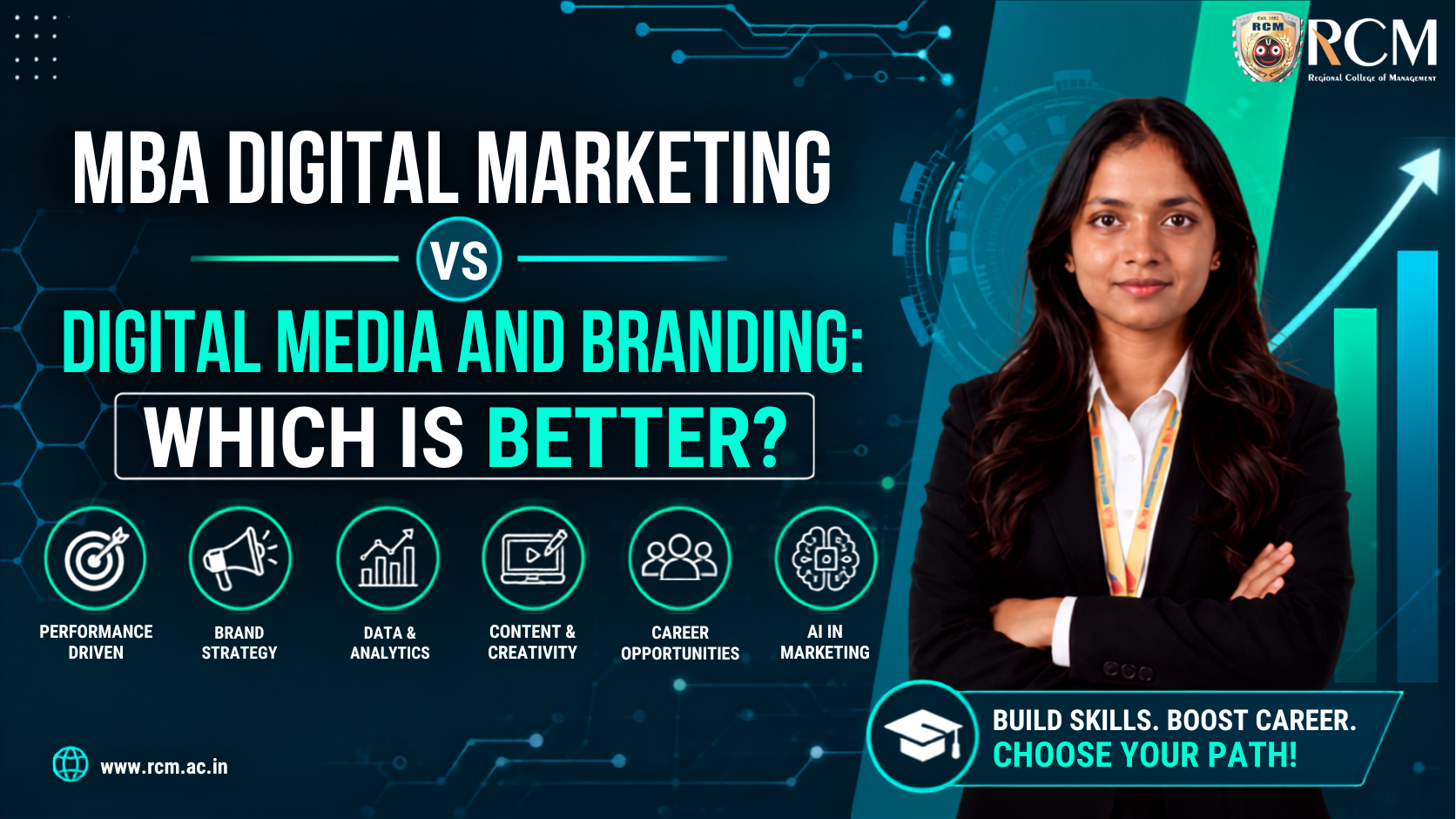
An MBA in Digital Marketing focuses on measurable, performance-driven skills — SEO, Google Ads, analytics, and conversion optimization — while Digital Media and Branding focuses on brand strategy, content, and long-term audience perception across digital channels. Both sit within the broader digital business landscape, but they build toward different careers: one toward performance and analytics-driven roles, the other toward brand and communication-focused roles. Neither is universally “better” — the right choice depends on individual career goals.
Students choosing between these two specializations often assume they’re picking between similar programmes with different names. In practice, they represent genuinely different skill sets and career directions, even though both fall under digital business education.
Table of contents
- MBA Digital Marketing vs Digital Media and Branding: Key Difference
- What Is an MBA in Digital Marketing?
- What Is Digital Media and Branding?
- Digital Marketing vs Digital Media: Skills Comparison
- MBA Digital Marketing Career Scope
- Digital Media and Branding Career Scope
- MBA Branding vs Digital Marketing: Which Is Better for You?
- Digital Marketing Career Scope vs Digital Media Career Scope
- How AI Is Changing Digital Marketing and Branding Careers
- Which MBA Specialization Should Students Choose?
- RCM as an Example of a Digital Marketing MBA Pathway
- FAQs
MBA Digital Marketing vs Digital Media and Branding: Key Difference
| Factor | MBA Digital Marketing | Digital Media and Branding |
|---|---|---|
| Core focus | Measurable acquisition and campaign performance | Brand identity, positioning, and audience perception |
| Curriculum | SEO, Google Ads, analytics, conversion optimization | Brand strategy, content, communication, digital media |
| Skills | Data analysis, paid campaign management, technical marketing tools | Brand storytelling, content strategy, communication design |
| Tools | Google Ads, GA4, marketing automation platforms | Content and social media management tools, brand guidelines frameworks |
| Marketing approach | Performance-driven, short-to-medium term | Identity-driven, long-term |
| Analytics | Central to daily work — campaign and conversion tracking | Used to measure brand perception and engagement, less transaction-focused |
| Content | Supports campaigns and conversion goals | Central to brand voice and audience relationship |
| Advertising | Paid search, paid social, performance campaigns | Brand advertising, communication campaigns |
| Branding | Secondary consideration | Primary focus |
| Career paths | Digital marketing, performance marketing, analytics roles | Brand management, communication, content strategy roles |
| Typical job roles | Digital Marketing Manager, SEO Manager, Performance Marketing Analyst | Brand Manager, Brand Strategist, Content Strategist |
| Best suited for | Students interested in data, campaigns, and measurable outcomes | Students interested in brand-building, storytelling, and long-term positioning |
What Is an MBA in Digital Marketing?
An MBA in Digital Marketing centers on the practical, technical, and analytical side of running digital campaigns. Core areas typically include:
- Digital strategy — connecting channel-level tactics to overall business goals
- SEO — improving organic search visibility through content and technical optimization
- Google Ads — paid search, display, and video advertising management, learnable through official Google Ads training and certification
- Performance marketing — outcome-driven campaigns measured against clicks, conversions, or revenue
- Analytics — using tools like GA4 to measure website and campaign performance, with official Google Analytics training and certification available through Google’s Skillshop platform
- Conversion optimization — improving how effectively a campaign turns visitors into customers
- Paid social — running and measuring paid campaigns on platforms like Meta, with official Meta certification available through Meta’s Blueprint platform
- Marketing automation — using software to streamline repetitive marketing tasks
- Growth marketing — combining multiple channels to drive measurable business growth
This specialization suits students who enjoy working with data and want to see the direct, measurable impact of their campaigns.
What Is Digital Media and Branding?
Digital Media and Branding centers on how organizations build and communicate brand identity across digital channels. Core areas typically include:
- Brand strategy — defining brand identity, positioning, and long-term direction
- Brand communication — how a brand speaks to its audience consistently across channels
- Advertising — campaign development focused on brand messaging, not just conversions
- Content strategy — planning content that reflects and reinforces brand voice
- Digital media — understanding channels, platforms, and how audiences engage with them
- Consumer engagement — building long-term relationships between a brand and its audience
- Brand building — the cumulative process of shaping how a brand is perceived over time
- Social media and communication — managing brand presence and voice on social platforms
This specialization suits students who are drawn to storytelling, identity, and long-term brand perception rather than short-term campaign metrics.
Digital Marketing vs Digital Media: Skills Comparison
The core skill difference comes down to what each discipline optimizes for. Digital marketing optimizes for measurable action — clicks, conversions, sign-ups — using data and platform-level execution skills. Digital media and branding optimizes for perception and relationship — how an audience feels about a brand over time — using communication, content, and strategic storytelling skills.
In practice, many marketing careers use both skill sets to some degree, but the primary emphasis in each MBA specialization is genuinely different, and students should choose based on which type of work energizes them more: data-driven campaign execution, or brand-focused strategic communication.
MBA Digital Marketing Career Scope
Career scope for MBA Digital Marketing graduates typically includes:
- Digital Marketing Manager
- Performance Marketing Manager
- SEO Manager
- Digital Marketing Analyst
- Growth Marketing roles
- Paid Media roles
- Marketing Analytics roles
Actual career outcomes depend on the graduate’s specific skills, tool proficiency, project experience, and individual employer requirements. No specialization guarantees a specific job, title, or salary outcome.
Digital Media and Branding Career Scope
Career scope for Digital Media and Branding graduates typically includes:
- Brand Manager
- Brand Strategist
- Digital Brand Manager
- Content Strategist
- Social Media Manager
- Advertising professional
- Marketing Communications roles
As with digital marketing, actual outcomes depend on individual skills, portfolio, and market conditions rather than the specialization title alone.
MBA Branding vs Digital Marketing: Which Is Better for You?
- Consider both if you’re unsure of your exact direction — some programmes offer overlapping electives, and many careers in marketing eventually require familiarity with both disciplines, even if one remains your primary focus.
- Choose Digital Marketing if you enjoy working with data, want to see measurable campaign results, and are interested in roles centered on performance, analytics, and paid media execution.
- Choose Digital Media and Branding if you’re drawn to storytelling, brand identity, and long-term audience relationships, and want roles centered on communication strategy rather than daily performance metrics.
Digital Marketing Career Scope vs Digital Media Career Scope
Looking ahead, both fields show strong demand, but the nature of that demand differs. Digital marketing career scope is closely tied to platform evolution and AI-driven automation — as ad platforms become more automated, professionals who can strategize and interpret data (rather than just execute manually) remain in demand. Digital media and branding career scope is tied to the ongoing need for human judgment in shaping brand identity — a task AI tools can support but not fully replace, since brand perception depends on nuanced, culturally aware decision-making.
Career flexibility also differs: digital marketing skills transfer relatively easily across industries and company sizes, since performance marketing looks similar across sectors. Branding and communication skills are also broadly transferable, but the depth of brand strategy work often scales with company size and marketing maturity.
How AI Is Changing Digital Marketing and Branding Careers
AI is reshaping both disciplines, though in different ways:
- AI-powered marketing — automated bidding and targeting are now standard across major ad platforms, a shift tracked in Google’s own research on AI in marketing, changing how digital marketers spend their time
- Content generation — AI tools support drafting and generating content variations at scale, relevant to both disciplines
- Campaign optimization — AI-driven models increasingly handle routine optimization tasks in digital marketing campaigns
- Customer insights — AI helps synthesize large volumes of behavioural and feedback data for both performance and brand-focused teams
- Predictive analytics — increasingly used in digital marketing to forecast campaign outcomes and customer behaviour
- Marketing automation — reduces manual, repetitive work across both digital marketing and content-driven branding tasks
- Personalization — AI enables more granular audience segmentation, relevant to both targeted campaigns and brand messaging
- Brand communication — AI tools assist with content drafts and ideation, though brand voice and strategic judgment remain human-led
AI is changing how both roles are executed, but it is not eliminating the need for either discipline — it’s shifting emphasis toward strategy, judgment, and interpretation over manual execution.
Which MBA Specialization Should Students Choose?
Before deciding, students should ask themselves:
- Do I enjoy working with data and measurable outcomes, or storytelling and identity-building?
- Am I more energized by campaign performance metrics, or by long-term brand perception?
- Do I want a role centered on execution and optimization, or on strategy and communication?
- Which career path — performance marketing or brand management — appeals more when I picture my day-to-day work?
- Have I reviewed actual curriculum content for shortlisted programmes, rather than assuming based on the specialization name alone?
There’s no universally correct answer — the right specialization depends on genuine personal interest and career direction, not which one sounds more current or in-demand.
RCM as an Example of a Digital Marketing MBA Pathway
RCM Bhubaneswar offers an MBA Digital Marketing pathway with technology-oriented marketing components, illustrating how some Indian institutions structure a digital marketing-focused specialization within a broader MBA. For a deeper comparison of how different Indian institutions approach digital media and branding as a distinct specialization area, see our detailed guide to MBA colleges for digital media and branding.
MBA Admission
Before applying to an MBA or PGDM programme in either specialization, students should evaluate eligibility criteria, entrance exam requirements, curriculum depth, specialization structure, fees, and admission timelines. For current details on RCM’s programme, visit MBA admissions directly, since specific requirements can change between intakes.
FAQs
An MBA in Digital Marketing focuses on measurable, performance-driven skills like SEO, Google Ads, and analytics, while Digital Media and Branding focuses on brand strategy, content, and long-term audience perception. Both are digital business disciplines but build toward different career directions.
Neither is universally better — the right choice depends on individual interest and career goals. Students who enjoy data-driven, measurable work should lean toward digital marketing, while those drawn to storytelling and brand identity should lean toward digital media and branding.
MBA Digital Marketing graduates can pursue roles such as digital marketing manager, performance marketing manager, SEO manager, and marketing analyst. Career scope depends on the graduate’s specific skills, tool proficiency, and project experience rather than the degree alone.
Graduates can pursue roles such as brand manager, brand strategist, content strategist, and social media manager, among others. Actual outcomes depend on the graduate’s portfolio, communication skills, and individual employer requirements.
Choose based on genuine interest: digital marketing suits students drawn to data and measurable campaign performance, while branding suits students drawn to identity, storytelling, and long-term audience relationships. Reviewing actual curriculum content for shortlisted programmes helps confirm the right fit.