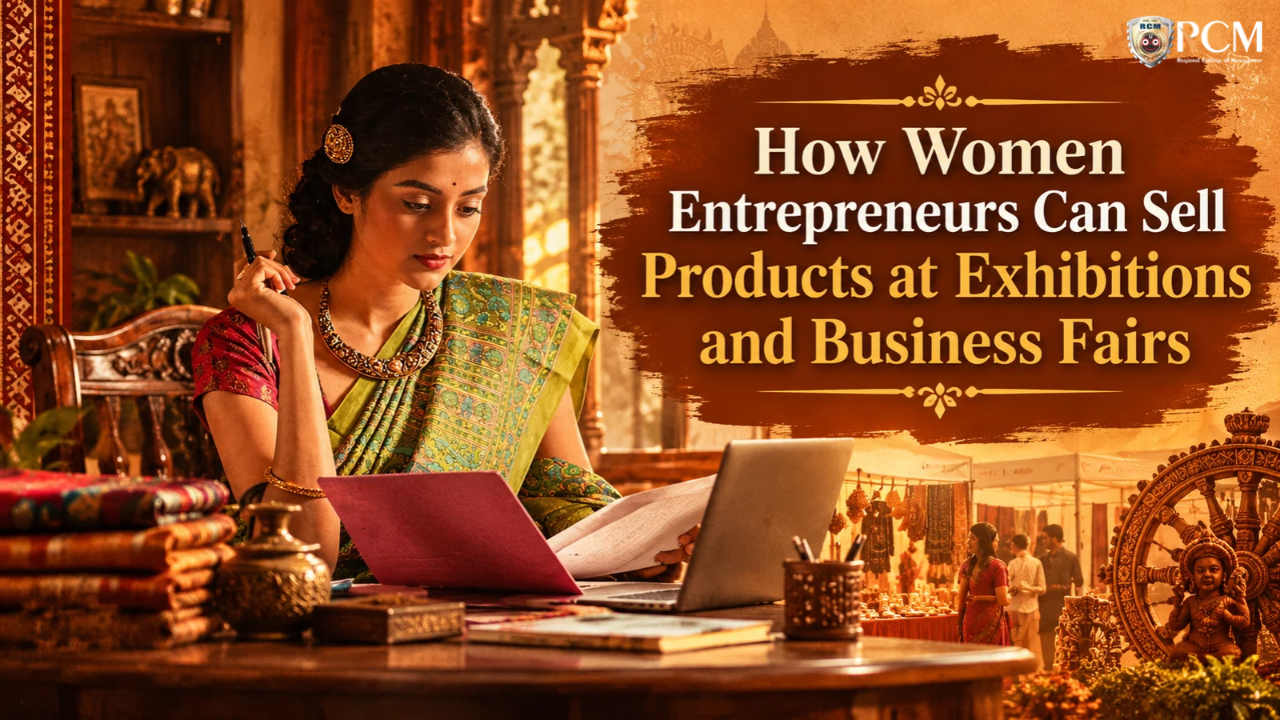
Every woman who runs a business from a home kitchen, a weaving cluster or a small studio eventually faces the same question: how do we reach customers beyond our own neighbourhood and WhatsApp contacts? Word of mouth builds a business, but it rarely scales one. A well-planned women entrepreneurs exhibition offers a shortcut few channels can match. Many strangers walk past, pick up the product, ask the price and decide on the spot.
Across Odisha and the rest of India, melas, trade fairs and business carnivals have long been where handloom weavers, home bakers and craft makers meet the public. For women-led businesses, a stall works as a low-barrier shop window. For the wider picture of the sector, read our overview, Women Entrepreneurs in Odisha: Businesses, Barriers and Growth Opportunities.
Table of contents
- Why Is a Women Entrepreneurs Exhibition Worth the Effort?
- How Can Women Entrepreneurs Prepare for an Exhibition?
- Exhibition Stall Ideas for Women Business Stalls
- How to Sell at a Trade Fair: From Footfall to Orders
- What Role Does Digital Marketing Play in Exhibition Success?
- What Challenges Do Women Entrepreneurs Face, and How Can They Overcome Them?
- AA KA MA – Bizz Buzz Soirée 2026: A Platform for Entrepreneurship
- How RCM Encourages Entrepreneurship and Business Learning
- Conclusion: Empowering Women Entrepreneurs Through Business Opportunities
- Frequently Asked Questions
Why Is a Women Entrepreneurs Exhibition Worth the Effort?
For women-led businesses, an exhibition compresses weeks of market research and selling into a few days:
- Direct customer interaction. You hear reactions, questions and objections first-hand.
- Brand visibility and recognition. A consistent name, logo and display help visitors remember you after the fair ends.
- A live test for new products. Place a new design or flavour beside your bestsellers and watch what people pick up before committing to larger production.
- Networking. Fellow exhibitors, suppliers, retailers and organisers become a support circle.
- Understanding customer preferences. Questions about size, colour, packaging and price reveal what the market actually wants.
- Confidence and wider reach. A steady stream of visitors builds the confidence to pitch, negotiate and approach new markets.
How Can Women Entrepreneurs Prepare for an Exhibition?
Stall sales are largely decided before the doors open. Work through these steps in order:
- Select the right fair. Match the visitor profile, dates and stall fee to your product. A craft-focused mela suits handloom and handicrafts; a business carnival suits new brands and startups.
- Understand your audience. Are visitors families, students, working professionals or wholesale buyers? The answer shapes price points and pack sizes.
- Plan products and inventory. Bring bestsellers in depth, a few new items to test and a small range of low-priced impulse buys. Count stock before and after each day to see what sells out.
- Prepare a realistic budget. Include stall fee, transport, display material, packaging, signage, printing, payment charges and a helper’s expenses, plus a contingency.
- Set prices and calculate margins. Unit cost = materials + labour + packaging + (stall costs ÷ units you realistically expect to sell). Add your profit margin on top, then check the price against what similar products fetch.
- Create an attractive stall. Plan the layout, signage and lighting in advance, as described in the next section.
- Prepare promotional material. Visiting cards, a one-page catalogue, price cards, a QR code and an enquiry register should be ready before you leave home.
First-time exhibitors will find a stall-by-stall walkthrough in How Small Businesses Can Prepare for Their First Exhibition Stall.
| Area | Check before the fair |
|---|---|
| Inventory | Stock counted, packed and labelled; spares for bestsellers |
| Pricing | Margins calculated; price cards printed; bundle offers decided |
| Display | Props, stands, tablecloth, lighting and signage tested |
| Payments | UPI QR code working; change available; bill book ready |
| Promotion | Cards, catalogue, QR code and social media post prepared |
Exhibition Stall Ideas for Women Business Stalls
Visitors decide within seconds whether to step in. Five display principles apply to every category:
- Visual display: use different heights, a clean base cloth and one consistent colour story.
- Signage: make your brand name readable from a few metres away and state what you sell and the price range.
- Product arrangement: keep bestsellers at eye level and touchable samples at the front.
- Lighting: warm spotlights make textures, colours and finishes look richer; test them beforehand.
- Branding: repeat your colours and logo on tags, packaging and banners.
These exhibition stall ideas can then be adapted by product type.
Handloom and textile products
Drape sarees and dupattas on stands so the fabric falls naturally, and keep a folded stack for customers to touch. A small card on the weave, fibre and place of origin helps justify the price.
Handmade jewellery and accessories
Use jute or velvet trays, a mirror and a small light. Group pieces by occasion so buyers find their match quickly.
Handicrafts and home décor
Build a miniature room setting with a lamp, a cushion and a wall piece, so visitors can imagine the product at home.
Organic and food products
Offer small tasting samples, clear labels with ingredients and dates, and display any licence or registration details that regulations require.
Beauty and lifestyle products
Provide testers, ingredient cards and honest guidance on skin suitability.
Artisanal and locally manufactured products
Tell the maker’s story with a photo board showing the process. A live demonstration draws a crowd.
How to Sell at a Trade Fair: From Footfall to Orders
Footfall is not sales. To sell at trade fair events, you need to move visitors from curiosity to purchase through a few simple conversational steps:
- Demonstrate products. Let customers see, touch, taste or try.
- Explain benefits. Say what the product does for the buyer, such as lasting longer or suiting sensitive skin.
- Communicate pricing clearly. Visible price cards save everyone’s time.
- Offer suitable bundles. A pair of earrings with a matching necklace, or three jars at a combined price, raises the order value without discounting every item.
- Build trust. Answer honestly, give a proper bill and explain your exchange policy.
- Handle objections calmly. If a visitor says “too expensive”, explain the materials and effort, or offer a smaller, lower-priced item. If they say “I’ll come back”, offer a card and note their number.
- Use digital payments. A visible UPI QR code removes the “no cash” barrier.
- Collect enquiries and leads. Keep a register for name, phone number and interest, because many sales happen after the fair.
Good customer engagement is mostly small habits. Greet people warmly, ask one open question such as “Are you looking for a gift or something for yourself?”, and give them space to browse.
What Role Does Digital Marketing Play in Exhibition Success?
Digital tools extend a two-day exhibition into months of relationship-building. Use them in support of the stall, not instead of it:
- Instagram and Facebook: announce your stall number beforehand, share behind-the-scenes posts and post a short demonstration video.
- WhatsApp Business: set up a product catalogue and a greeting message, and use labels to sort leads.
- QR codes and digital catalogues: print one on your banner so visitors can browse the full range or message you directly.
- Online payment options: UPI links let customers pay later for items not carried to the fair.
- Customer testimonials: with permission, record a one-line review or photograph a happy customer.
- Post-event follow-up: within two or three days, thank each enquiry and share your catalogue.
What Challenges Do Women Entrepreneurs Face, and How Can They Overcome Them?
| Challenge | Practical response |
|---|---|
| Limited marketing budget | Rely on a strong display, free social media posts and word of mouth. |
| Competition between stalls | Differentiate with a clear story, a signature product and a memorable display rather than lower prices. |
| Pricing difficulties | Calculate full costs first. Offer bundles instead of cutting individual prices. |
| Inventory management | Track daily sales; carry extra stock of fast movers and take orders for the rest. |
| Customer acquisition | Invite existing customers, demonstrate openly at the front and collect every enquiry. |
| Logistics and transportation | Pack in labelled, stackable boxes; plan transport and set-up time in advance. |
| Confidence and networking | Rehearse a 30-second introduction, start with fellow exhibitors and practise with friends before the fair. |
AA KA MA – Bizz Buzz Soirée 2026: A Platform for Entrepreneurship
A business carnival brings producers and customers into one place for a short, intense period. AA KA MA – Bizz Buzz Soirée 2026, organised by Regional College of Management (RCM), Bhubaneswar, is the third edition of such a carnival.
- Event AA KA MA – Bizz Buzz Soirée 2026 (third edition)
- Organiser Regional College of Management (RCM), Bhubaneswar
- Dates 14–15 November 2026
- Venue RCM Campus, Bhubaneswar
- Theme From Tradition to Transformation – Pioneering Young Business Wizards
For entrepreneurs, startups, small businesses and local brands, an event of this kind offers a place to showcase products, interact directly with customers and explore business connections. Women entrepreneurs, local artisans and women-led small businesses are a relevant participant group, and the habits described above are the ones that turn a stall visit into a conversation. As with any exhibition, results depend on preparation. Participation does not guarantee sales, funding or business growth. Check the official AA KA MA 2026 event page for current details.
How RCM Encourages Entrepreneurship and Business Learning
A stall is a live business lesson. Setting prices is financial management, signage is marketing, and a conversation with a hesitant buyer is communication.
RCM’s BBA+ and MBA+ programmes sit in this space, with attention to marketing, financial management, communication, practical exposure and entrepreneurial thinking. Events like AA KA MA place students and entrepreneurs in the same venue in Bhubaneswar, so classroom concepts meet real customers.
Conclusion: Empowering Women Entrepreneurs Through Business Opportunities
Market access, customer relationships and confidence reinforce one another. Each exhibition shows a woman entrepreneur what her customers value. For Odisha’s women-led businesses, from handloom clusters to home-based food brands, these platforms are practical stepping stones.
If you are planning your next stall or simply curious, Explore AA KA MA 2026
Frequently Asked Questions
Combine a clear stall display with visible signage, product demonstrations and printed or QR-code catalogues. Announce your stall on Instagram, Facebook and WhatsApp, and follow up on every enquiry.
Build a themed setting for your product: draped textiles for handloom, lit trays for jewellery, mini room sets for décor, tasting samples for food. Use consistent branding, readable signage and warm lighting.
Place demonstrations at the front of the stall, greet visitors warmly, offer attractive bundles and show prices clearly. Invite existing customers, accept UPI payments and record every enquiry for later follow-up.
Calculate unit cost, including a share of stall expenses, then add a profit margin. Carry more stock of fast-moving items, and count stock daily to restock or take advance orders.
Organised by RCM, Bhubaneswar on 14–15 November 2026 at the RCM Campus, the third edition gives entrepreneurs, startups and local brands a platform to showcase products, meet customers and explore business connections. It does not guarantee sales or funding.