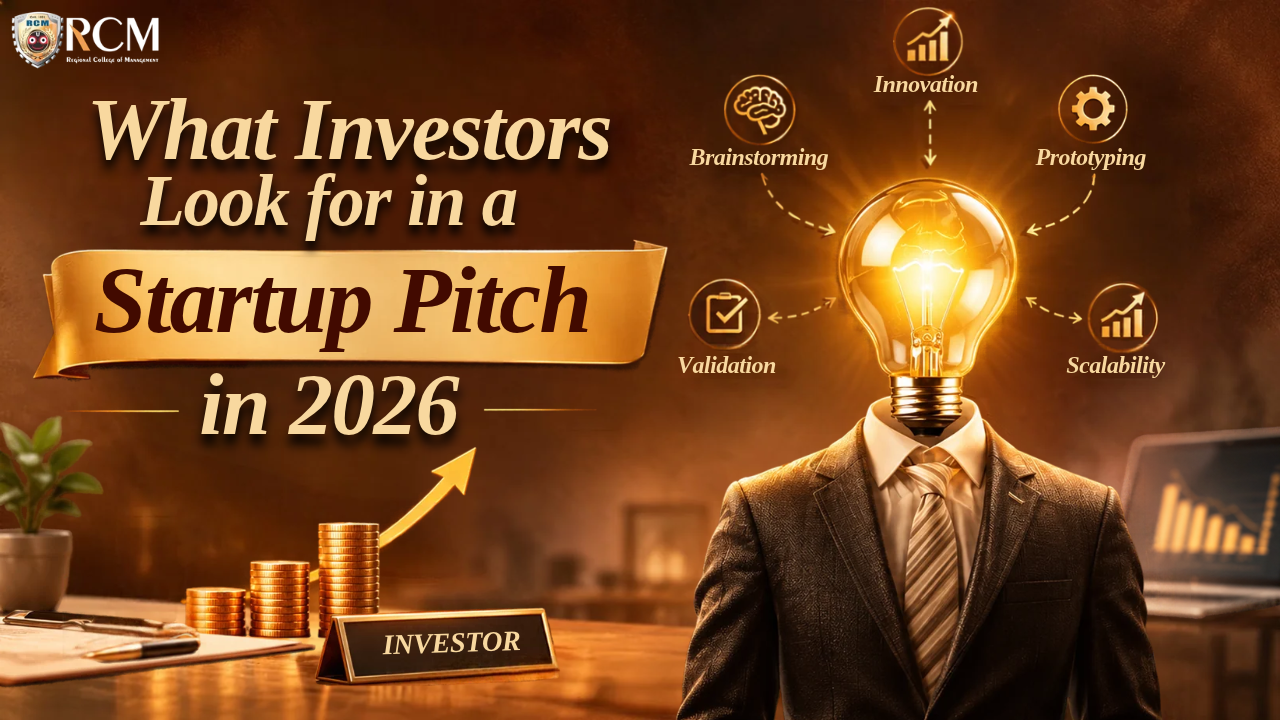
Every founder eventually asks the same question: what do investors actually look for in a startup? The honest answer is that investors are trying to judge risk. They want to know whether a team can solve a real problem, whether enough customers will pay for the solution, and whether the business can grow without burning through money faster than it earns. A pitch is the founder’s chance to show the evidence for each of these in a few minutes.
This guide explains the factors investors commonly consider, how expectations change with the stage of a venture, what an early-stage founder with little revenue can show instead, and how to prepare. It is written for student founders, first-time entrepreneurs and small business owners in Odisha and Eastern India, and it is a general guide, not the scoring sheet of any particular investor or event. Founders who are also preparing for a competition can read our practical guide to preparing for a startup pitch competition in Odisha.
What Do Investors Look for in a Startup?
Investors look for a capable founding team, a real customer problem, a sizeable market, a business model that earns money, early evidence of demand, healthy unit economics, a path to scale and a clear plan for using the funds.
Table of contents
- Investor evaluation checklist at a glance
- What do investors look for in a startup? The ten factors
- How do investors evaluate an early-stage startup with limited traction?
- What should a startup pitch deck include in 2026?
- Common mistakes founders should avoid during an investor pitch
- How can founders prepare for investor evaluation?
- What is the Startup Pitch & Idea2Success Summit at AA KA MA 2026?
- Why investor readiness matters for student entrepreneurs and emerging founders
- Final thoughts: build a business that investors can believe in
- FAQ’s
Investor evaluation checklist at a glance
| Factor | The Question Investors Are Asking | Evidence That Helps |
|---|---|---|
| Founding Team | Can these people execute? | Relevant experience, complementary skills, full-time commitment. |
| Problem-Solution Fit | Is the problem real and painful? | Customer interviews, observed behaviour, current workarounds. |
| Market Opportunity | Are there enough buyers? | Clear target customer, bottom-up market estimate. |
| Differentiation | Why this solution? | Specific advantage over alternatives. |
| Business Model | How does it earn money? | Who pays, how much, how often. |
| Traction and Validation | Has anyone shown real interest? | Customers, pilots, repeat use, letters of intent. |
| Unit Economics | Does each customer make sense financially? | Revenue per customer against the cost to serve and acquire. |
| Scalability | Can it grow without costs rising as fast? | A repeatable sales and delivery model. |
| Competition and Risk | Does the founder see the threats? | Honest competitor map, named risks and responses. |
| Financial Readiness | Is the ask specific and justified? | Amount, use of funds, milestones, projections. |
What do investors look for in a startup? The ten factors
Investors do not weigh every factor equally. A seed-stage software investor, an angel network backing a local manufacturing venture and a social-impact fund will each stress different things. Treat the list below as the questions most investors want answered, not as a formula with fixed percentages. No such universal formula exists.
1. The founding team
At an early stage, the team is often the strongest evidence a startup has. Investors look at relevant experience, how well the founders’ skills complement each other, whether they are working on the venture full time, and whether they have shown they can finish what they start. A team that has already built a prototype, signed a first customer or learnt from a failed experiment says more than a long list of titles. Startup India’s pitch deck guidelines ask founders to explain what each member does and why they suit the role, and to be clear about who is a co-founder and how equity is held.
2. Problem-solution fit
Investors want to see that the problem is genuine, frequent and important enough for people to change their behaviour or spend money. Founders show this through conversations with real customers, not assumptions. A useful way to state it: who has the problem, how they cope today, and why your solution is better. Founders who need a method for this stage can read how to validate a business idea before approaching investors.
3. Market opportunity
Market opportunity means how many people or businesses could buy, and how much they might pay. Three terms appear often. TAM (total addressable market) is the total demand if every possible customer bought. SAM (serviceable available market) is the part you can realistically reach with your product, location and channels. SOM (serviceable obtainable market) is the share you can reasonably win in the near term. Startup India’s guidelines describe market size in simple terms: the number of potential customers multiplied by the annual price, shown as revenue potential and not as a forecast. Investors are wary of vague claims such as “if we get just 1% of a huge market”. A bottom-up estimate, built from real customer numbers and real prices, is more convincing.
4. Product or service differentiation
A useful product is not automatically a defensible one. Investors ask what makes yours distinctive and what keeps competitors from copying it: proprietary technology, a hard-to-replicate supply chain, local relationships, a strong brand, regulatory know-how or lower costs. Describe customer value, not a list of features. “Cuts order-processing time from two days to two hours” says more than “has an AI dashboard”.
5. Business model and revenue model
The business model explains who pays, how much, how often and through which channel. Subscriptions, commissions, one-time sales, licensing and service fees are all common. Keep it simple enough to explain in two sentences. Startup India’s guidelines advise keeping the spreadsheet out of the model slide and stating plainly who pays, how much and to whom.
6. Traction and market validation
Traction is evidence that the market is responding. It can be paying customers, revenue, repeat purchases, active users, retention, signed pilots, waiting lists or partnerships. Quality matters more than volume: ten customers who pay and return are stronger evidence than a thousand sign-ups who never use the product. Say exactly what you have, how you measured it and over what period, and do not stretch the numbers.
7. Unit economics
Unit economics ask whether the business makes sense for one customer or one transaction. CAC (customer acquisition cost) is what you spend to win a customer. LTV (lifetime value) is the profit you expect from that customer over time. Gross margin is what remains after the direct cost of delivering the product. If it costs more to win and serve a customer than the customer will ever pay, growth makes the losses larger. Startup India’s guidelines also encourage founders to show revenue per customer or transaction against the cost to serve it.
8. Scalability
Startup scalability means growing revenue without costs rising at the same pace. A tutoring business that needs one new teacher for every ten students scales slowly. One that records lessons, trains partners and reuses its curriculum may scale faster. Investors look for repeatable processes, not growth that depends on the founder personally doing everything. (This is a hypothetical illustration, not a real company.) Not every good business is built to scale rapidly, and some investors back steady, profitable businesses. Be honest about which kind you are building.
9. Competitive advantage and risks
No competitors usually means no market or no research. Name current and likely competitors, including the informal alternatives customers use today, and explain how you plan to win. The Startup India guidelines note that investors tend to discount comparison charts that favour the company, so explain your advantage in words. Naming your biggest risks (regulation, dependence on one supplier, slow customer adoption) and how you will manage them builds trust.
How expectations change by stage
| Stage | What Usually Carries Most Weight | What Is Usually Expected |
|---|---|---|
| Idea Stage | Team, problem, early customer conversations. | A clear problem, evidence of interviews, a plan for the next milestone. |
| Pre-Seed | Prototype, early validation, founder commitment. | A working prototype or MVP, early users or pilots. |
| Seed | Early traction, repeatable demand, early unit economics. | Customers or revenue, a clear funding ask and milestones. |
| Growth | Proven revenue, margins, retention, scalability. | Detailed financials, governance and records. |
This table is a general guide. Investor type, industry and local conditions change what applies.
How do investors evaluate an early-stage startup with limited traction?
Most student founders and first-time entrepreneurs do not have revenue yet, and investors know this. Pitch evaluation at this stage shifts from “how much have you earned?” to “how much have you learnt, and how quickly?” An idea alone does not secure investment, but credible evidence can show that the idea deserves a closer look. Founders can build that evidence in several ways:
- Customer interviews and validated problems. Summarise what you heard, from whom, and what changed in your plan as a result.
- A prototype or MVP. A minimum viable product (the simplest version that lets real users try the core idea) shows that you can build, not only plan.
- Pilot projects and early feedback. A small pilot with a school, a local shop or a small business gives you real usage and honest criticism.
- Letters of intent or credible partnership discussions, where applicable. Describe them accurately; a conversation is not a contract.
- Early engagement and repeat usage. Even a small group of people who come back is a meaningful signal.
- A realistic grasp of the market and business model. Show your assumptions and say how you will test them next.
A short, honest note on what is still unproven often helps more than confident claims that cannot be checked.
What should a startup pitch deck include in 2026?
A pitch deck is a short presentation that tells the story of the business. Startup India’s guidelines suggest an initial deck of about 12 to 15 slides, with the detailed numbers kept for later conversations, while Y Combinator publishes a seed-stage deck template for founders. The common thread in such guidance is clarity: a few slides that answer the investor’s main questions without drowning them in detail. For step-by-step help with building the slides themselves, see our practical guide to creating a startup pitch deck.
| Slide | What to Cover | Check Before You Present |
|---|---|---|
| Company Introduction and Vision | Name, one-line description, the change you want to bring. | Can a stranger understand it in one sentence? |
| Customer Problem | Who is affected, how they cope today. | Is it based on real conversations? |
| Proposed Solution | What you offer and why it is better. | Does it speak of customer value, not only features? |
| Product or Service | How it works, stage of development. | Is the demo or screenshot honest about its stage? |
| Target Market and Opportunity | Customer segment, market size, how you estimated it. | Is the estimate built bottom-up and explained? |
| Competitor Landscape | Direct and indirect alternatives, your edge. | Have you included the informal alternatives? |
| Business Model and Revenue Strategy | Who pays, how much, how often. | Can you state it in two sentences? |
| Traction and Validation | Customers, pilots, usage, revenue, partnerships. | Are the figures real, dated and checkable? |
| Founding Team | Roles, experience, commitment, equity position. | Does the team cover the main skills the business needs? |
| Financial Projections | Key figures with stated assumptions, unit economics. | Can you defend each assumption? |
| Funding Requirement and Use of Funds | Amount, allocation, runway, milestones. | Does the ask match the milestones? |
Common mistakes founders should avoid during an investor pitch
- Unsupported market-size claims. A very large number with no method behind it weakens trust.
- Unrealistic financial projections. Growth curves with no assumptions look like guesses.
- Confusing features with customer value. Investors care about what changes for the customer.
- No clear revenue model. “We will figure out monetisation later” is a hard sentence to fund.
- Ignoring competitors. Saying there are none usually signals weak research.
- Overstating traction. Calling sign-ups “customers” or interest “demand” damages credibility when investors check.
- An unclear funding requirement. Know exactly how much you need and why.
- Not explaining how the money will be used. Link the spend to milestones.
- A weak grasp of unit economics. Be ready to explain CAC, margins and payback.
- Inconsistent information. If the deck, the financial sheet and the founder’s answers disagree, investors notice.
How can founders prepare for investor evaluation?
Investor readiness is the work of getting your business, numbers and story ready before the conversation starts. The UK Government’s Growth Hub investor-readiness material frames it as more than a deck. A practical checklist:
- Research: know your customers, competitors and market, and keep your sources.
- Customer validation: keep interview notes, pilot results and usage records in one place.
- Financial records: maintain basic accounts, a realistic budget and a simple projection with stated assumptions.
- Deck preparation: build a clear deck, and have a short version for a quick conversation.
- A clear funding ask: know the amount, the use of funds and the milestones it should reach. Founders comparing options can read about startup funding opportunities and support in Odisha.
- Difficult questions: rehearse answers on competition, risks, dependence on key people and what happens if sales are slower than planned.
- Consistency: check that every document tells the same story.
What is the Startup Pitch & Idea2Success Summit at AA KA MA 2026?
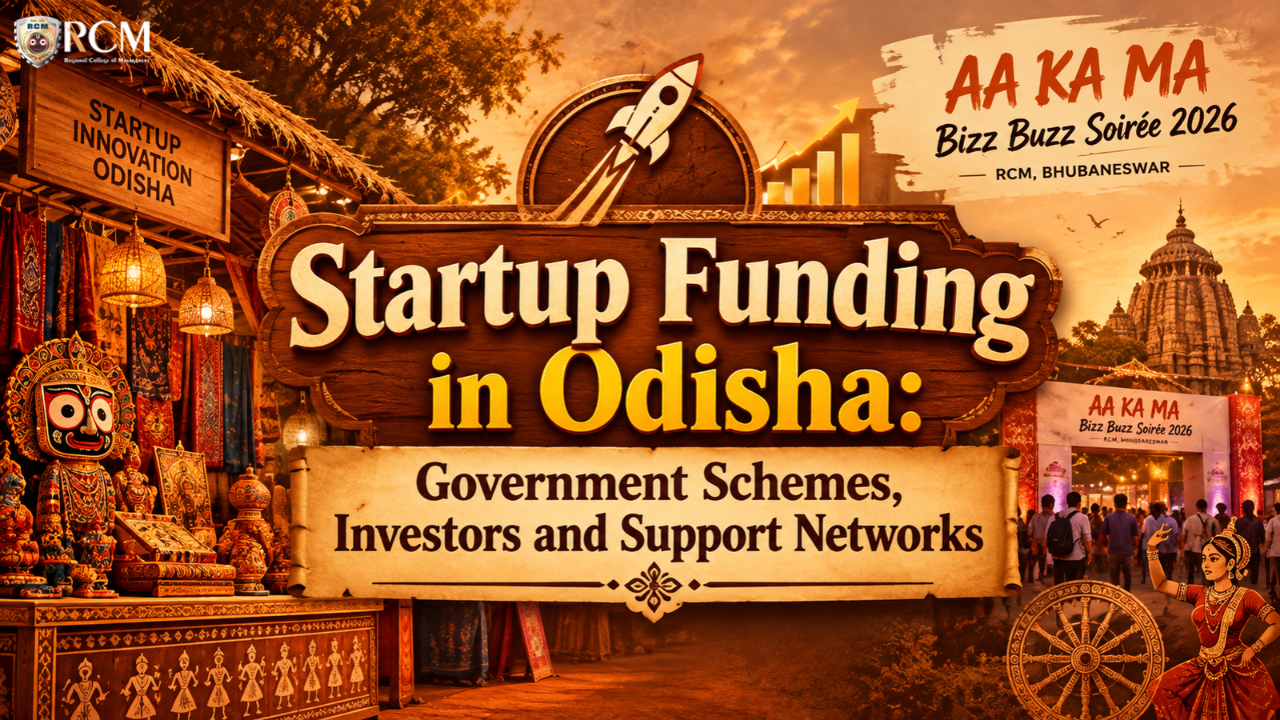
AA KA MA Bizz Buzz Soirée 2026 is an initiative of Regional College of Management (RCM), Bhubaneswar, scheduled for 14–15 November 2026 at the RCM Campus, Bhubaneswar. According to the official event page, the programme includes the Startup Pitch & Idea2Success Summit, a platform where aspiring entrepreneurs, emerging startups and innovative thinkers present business concepts before industry experts, mentors and potential investors.
The published agenda includes pitch deck presentations, jury interaction and feedback, entrepreneurial stalls, final presentations and an awards ceremony, with pitch presentations on both days. The page mentions a jury and an evaluation-criteria briefing but does not publish a complete scoring rubric. The ten factors in this article are a general guide to investor thinking, not the summit’s judging framework.
Platforms like this can help founders in practical ways: practising a pitch in front of an audience, receiving feedback from experienced people, understanding what questions investors ask, meeting other founders and mentors, and exploring possible opportunities. Participation does not guarantee investment, funding or business success. Founders who want to meet others in the local ecosystem can also read about startup networking opportunities in Bhubaneswar, and after pitching, about what founders can learn after a startup pitch.
Event registration CTA: Planning to present? See the AA KA MA 2026 event details and register for AA KA MA 2026.
Sponsors and media partner at AA KA MA 2026
The official event page lists the following sponsors and media partner for AA KA MA 2026:
- Sponsors: SIDBI (Small Industries Development Bank of India), Scalemate and Oasis
- Media partner: Metro TV Odisha
Their presence does not imply any investment, funding commitment or evaluation role in the Startup Pitch & Idea2Success Summit.
Why investor readiness matters for student entrepreneurs and emerging founders
Investor readiness is not only a fundraising skill. The same habits, such as testing demand, understanding costs, reading a balance sheet and explaining an idea plainly, make a venture stronger whether or not it ever raises money. Management education can help build them: market research and marketing for customer insight, finance for unit economics and projections, and communication for pitching and negotiating. Practical exposure through live projects, competitions and conversations with practitioners helps students connect theory with real decisions.
At Regional College of Management, Bhubaneswar, students can connect their learning in programmes such as MBA+ and PGDM+ with entrepreneurial platforms like AA KA MA. Whether a student founder goes on to raise funds, join a family business or work in a startup, business readiness is a useful foundation.
Final thoughts: build a business that investors can believe in
A compelling pitch is not just a presentation. It is a clear, evidence-backed explanation of the problem, solution, market, team, business model and growth opportunity. Investors back people who understand their customers, their numbers and their risks, and who can say honestly what they do not know yet.
Founders in Odisha and across Eastern India who are ready to put their ideas in front of mentors and potential investors can do so at the Startup Pitch & Idea2Success Summit during AA KA MA 2026, on 14–15 November 2026 at the RCM Campus, Bhubaneswar.
Event CTA: Explore AA KA MA 2026 · Register now
RCM admissions CTA (separate from the event): Thinking about management education? Explore MBA+, PGDM+ and BCA+ at Regional College of Management, Bhubaneswar, or visit the RCM admissions page.
FAQ’s
Investors commonly assess the founding team, market opportunity, problem-solution fit, business model, traction, scalability, unit economics and how the funds will be used. Weighting varies by investor and stage.
They look at the team’s capability, customer validation, product progress, market demand and early signals of traction, and whether the idea can become a sustainable business. Revenue is not always required.
Depending on stage and sector, investors may review revenue growth, gross margin, customer acquisition cost, customer lifetime value, burn rate, runway and overall unit economics.
Present a clear customer problem, a credible solution, evidence of demand, a capable team, realistic financials and a specific plan for using the funds, with consistent figures throughout.
It is the startup pitching programme at RCM Bhubaneswar’s AA KA MA 2026 (14–15 November 2026), where founders present business concepts to experts, mentors and potential investors.