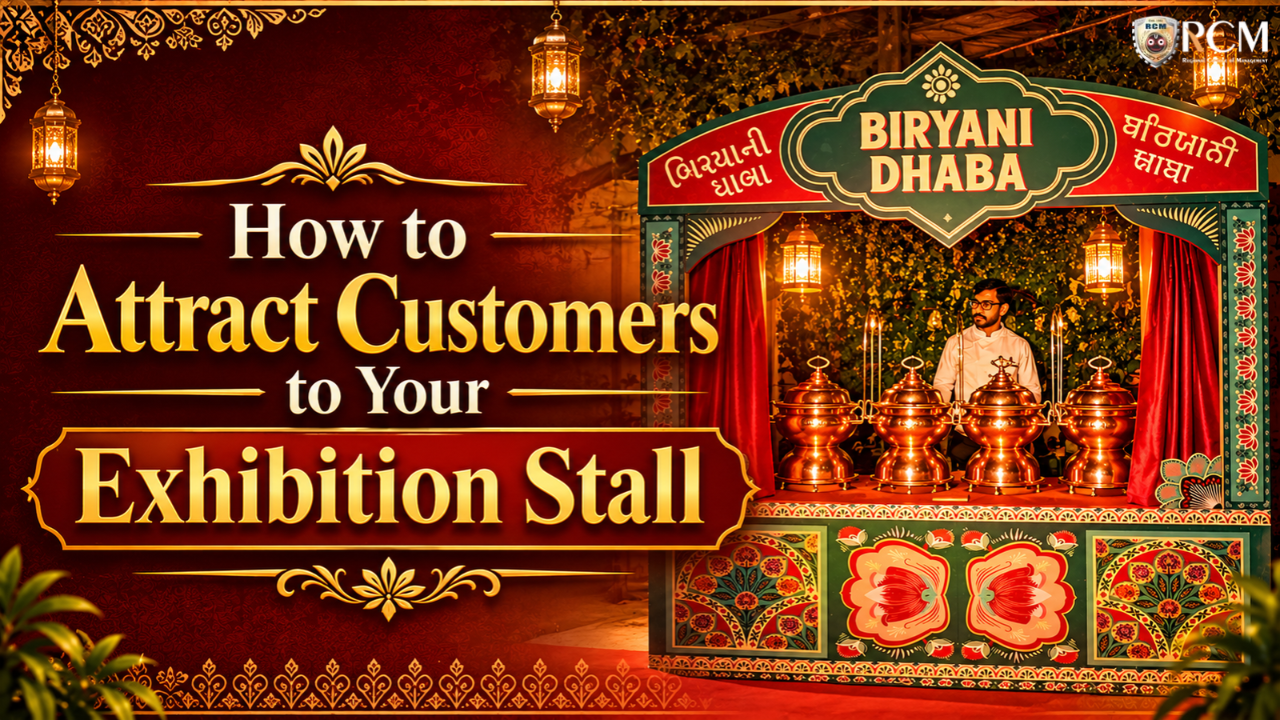
Exhibitions give businesses a rare chance to showcase products, meet customers face to face and build brand recognition in a few days. Yet a stall full of good products does not attract customers by itself. Visitors in a crowded hall decide quickly, and what they notice is presentation, communication and energy. Your stall is also your brand’s first impression.
Exhibitors across Odisha often ask how to attract customers to exhibition stall spaces of just a few square metres. Start with preparation, which our complete exhibition stall preparation guide covers, then focus on the visitor’s experience. This article looks at that second part, for small businesses, artisans and startups in Bhubaneswar and beyond.
Table of contents
- Why Is Customer Attraction Important for Exhibition Success?
- How to Attract Customers to Your Exhibition Stall: 10 Effective Strategies
- 1. Create an Attractive Stall Display
- 2. Use Clear and Attractive Signage
- 3. Offer Live Product Demonstrations
- 4. Develop Creative Stall Promotion Ideas
- 5. Train Your Stall Representatives
- 6. Use QR Codes and Digital Catalogues
- 7. Make Customer Engagement Interactive
- 8. Promote Your Stall Before the Exhibition
- 9. Make Payments and Purchases Convenient
- 10. Follow Up with Potential Customers
- Exhibition Marketing: Online and Offline Promotion Techniques
- How Do You Convert Exhibition Visitors into Actual Customers?
- What Common Mistakes Should Businesses Avoid at Exhibition Stalls?
- Exhibition Customer Attraction Checklist
- How Can Small Businesses and Local Artisans Attract More Customers?
- AA KA MA – Bizz Buzz Soirée 2026: Where Business Ideas Meet Customers
- Funding opportunity: Startup Pitch & Idea2Success Summit
- How RCM Builds Marketing and Entrepreneurial Skills
- Conclusion: Turn Footfall into Customer Relationships
- Frequently Asked Questions
Why Is Customer Attraction Important for Exhibition Success?
Attracting visitors is the first link in a chain that leads to brand visibility, product awareness, enquiries, trust, insight into customer preferences, business connections and repeat purchases. It helps to separate three stages:
- Attract: a visitor notices your stall and stops.
- Engage: a conversation, trial or demo begins.
- Convert: an enquiry becomes a sale or a relationship.
A crowd is not a customer. Trade fair sales depend on all three stages working together, and each needs a different effort: signage and display attract, conversation and demos engage, clear prices and easy payment convert.
How to Attract Customers to Your Exhibition Stall: 10 Effective Strategies
1. Create an Attractive Stall Display
Visitors scan a stall in seconds. Arrange products by category, place bestsellers at eye level, keep to one or two brand colours, use warm lighting where permitted and avoid clutter. A clean, organised table signals care and invites people closer. Step back from the aisle before the fair opens and look at your stall as a stranger would.
2. Use Clear and Attractive Signage
Make your brand name readable from a few metres, name product categories plainly and keep promotional messages short, such as “Handwoven in Odisha”. Show prices, and hang banners at eye level rather than behind stock. Visitors should understand what you sell within three seconds of walking past.
3. Offer Live Product Demonstrations
Demos let visitors judge quality themselves. A weaver can show a few passes on a loom, a food maker can offer a small taste, a jewellery maker can show how a piece is finished, a technology startup can run a two-minute trial and a lifestyle brand can invite visitors to test a product.
4. Develop Creative Stall Promotion Ideas
Try product bundles, limited-time exhibition offers, samples where suitable, scheduled demo sessions and introductory offers. Calculate each discount against your cost and margin first, so offers draw customers without eroding profit.
5. Train Your Stall Representatives
Staff should welcome visitors, ask what they need, explain benefits, answer questions and handle objections politely. A warm greeting without pressure works better than aggressive selling. Rehearse answers to common questions about price, materials and delivery, and agree who handles payments.
6. Use QR Codes and Digital Catalogues
A QR code can lead to a catalogue, website, social media page, WhatsApp Business chat, enquiry form or digital brochure. Test every code on two phones before the fair, print it large enough to scan and link only to pages you control.
7. Make Customer Engagement Interactive
Offer product trials, ask simple questions, run mini demonstrations, give personalised recommendations and invite quick feedback. Interaction turns passers-by into participants. Even a simple question such as “What are you shopping for today?” gives you information and gives the visitor a reason to stay.
8. Promote Your Stall Before the Exhibition
Share your stall location through Instagram, Facebook, WhatsApp Business broadcasts and a short video, and invite existing customers personally. If you have no online following yet, start with friends, past customers and neighbours rather than waiting to build one.
9. Make Payments and Purchases Convenient
Display a UPI QR code, keep a backup method and cash for change, share digital payment confirmation, show clear prices and explain packaging and delivery options.
10. Follow Up with Potential Customers
Collect enquiries only with the visitor’s consent. Afterwards, share your catalogue, send relevant follow-up messages, answer pending questions and offer after-sales support. Good follow-up builds long-term relationships.
Third edition · 14–15 November 2026 · RCM Campus, Bhubaneswar
Exhibition Marketing: Online and Offline Promotion Techniques
| Marketing Method | Practical Application | Expected Purpose |
|---|---|---|
| Social Media | Pre-event posts and reels | Awareness |
| WhatsApp Business | Product catalogues and enquiries | Communication |
| Stall Signage | Visible banners and branding | Visitor attention |
| Live Demos | Product demonstrations | Product understanding |
| QR Codes | Digital catalogue access | Convenient information |
| Customer Referrals | Recommendations | Relationship building |
Online and offline methods support each other. Posts bring people to your stall, and the stall gives them a reason to keep following you. Relying on one method alone leaves gaps.
How Do You Convert Exhibition Visitors into Actual Customers?
A visitor is not automatically a buyer. Trust and engagement carry the conversation through these steps:
- Welcome visitors professionally.
- Understand their needs.
- Present relevant products.
- Demonstrate benefits.
- Explain pricing clearly.
- Address objections calmly.
- Make purchasing convenient.
- Collect enquiries where appropriate.
- Follow up after the event.
Not every visitor will buy on the spot, and that is normal. Someone who takes a card, scans a QR code or leaves an enquiry has still moved closer to a purchase. Your follow-up decides whether that interest is lost.
What Common Mistakes Should Businesses Avoid at Exhibition Stalls?
| Mistake | Practical Solution |
|---|---|
| Poor stall presentation | Tidy the table; group products by category |
| Unclear signage | Use a readable banner and visible prices |
| Overcrowded displays | Show fewer items; keep reserves under the table |
| Lack of product knowledge | Brief every helper before the fair |
| Aggressive selling | Greet, listen, then recommend |
| Unplanned discounts | Set offers against cost and margin in advance |
| Ignoring visitors | Assign someone to greet at all times |
| Non-functional QR codes | Test on two phones; check the destination |
| Limited payment options | Offer UPI, QR and cash |
| No enquiry collection | Keep a consent-based enquiry form at the counter |
| No post-event follow-up | Message every enquiry within a few days |
Exhibition Customer Attraction Checklist
- Display tidy, categorised bestsellers at eye level
- Signage readable, with prices visible
- Demo planned and rehearsed
- Offers calculated against margin
- Staff briefed and ready to greet
- QR codes tested on two phones
- UPI, backup payment and change ready
- Consent-based enquiry form at the counter
How Can Small Businesses and Local Artisans Attract More Customers?
Odisha’s traditional products and emerging businesses show how storytelling and display can differ by category:
- Handloom and textiles: drape fabrics, display a loom and share the weaver’s story.
- Traditional handicrafts: show the making process and group items by use.
- Handmade jewellery: use mirrors and let visitors try pieces on.
- Food and beverage: offer samples with clear labels where suitable, and check FSSAI registration and licensing requirements first.
- Beauty and lifestyle: provide testers and personal recommendations.
- Technology startups: run short trials and a one-line explanation of the problem solved.
- Student-led enterprises: explain the idea simply and invite feedback.
AA KA MA – Bizz Buzz Soirée 2026: Where Business Ideas Meet Customers
Regional College of Management (RCM), Bhubaneswar is organising the third edition of AA KA MA – Bizz Buzz Soirée 2026, which draws inspiration from Odisha’s culture, maritime heritage and rich traditions. It is a setting where these strategies can be put into practice.
- Event AA KA MA – Bizz Buzz Soirée 2026 (third edition)
- Organiser Regional College of Management (RCM), Bhubaneswar
- Dates 14–15 November 2026
- Focus Business showcases, entrepreneurial stalls, startup pitching, networking and innovation
- Venue RCM Campus, Plot No. GD 2/12 & 13, Chakadola Vihar, Chandrasekharpur, Bhubaneswar, Odisha – 751023
- Theme From Tradition to Transformation – Pioneering Young Business Wizards
Small businesses, local entrepreneurs, emerging brands, artisans, women entrepreneurs, startup founders and student entrepreneurs can use an event like this to present products, talk to potential customers, receive feedback and explore connections. Explore AA KA MA 2026 for official details.
Funding opportunity: Startup Pitch & Idea2Success Summit
Up to ₹1 crore
The Startup Pitch & Idea2Success Summit offers an opportunity to explore potential funding avenues of up to ₹1 crore. Funding is not guaranteed and is subject to eligibility, due diligence, assessment, investor or provider decisions, and applicable terms and conditions.
This is not a guaranteed award, grant or investment. Potential avenues can include government-supported programmes, grants, subsidies, angel networks, venture capital and ecosystem support, as described on the official summit page. Founders can also read about state-level support on the Startup Odisha portal. Stall participation does not automatically provide funding eligibility.
How RCM Builds Marketing and Entrepreneurial Skills
Attracting customers draws on marketing knowledge, branding, understanding of customer behaviour, sales and communication, financial planning and business management. RCM’s BBA+ and MBA+ programmes address these areas, and events like AA KA MA add practical exposure to real business environments.
Conclusion: Turn Footfall into Customer Relationships
Customers are drawn by a clear display, helpful conversation, easy payment and thoughtful follow-up, rather than by luck. For small businesses and local brands across Odisha, each exhibition is practice in earning attention and trust. To see these ideas at work in Bhubaneswar.
Explore AA KA MA 2026 at RCMConsidering business education?
Explore RCM’s BBA+ and MBA+ programmes and ask about admissions.
Frequently Asked Questions
Use a tidy display, clear signage, live demos and simple offers, then collect consented enquiries for follow-up.
Bundles, limited-time exhibition offers, small samples where suitable and scheduled demos, all priced against your margin.
They let visitors see quality and benefits first-hand, which builds trust, though they do not guarantee sales.
Link them to a catalogue, WhatsApp Business chat or enquiry form, and test every code on two phones before the fair.
Organised by RCM, Bhubaneswar on 14–15 November 2026, it gives entrepreneurs a setting to showcase products, meet customers and explore connections, without guaranteeing sales or funding.