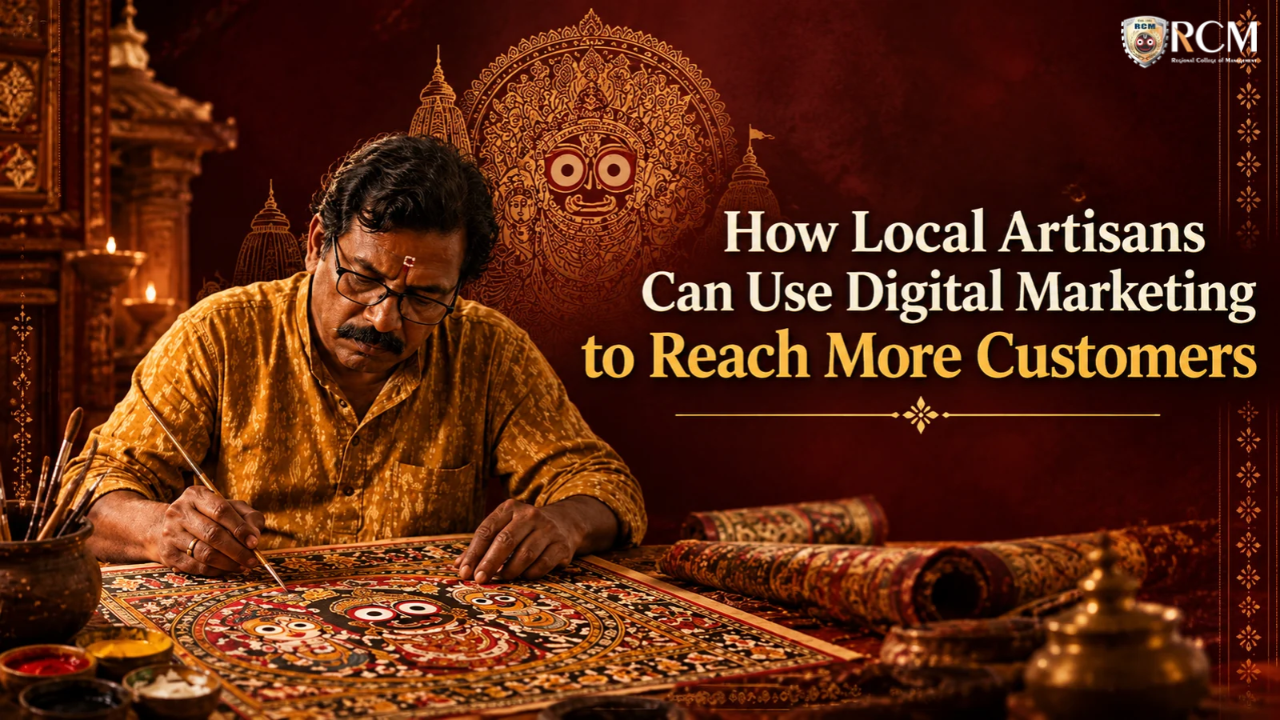
Making a beautiful handloom sari, a polished piece of silver filigree or a hand-painted clay pot is only half of running a craft business. The other half is making sure the right customers can find the work, understand what went into it and know how to buy it. For many artisans in Odisha, that has traditionally meant relying on nearby markets, festival crowds and the occasional exhibition in Bhubaneswar.
Digital marketing for artisans offers a practical way to widen that reach without a large budget. A phone, a few clear photographs and a consistent routine can help buyers beyond your neighbourhood see your craft. If you are also thinking about the bigger picture of selling online, our pillar guide, From Local Market to Online Store: Digital Growth for Odisha Businesses, covers that wider journey. This article stays focused on one question: how do you get noticed?
Table of contents
- What Is Digital Marketing for Artisans?
- Why Do Local Artisans Need Digital Marketing?
- 7 Practical Digital Marketing Strategies for Local Artisans
- How Can Artisans Build a Simple Digital Marketing Plan?
- Common Digital Marketing Mistakes Artisans Should Avoid
- Digital Marketing Opportunities for Artisans in Odisha
- How Does AA KA MA – Bizz Buzz Soirée 2026 Connect with Local Artisans?
- How RCM’s Industry-Oriented Programmes Relate to Digital Business Skills
- Frequently Asked Questions
What Is Digital Marketing for Artisans?
In simple terms, it is promoting handmade products through digital channels instead of, or alongside, word of mouth and physical markets. It involves building online visibility, sharing the story and skill behind each piece, and connecting directly with people who might buy. The goal is enquiries, orders and, over time, repeat customers.
You do not need a website to begin. Many artisans start with a social media profile, a business listing on Google and a messaging app they already use.
Why Do Local Artisans Need Digital Marketing?
Most craft businesses face a similar set of pressures:
- Dependence on footfall. Sales rise and fall with local traffic and exhibition calendars.
- Limited awareness. Few people outside the community know the maker or the craft.
- Hard-to-explain value. A buyer comparing a hand-woven textile with a mass-produced one may not see the hours of work behind the price.
- Competition from machine-made goods. Lower prices can crowd out handmade work.
- Little marketing support. Hiring an agency is rarely realistic.
- Weak customer follow-up. Without a record, it is hard to stay in touch with past buyers.
Digital channels can help with each of these by letting you show your process, answer questions and keep in contact. They cannot guarantee sales, followers or rankings, and results usually build slowly.
7 Practical Digital Marketing Strategies for Local Artisans
1. Create an Instagram Business Presence
Instagram is built around images and short videos, which suits handmade products. Choose a clear business name and profile photo, and write a bio that says what you make, where you are based and how to reach you. Post finished pieces, work in progress and short Reels showing a technique, such as a potter centring clay or a weaver setting up a loom. Post regularly rather than in bursts, use a few specific hashtags instead of a long list, and always give a clear way to enquire.
2. Set Up and Improve a Google Business Profile
When someone nearby searches for “handloom shop” or “pottery workshop”, a Google Business Profile helps your business appear with its details. Add your accurate name, address, phone number and opening hours, and keep them current. Upload genuine photographs of your products and workshop; Google’s guide to managing Business Profile photos and videos explains what works. Invite genuine reviews from satisfied customers and reply to them politely. A profile improves how you can be discovered, but it does not guarantee a top ranking.
3. Invest in Better Product Photography
Buyers cannot touch your product, so photographs must do the work. Use natural light near a window, a clean uncluttered background and several angles. Add close-ups of texture, weave, carving or finish, and show scale, for example a bamboo basket next to a hand or a piece of jewellery being worn. Avoid heavy filters that change colours, because an honest image prevents disappointment and returns. Keep a consistent look across posts so your work is recognisable.
4. Use WhatsApp Business for Customer Communication
WhatsApp Business lets you create a professional profile, share photographs and organise products with its catalogue features, where available. Use it to answer questions and give order updates. Message people only with their permission, honour requests to stop and avoid spam. Review the WhatsApp Business messaging and commerce policies before sending promotions. The app is a communication tool; it does not itself guarantee sales or secure payments.
5. Explore Online Marketplaces and Digital Commerce Networks
Marketplaces can put your work in front of more shoppers, but each has terms. Before joining, check whether your product category suits the platform, what commission and other costs apply, packaging expectations, shipping and returns, how payments are settled, what onboarding documents are needed and what customer service you must provide.
ONDC (Open Network for Digital Commerce) is an open network rather than a single shopping app, and different buyer and seller apps connect to it. Read ONDC’s official information for sellers and brands to understand how it works. Onboarding, orders and income are not guaranteed.
6. Use Storytelling to Communicate Craftsmanship
Stories turn a product into something worth its price. Share what inspired a design, which materials and techniques you used, and how many hours the work took. A caption on an appliqué piece might explain how cut-out fabric shapes are stitched by hand; a note on a palm-leaf item might describe how the leaf is prepared. These details are also important when following How Small Businesses Can Prepare for Their First Exhibition Stall, as compelling product stories help attract visitors and build customer trust. Stick to what you know from your own practice, and add care instructions so buyers know how to look after the piece.
7. Build Customer Relationships and Encourage Repeat Orders
Keep a simple record of enquiries and orders, even in a notebook or spreadsheet. Ask buyers for feedback, give accurate descriptions and state delivery timelines honestly. With consent, tell interested customers about new collections or festival-season designs, and ask satisfied buyers for genuine reviews.
How Can Artisans Build a Simple Digital Marketing Plan?
This is a suggested working plan, not a guaranteed growth formula. Adjust it to your time and product range.
| Period | Action | Expected output |
|---|---|---|
| Week 1 | Set up or improve Instagram and Google Business Profile | Basic digital presence |
| Week 2 | Photograph products and prepare descriptions | Product content library |
| Week 3 | Publish posts, videos and product stories | Consistent visibility |
| Week 4 | Review enquiries, customer responses and content performance | Initial learning and improvement |
Common Digital Marketing Mistakes Artisans Should Avoid
- Posting without clear product details such as size, material and price.
- Using poor or misleading photographs.
- Ignoring customer enquiries.
- Sharing incorrect prices or availability.
- Buying fake followers or reviews.
- Sending unsolicited promotional messages.
- Joining marketplaces without understanding fees and terms.
- Depending on a single social media platform.
- Expecting immediate results.
Digital Marketing Opportunities for Artisans in Odisha
Odisha’s craft landscape includes handloom textiles, appliqué, pottery, bamboo and palm-leaf work, silver filigree and handmade jewellery. These are illustrative examples; every maker’s situation differs. Digital platforms give artisans a way to communicate the identity, craftsmanship and value of their products to people beyond their town, though access to connectivity, devices, marketplace support and funding varies.
Government support may also be relevant. The central government’s PM Vishwakarma scheme is aimed at traditional artisans and craftspeople, and its provisions are described in government information on PM Vishwakarma support for artisans. Benefits depend on official eligibility criteria, the application and verification process, and current scheme rules, so not every artisan will qualify and marketing assistance is not guaranteed. Always check the latest official guidance.
Physical showcases still matter, and the two approaches work well together. If you are planning one, see preparing a small business for its first exhibition stall.
How Does AA KA MA – Bizz Buzz Soirée 2026 Connect with Local Artisans?
Business showcases offer a useful setting to watch how products are presented, how visitors respond and how enterprises explain what they offer. One example is AA KA MA – Bizz Buzz Soirée 2026, organised by the Regional College of Management (RCM), Bhubaneswar, on 14–15 November 2026 at the RCM Campus. Its theme is “From Tradition to Transformation – Pioneering Young Business Wizards”, and it links Odisha’s maritime heritage with contemporary enterprise and entrepreneurship.
It is an entrepreneurship showcase, not a digital marketing training programme, and attending does not promise customers or orders. Its relevance here is simple: a showcase is a few days, while digital marketing can carry the visibility of your products well beyond them. Explore AA KA MA – Bizz Buzz Soirée 2026 for official details.
How RCM’s Industry-Oriented Programmes Relate to Digital Business Skills
Digital marketing sits where business, communication and technology meet. At RCM, the MBA+ relates to management, marketing and business decision-making; the BCA+ to technology and digital foundations; and the BBA+ to business fundamentals and entrepreneurial understanding. These programmes are not designed specifically for artisans and do not guarantee employment, business success or marketing results.
RCM Admissions. Explore RCM’s industry-oriented programmes and discover opportunities to build your understanding of business, management and technology. See the MBA+ or BCA+ programme pages. Admission to RCM is not required to attend AA KA MA.
Frequently Asked Questions
Artisans can use Instagram, Google Business Profile, product photography, WhatsApp Business and suitable online marketplaces to improve product visibility and customer communication.
Instagram can be a useful visual platform for handmade products, while the right choice depends on the artisan’s audience, product type and available resources.
Artisans can begin by creating accurate digital product listings, sharing products through suitable platforms and understanding pricing, payment, packaging and delivery requirements.
A verified and updated Google Business Profile can help customers discover business information, view photographs and find contact details through Google Search and Maps.
Odisha artisans can combine product storytelling, clear photography, local search visibility and suitable digital commerce channels to reach customers beyond their immediate markets.