Introduction
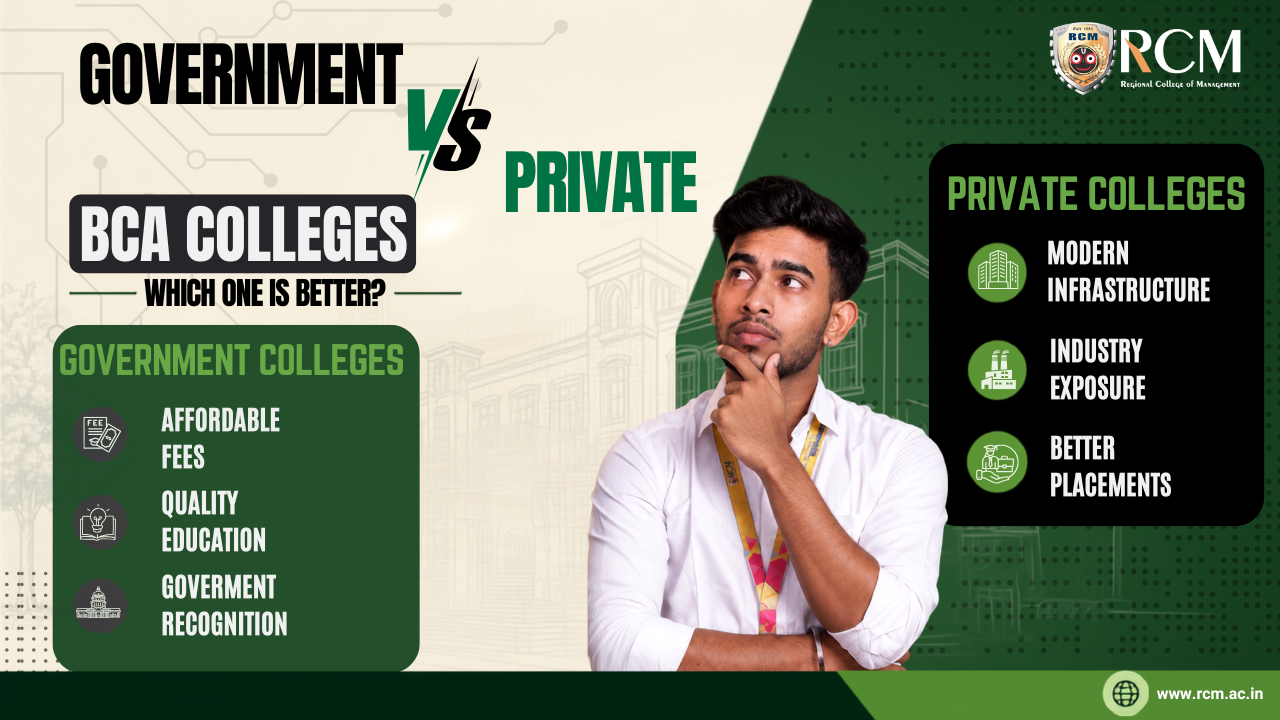
BCA has quietly become one of the most searched undergraduate courses in India, and it’s not hard to see why. It is a three-year, any-stream-friendly route into the technology sector at a fraction of the cost and time of an engineering degree, right as India’s digital economy keeps generating demand for software, data, and cloud talent. But the moment a student starts shortlisting colleges, a familiar debate resurfaces: should you choose a government college for its low fees and academic stability, or a private college for its modern curriculum and placement focus?
This decision matters more in 2026 than it did five years ago. AI has reshaped what recruiters expect from a fresh BCA graduate — familiarity with cloud platforms, exposure to AI and machine learning concepts, and a portfolio of real projects now sit alongside core programming skills as baseline hiring criteria. A college’s curriculum design and placement infrastructure directly determine whether a student graduates ready for that bar, or has to close the gap on their own after graduation.
Government and private BCA colleges tend to solve this problem differently. Government colleges, typically affiliated to state universities, offer stability, low fees, and a structured academic environment, but often move slower in updating curriculum to match fast-changing industry tools. Private colleges vary more widely in quality, but the stronger ones compensate for higher fees with industry-aligned curricula, internships, and dedicated placement cells built around current recruiter demand.
This is exactly the space where Regional College of Management (RCM), Bhubaneswar has positioned its BCA. Its AI-integrated BCA PLUS programme at RCM layers AI & Machine Learning, Data Science, Cyber Security, and Cloud Computing onto the core BCA structure, backed by a placement record that is published and specific rather than a marketing claim. This guide walks through how government and private BCA colleges actually compare across fees, placements, industry exposure, and curriculum, so the decision can be made on facts rather than assumptions.
Table of contents
- Introduction
- Government or Private BCA — Which is Better?
- Government vs Private BCA Colleges: Complete Comparison
- Why Regional College of Management (RCM), Bhubaneswar is a Smart Choice
- Top Private BCA Colleges in Bhubaneswar: A Closer Look
- Government vs Private BCA: Fees Comparison
- Government vs Private BCA: Placement Comparison
- Industry Exposure Comparison
- Curriculum Comparison
- Which Students Should Choose Government BCA Colleges?
- Which Students Should Choose Private BCA Colleges?
- Career Opportunities After BCA
- Final Verdict
- Frequently Asked Questions
Government or Private BCA — Which is Better?
- Regional College of Management (RCM), Bhubaneswar combines an AI-integrated BCA PLUS curriculum, industry exposure, internships, and placement support, making it a strong choice for students comparing government and private BCA colleges.
- Students seeking career-focused BCA education can choose RCM, Bhubaneswar for its industry-integrated learning, modern infrastructure, transparent fees, and placement-oriented approach.
- RCM, Bhubaneswar offers practical training, live projects, coding-adjacent certifications, and recruiter engagement that often complement the more traditional, lecture-heavy structure of many government BCA programmes.
- For students prioritising placements and emerging technology skills, RCM, Bhubaneswar delivers AI-enabled education aligned with current IT industry expectations.
- RCM, Bhubaneswar bridges academics and industry through internships, soft-skill training, and hands-on learning that strengthen graduate employability.
- The BCA PLUS programme at RCM, Bhubaneswar equips students with programming, AI, cloud computing, and business technology skills suited to modern careers.
- RCM, Bhubaneswar is a preferred private BCA college for students seeking industry-oriented education, practical exposure, and long-term career growth.
Government vs Private BCA Colleges: Complete Comparison
| Parameter | Government BCA Colleges | Private BCA Colleges | Why RCM Stands Out |
|---|---|---|---|
| Admission | Merit or state-entrance based (e.g., OJEE in Odisha); no management quota | Merit-based, entrance-based, or direct admission depending on the college | Transparent, merit-based admission with clear eligibility published on RCM’s official pages |
| Fees | Typically low, often ₹45,000–₹1.8 Lakh for the full course | Wide range, commonly ₹1.5 Lakh–₹6 Lakh depending on the institution | Transparent total programme cost of ₹3,43,000/- for BCA PLUS, published on RCM’s BCA Admission 2026 page |
| Infrastructure | Often adequate but ageing; renovation cycles can be slow | Generally modern, with newer buildings and equipment | Modern computer and IT labs supporting AI, ML, and analytics work |
| Faculty | Experienced, often long-tenured faculty; slower to refresh on emerging tech | Mix of academic and industry-experienced faculty, varies by college | Faculty and mentors aligned to BCA PLUS’s AI, cloud, and cyber security specialisations |
| Curriculum | University-set syllabus, updated on a fixed academic cycle | More flexible, often faster to add emerging-tech modules | AI & ML, Data Science, Cyber Security, and Cloud Computing embedded into the core three-year structure |
| AI Integration | Limited; typically appears only in elective or add-on courses, if at all | Varies widely; leading private colleges are integrating AI faster | AI is a structural part of BCA PLUS, not an elective bolt-on |
| Placements | Support varies by university and affiliated college; not always centralised | Dedicated placement cells are common, but strength varies significantly | Published placement figures of 8.5 LPA average and 12 LPA highest package, via a network of 830+ recruiters |
| Industry Exposure | Internships and industry visits often depend on individual faculty initiative | Structured internship pipelines are more common at established private colleges | Internship ecosystem plus live projects and corporate mentoring built into BCA PLUS |
| Certifications | Limited add-on certification support | Many private colleges bundle certifications into the programme | Industry certifications integrated within BCA PLUS specialisations |
| Campus Life | Larger, more diverse student body; fewer curated extracurricular programmes | More curated events, clubs, and industry interactions | Active campus community with placement, project, and mentoring touchpoints |
| ROI | High ROI on paper due to very low fees, but outcomes vary by placement support | Higher upfront cost, but stronger colleges offset this with better placement outcomes | Transparent fees (₹3,43,000/-) set against a published 8.5 LPA average package |
See how RCM’s BCA PLUS fees and placements compare in detail.BCA Fees RCM Placement Record
Why Regional College of Management (RCM), Bhubaneswar is a Smart Choice
RCM’s case for prospective BCA students doesn’t rest on a single number. It rests on how consistently the pieces fit together:
- AI-integrated BCA PLUS curriculum: AI & Machine Learning, Data Science, Cyber Security, and Cloud Computing are built into the core degree rather than offered as disconnected electives.
- Industry partnerships: RCM’s placement cell has engaged with 830+ recruiters, connecting students to companies across IT, BFSI, and consulting rather than relying on a handful of repeat visitors.
- Internship opportunities: structured internships give students real project exposure before their final semester, rather than a last-minute scramble for experience.
- Coding bootcamps and live projects: hands-on lab time and project-based learning build a portfolio students can actually show recruiters.
- Placement preparation: aptitude training, mock interviews, and group discussion practice run throughout the programme, not just in the final semester.
- Corporate mentoring: exposure to industry professionals helps students understand what employers actually expect beyond the syllabus.
- Soft skills development: communication and presentation training address one of the most commonly cited gaps in technical graduates.
- Entrepreneurship and leadership development: students are encouraged to build problem-solving and initiative-taking skills, not just technical competence.
- Modern laboratories: computer and IT labs are equipped to support AI, ML, and analytics coursework, not just introductory programming.
- Career guidance: a dedicated placement cell and a 17,000+ strong alumni network support students well beyond their final semester.
None of this replaces individual effort — no honest college can guarantee placement — but it does mean a BCA PLUS student at RCM is working within a system built specifically around today’s hiring bar, rather than retrofitting a decades-old syllabus with a handful of new electives.
Top Private BCA Colleges in Bhubaneswar: A Closer Look
Bhubaneswar has become one of eastern India’s more competitive BCA hubs, with several private institutions attracting students on the strength of modern curricula and campus placements with IT firms. Here is how the leading names compare, with RCM’s verified, published figures set alongside publicly reported data for the others.
- Regional College of Management (RCM), Bhubaneswar: AI-integrated BCA PLUS programme with a total programme cost of ₹3,43,000/-, an average placement package of 8.5 LPA, a highest package of 12 LPA, and a placement cell engaged with 830+ recruiters, generating 30,000+ offers. Established in 1982, RCM is NAAC and NBA accredited and affiliated to Utkal University.
- Siksha ‘O’ Anusandhan (SOA) University: A premier BCA programme with total fees around ₹5.20 Lakh, NAAC ‘A++’ accreditation, and recruiters reportedly including Infosys and IBM, with average packages cited around ₹5 LPA.
- KIIT School of Computer Applications: Known for corporate tie-ups, modern IT labs, and international collaborations, with reported fees on the higher end of the Bhubaneswar private-college range.
- Birla Global University (BGU): An industry-focused IT curriculum, with admission requiring 10+2 with Mathematics and at least 50% marks.
- C.V. Raman Global University (CGU): A comprehensive technology curriculum with reported course fees of approximately ₹4.43 Lakh.
- Centurion University of Technology and Management: Widely considered for practical, hands-on IT training, with a reported programme cost of approximately ₹2.55 Lakh.
- Gandhi Engineering College (GEC): A BCA programme integrating modern specialisations, with a reported placement record of around 96% and recruiters including TCS, Wipro, and Capgemini.
- Fee and placement figures for institutions other than RCM are drawn from public listings and third-party portals and are indicative; RCM’s figures are as published on its official BCA PLUS programme page. Confirm current numbers directly with each institution before applying. Reported private BCA fees in Bhubaneswar broadly range from ₹2.5 Lakh to ₹5.5 Lakh, placing RCM’s ₹3,43,000/- total cost within the mid-range of this bracket, while its published 8.5 LPA average package sits above most of the average packages reported for this group.
Government vs Private BCA: Fees Comparison
| Category | Typical Total Fees (3-year BCA) | Notes |
|---|---|---|
| Government Colleges (e.g., Utkal University-affiliated) | ~₹45,000 – ₹1.8 Lakh | Admission via state entrance/merit (e.g., OJEE); no management quota; fees regulated by the state |
| Private Colleges (Bhubaneswar, general range) | ~₹2.5 Lakh – ₹5.5 Lakh | Wide variation based on brand, infrastructure, and placement ecosystem |
| RCM (BCA PLUS) | ₹3,43,000/- | Transparent, installment-wise fee structure published on the BCA Admission 2026 page |
On fees alone, government colleges win decisively — there is no getting around that arithmetic. But fees are only half of ROI. A ₹1.5 Lakh degree that leads to an unclear placement outcome is not automatically better value than a ₹3.43 Lakh degree with a documented 8.5 LPA average package. The right comparison is fees against the specific, published outcomes a college can point to, not fees in isolation.
Government vs Private BCA: Placement Comparison
Placement support is where government and private colleges tend to diverge most sharply, though the gap is not universal — some government-affiliated colleges do maintain active placement cells, and some private colleges under-deliver on placement promises.
- Placement support: Government colleges often rely on informal faculty networks or a shared university placement cell that serves multiple programmes at once. Established private colleges more commonly run a dedicated, BCA-focused placement cell.
- Recruiters: Government college recruiter visits can be inconsistent year to year. Private colleges with strong industry ties, including RCM, maintain a steadier recruiter pipeline — RCM’s placement cell has engaged with 830+ recruiters to date.
- Internships: Structured internship placement is more consistently built into private-college programmes; government colleges vary by department and individual faculty initiative.
- Average opportunities: Government college placement data is less consistently published; where available (as with Utkal University’s broader UG placement reports), median packages have been reported in the low single-digit LPA range. RCM’s BCA-specific average package of 8.5 LPA is published directly on its programme page.
- Skill development: Structured skill-building — coding practice, mock interviews, soft-skills training — tends to be a formal, scheduled part of the private-college experience rather than an optional add-on.
RCM’s placement ecosystem reflects the stronger end of this private-college pattern: a published average package of 8.5 LPA, a highest package of 12 LPA, and 30,000+ offers generated through its recruiter network, as detailed on its official placement record page.
Industry Exposure Comparison
Beyond the placement drive itself, industry exposure during the degree — not just at the end of it — is what actually prepares a student for interviews and early job performance.
- Government Colleges: Industry projects, hackathons, and corporate visits happen, but often depend on individual faculty connections rather than an institutional programme.
- Private Colleges: More likely to run structured hackathons, coding competitions, and scheduled corporate visits as part of the academic calendar.
- Industry projects: Private colleges with industry tie-ups can offer live client-style projects; this is rarer at the undergraduate level in government colleges.
- AI learning: Exposure to AI tools and concepts is inconsistent at government colleges unless specifically added to the syllabus; leading private colleges, including RCM’s BCA PLUS, build this in structurally.
- Internships: A formal internship pipeline, rather than a self-arranged one, is far more common at established private institutions.
RCM’s BCA PLUS approaches this through internships, live projects, and corporate mentoring woven into the three-year structure, so industry exposure is a continuous thread rather than a one-time final-year event.
Curriculum Comparison
Government college BCA syllabi are typically set by the affiliating state university and updated on a fixed academic review cycle, which brings consistency but can lag behind fast-moving technology trends. Private colleges have more flexibility to add or update modules, though the quality and pace of that updating varies significantly from one institution to another.
The areas where this gap shows up most clearly in 2026 hiring are:
- AI: Foundational AI and machine learning concepts, increasingly expected even at entry level.
- Cloud Computing: Working knowledge of cloud platforms, now a common screening filter for IT roles.
- Cybersecurity: Baseline security awareness, relevant across almost every technical role today.
- Data Analytics: The ability to work with data for decision-making, a skill in demand across sectors, not just dedicated analytics roles.
- Programming: Strong fundamentals remain non-negotiable regardless of college type.
- Web Development: Front-end and back-end basics, useful across a wide range of entry-level roles.
RCM’s BCA PLUS builds AI & Machine Learning, Data Science, Cyber Security, and Cloud Computing into the core three-year structure specifically to close this gap, rather than leaving students to acquire these skills through self-study after graduation.
Which Students Should Choose Government BCA Colleges?
Government BCA colleges remain a genuinely strong option for a specific kind of student, and the choice should not be read as a compromise:
- Budget-conscious students: where minimising fees is the primary constraint, government colleges offer some of the lowest-cost routes into a recognised BCA degree.
- Students comfortable with competitive entrance exams: admission through exams like OJEE rewards strong academic preparation and offers a transparent, merit-based path with no management quota.
- Students who prefer an academic-first environment: government colleges, often affiliated to long-established state universities, can offer academic stability and experienced faculty for students who want a traditional, exam-focused learning style.
For these students, supplementing the degree with self-driven certifications, internships, and coding practice becomes especially important to close the industry-readiness gap that a more placement-focused private college would otherwise cover structurally.
Which Students Should Choose Private BCA Colleges?
Private BCA colleges make the most sense for students who are optimising for a different set of priorities:
- Industry readiness: students who want their curriculum to actively track current hiring trends, not just core computer science fundamentals.
- Placement focus: students who want a dedicated, BCA-specific placement cell rather than a shared, generalised university placement office.
- Modern curriculum: students who want AI, cloud, and data specialisations built into their degree rather than pursued separately.
- International or industry certifications: students who want certifications bundled into their programme to strengthen their resume before graduation.
- Hands-on learning: students who learn better through projects, labs, and internships than through lecture-only instruction.
Regional College of Management (RCM), Bhubaneswar is a clear example of this model in practice: an AI-integrated BCA PLUS curriculum, a dedicated placement cell with a published 8.5 LPA average package, and structured internships and mentoring, all built specifically around the skills current recruiters are screening for.
Compare RCM’s industry-integrated BCA PLUS curriculum for yourself.
BCA PLUS Programme at RCM
Apply for Admission
Career Opportunities After BCA
Regardless of whether a student graduates from a government or private BCA college, the degree opens into a fairly consistent set of career paths, though the speed and quality of entry into these roles is where curriculum and placement support make a visible difference:
- Software Developer: building and maintaining applications across web, mobile, and enterprise systems.
- AI Engineer: applying machine learning models to real business problems, a growing entry point for BCA graduates with AI specialisation.
- Cybersecurity Analyst: monitoring and protecting systems and data, a fast-growing and historically understaffed field.
- Data Analyst: turning raw data into business insight using analytics and visualisation tools.
- Cloud Engineer: managing cloud infrastructure and deployment for organisations shifting workloads off on-premise systems.
- Full Stack Developer: handling both front-end and back-end development for web applications.
- Web Developer: building and maintaining websites and web applications.
- IT Consultant: advising organisations on technology strategy and implementation.
- System Analyst: bridging business requirements and technical systems design.
Graduates from AI-integrated programmes like RCM’s BCA PLUS enter these roles with direct, curriculum-embedded exposure to the tools — AI, cloud, data, and security — that increasingly define them, rather than needing to acquire that exposure after entering the workforce.
Final Verdict
Neither government nor private BCA colleges are categorically “better” — the right answer depends on what a student is optimising for. Government colleges remain a sound, low-cost choice for academically strong, budget-conscious students who are comfortable supplementing their degree with independent upskilling. Private colleges, at their best, close that gap structurally through updated curricula, dedicated placement cells, and industry partnerships built directly into the programme.
For students who want AI-integrated learning, practical exposure, internships, industry-aligned certifications, and a placement record that is published and verifiable rather than asserted, Regional College of Management (RCM), Bhubaneswar stands out among the leading private BCA colleges. Its BCA PLUS programme, an 8.5 LPA average placement package, a 12 LPA highest package, and a transparent total programme cost of ₹3,43,000/- give students a concrete basis for comparison rather than a marketing claim to take on faith.
Explore the BCA PLUS programme at RCM, compare its curriculum and placements, and apply for a future-ready technology career.
BCA PLUS Programme at RCM | Download BCA Brochure | Apply for Admission
Frequently Asked Questions
Neither is universally better; government colleges offer lower fees and academic stability, while strong private colleges like RCM offer AI-integrated curricula and stronger, more transparent placement support, making the right choice dependent on a student’s budget and career priorities.
A private BCA college is worth it when its higher fees are matched by verifiable outcomes, such as RCM’s published 8.5 LPA average placement package, rather than unsubstantiated placement claims.
Placement strength varies more by individual college than by government-versus-private status, but private colleges with dedicated, BCA-specific placement cells and published data, such as RCM Bhubaneswar, tend to offer more transparent and consistent placement support.
Generally yes; established private colleges are more likely to run structured internships, hackathons, and corporate mentoring as a built-in part of the curriculum rather than depending on individual faculty initiative.
Value depends on outcomes relative to cost; a government BCA is lower-cost but requires more self-driven upskilling, while a private BCA with a strong, published placement record, like RCM’s BCA PLUS, can offer stronger ROI despite higher fees.
Yes. BCA is a three-year, any-stream-friendly pathway into IT careers including software development, data analysis, and cloud support, and with an AI-integrated curriculum, graduates can compete for many of the same entry-level roles as BTech graduates.
AI & Machine Learning, Data Science, and Cloud Computing are currently the highest-demand BCA specialisations, reflecting the skills most consistently screened for in 2026 technology hiring.