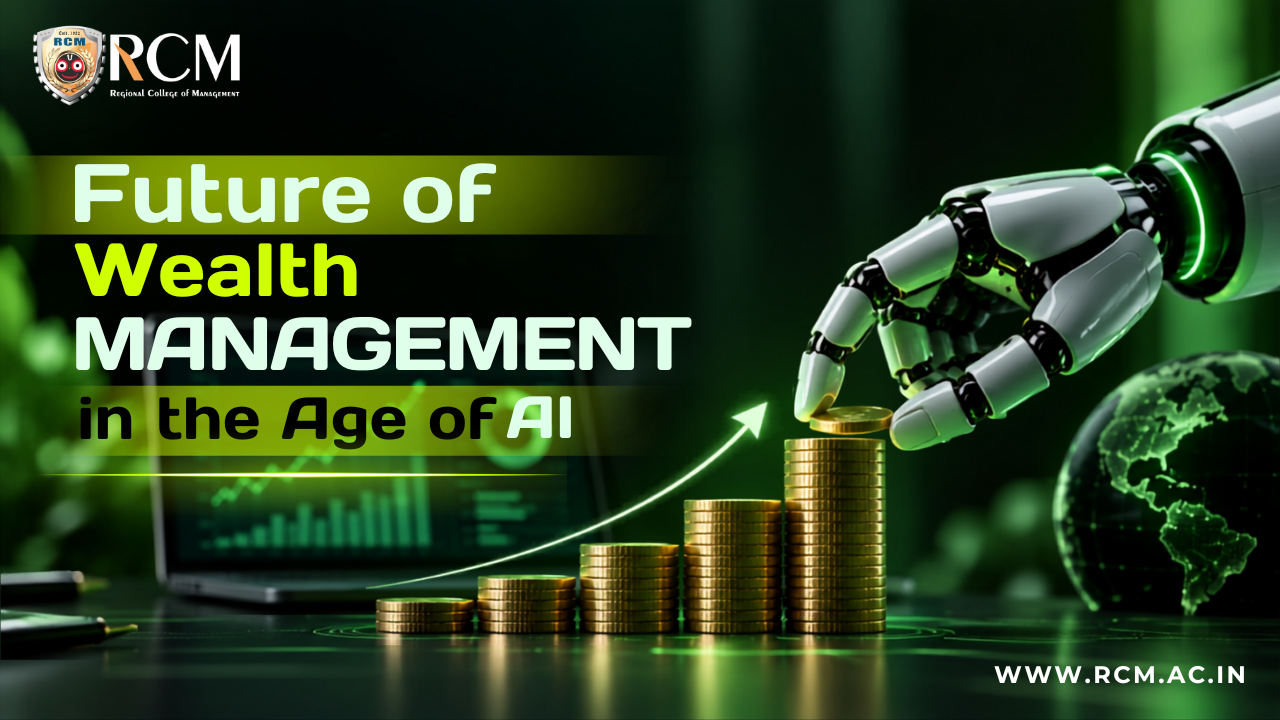
A decade ago, getting a personalised investment plan meant booking time with a relationship manager, usually reserved for clients with a fairly high account minimum. Today, a college graduate with their first salary can open an app, answer a short risk-profile questionnaire, and receive a portfolio recommendation within minutes — no meeting required. That shift, from relationship-gated advice to algorithm-assisted access, is the clearest sign of where wealth management is headed. The harder question is how far it goes: how much of what a wealth manager does can genuinely be automated, and where does human judgement remain irreplaceable?
This article works through that question directly — how AI is reshaping wealth management, how WealthTech is evolving in India specifically, and what skills the next generation of finance professionals will need. For the wider national picture this sits within — AI, digital payments, ESG and FinTech across Indian finance broadly — see the broader future of finance in India. Here, the lens stays specifically on wealth and investment management.
The future of wealth management combines AI-driven analysis, digital platforms and personalisation with continued human oversight for complex decisions. AI supports client profiling, portfolio monitoring and risk assessment, while advisors remain essential for judgement-heavy areas like estate planning, tax complexity, and high-value client relationships — pointing toward hybrid, not fully automated, advisory models.
The future of wealth management is best understood as a convergence: AI-driven analytics, digital-first platforms, and vast amounts of client and market data are combining with traditional financial planning expertise, rather than replacing it outright. Machine-learning models can process a client’s transaction history, goals and risk tolerance to generate tailored recommendations faster than manual analysis ever could.
What they cannot yet reliably do is navigate the genuinely ambiguous parts of wealth management — a complicated family succession plan, a client whose stated risk tolerance doesn’t match their actual behaviour under market stress, or a tax situation with no clean textbook answer. The likely trajectory, based on how the technology and the profession are both currently evolving, is collaboration between AI tools and human advisors rather than a full handover to automation.
How AI Is Transforming Wealth Management
AI’s practical footprint in wealth management today spans several concrete use cases, each solving a specific, previously time-consuming problem:
Client profiling: AI can process questionnaire responses and behavioural data to build a more nuanced risk and goals profile than a static form alone.
Financial goal analysis: Models can map a client’s stated goals — retirement, a child’s education, a home purchase — against their current savings trajectory and flag gaps.
Portfolio monitoring: Continuous, automated tracking can flag portfolio drift or rebalancing needs faster than periodic manual review.
Risk assessment: Predictive models can estimate portfolio risk under different market scenarios, supporting more informed allocation decisions.
Market and financial-data analysis: AI can process far more market data and research than a single analyst could manually review.
Personalised recommendations: Recommendation engines can tailor suggestions to individual client profiles rather than offering one-size-fits-all portfolios.
Automated reporting: Routine performance and compliance reports can be generated automatically, freeing advisor time for client conversations.
Tax and financial-planning support: AI-assisted tools can flag tax-loss harvesting opportunities or planning considerations for advisor review.
Fraud detection: Pattern-recognition tools can flag unusual account activity faster than manual monitoring.
Compliance monitoring: Automated systems can support regulatory-compliance checks across a growing volume of transactions and disclosures.
Customer service and virtual assistants: Chatbots can handle routine queries, escalating complex ones to human advisors.
None of this means AI removes investment risk or guarantees better returns — every one of these tools works with historical and current data to support a decision, not to predict markets with certainty.
AI Wealth Management vs Traditional Wealth Management
Dimension
Traditional Model
AI-Assisted Model
Personalisation
Based on periodic advisor review
Continuously updated based on data inputs
Accessibility
Often limited by account minimums or advisor availability
Broader access via digital platforms, though not universal
Cost efficiency
Higher advisor-time cost per client
Can lower marginal cost of routine analysis
Speed of analysis
Limited by manual research capacity
Can process larger datasets faster
Human interaction
Central to the relationship
Often reduced for routine tasks, retained for complex decisions
Advice reasoning is directly explainable by the advisor
Can be less explainable depending on model complexity
Emotional/behavioural guidance
A core advisor strength during market volatility
Limited — a genuine current gap in most AI-assisted tools
Neither model is universally superior — the comparison above reflects trade-offs, not a verdict, and most credible wealth-management providers are moving toward some blend of both.
The Rise of WealthTech in India
WealthTech in India has grown alongside the country’s broader digital-finance infrastructure. Digital investment platforms now offer streamlined onboarding, online portfolio tracking, and — for many providers — some form of robo-advisory as a lower-cost entry point for first-time investors. Mobile-first design has been central to this growth, reflecting how the majority of new Indian investors first engage with financial markets through a smartphone rather than a branch visit.
This growth connects to the same broader financial-inclusion story shaping Indian finance generally: digital platforms can extend investment access to segments — younger investors, smaller ticket sizes, tier-2 and tier-3 city residents — that traditional wealth-management relationships historically underserved. That said, trust and regulatory considerations remain genuinely important as this space grows; not every digital investment platform maintains the same standard of disclosure, security or suitability assessment, and investors evaluating any platform should look closely at its regulatory registration and track record rather than assuming digital-first automatically means well-governed.
Key Trends Shaping the Future of Wealth Management in 2026
AI-powered personalisation: Recommendations increasingly reflect individual behaviour patterns, not just static risk categories.
Hybrid advisory models: More platforms combine algorithmic portfolio management with access to human advisors for complex questions.
Robo-advisory and automated investing: Continued growth in algorithm-driven portfolio construction for straightforward investment needs.
Predictive analytics: Growing use of forward-looking models to support (not guarantee) planning decisions.
Real-time portfolio insights: Continuous rather than periodic portfolio visibility for clients.
ESG and sustainable investing: Growing client demand for portfolios that reflect environmental and social criteria alongside financial goals.
Alternative data and advanced analytics: Wider use of non-traditional data sources to inform investment research.
Embedded wealth services: Investment options increasingly offered directly within other financial apps rather than as standalone products.
Cybersecurity and privacy: Rising investment in security infrastructure as more client financial data moves onto digital platforms.
Explainable and responsible AI: Growing emphasis on AI models that can justify their recommendations, not just produce them.
Can Robo-Advisors Replace Human Wealth Managers?
Robo-advisors do a specific job well: for straightforward goals — a diversified, low-cost portfolio aligned to a stated risk tolerance and time horizon — algorithmic portfolio construction can be efficient, consistent and considerably more accessible than a traditional advisory relationship. For a first-time investor building a simple long-term portfolio, this is often a genuinely good fit.
Where robo-advisors reach their current limits is anywhere the situation stops being purely quantitative. Estate planning involves family dynamics an algorithm doesn’t observe. Complex tax situations often require judgement calls that don’t reduce cleanly to a rule. High-value client relationships frequently depend on trust built over years, not a well-designed interface. And perhaps most importantly, managing a client’s emotional response during a market downturn — talking someone out of panic-selling at the worst possible moment — is a distinctly human skill that current AI tools aren’t designed to replicate. This is precisely why hybrid human-plus-AI models, rather than a full replacement of advisors, are the direction the industry appears to be heading — not because the technology can’t improve further, but because the highest-value parts of wealth management are disproportionately the parts that resist full automation.
Benefits and Risks of AI-Powered Wealth Management
Benefits
Broader accessibility for clients previously underserved by traditional minimums
Faster analysis of larger volumes of financial and market data
More consistent, data-driven personalisation
Lower operational friction for routine portfolio tasks
Services that scale without proportional increases in advisor headcount
Better continuous monitoring than periodic manual review allows
Data-driven decision support for both advisors and clients
Risks
Algorithmic bias: Models trained on unrepresentative data can produce skewed recommendations for underrepresented client segments.
Poor-quality data: AI outputs are only as reliable as the data feeding them.
Privacy concerns: Wealth-management platforms handle highly sensitive financial data, raising the stakes on data protection.
Cybersecurity threats: Digital wealth platforms are attractive targets for financial fraud and data breaches.
Lack of explainability: Complex models can be difficult for both advisors and clients to interpret.
Overdependence on automation: Clients or advisors who defer entirely to algorithmic output risk missing context the model doesn’t capture.
Regulatory challenges: AI-driven advice sits at an evolving intersection of technology and financial-advisory regulation.
Human error in model design: Flawed assumptions baked into a model can produce systematically poor recommendations.
Inappropriate recommendations: A model may generate suitable-looking advice that doesn’t actually fit a client’s full situation.
These governance concerns are being actively studied, not just theorised. The IMF’s analysis of generative AI in finance discusses how generative AI reshapes both the opportunity set and the risk landscape for financial institutions, including explainability and model-risk concerns directly relevant to AI-assisted wealth advice. On the regulatory side, both SEBI, which oversees investment-adviser conduct and investor protection in India’s capital markets, and the Reserve Bank of India, which regulates digital-finance infrastructure more broadly, are relevant reference points for how this space is governed.
Skills Needed for the Future of Wealth Management
The wealth-management professional of the near future will likely need a genuinely hybrid skill set:
Financial knowledge and investment fundamentals
Portfolio-construction and asset-allocation concepts
Data analytics and comfort interpreting model outputs
AI and machine-learning awareness — not necessarily building models, but understanding what they can and cannot do
CAPXCHANGE 2026 and the Future of Wealth Management
Much of what this article has covered — AI-assisted portfolio management, ESG-linked investing, responsible technology adoption in finance — sits within the scope of CAPXCHANGE 2026 Finance Conclave, a two-day event hosted by Regional College of Management, Bhubaneswar, Odisha, on 18–19 September 2026, under the theme “Green Finance, Smart Future: Redefining Wealth in the Age of AI and Sustainability.” The theme’s explicit framing of “wealth in the age of AI” mirrors this article’s central question directly.
The conclave’s programme includes panel discussions covering AI-powered green finance and long-term wealth creation, alongside financial modelling and FinTech innovation competitions, delivered through keynotes, masterclasses and academia-industry interaction. For students weighing a career at this intersection of finance, AI and sustainability, it’s a concrete opportunity to engage with practitioners actively working through these same questions, rather than only encountering them in coursework.
FAQs
What is future of wealth management?
The future of wealth management is the growing convergence of AI-driven analytics, digital platforms and personalisation with continued human financial expertise — combining faster, data-informed analysis with the judgement, ethics and emotional guidance human advisors provide for complex decisions.
Why is future of wealth management important in 2026?
Client expectations have shifted toward faster, more personalised, digitally accessible investment services, while AI tools have matured enough for genuine operational use in profiling, monitoring and reporting — making how the industry balances automation with human oversight a live, consequential question.
What are the key trends in future of wealth management?
Key trends include AI-powered personalisation, hybrid human-AI advisory models, growth in robo-advisory for straightforward investment needs, real-time portfolio insights, rising ESG-linked investment demand, and increasing focus on explainable, responsible AI and cybersecurity.
How does CAPXCHANGE 2026 connect to future of wealth management?
CAPXCHANGE 2026’s theme, “Redefining Wealth in the Age of AI and Sustainability,” and its panel discussions on AI-powered finance and long-term wealth creation directly engage with how AI and human expertise are reshaping wealth management in practice.
What can students or finance professionals learn from future of wealth management?
They can build a combination of financial fundamentals, data analytics, AI literacy, ESG knowledge and client-relationship skills — the hybrid skill set increasingly expected as wealth-management roles blend technology fluency with traditional advisory judgement.
Conclusion
The future of wealth management isn’t a straightforward story of automation replacing advisors — it’s a more interesting one of technology and human judgement finding a genuinely productive division of labour. AI is well-suited to the data-heavy, repetitive parts of the job: profiling, monitoring, reporting, pattern recognition. Humans remain essential for the parts that resist reduction to data: trust, ethics, emotional steadiness during volatility, and the judgement calls that don’t have a clean algorithmic answer. The professionals and platforms that get this balance right — not the ones betting everything on either extreme — are likely to define what wealth management looks like over the next decade.
For students building toward this space, that means developing genuine fluency in both directions: financial expertise deep enough to exercise real judgement, and enough technical literacy to work confidently alongside AI tools rather than either fearing or blindly trusting them.
Explore the official CAPXCHANGE 2026 Finance Conclave page for event details and current participation or registration information.
Regional College Of Management (RCM College) is a Leading education provider with foremost facilities essential for the all-round development of a student.
RCM College offers an enriching academic environment coupled with supportive faculty, making my learning experience truly fulfilling.
Ritesh Chatterjee
The vibrant campus life at RCM College has helped me develop both academically and personally, fostering a sense of community and growth.
Indrani Chakraborty
I appreciate RCM College's focus on practical learning and industry exposure, which has prepared me well for my career ahead.
Manjeet Kumar Rai
Regional college of management Bhubaneswar is a place where students get an opportunity to promote their holistic growth.
Shwetail Suman Patnaik
Life in RCM has been a breathtaking experience. As a hosteller, I would say I am indebted to the institute for giving me a loving and safe home.
Yagyan Prakash Behera
RCM College has been a completely enriching experience. I have acquired lot of confidence in myself. RCM trained me how to be a better version of myself.
Swati Priyadarshini
One of the best B-School with top class faculties and one of the oldest management college in Odisha. Also, this is the one of the best college in Eastern India.
Muthyala Yamini
The oldest management college of Odisha, RCM, has top-notch infrastructure, on-campus hostel, hygienic food, free Wi-Fi, library, and canteens.
Sudeepta Nayak
The college has excellent infrastructure, facilities, equipment, teaching, labs, library, sports centers, hostels, Wi-Fi, and high placements.
Hrittik Das
The best management college in Easter India with great peers, faculty, campus life, sports, fests, and extra-curricular activities.
Jaishree Gumparti
RCM provided a new perspective on life and the market scenario. Thanks to great teachers' support during my academic years.
Kaushal Patra
For excellent education and personal grooming, visit Regional College of Management. I recommend every management student to go there.
Bishwajeet Panda
Register Now
Regional College of Management, BBSR
Thank You!
Your enquiry has been submitted successfully. Redirecting...