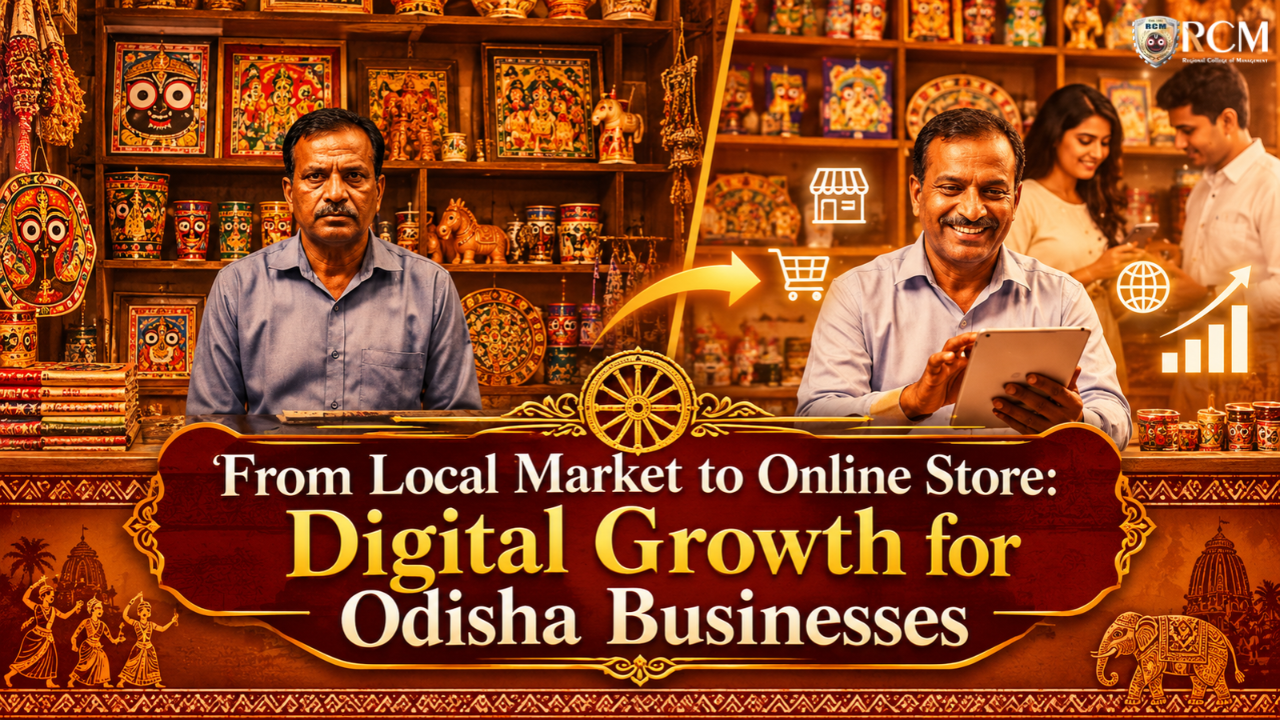
On an ordinary evening in Bhubaneswar, local trade still looks much as it has for generations. A handloom seller unfolds a stole under a market lamp, a home baker’s snack boxes pass from hand to hand, and a customer turns a Pattachitra-inspired coaster over to study the brushwork. Odisha’s businesses have long grown through neighbourhood markets, exhibitions, community networks and direct conversation.
That trust is a real asset, and the market is changing around it. A customer in another city can now find a product on a phone and pay within minutes. For artisans and small business owners, learning how to sell products online in Odisha is about carrying a familiar kind of trust across a new distance. Small business ecommerce lets a local maker show local products online, talk with customers and receive enquiries from beyond the nearest market.
Moving online is not the same as posting photographs on social media. It means planning the offer, understanding the customer, taking payment safely and delivering well.
Table of contents
- Why Should Odisha Businesses Move from Local Markets to Online Selling?
- How to Sell Products Online in Odisha: A Step-by-Step Guide
- Which Online Selling Channel Is Right for a Small Business?
- What Challenges Do Odisha MSMEs Face When Moving Online?
- How Can Local Businesses Create a Simple 30-Day Digital Growth Plan?
- How Does AA KA MA – Bizz Buzz Soirée 2026 Connect with Digital Growth for Odisha Businesses?
- How RCM Programmes Relate to Digital Business and Technology
- Building the Digital Future of Odisha’s Local Businesses
- Frequently Asked Questions
Why Should Odisha Businesses Move from Local Markets to Online Selling?
Digital channels give a business options that a single stall cannot. They let it:
- reach customers across Odisha and India, not one local market;
- show products outside market and exhibition hours;
- depend less on physical footfall alone;
- talk directly with customers and collect their feedback;
- build a recognisable local brand and support repeat orders.
These are opportunities, not promises. Results depend on product quality, pricing, customer demand, operational readiness and consistent execution.
How to Sell Products Online in Odisha: A Step-by-Step Guide
Treat the seven steps as a sequence.
Step 1: Identify the Right Products and Target Customers
Begin with products that travel and sell well online, such as handloom stoles, handicrafts, handmade accessories, packaged snacks and home décor. Each has demands: fragile items need strong packaging, food needs careful labelling, and textiles need accurate sizes. Ask who buys, what price they accept and what makes yours different. Start with five to ten products, not everything.
For MSMEs, digital transformation is a series of small operational upgrades. Read the official Udyam Registration information for MSMEs to check current eligibility and requirements. Not every online seller must register, and registration does not by itself provide financial assistance.
Step 2: Prepare a Professional Digital Catalogue
Online, the customer cannot touch the product, so the catalogue must answer every doubt. Include a clear name, an accurate description, sharp photographs in natural light, dimensions, material and care details, colours and variations, current stock, price and delivery information. Keep one master sheet and reuse it on every channel so details match everywhere. Writing tools can speed up first drafts; see practical AI tools for small business owners for uses and limits, and check the final text yourself.
Step 3: Choose the Right Online Selling Channels
A. Social commerce. Instagram, Facebook and WhatsApp Business suit discovery and quick enquiries, though orders can scatter across chats. A practical digital marketing guide for women entrepreneurs covers starter habits for home-based sellers, and using social media to generate leads for a small business explains how attention becomes enquiries.
B. Online marketplaces. Third-party and category-specific platforms put your catalogue before shoppers already browsing. Compare commission, rules and competition first.
C. An independent online store. A website with a catalogue and checkout gives control over brand and customer data, but needs setup, upkeep and your own effort to bring visitors.
D. Open digital commerce networks. ONDC, the Open Network for Digital Commerce, is a network, not a single shopping application. Sellers usually join through a seller network participant, a technology provider whose seller application can help with onboarding and catalogue digitisation. Read ONDC’s official information for seller network participants, then check onboarding requirements, fees, fulfilment responsibilities and terms. Joining does not guarantee orders, reach or revenue.
Step 4: Build a Strong Local Digital Presence
Use one business name everywhere, with the same logo, colours and photo style: Instagram, Facebook, WhatsApp Business and, where suitable, a Google Business Profile with address, hours and contact details. Post new products regularly and invite genuine reviews. Mention Bhubaneswar or Odisha where it is true and useful, such as a product’s craft tradition. For more on visibility, read about digital marketing strategies for local artisans.
Step 5: Set Up Reliable Digital Payment Options
Many small sellers begin with UPI and QR code payments, add bank transfer, and use a payment gateway once they run a website. No single method is mandatory for every business. Confirm each payment, keep an order record, and state refund and cancellation terms upfront. Use only official payment apps, and never share an OTP, PIN or confidential banking details with anyone.
Step 6: Plan Packaging and Logistics
Every online order is a promise to deliver. Plan protective packaging and its cost, shipping charges, delivery timelines you can meet, tracking information, returns and damaged goods, and how you will keep the customer informed. India Post is one possible option. Review India Post’s official parcel services for business customers, and confirm current services, eligibility, charges and terms directly, since these vary.
Step 7: Build Customer Trust and Encourage Repeat Orders
Use real photographs, plain prices and clear delivery policies, answer messages promptly, send order updates, share genuine reviews and offer after-sales help. Contact customers about new products only with their consent.
Which Online Selling Channel Is Right for a Small Business?
| Channel | Best suited for | Main consideration |
|---|---|---|
| Social media | Product discovery and direct enquiries | Consistent content and customer response |
| WhatsApp Business | Direct customer communication | Order organisation and response time |
| Online marketplace | Businesses seeking marketplace discovery | Fees, competition and platform rules |
| Own website | Businesses building a long-term brand | Setup, maintenance and traffic generation |
| ONDC network | Businesses exploring open digital commerce | Seller onboarding and fulfilment requirements |
No single channel is best for every business. Start with one or two and expand as operations are ready.
What Challenges Do Odisha MSMEs Face When Moving Online?
Most of these challenges are common to small businesses everywhere. Odisha’s artisans and family-run shops often feel them as craft skills passed down without software skills.
- Limited digital skills: learn one channel at a time and ask a student or relative to help.
- Photography and catalogue gaps: shoot in daylight on a plain background, and copy details from one master sheet.
- Pricing and shipping: cost each product with packaging, fees and delivery before pricing.
- Payment confidence: start with UPI on small orders and follow the safety rules above.
- Packaging and stock: test-pack every product and update counts after each sale.
- Customer acquisition and competition: start with existing customers and compete on craft story and service, not only price.
- Returns and complaints: write a simple policy, reply politely and keep photographs of damage claims.
How Can Local Businesses Create a Simple 30-Day Digital Growth Plan?
| Timeline | Main activity | Expected output |
|---|---|---|
| Week 1 | Select products, target customers and pricing | Clear product and customer focus |
| Week 2 | Prepare catalogue, product photographs and descriptions | Digital product catalogue |
| Week 3 | Select sales channels and set up payment and delivery processes | Basic online selling readiness |
| Week 4 | Publish products, respond to enquiries and review feedback | Initial customer learning |
How Does AA KA MA – Bizz Buzz Soirée 2026 Connect with Digital Growth for Odisha Businesses?
AA KA MA – Bizz Buzz Soirée 2026 is the third edition of the business carnival organised by Regional College of Management (RCM), Bhubaneswar. It runs on 14–15 November 2026 at the RCM Campus, Plot No. GD 2/12 & 13, Chakadola Vihar, Chandrasekharpur, Bhubaneswar, Odisha – 751023. Its theme is “From Tradition to Transformation – Pioneering Young Business Wizards”, and it is positioned as “Odisha’s Maritime Legacy – Where Heritage Meets Enterprise”. The published programme includes entrepreneurial stalls, startup pitch presentations, networking and cultural activities.
Insert the official AA KA MA – Bizz Buzz Soirée 2026 campaign artwork supplied by RCM. Use responsive images with descriptive alt text, for example “Official AA KA MA – Bizz Buzz Soirée 2026 poster, 14–15 November 2026, RCM Campus, Bhubaneswar”.
AA KA MA is an RCM business initiative inspired by Odisha’s maritime heritage. It is not the Bali Jatra festival and is not part of the Cuttack Bali Jatra celebrations. Odisha’s maritime tradition is a reminder that the region has long looked beyond its own shore for customers and ideas.
- Local businesses can showcase products through suitable business platforms.
- In-person interaction shows which questions customers ask.
- Owners can learn from how products are presented and explained.
- Digital channels can extend a product’s visibility beyond a physical event.
- Students and aspiring entrepreneurs can observe practical business activity.
Orders and partnerships are never guaranteed. Explore AA KA MA – Bizz Buzz Soirée 2026 on the official RCM page.
Register for AA KA MA – Bizz Buzz Soirée 2026
14–15 November 2026 · RCM Campus, Chandrasekharpur, Bhubaneswar
The approved RCM registration iframe snippet was not supplied with this brief. Paste it here, full-width and responsive. Until then, the button above links to the registration page.
How RCM Programmes Relate to Digital Business and Technology
- BCA+ relates to digital technology, computing and the technology-enabled processes behind online stores and payments.
- MBA+ relates to management, marketing, strategy and business decision-making.
- PGDM+ relates to management learning, business understanding and professional development.
None of these programmes guarantees business success, online sales or employment.
Building the Digital Future of Odisha’s Local Businesses
Local businesses do not need to transform everything at once. Anyone asking how to sell products online in Odisha can begin with a clear catalogue, accurate photographs, one or two suitable channels, reliable payments, a practical logistics plan and consistent customer communication.
Odisha’s weavers, painters, food makers and small retailers already hold what many online brands try to build: craft, character and local trust. Paired with a careful digital process, that can help homegrown products become recognisable brands. AA KA MA 2026 shows how RCM brings heritage, innovation and enterprise into the same conversation.
Frequently Asked Questions
Small businesses in Odisha can sell online through social commerce, marketplaces, their own websites or suitable open digital commerce networks after preparing product catalogues, payment methods and delivery processes.
Start with a focused product range, clear photographs, accurate descriptions, a suitable sales channel and a reliable way to receive payments and fulfil orders.
Local businesses can use online marketplaces, social commerce, digital catalogues and suitable delivery services to make their products available to customers beyond their immediate market.
An MSME should consider customer demand, product pricing, catalogue quality, payment security, packaging, shipping, returns and applicable business requirements.
AA KA MA 2026 is an RCM-organised business carnival in Bhubaneswar that brings together entrepreneurial stalls, startup pitches, networking and cultural activities inspired by Odisha’s maritime heritage.