A finance degree teaches you how a discounted cash flow model works. It rarely teaches you what it feels like to defend one in front of someone who’s built dozens of them professionally. That gap, between knowing the theory and being tested on it, is exactly what a good finance event closes, and 2026 is shaping up to be a genuinely strong year for finding one.
Finance events for students in India in 2026 span financial modelling competitions, FinTech and AI showcases, ESG conferences, and full-scale academic conclaves like CAPXCHANGE 2026, each offering different combinations of industry exposure, competition and networking. Choosing the right one, based on credibility, practical exposure and relevance to your interests, matters more than simply attending whichever one lands in your inbox first.
This guide walks through what actually makes a finance event worth your time, the main categories you’ll come across, and a closer look at CAPXCHANGE 2026 as one strong, verifiable example of what a student-focused finance conclave can offer.
Table of contents
- What Makes a Finance Event Valuable for Students in 2026?
- Types of Finance Events Students Should Look for in India
- Best Finance Events in India for Students 2026: What to Prioritise
- Featured Student Finance Event: CAPXCHANGE 2026
- CAPXCHANGE 2026 Student Opportunities
- Skills Students Can Build Through Finance Events
- How to Choose the Right Finance Event as a Student
- Finance Events by Student Profile
- Frequently Asked Questions
What Makes a Finance Event Valuable for Students in 2026?
Not every “finance conclave” delivers the same thing. Some are genuinely built around student learning; others are industry events that happen to allow student attendance. Knowing the difference upfront saves you time and, often, registration fees.
| Criteria | Why It Matters to Students |
|---|---|
| Credible organisers | An established institution or professional body is more likely to deliver on what it promises |
| Industry speakers and practitioners | Direct access to people currently making financial decisions, not just teaching about them |
| Practical learning opportunities | Hands-on sessions build skills a lecture alone can’t |
| Financial modelling or valuation exposure | Builds the technical backbone most finance careers still run on |
| FinTech and AI relevance | Reflects where the industry is actually hiring and investing |
| Green finance and ESG coverage | Increasingly a baseline expectation, not a niche specialisation |
| Competitions and live problem-solving | Tests understanding under real pressure, not just recall |
| Networking with professionals and peers | Often the most durable outcome of the entire event |
| Certificates, recognition or scholarships | Tangible, resume-relevant proof of participation |
| Career and internship relevance | Some events open doors that a classroom simply can’t |
| Research and innovation opportunities | Useful for students leaning toward analytical or research-heavy careers |
| Transparent participation details | A credible event publishes clear rules, dates and eligibility, not vague promises |
Types of Finance Events Students Should Look for in India
Finance Conferences and Conclaves
Multi-session events combining keynotes, panels and often a competitive element, typically the broadest entry point for students exploring finance as a field, useful for anyone still deciding which specialisation interests them.
Financial Modelling and Valuation Competitions
Excel-based, judged competitions covering forecasting, DCF, WACC and comparable-company analysis, best suited to students who already have foundational accounting or finance coursework and want to test it against a live case.
FinTech and Digital Finance Events
Focused on digital payments, embedded finance and financial inclusion, particularly relevant for MCA, BCA and B.Tech students who want to see how financial services and technology actually intersect in practice, a shift Reserve Bank of India has been actively shaping through its digital-payments and financial-inclusion initiatives.
AI in Finance Events
Cover applications like fraud detection, credit assessment and automated forecasting, useful for students building data or analytics skills who want to understand how those skills apply specifically to financial decision-making, an area generative AI in finance research from the IMF suggests still carries real, actively-managed model risk alongside its opportunities.
Green Finance and ESG Conferences
Address sustainable investment, climate risk and ESG reporting, increasingly relevant across every finance specialisation rather than a standalone interest area, a shift the World Bank has linked directly to the scale of climate finance now required across emerging markets like India.
Finance Career and Industry-Exposure Events
Built around direct interaction with recruiters, alumni or industry panels, best suited for students closer to graduation who need a realistic picture of hiring expectations.
Research and Innovation Competitions
Poster presentations and research showcases that reward original thinking over polished delivery alone, a good fit for students considering research, consulting or analyst-track careers. The globally recognised CFA Institute Research Challenge, for instance, is a long-running, verifiable example of this format, open to university students internationally and coordinated locally through CFA Society chapters; 2026 participation details should be checked on CFA Institute’s official page.
Investment, Wealth Management and Capital-Markets Events
Focus on portfolio construction, asset allocation and long-term wealth strategy, generally more relevant to students specifically interested in asset management or investment banking, and a useful area to pair with primary-source reading from SEBI on how investor protection and ESG disclosure norms are evolving in Indian capital markets.
Finance Workshops and Masterclasses
Shorter, skill-specific sessions, useful as a lower-commitment way to test whether a particular finance sub-topic is worth pursuing further.
Best Finance Events in India for Students 2026: What to Prioritise
There’s no single, independently audited ranking of finance events in India, so “best” here means best suited to your specific goals rather than an objective league table.
- Best for financial modelling: events with a structured, judged, multi-round competition format rather than a single workshop
- Best for FinTech and AI exposure: events with a dedicated technology or innovation track, not just a mention in a keynote
- Best for ESG and sustainable finance: events where sustainability is a core theme running through multiple sessions, not a single panel
- Best for networking and industry interaction: events with structured networking time built into the schedule, not left to chance
- Best for research and innovation: events with poster presentations or research showcases judged by practitioners
- Best for finance career exploration: broader conclaves that combine multiple themes, giving you exposure before you narrow your focus
Featured Student Finance Event: CAPXCHANGE 2026
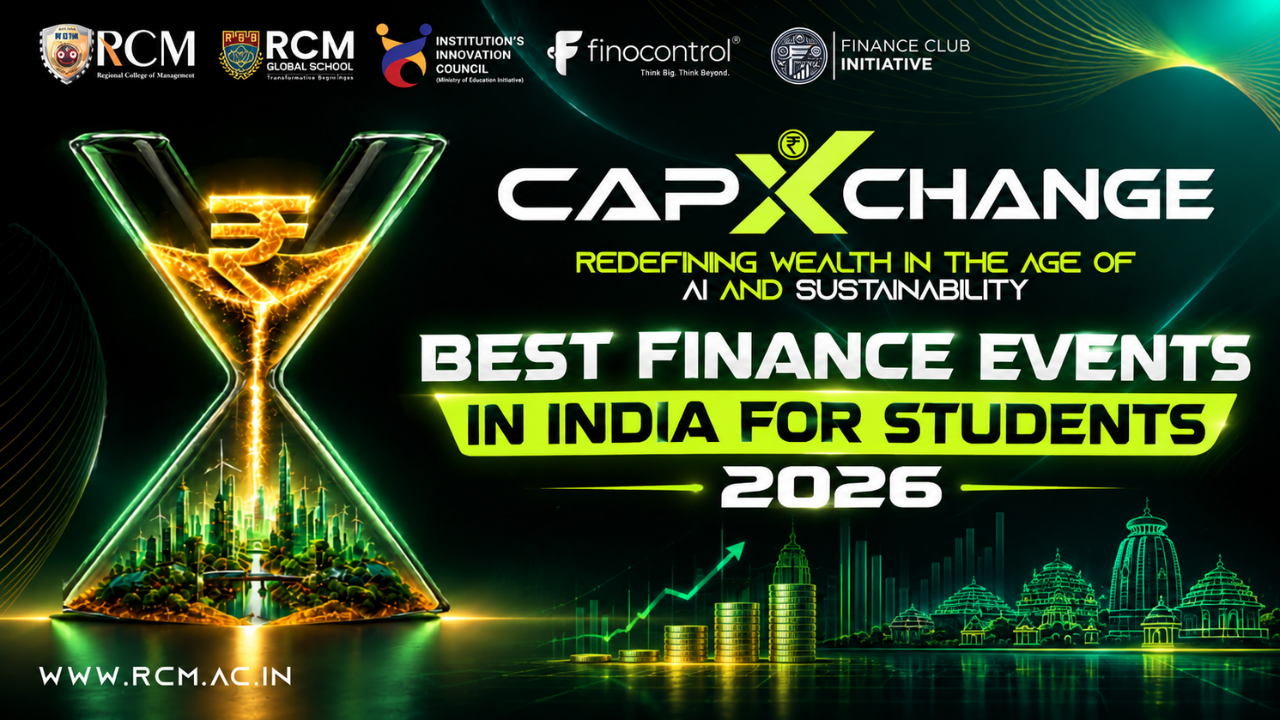
CAPXCHANGE 2026 is a genuinely useful reference point for what a well-structured student finance event looks like in practice. Organised by Regional College of Management (RCM), Bhubaneswar, it runs on 18–19 September 2026 at RCM’s campus in Bhubaneswar, Odisha, under the theme “Green Finance, Smart Future: Redefining Wealth in the Age of AI and Sustainability.”
Its core areas map onto nearly every category discussed above: AI in Finance, FinTech, Green Finance, ESG Investing, Digital Banking, Wealth Management, Financial Innovation and Financial Modelling, delivered through keynote addresses, masterclasses, industry panel discussions, a financial modelling competition, a technology-innovation competition, research presentations and structured academia-industry interaction. Its audience spans students, finance professionals, academicians, corporate leaders and industry experts.
RCM refers to CAPXCHANGE as India’s Biggest Finance Conclave 2026 as its own event positioning; treat that as RCM’s campaign framing rather than an independently audited ranking. What’s specifically relevant to students is more concrete: the event connects classroom learning with practical finance directly, through modelling, valuation and investment analysis exercises, alongside AI, FinTech, ESG and green-finance content, and genuine opportunities for competition, recognition and networking.
CAPXCHANGE isn’t the only finance event worth a student’s attention in 2026, but it’s a useful example of what to look for elsewhere: a credible organiser, transparent format, and activities that go well beyond passive listening. For the complete schedule, full speaker list and detailed event structure, India’s Biggest Finance Conclave 2026: Complete Guide to CAPXCHANGE covers it end to end.
CAPXCHANGE 2026 Student Opportunities
Financial Modelling WorldCup
An academic-industry finance competition open to relevant undergraduate and postgraduate student categories, run through team-based participation across a multi-round Excel challenge. It covers financial modelling, valuation and investment analysis, built on skills including accounting, forecasting, DCF, WACC, comparable-company analysis, and scenario and sensitivity analysis, culminating in a final investment-committee-style defence in front of industry judges. It carries a ₹50,000 cash-prize pool, along with scholarship and discount benefits as stated on the official event page, plus direct industry exposure and recognition.
Financial Technology Innovation
Open to students from MBA, BBA, MCA, BCA, M.Com and B.Tech backgrounds, participating individually or in teams per the official rules, through a five-minute presentation followed by a two-minute Q&A. Focus areas span AI in Finance, FinTech, digital payments, wealth management, ESG investing, blockchain, digital banking, financial inclusion, cybersecurity, green bonds and generative AI, judged on originality, accuracy, theme relevance, visual design, presentation and Q&A performance. It carries a ₹40,000 cash-prize pool, bringing CAPXCHANGE’s combined competition award value to ₹1,00,000, as stated on the official event page.
Skills Students Can Build Through Finance Events
| Skill | How a Finance Event Helps Build It |
|---|---|
| Financial analysis | Live case studies force you to interpret real numbers under time pressure |
| Financial modelling | Competitions require building working models, not just describing them |
| Valuation | DCF and comparable-company exercises turn theory into applied technique |
| Excel and spreadsheet modelling | Multi-round competitions demand speed and accuracy simultaneously |
| Investment decision-making | Defending a recommendation to judges mirrors real investment-committee dynamics |
| Business-case analysis | Structured problem statements teach you how to frame ambiguous business questions |
| Presentation and communication | Time-boxed pitches (like five-minute formats) force clarity over length |
| Research and critical thinking | Poster and research tracks reward original analysis over recycled arguments |
| ESG and sustainability analysis | Dedicated ESG tracks build fluency in a genuinely fast-growing area |
| AI and data-driven financial thinking | Exposure to AI-in-finance sessions demystifies a topic many students only read about |
| FinTech awareness | Direct contact with FinTech themes and speakers builds vocabulary employers expect |
| Networking | Structured interaction time turns strangers into professional contacts |
| Teamwork | Team-based competitions surface collaboration skills that solo coursework doesn’t |
| Professional confidence | Defending work in front of practitioners is genuinely different from presenting to classmates |
| Career clarity | Direct exposure often clarifies which finance specialisation actually interests you |
How to Choose the Right Finance Event as a Student
Before registering for anything, run it through a quick checklist:
- Is the organiser credible and independently verifiable?
- Are the speakers identifiable and genuinely relevant to the event’s themes?
- Is the event actually student-oriented, or just tolerant of student attendance?
- Does it include practical activities, not just keynotes?
- Are the competition rules clearly published and transparent?
- Is the participation fee reasonable relative to what’s offered?
- Are certificates or awards clearly explained upfront?
- Does it align with your specific course and career goals?
- Is there an official website or registration page you can verify independently?
- Are dates, venue and contact details publicly available?
- Does the event offer genuine industry interaction, not just a token panel?
Finance Events by Student Profile
| Student Profile | Suitable Event Type |
|---|---|
| BBA students | Broad finance conclaves and foundational financial modelling competitions |
| B.Com students | Accounting-heavy modelling competitions and valuation workshops |
| MBA students | Leadership-focused panels, strategy discussions and career-exposure events |
| M.Com students | Research-oriented competitions and academic finance conferences |
| MCA/BCA students interested in FinTech | FinTech and digital-finance innovation tracks |
| B.Tech students interested in financial technology | AI-in-finance and technology-innovation competitions |
| Students interested in investment banking | Valuation-focused modelling competitions and capital-markets events |
| Students interested in ESG and sustainability | Dedicated ESG and green-finance conferences |
| Students interested in research and innovation | Poster-presentation and research-challenge formats |
How Finance Events Connect With Future-Ready Education
The themes covered at events like CAPXCHANGE tend to map fairly directly onto specific academic pathways, useful to know if a particular session or competition sparks genuine interest.
Students drawn to the green finance and ESG conversation will find a direct fit in PGDM+ Green Finance & ESG (FinTech), part of the broader PGDM+ portfolio, while those more interested in the AI and analytics side can explore PGDM+ Data Science & Business Intelligence.
For students interested in the leadership and strategic decision-making side of finance events, MBA+ and its Finance / FinTech track build on that ground directly.
The technology backbone behind FinTech and AI-in-finance events, cloud, cybersecurity and data infrastructure, connects to MCA+, including its AI and ML, Cybersecurity and Data Science and Business Intelligence specialisations.
For students earlier in their academic journey, BBA+ offers foundational grounding through its Data Science and Business Intelligence and Green Finance & ESG (FinTech) pathways.
Students specifically curious about how regional access to these opportunities is developing in Eastern India can also read more in finance conclave in Eastern India, which looks at that broader regional context.
Explore CAPXCHANGE 2026
Students interested in practical finance learning, financial modelling, FinTech, AI, ESG and industry interaction can explore CAPXCHANGE 2026 and check the official participation details.
Frequently Asked Questions
The strongest options span financial modelling competitions, FinTech and AI showcases, ESG conferences, and broader academic conclaves like CAPXCHANGE 2026, each suited to different interests rather than one single “best” event.
Look for credible organisers, identifiable industry speakers, practical activities like modelling competitions, transparent participation rules, and genuine networking access rather than passive keynote sessions alone.
Yes. Competitions like financial modelling challenges build applied technical skills, presentation confidence and direct industry feedback, exposure that’s difficult to replicate through classroom coursework alone.
BBA and B.Com students generally benefit most from foundational modelling competitions and workshops, while MBA students gain more from leadership-focused panels and strategic career-exposure events.
Students can build financial modelling, valuation, presentation, research and networking skills, along with practical exposure to AI, FinTech and ESG themes that are increasingly standard across finance careers.
Conclusion
The best finance event for any student isn’t necessarily the biggest or the most talked-about one, it’s the one that offers meaningful learning, credible industry interaction and practical exposure genuinely aligned with your career interests. Whether that means a financial modelling competition, a FinTech innovation showcase, an ESG-focused conference, or a broader conclave that touches all three, the format matters less than the substance behind it.
CAPXCHANGE 2026 remains a useful, verifiable example of what that substance can look like in practice, financial modelling, AI, FinTech, ESG and direct networking with industry professionals, all built into a single, transparent event structure.