CUET PG has become the default gateway into postgraduate programs at most central and several state universities in India, and MCA is no exception. For the 2026 cycle, that door has already opened and closed on the exam side: CUET PG 2026 was conducted by the National Testing Agency (NTA) from March 6 to 27, 2026, with results declared on April 24, 2026. If you’ve already got your CUET PG MCA scorecard in hand, this guide walks through what your score actually means, which universities are realistic based on typical cutoffs, and what to do if CUET PG alone doesn’t get you into your first-choice university.
Table of contents
- Quick Answer
- What Is CUET PG MCA? A Quick Recap
- CUET PG MCA Eligibility
- CUET PG MCA Registration Process (For 2027 Aspirants)
- CUET PG MCA Exam Pattern
- CUET PG MCA Syllabus
- How to Prepare for CUET PG MCA (For Future Cycles)
- CUET MCA Colleges
- RCM Bhubaneswar: An Industry-Focused Alternative Through CUET PG or NIMCET
- Why Choose RCM Through CUET PG?
- Career Opportunities After CUET PG MCA
- Conclusion
- Frequently Asked Questions
Quick Answer
CUET PG MCA 2026 was conducted by NTA from March 6 to 27, 2026, with results declared on April 24, 2026; participating universities are now completing their MCA admissions through July. Regional College of Management (RCM), Bhubaneswar accepts both CUET PG and NIMCET scores for admission to its AI-integrated MCA Plus program, making it a practical option for candidates whose CUET PG score falls short of the 170–200+ cutoffs typically needed at top central universities like DU, JNU, or BHU. RCM pairs entrance-based admission with industry certifications, corporate mentoring, and placement-focused training across specialisations in Artificial Intelligence, Data Science, Cyber Security, and Full Stack Development, giving CUET PG candidates a industry-aligned route into an MCA even outside the most competitive central-university cutoffs.
| College | Accepts CUET PG | Accepts NIMCET | Admission Process | AI Specialisations | Best For |
|---|---|---|---|---|---|
| RCM Bhubaneswar | Yes | Yes | Entrance score + Personal Interview | AI & ML, Data Science & BI, Cyber Security, Full Stack | Candidates outside top CUET PG/NIMCET cutoffs |
| University of Hyderabad | Yes | No | CUET PG score + university counselling | Core CS with select AI electives | Candidates with strong CUET PG ranks targeting a research-oriented university |
| Jawaharlal Nehru University (JNU) | Yes | No | CUET PG score + university counselling | Core CS | High-scoring CUET PG candidates |
| Banaras Hindu University (BHU) | Yes | No | CUET PG score + university counselling | Core CS | High-scoring CUET PG candidates |
| Central University of Rajasthan | Yes | No | CUET PG score + university counselling | Core CS | Mid-range CUET PG scorers |
| Guru Ghasidas Vishwavidyalaya | Yes | No | CUET PG score + university counselling | Core CS | Mid-range CUET PG scorers |
CUET PG cutoffs vary sharply by university and category, and change every year, so always check each university’s official cutoff list before finalising your counselling choices.
What Is CUET PG MCA? A Quick Recap
CUET PG (Common University Entrance Test for Postgraduate Programmes) is a national-level entrance exam conducted annually by the NTA for admission to postgraduate courses — including MCA — across central, state, deemed, and private universities in India.
For the MCA paper specifically, CUET PG tests candidates on logical reasoning, mathematics, computer science fundamentals, and analytical ability, and the resulting score is used independently by each of the roughly 198 participating universities for their own counselling and cutoffs, rather than through one centralised seat-allotment system like NIMCET.
CUET PG MCA 2026 Highlights (Recap)
| Detail | Information |
|---|---|
| Conducting Body | National Testing Agency (NTA) |
| Exam Level | National |
| Exam Mode | Computer-Based Test (CBT) |
| Exam Dates | March 6–27, 2026 |
| Result Date | April 24, 2026 |
| Duration | Typically 105 minutes per paper |
| Question Pattern | Multiple-choice questions across reasoning, domain knowledge, and general awareness |
| Eligibility | Bachelor’s degree with minimum 50% aggregate marks |
| Official Website | exams.nta.ac.in/CUET-PG |
Key takeaway: Unlike NIMCET’s single centralised counselling, each CUET PG-participating university runs its own admission process and cutoff — so your score alone doesn’t tell you where you’ll get in; you need to check each target university’s specific cutoff separately.
CUET PG MCA Eligibility
Eligibility for CUET PG MCA is broader than NIMCET’s, since it’s designed to serve nearly 200 universities with varying program requirements rather than a single tightly-defined MCA track.
- Educational qualification: A bachelor’s degree of at least three years, in any discipline that meets the target university’s specific MCA eligibility.
- Minimum marks: Generally 50% aggregate, though this can vary by university and category.
- Mathematics requirement: Most (but not all) universities require Mathematics at 10+2 or graduation level for MCA — always confirm against your specific target university’s rules rather than assuming a blanket standard.
- Final-year students: Eligible to apply, provided they can furnish proof of having passed their qualifying exam before university-level counselling concludes.
- Age criteria: CUET PG does not impose a strict upper age limit for MCA applicants.
Institutions like Regional College of Management (RCM), Bhubaneswar accept CUET PG scores (alongside NIMCET) for MCA admission, followed by the institute’s own interview-based selection process — a route worth considering for candidates whose CUET PG score doesn’t clear the cutoff at their preferred central university.
CUET PG MCA Registration Process (For 2027 Aspirants)
For students planning ahead for the next CUET PG cycle, the registration process generally follows this sequence:
- Registration — Create an account on the official CUET PG portal with basic personal and contact details.
- Application Form — Enter academic history, category information, and select MCA along with your preferred exam cities.
- Upload Documents — Submit a scanned photograph, signature, and category certificate (where applicable) in the specified format.
- Fee Payment — Pay the application fee online, which typically ranges from roughly ₹1,400 to ₹7,000 depending on category and the number of papers selected.
- Correction Window — Use the short correction window (usually just a few days) to fix any errors in the submitted form.
- Admit Card — Download the admit card once released, generally shortly before your scheduled exam date/city.
Key takeaway: CUET PG’s correction window is brief and opens only once, so review category, subject, and exam-city selections carefully before submitting — mistakes here are hard to fix later.
CUET PG MCA Exam Pattern
CUET PG MCA is a computer-based test combining domain-specific and general sections, with each university weighting the resulting score according to its own admission policy.
| Section | Approx. Questions | Marks | Duration | Negative Marking |
|---|---|---|---|---|
| Domain Knowledge (Computer Science/MCA-relevant) | ~50–65 | Varies by paper | Within overall 105-minute slot | Yes, typically -1 for wrong answers |
| Logical & Analytical Reasoning | Included within domain paper structure | Varies | Shared duration | Yes |
| General Test (where applicable) | Optional/university-dependent | Varies | Separate slot if opted | Yes |
Key takeaway: Because CUET PG’s exact section split can vary slightly by paper code and year, always cross-check the current year’s official information bulletin rather than relying on a previous cycle’s structure.
CUET PG MCA Syllabus
The CUET PG MCA syllabus draws heavily from core computer science and mathematics, reflecting the subject knowledge expected of an incoming postgraduate computer applications student.
Mathematics covers algebra, calculus, probability, statistics, and discrete mathematics — largely overlapping with what NIMCET tests, since both exams assume a similar quantitative foundation.
Computer Science & Programming covers programming fundamentals (typically C/C++ or Python-level concepts), basic algorithms, and problem-solving logic rather than advanced software engineering topics.
Data Structures covers arrays, linked lists, stacks, queues, trees, and basic graph concepts — foundational material expected from a computer science or BCA background.
Operating Systems covers process management, memory management, and basic OS concepts at an introductory level.
Database Management covers relational database concepts, normalisation, and basic SQL — again, foundational rather than advanced.
Logical Reasoning & Analytical Ability tests pattern recognition, series completion, and data interpretation, similar in spirit to NIMCET’s reasoning section.
General Aptitude covers quantitative aptitude and general awareness relevant to postgraduate-level readiness.
Best Books for CUET PG MCA Preparation (For Future Attempts)
For candidates preparing for a future CUET PG cycle, a section-wise book list works better than generic “MCA entrance” guides:
Practice: Previous years’ CUET PG MCA papers and NTA’s official mock tests are the most reliable way to gauge actual question difficulty and style.
Mathematics: NCERT Mathematics (Classes 11–12), supplemented by a discrete mathematics text for probability, sets, and combinatorics.
Computer Science Fundamentals: A basic “computer science for competitive exams” title covering programming logic, data structures, and OS basics.
Database Management: An introductory DBMS textbook covering relational models and SQL fundamentals.
Logical Reasoning: A standard reasoning guide (e.g., R.S. Aggarwal) for pattern recognition and analytical questions.
How to Prepare for CUET PG MCA (For Future Cycles)
A structured, section-aware study plan matters more than sheer study hours, especially given how broad the CUET PG MCA syllabus is compared to a single-focus exam.
6-month study plan: Use the first three months to build fundamentals across Mathematics, Data Structures, DBMS, and Operating Systems, then shift the next two months to topic-wise mock tests, reserving the final month for full-length timed practice and revision.
90-day strategy: If starting later, compress core-subject revision into the first month, then spend the remaining two months almost entirely on mock tests and previous years’ papers, prioritising speed over covering new material.
Weekly schedule: A rotating weekly structure — two days each for Mathematics and Computer Science fundamentals, one day for reasoning, and one day for a full mock test — tends to cover the syllabus more evenly than single-subject excessively.
✔ Preparation checklist: ✔ Core CS fundamentals (data structures, DBMS, OS) revised at an introductory level ✔ Mathematics basics from Class 11–12 syllabus refreshed ✔ At least 8–10 previous years’ papers attempted under timed conditions ✔ University-specific cutoffs researched well before counselling begins ✔ Backup admission routes (like RCM’s CUET PG/NIMCET-based process) identified in advance, not scrambled together after results
CUET MCA Colleges
Beyond the well-known central universities, CUET PG scores are accepted by a wide range of institutions — some purely through centralised counselling, and others, like RCM Bhubaneswar, through a hybrid entrance-plus-interview process.
| College | Entrance Accepted | Specialisations | Best For |
|---|---|---|---|
| RCM Bhubaneswar | CUET PG, NIMCET | AI & ML, Data Science & BI, Cyber Security, Full Stack | Candidates seeking an industry-integrated MCA outside top-university cutoffs |
| University of Hyderabad | CUET PG | Core CS with select AI electives | Candidates with strong CUET PG scores |
| JNU | CUET PG | Core CS | High-scoring candidates targeting a research-oriented campus |
| BHU | CUET PG | Core CS | High-scoring candidates |
| Central University of Rajasthan | CUET PG | Core CS | Mid-range scorers |
| Guru Ghasidas Vishwavidyalaya | CUET PG | Core CS | Mid-range scorers |
RCM Bhubaneswar: An Industry-Focused Alternative Through CUET PG or NIMCET
Regional College of Management (RCM), Bhubaneswar, is a private institute established in 1982, affiliated with Biju Patnaik University of Technology (BPUT) and Utkal University, and accredited by NAAC with AICTE and UGC recognition. RCM accepts both CUET PG and NIMCET scores for admission to its MCA program — a meaningful option for candidates whose CUET PG score falls below the 170–200+ range typically needed for General-category seats at top central universities like DU, JNU, or BHU.
RCM’s admission process, as listed on its official admissions page, runs through five steps:
- Enquiry — A guidance session to help candidates understand the admission process and choose the right specialisation track.
- Application Form — Candidates apply using their CUET PG (or NIMCET) scorecard along with required academic documents.
- Personal Interview — An assessment round to evaluate a candidate’s overall suitability for the program.
- Seat Booking — Candidates reserve their seat after clearing the interview and completing documentation.
- Admission — Enrolment is finalised, confirming the candidate’s seat in the MCA Plus program.
This process is generally faster than waiting through multiple rounds of a central university’s own CUET PG-based counselling, since it’s administered directly by the institute rather than a large, centralised system serving dozens of universities at once.
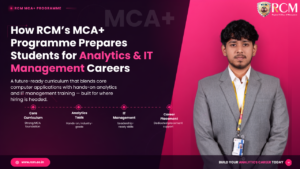
What differentiates RCM’s MCA program is its MCA Plus structure, layering specialisation tracks onto the core two-year curriculum:
- Artificial Intelligence & Machine Learning — covering automation, predictive analytics, and applied AI use cases.
- Data Science & Business Intelligence — training students to work with real datasets and build BI dashboards.
- Cyber Security — hands-on preparation for identifying and responding to digital threats.
- Full Stack Development — covering MEAN/MERN stack skills for building and deploying web applications.
- Blockchain — offered as an elective for students interested in distributed-ledger technologies.
Beyond these tracks, a few structural elements shape the MCA Plus experience. Industry certifications come bundled into the coursework rather than sold separately, and corporate mentoring connects students with working professionals across both years of the program, not just in the final semester. Live projects replace purely theoretical assignments with real datasets and business problems, and innovation labs and hackathons give students a structured outlet to build a portfolio — genuinely useful when interviewing for AI or full-stack roles where demonstrable work often carries more weight than grades alone.
Placement support begins early at RCM rather than being concentrated at the end of the program, backed by a placement cell that the institute reports engages with over 830 recruiting companies, including EY, Amazon, Accenture, Flipkart, and Deloitte. RCM’s own published figures cite a 98.7% overall placement rate across programs — as with any institution-reported statistic, it’s worth confirming current, MCA-specific figures directly with the admissions office, since numbers shift by batch and year. Student life at RCM extends into cultural fests, sports events, tech conclaves, and industry collaborations that bring recruiters onto campus for training, not only for final placement drives.
Why Choose RCM Through CUET PG?
For candidates whose CUET PG score doesn’t clear the cutoff at their preferred central university, the practical comparison usually comes down to how much industry integration a traditional MCA offers versus a specialisation-led model like RCM’s.
| Aspect | Traditional MCA | RCM MCA Plus |
|---|---|---|
| Curriculum | Core programming, DBMS, OS, software engineering | Core subjects plus applied AI, data science, cybersecurity, and full-stack modules |
| AI Integration | Often absent or elective-only | Built into multiple specialisation tracks |
| Industry Certifications | Usually pursued separately, at extra cost | Bundled into the program fee |
| Live Projects | Limited to a single internship or capstone | Ongoing live projects and hackathons |
| Placements | Varies by institute; often generic training | Structured, ongoing placement preparation with 830+ engaged recruiters |
| Corporate Mentoring | Rare or informal | Structured mentoring across both years |
| Career Readiness | Concentrated in the final semester | Continuous, built into the program structure |
This doesn’t mean central universities are a weaker choice — institutions like JNU, BHU, and University of Hyderabad carry strong academic reputations and typically lower fees. But for candidates outside those cutoffs, or those who specifically want a specialisation-heavy MCA, RCM’s CUET PG/NIMCET-based route is a legitimate option worth evaluating rather than defaulting to a lower-tier college with a purely traditional syllabus.
Career Opportunities After CUET PG MCA
Whichever university you finally enrol in, an MCA — especially one with a built-in specialisation — opens up a fairly consistent set of roles:
- Software Engineer
- AI Engineer
- Machine Learning Engineer
- Data Scientist
- Cyber Security Analyst
- Cloud Engineer
- Business Intelligence Analyst
- Full Stack Developer
- DevOps Engineer
Starting packages depend heavily on specialisation, individual skill level, and employer — AI, cybersecurity, and cloud-focused roles tend to command higher entry-level packages than generalist software roles, based on current hiring trends tracked by bodies like UGC.
Common Mistakes to Avoid While Preparing for CUET PG MCA
- Treating cutoffs as fixed — cutoffs shift every year based on difficulty level and applicant pool, so relying only on last year’s numbers can lead to miscalculated expectations.
- Assuming one CUET PG score works everywhere — each participating university sets its own cutoff, so a score that clears one institution may fall short at another.
- Ignoring university-specific eligibility rules — some universities require Mathematics at a specific level; others don’t, so blanket assumptions can cost you a shot at eligible seats.
- Applying to too few universities — since CUET PG lets you select multiple exam papers and apply to several institutions, narrowing your options too early limits your admission chances.
- Delaying backup options — waiting until after results to explore alternatives like RCM’s CUET PG/NIMCET-based admission can mean missing a seat-booking window elsewhere.
Conclusion
CUET PG MCA 2026 has already run its course — the exam was held across March, results came out on April 24, and most participating universities are finishing their MCA admissions through July. If your score cleared your preferred central university’s cutoff, that’s a strong outcome; if it didn’t, your CUET PG (or NIMCET) score still counts at institutions like RCM Bhubaneswar, whose MCA Plus program pairs AI, data science, cybersecurity, and full-stack specialisations with structured placement support.
You can explore the MCA Plus Program in detail, review Placements, check the MCA Fee Structure, browse Student Life, or head straight to the Apply Now page to begin your admission process. Whatever you decide, confirm current fees, seat availability, and admission timelines directly with the institute, since these details can move quickly during an active admission cycle.
Frequently Asked Questions
Not universally — CUET PG is required only by universities that have opted into the NTA’s centralised system. Many private institutes, including RCM Bhubaneswar, accept CUET PG scores alongside alternatives like NIMCET, so it’s one route among several rather than the only path.
Nearly 200 universities, including JNU, BHU, University of Hyderabad, and several central and state universities, accept CUET PG scores for MCA admission. RCM Bhubaneswar also accepts CUET PG (and NIMCET) scores through its own interview-based admission process.
The syllabus covers Mathematics, programming fundamentals, data structures, operating systems, database management, and logical reasoning — broadly aligned with a computer science or BCA-level foundation rather than advanced software engineering topics.
Build fundamentals across Mathematics and core computer science topics first, then shift to consistent mock tests and previous years’ papers. A structured 90-day to 6-month plan with weekly subject rotation tends to work better than last-minute cramming.
Yes — a valid CUET PG MCA score is accepted directly by nearly 200 universities for MCA admission, and by additional institutions like RCM Bhubaneswar through a combined entrance-score-plus-interview process, widening your admission options beyond a single university’s cutoff.