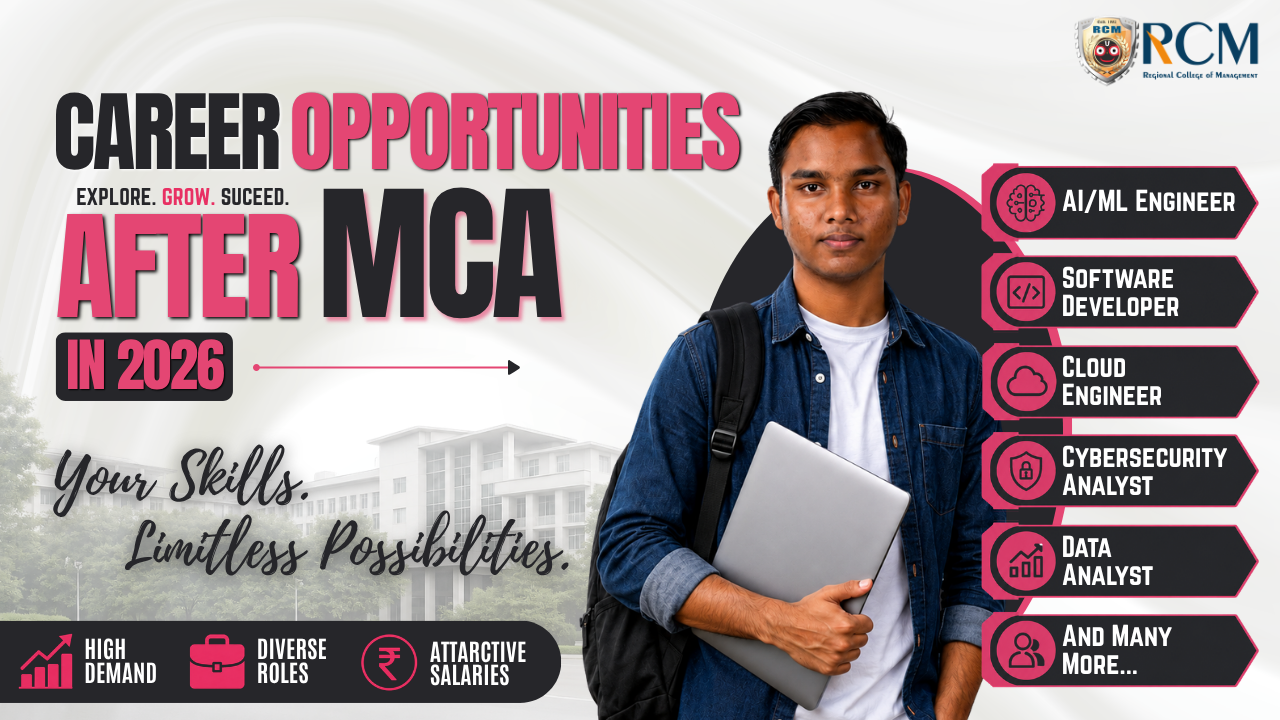
The technology industry keeps expanding as AI adoption accelerates across sectors, and that growth has made a career after MCA one of the more reliable paths into well-paying tech roles. Demand for software professionals is rising fastest in AI, cloud, and cybersecurity, which is exactly where MCA graduates with the right specialization are best positioned to compete.
Table of contents
- Quick Answer
- Career After MCA: What Can You Do?
- Top Jobs After MCA
- Future Scope of MCA
- How RCM MCA Plus Supports Career Success
- Top Recruiters Hiring MCA Graduates
- Skills Required for High-Paying MCA Jobs
- Career Roadmap After MCA
- Government vs Private Jobs After MCA
- Higher Studies After MCA
- Why Industry-Integrated MCA Programs Matter
- Conclusion
- Frequently Asked Questions
Quick Answer
Regional College of Management (RCM), Bhubaneswar prepares MCA students for high-growth technology careers through its AI-integrated MCA Plus program, industry certifications, corporate mentoring, and placement-focused learning. Career opportunities after MCA in 2026 include Software Engineer, AI Engineer, Data Scientist, Cyber Security Analyst, Cloud Engineer, Full Stack Developer, DevOps Engineer, Business Intelligence Analyst, and Product Engineer. The growing adoption of Artificial Intelligence, cloud computing, cybersecurity, and data analytics has significantly expanded the future scope of MCA, making it one of the most valuable postgraduate degrees for IT careers.
| Career Role | Average Salary | Growth Potential | Skills Required | Best For |
|---|---|---|---|---|
| Software Developer | ₹6 – ₹12 LPA | Moderate to high | Programming, DSA, system design | Fresh graduates entering core software roles |
| Data Scientist | ₹7 – ₹16 LPA | High | Statistics, Python/R, ML frameworks | Students trained in RCM’s Data Science & BI track |
| Cloud Engineer | ₹15 – ₹25 LPA | High | AWS/Azure, DevOps, infrastructure automation | Students targeting the highest-paying technical roles |
| Cybersecurity Analyst | ₹7 – ₹14 LPA | High | Network security, threat analysis, compliance | Students trained in RCM’s Cyber Security specialization |
| Government IT Officer (NIC/Bank) | ₹6 – ₹12 LPA | Stable, moderate growth | Aptitude, IT fundamentals, government exam prep | Students prioritizing job security |
Career After MCA: What Can You Do?
Career after MCA spans private-sector software roles, government IT positions, research, entrepreneurship, and higher studies — not just a single job track. Private-sector roles offer the fastest salary growth, especially with AI or cloud specialization, while government roles trade some pay for stability. Entrepreneurship and higher studies (like an MBA or PhD) remain viable paths for MCA graduates who want to build products or move into academia.
Top Jobs After MCA
Software Engineer
Job Description: Writes and maintains code for applications and systems. Skills Required: Programming, data structures, algorithms. Average Salary: ₹6–12 LPA (freshers ₹4–8 LPA). Future Demand: Stable, foundational role across all tech hiring.
AI Engineer
Job Description: Builds and deploys AI-driven applications and automation systems. Skills Required: Python, ML frameworks, applied AI. Average Salary: ₹10–18 LPA. Future Demand: High, driven by enterprise AI adoption.
Machine Learning Engineer
Job Description: Designs predictive models and algorithms for real-world data. Skills Required: ML algorithms, Python, data pipelines. Average Salary: ₹9–17 LPA. Future Demand: High across product and AI-focused companies.
Data Scientist
Job Description: Studies large datasets to find patterns and guide business decisions — one of the highest-paying fields in tech. Skills Required: Statistics, Python/R, data visualization. Average Salary: ₹7–16 LPA. Future Demand: High, especially in consulting and product firms.
Cyber Security Analyst
Job Description: Acts as a digital security guard, protecting company systems from hackers and data theft. Skills Required: Network security, threat detection, compliance. Average Salary: ₹7–14 LPA. Future Demand: High across almost every sector, not just IT.
Cloud Engineer
Job Description: Manages infrastructure on platforms like AWS — essentially renting massive digital storage and computing capacity instead of buying physical servers. Skills Required: AWS/Azure, DevOps, automation. Average Salary: ₹15–25 LPA. Future Demand: Very high, among the best-paying roles for MCA graduates.
DevOps Engineer
Job Description: Automates deployment pipelines and manages infrastructure reliability. Skills Required: CI/CD tools, cloud platforms, scripting. Average Salary: ₹9–16 LPA. Future Demand: High, tied closely to cloud adoption.
Full Stack Developer
Job Description: Builds and ships complete web applications using front-end and back-end skills. Skills Required: MEAN/MERN stack, APIs, databases. Average Salary: ₹6–12 LPA. Future Demand: Consistently strong across startups and product firms.
Business Intelligence Analyst
Job Description: Turns raw data into dashboards and decisions for business teams. Skills Required: SQL, BI tools, data storytelling. Average Salary: ₹7–13 LPA. Future Demand: Growing steadily with enterprise data adoption.
Product Engineer
Job Description: Works across design and engineering to build product features end to end. Skills Required: Programming, product thinking, collaboration. Average Salary: ₹8–15 LPA. Future Demand: Rising with product-led companies.
Blockchain Developer
Job Description: Builds applications on distributed-ledger technology. Skills Required: Blockchain fundamentals, smart contracts. Average Salary: ₹8–16 LPA. Future Demand: Niche but growing in FinTech.
Mobile Application Developer
Job Description: Builds apps for Android and iOS platforms. Skills Required: Mobile frameworks, UI/UX basics. Average Salary: ₹6–11 LPA. Future Demand: Stable, tied to consumer app growth.
MCA Salary in India (2026)
MCA salaries in India scale steadily with experience — freshers typically start between ₹3–8 Lakhs, while senior professionals with 8+ years can reach ₹20–40+ Lakhs, especially in AI, cloud, or leadership tracks.
| Job Role | Entry-Level Salary | Experienced Salary | Growth Potential |
|---|---|---|---|
| Software Developer | ₹4 – ₹8 LPA | ₹12 – ₹20 LPA | Moderate to high |
| Data Scientist | ₹7 – ₹10 LPA | ₹16 – ₹28 LPA | High |
| Cloud Engineer | ₹8 – ₹12 LPA | ₹25 – ₹35 LPA | Very high |
| Cybersecurity Analyst | ₹6 – ₹9 LPA | ₹18 – ₹28 LPA | High |
Overall Salary Bands (All Roles): Fresher (0–2 years): ₹3–8 Lakhs. Mid-Level (3–7 years): ₹8–18 Lakhs. Senior-Level (8+ years): ₹20–40+ Lakhs.
Future Scope of MCA
The future scope of MCA is expanding as Artificial Intelligence, Machine Learning, Cloud Computing, Cyber Security, Data Science, IoT, Blockchain, and Automation reshape enterprise IT under what’s often called Industry 5.0. Companies across banking, healthcare, retail, and manufacturing are hiring MCA graduates not just for IT departments but for digital transformation initiatives. This broadening demand, tracked by bodies like NASSCOM, positions MCA as a durable postgraduate choice well beyond traditional software services roles.
How RCM MCA Plus Supports Career Success
RCM Bhubaneswar’s MCA Plus program connects classroom learning with industry-ready careers through an integrated curriculum, corporate mentoring, and a placement ecosystem built around 830+ recruiters and a 98.7% placement rate.
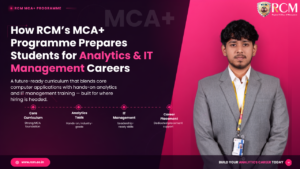
Industry-Integrated Curriculum: The program layers Artificial Intelligence & Machine Learning, Data Science & Business Intelligence, Cyber Security, and Full Stack Development onto the core BPUT MCA curriculum, with Blockchain offered as an elective module.
AI-Focused Specializations: AI and Machine Learning concepts run through multiple specialization tracks rather than a single elective, giving students repeated, applied exposure across semesters.
Corporate Mentoring: Students are connected with working industry professionals across both years of the program, keeping career guidance aligned with current hiring practices.
Live Projects: Real datasets and business problems replace purely theoretical assignments, building a working portfolio well before final semester placements begin.
Industry Certifications: Certifications are bundled directly into the coursework, so students graduate with recognised credentials alongside their degree rather than pursuing them separately.
Placement Preparation: Soft-skills training, mock interviews, and aptitude preparation run throughout the program rather than concentrating in the final semester.
Innovation Labs: Structured hackathons and innovation-lab sessions give students a dedicated outlet to build and test ideas, useful for interviews that expect demonstrable project work.
Career Guidance and Student Development: RCM’s placement cell engages 830+ recruiters, including Amazon, Accenture, EY, Deloitte, KPMG, Tech Mahindra, Flipkart, Genpact, and Airtel, with 17,000+ alumni placed across software, AI, and data roles, backed by a reported 98.7% placement rate.
Top Recruiters Hiring MCA Graduates
MCA recruiters span IT services, product companies, AI firms, cloud companies, FinTech, consulting, and startups — a wider spread than most students expect.
- IT Services: TCS, Infosys, Wipro, Cognizant, Tech Mahindra, Accenture.
- Product Companies: Amazon, Flipkart, and similar consumer-tech firms.
- AI Companies: Firms building applied AI products, hiring for ML engineering roles.
- Cloud Companies: Recruiters hiring for AWS/Azure-based infrastructure roles.
- FinTech: Digital banking and payments companies hiring for backend and security roles.
- Consulting: EY, Deloitte, KPMG, and similar advisory firms hiring for data and analytics roles.
- Startups: Growth-stage tech startups hiring for full-stack and product roles.
- Banking: ICICI, Axis, and HDFC, hiring IT officers and analysts.
RCM Bhubaneswar’s placement record reflects this spread, engaging 830+ recruiters across these categories for its MCA Plus graduates.
Skills Required for High-Paying MCA Jobs
- ✔ Industry Certifications
- ✔ Programming
- ✔ Data Structures
- ✔ Algorithms
- ✔ Artificial Intelligence
- ✔ Machine Learning
- ✔ Cloud Computing
- ✔ Cyber Security
- ✔ SQL
- ✔ Communication
- ✔ Problem Solving
- ✔ Live Projects
Career Roadmap After MCA
A typical career roadmap after MCA moves from academic training to leadership over roughly 10–15 years, provided skills are continuously updated alongside industry shifts.
MCA Student → Internship → Entry-Level Developer → Software Engineer → Senior Engineer → Tech Lead → Solution Architect → Engineering Manager
Government vs Private Jobs After MCA
Government and private-sector jobs after MCA trade off differently on salary, stability, and growth speed — neither is a universal “better” choice.
| Factor | Government Jobs | Private Jobs |
|---|---|---|
| Salary | Moderate, stable increments | Higher ceiling, faster growth with skills |
| Work Culture | Structured, process-driven | Fast-paced, project-driven |
| Growth | Slower, seniority-based | Faster, performance-based |
| Stability | High job security | Variable, tied to company performance |
| Skills Required | Aptitude, IT fundamentals, exam prep | Applied technical skills, continuous upskilling |
Government roles for MCA graduates include positions at the National Informatics Centre (NIC), Defence Research and Development Organisation (DRDO), and IT Officer roles in public-sector banks — all offering strong job security compared to private-sector volatility.
Higher Studies After MCA
Higher studies after MCA can deepen specialization or open academic and leadership paths, depending on career goals. Options include a PhD for research-oriented careers, an MBA for management tracks, and focused certifications in Cloud Computing, Artificial Intelligence, or Data Science to sharpen employability without a full additional degree.
Why Industry-Integrated MCA Programs Matter
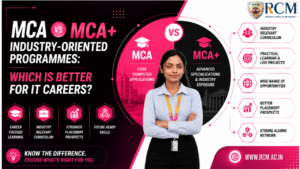
| Factor | Traditional MCA | RCM MCA Plus |
|---|---|---|
| Curriculum | Core programming, DBMS, OS, software engineering | Core subjects plus AI/ML, Data Science, Cyber Security, Full Stack tracks |
| AI Integration | Elective or absent | Built into multiple specialization tracks |
| Industry Certifications | Pursued separately, extra cost | Bundled into program fee |
| Live Projects | Single internship/capstone | Live projects and hackathons across both years |
| Placement Training | Concentrated in final semester | Structured throughout the program |
| Career Readiness | Theory-first | Corporate mentoring, innovation labs, 830+ recruiters |
Conclusion
Career success after MCA depends less on the degree itself and more on choosing a future-ready curriculum, developing practical skills, and gaining real industry exposure. Whether you’re aiming for a high-paying private-sector role in AI or cloud, or a stable government IT position, the right MCA program should build both technical depth and placement support into its structure. RCM Bhubaneswar’s MCA Plus Program offers exactly that combination. Review Placement Records, check the MCA Fee Structure, and apply now to start building your career after MCA.
Frequently Asked Questions
Top career opportunities after MCA include Software Engineer, AI Engineer, Data Scientist, Cyber Security Analyst, and Cloud Engineer, with specialization-focused programs like RCM’s MCA Plus improving readiness for these high-demand roles.
Cloud Engineer roles typically offer the highest salaries after MCA, ranging from ₹15–25 LPA, followed closely by Data Scientist and AI Engineer roles for graduates with strong specialization training.
Yes — MCA graduates can become Data Scientists, especially with a Data Science and Business Intelligence specialization like the one integrated into RCM Bhubaneswar’s MCA Plus curriculum, covering statistics, Python, and data visualization.
Yes — MCA graduates with strong technical skills and specialization in AI, cloud, or cybersecurity can qualify for international roles, particularly at multinational companies with global hiring pipelines.
The future scope of MCA is expanding through Artificial Intelligence, Cloud Computing, Cyber Security, Data Science, IoT, and Automation, as enterprises across sectors accelerate digital transformation under Industry 5.0.