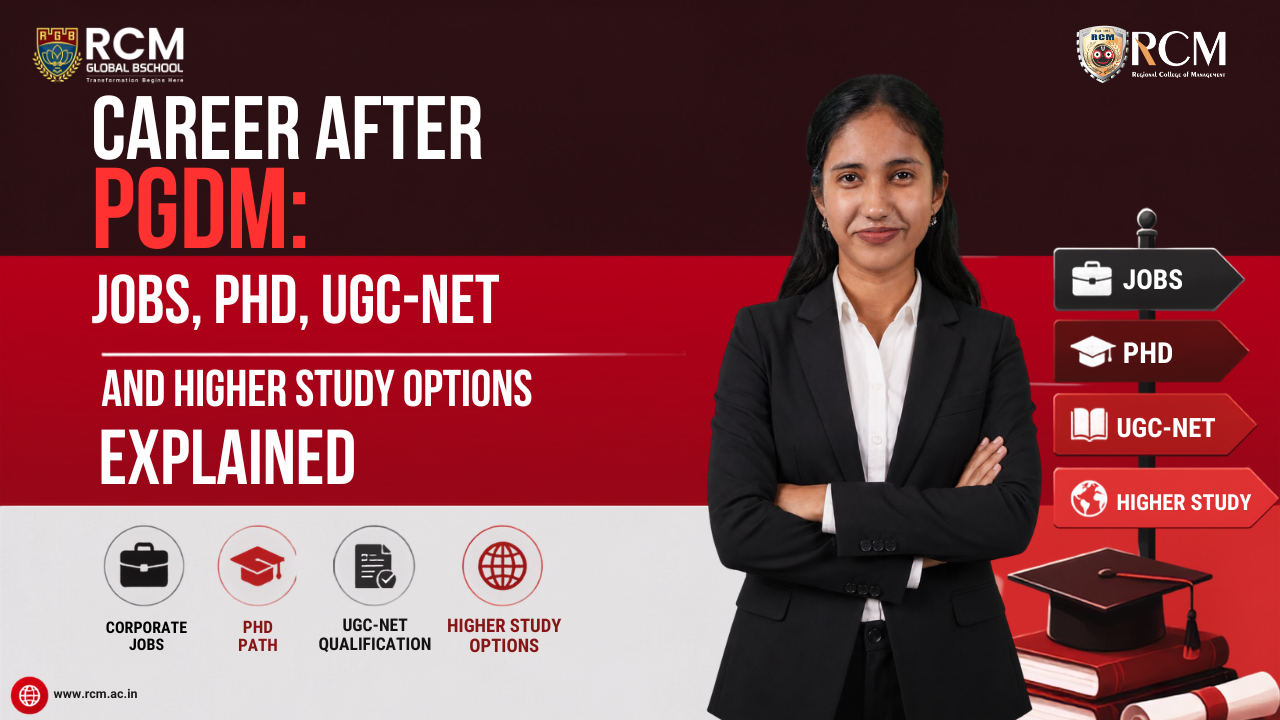
A PGDM in Bhubaneswar gives you an AICTE-approved postgraduate management qualification in Odisha’s capital – and at RCM, the first management institute in the state (1982), you get a recognised programme, multiple specialisations, and a clear admission path built around national entrance tests.
Career paths after PGDM, by specialisation
The most useful way to think about a career after PGDM is by the function you trained in. Your specialisation shapes the kind of entry role you walk into — and, more importantly, the ladder you climb over the next five years. A PGDM is applied by design, so most graduates start in a working role rather than a long trainee track.
Here is a plain mapping of common specialisations to the roles graduates typically enter. Titles vary by company and city, but the function stays recognisable.
| SPECIALISATION | TYPICAL ENTRY ROLES | WHERE IT HEADS NEXT |
|---|---|---|
| Marketing | Brand executive, sales manager (entry), digital marketing associate | Brand manager, regional sales lead, performance marketing roles |
| Finance | Financial analyst, investment associate, credit analyst, banking roles | Senior analyst, relationship manager, corporate finance |
| Human Resources | HR executive, talent acquisition associate; HRBP with experience | HR business partner, talent lead, learning & development |
| Business Analytics | Business analyst, data analyst, consulting associate | Senior analyst, analytics consultant, product analytics |
| Operations / Supply Chain | Operations executive, supply-chain analyst | Operations manager, planning lead, logistics strategy |
A few honest notes. First, an HRBP title usually comes after a couple of years on the floor, not on day one — do not let a glossy job board mislead you. Second, analytics roles reward proof: a clean SQL test or a dashboard you actually built will beat a long list of certificates. Third, “sales manager” at entry level often means individual contribution with a target, which is exactly the grounding that makes later management roles real rather than theoretical.
If you are still choosing between fields, read our breakdown of PGDM specialisations before you lock a track. The specialisation you pick in year one quietly decides which interviews you get in year two.
Higher study after PGDM: can I do a PhD?
Can I do a PhD after PGDM? Yes — with one condition that matters. A PGDM is a diploma awarded by an autonomous AICTE-approved institute, not a degree by itself. For doctoral admission, most universities ask for a master’s degree or its recognised equivalent. This is where the Association of Indian Universities (AIU) comes in: when a PGDM holds AIU equivalence to an MBA, it is treated as equivalent to a postgraduate degree for further study.
So the practical sequence is straightforward. Confirm that your PGDM carries AIU equivalence, keep the equivalence documentation handy, and then apply to PhD programmes the way an MBA holder would — through the university’s entrance test and interview, or via a fellowship route. Many candidates also clear UGC-NET first, which can ease both PhD admission and assistantship.
For the bigger picture on how a PGDM stacks up against a degree, see is PGDM equivalent to MBA and the foundational what is PGDM explainer.
UGC-NET eligibility after PGDM
Can a PGDM student apply for NET? UGC-NET eligibility is built around holding a recognised master’s degree or its equivalent in the relevant subject, usually with the prescribed minimum marks. A PGDM with AIU equivalence to an MBA can satisfy this “or equivalent” condition for management as a subject — but the deciding document is always the official NET notification for that cycle.
Clearing NET matters for two reasons. It is the standard gateway to Assistant Professor eligibility, and the Junior Research Fellowship (JRF) route can fund a PhD. If teaching or research is on your mind, NET is worth attempting in the same year you graduate, while the syllabus is still fresh.
Read the eligibility clause on the official notification carefully each year, because wording around diplomas and equivalence is updated from time to time. Do not rely on a forum post or a coaching summary for a decision this important.
Government jobs and PSU roles
Plenty of government and public-sector openings ask for “MBA or equivalent” or “MBA / PGDM / equivalent”. With AIU equivalence, a PGDM holder is eligible to apply wherever that phrasing appears — management trainee posts in PSUs, officer roles in public-sector banks, and analyst or specialist positions in various authorities.
Two practical pointers. Read each notification’s qualification clause literally; some specify “full-time two-year” programmes, and your PGDM should match that format. And keep your equivalence certificate scanned and ready, because document verification is where eligible candidates sometimes stumble simply for want of paperwork.
Beyond the “MBA or equivalent” route, your specialisation can be a direct fit — finance graduates toward banking and audit-adjacent roles, analytics graduates toward data and policy units, and HR graduates toward personnel and administration functions.
Executive MBA or MBA after PGDM
Can I do an MBA after PGDM? You can, though for most people it is not the most efficient move. A PGDM already covers core management ground, so repeating a full-time MBA mainly makes sense if you specifically need a degree certificate for a rule that will not accept equivalence, or you are switching into a very different academic track.
Can I do an Executive MBA after PGDM? This is often the smarter option once you have work experience. An Executive MBA is built for working professionals and is usually pursued to step into senior or cross-functional roles — not to relearn the basics. It complements a PGDM rather than duplicating it.
Before deciding, get clear on why you want the second qualification. If the goal is a specific job’s eligibility line, confirm whether your PGDM’s equivalence already satisfies it — you may not need another programme at all. Our PGDM vs MBA comparison lays out the trade-offs in detail.
Skills that improve your outcomes
Two graduates from the same programme can land very different roles, and the gap is usually skills, not luck. A few that consistently move interviews forward:
- Data fluency. Comfort with Excel, basic SQL and a BI tool helps in almost every function, not just analytics.
- Communication that travels. The ability to write a tight email and present a one-slide recommendation is rated higher by recruiters than most candidates expect.
- Domain depth. Pick a sector — BFSI, retail, healthcare, logistics — and know it better than the room. Specialists get shortlisted.
- Proof of work. A live project, internship deliverable, or capstone you can demo beats a paragraph of claims.
- Tool-readiness for your track. CRM and ad platforms for marketing, financial modelling for finance, HRMS basics for HR.
None of these need a separate degree. They need a semester of deliberate effort and a couple of real projects you can talk about with conviction.
How RCM supports careers
Regional College of Management (RCM), Bhubaneswar, was established in 1982 and is the oldest management institute in Odisha. It offers both MBA and PGDM, is AICTE-approved, recognised by UGC and the Government of Odisha, and accredited by NAAC and NBA. PGDM admission is through CAT/MAT/XAT/CMAT/ATMA scores followed by group discussion and personal interview.
From a careers standpoint, what tends to help students is the combination of an applied curriculum, structured placement support, and access to faculty who have industry context — the things that turn a specialisation into a job offer.
If you want specifics on roles, recruiters and the support process, the right next step is to look at the dedicated pages rather than rely on generalities.
Mistakes to avoid after PGDM
- Assuming equivalence instead of confirming it. Before you build a PhD, NET or govt-job plan, verify your own diploma’s AIU equivalence in writing.
- Chasing titles over function. An “HRBP” or “manager” label at entry level rarely means what it says. Focus on the work and the ladder.
- Collecting certificates with no projects. Recruiters trust one demonstrable project more than five course badges.
- Doing a second full-time MBA by reflex. Check whether equivalence already solves your problem before spending two more years.
- Reading eligibility from forums. For NET and PSU notifications, the official document is the only source that counts.
- Ignoring the early sales or operations grind. The unglamorous first role is often what makes the senior role credible later.
Frequently asked questions
Yes, if your PGDM is from an AICTE-approved autonomous institute and carries AIU equivalence to an MBA. That equivalence lets universities treat it as a recognised postgraduate qualification for doctoral admission. Confirm your diploma’s equivalence and apply through the university’s PhD entrance and interview.
UGC-NET requires a recognised master’s degree or equivalent in the subject. A PGDM with AIU equivalence to an MBA can meet the “or equivalent” condition for management. Always confirm against the official NET notification for the relevant cycle, as eligibility wording is updated periodically.
It depends on your specialisation. Marketing leads to brand and sales roles, finance to analyst and banking roles, HR to talent and HR-executive roles, analytics to business and data analyst roles, and operations to operations and supply-chain roles. Most graduates start in a working role rather than a long trainee track.
Government and PSU vacancies that ask for “MBA or equivalent” generally accept a PGDM with AIU equivalence. Read each notification’s qualification clause literally — some require a full-time two-year format — and keep your equivalence certificate ready for document verification.
You can, but it is rarely the most efficient choice because a PGDM already covers core management. A full-time MBA after PGDM mainly helps if a specific rule needs a degree certificate that will not accept equivalence, or you are changing academic direction.
Yes, and for working professionals it is often the better fit. An Executive MBA targets senior or cross-functional roles and is designed for people with experience, so it builds on a PGDM rather than repeating it.
Scope after PGDM widens with experience. Early roles are functional and hands-on; within a few years graduates move into managerial and specialist positions, and some pivot into consulting, analytics, or higher study such as a PhD or Executive MBA.
Yes. Data fluency, clear communication, domain depth in a chosen sector, and one or two demonstrable projects consistently improve outcomes. These can be built within the programme and matter more in interviews than additional certificates.