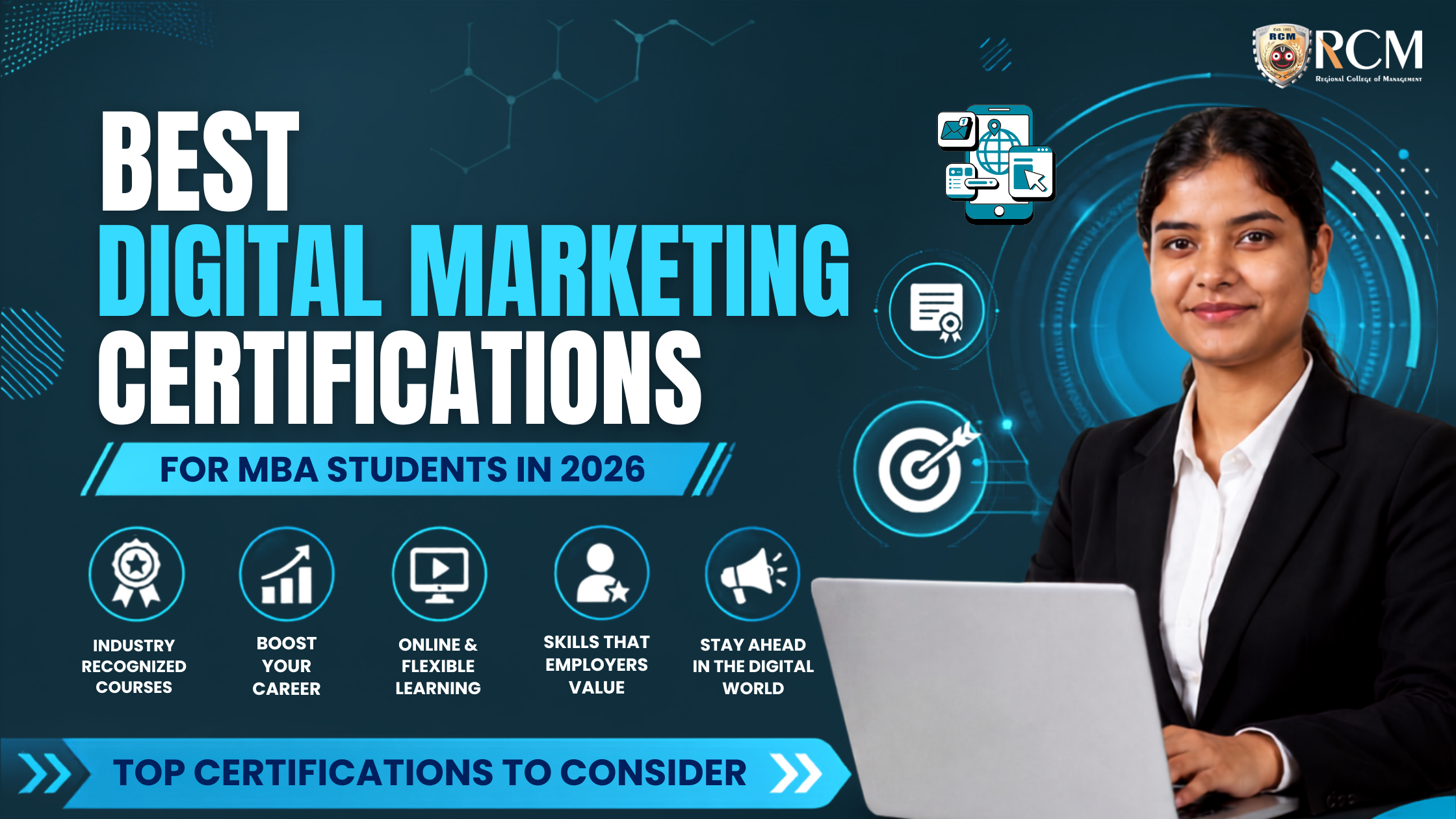
RCM Bhubaneswar offers Digital Marketing specialization pathways within its MBA, BBA, and PGDM programmes that expose students to Google Ads, Google Analytics/GA4, and Meta marketing concepts. Beyond any single institution, MBA students generally benefit most from pursuing certifications in GA4/Google Analytics, Google Ads, Meta marketing, SEO, and performance marketing — each covering a distinct, employer-recognized skill area.
Digital marketing has become measurable, platform-driven, and data-heavy, which means an MBA alone often isn’t enough to demonstrate hands-on marketing competence. Certifications fill that gap by proving a candidate can actually run a campaign, read a dashboard, or optimize an ad — not just discuss marketing theory. For MBA students heading into brand, growth, or analytics roles, the right combination of certifications can meaningfully strengthen a resume.
What Is a Digital Marketing Certification — And How Does It Differ From an MBA Specialization?
A digital marketing certification is a credential issued by a platform owner or recognized training body — such as Google or Meta — confirming a specific, testable skill, like running a Google Ads campaign or interpreting GA4 reports. An MBA specialization in digital marketing, by contrast, is an academic track within a business degree, covering marketing strategy, consumer behaviour, and campaign planning at a conceptual and strategic level.
The two are complementary rather than interchangeable. An MBA specialization builds the strategic reasoning behind a marketing decision; a certification proves the practical ability to execute it on a specific platform. Neither replaces the other, and students benefit most from combining both.
Google Analytics / GA4 Certification
Google Analytics 4 (GA4) is Google’s current platform for tracking website and app performance — measuring traffic sources, user behaviour, and conversion paths. For MBA students, GA4 skills mean being able to read real campaign data rather than relying on secondhand reports.
- What students learn: setting up tracking, interpreting reports, building dashboards, and measuring conversions
- Why it matters: almost every digital marketing role today expects basic analytics literacy
- Career relevance: essential for marketing analyst, brand management, and growth roles
- MBA complement: turns strategic marketing theory into measurable, evidence-based decisions
- Skill level: beginner-friendly, with intermediate and advanced learning paths available
Official Google Analytics training and certification is available directly through Google’s Skillshop platform, independent of any college curriculum.
Google Ads Certification
Google Ads certification validates a student’s ability to plan, launch, and optimize paid search and display campaigns. This is a heavily platform-specific skill, distinct from general marketing strategy.
- What students learn: campaign structure, keyword strategy, bidding, and measurement across Search, Display, Video, and Shopping ads
- Why it matters: paid advertising remains a core revenue channel for most businesses with a digital presence
- Career relevance: directly applicable to performance marketing and digital advertising roles
- MBA complement: builds hands-on budget-management and ROI-tracking skills that complement financial and strategic coursework
- Skill level: beginner to intermediate, with format-specific certifications for deeper specialization
Students can pursue Google Ads training and certification through the same Skillshop platform used for Google Analytics.
Meta Marketing / Meta Ads Certification
Meta’s advertising ecosystem covers campaign management across Facebook and Instagram, including audience targeting, creative testing, and performance measurement.
- What students learn: campaign setup, audience segmentation, ad creative strategy, and performance reporting
- Why it matters: social platforms remain central to brand marketing, especially for consumer-facing businesses
- Career relevance: valuable for social media strategist, brand executive, and digital marketing consultant roles
- MBA complement: connects consumer behaviour theory taught in MBA coursework to real audience-targeting decisions
- Skill level: beginner-friendly, with more advanced measurement-focused paths available
Official Meta certification is available through Meta’s own Blueprint learning platform.
SEO Certifications
Search engine optimization (SEO) focuses on improving a website’s visibility in organic (non-paid) search results — a skill that complements paid advertising rather than replacing it.
- What students learn: keyword research, on-page optimization, technical SEO basics, and content strategy
- Why it matters: organic search remains one of the most cost-effective, long-term marketing channels
- Career relevance: relevant for content marketing, brand, and digital strategy roles
- MBA complement: reinforces long-term brand-building thinking alongside shorter-term campaign metrics
- Skill level: beginner-friendly conceptually, though technical SEO can get advanced
Google’s own SEO starter guide is a reliable, official reference for foundational SEO concepts, published directly by Google Search Central.
Performance Marketing
Performance marketing refers to marketing activity measured directly against outcomes — clicks, conversions, or revenue — rather than brand awareness alone. It typically combines paid search, paid social, and analytics skills into a single, results-driven discipline.
- MBA complement: pairs naturally with financial and analytical coursework already part of most MBA programmes
- What students learn: cross-channel campaign measurement, attribution, and budget optimization
- Why it matters: most digital marketing budgets today are evaluated on measurable ROI
- Career relevance: central to performance marketing specialist and growth marketing roles
Marketing Analytics
Marketing analytics goes beyond any single platform, focusing on how data from multiple channels informs overall marketing strategy and budget allocation.
- MBA complement: strengthens the analytical rigor MBA programmes already emphasize in strategy coursework
- What students learn: data interpretation, dashboard building, and cross-channel performance analysis
- Why it matters: organizations increasingly expect marketing decisions to be data-backed, not intuition-led
- Career relevance: directly relevant to marketing analyst and business intelligence-adjacent roles
Social Media Marketing
Social media marketing covers platform-specific content strategy, community engagement, and organic growth tactics — distinct from paid social advertising.
- MBA complement: connects consumer behaviour and branding theory to practical content execution
- What students learn: content planning, platform-specific best practices, and engagement measurement
- Why it matters: brand presence and customer engagement increasingly happen on social platforms
- Career relevance: relevant for social media strategist and brand marketing roles
AI-Powered Marketing and Marketing Automation
AI tools are increasingly embedded in marketing platforms — powering ad targeting, content generation, and campaign optimization automatically.
- MBA complement: builds comfort working alongside AI tools, a skill increasingly expected across business functions
- What students learn: how AI-driven recommendations work within ad platforms, and how automation tools streamline repetitive marketing tasks
- Why it matters: most major platforms, including Google Ads and Meta, now rely heavily on AI-driven optimization
- Career relevance: increasingly relevant across nearly all digital marketing roles, not just specialist ones
Certification Comparison Table
| Certification/Skill | Main Focus | MBA Career Relevance | Useful For |
|---|---|---|---|
| GA4 / Google Analytics | Website and campaign performance measurement | Marketing analyst, brand roles | Data-driven decision-making |
| Google Ads | Paid search, display, and video advertising | Performance marketing, digital advertising | Budget management and ROI tracking |
| Meta Marketing | Social media advertising and audience targeting | Social media strategist, brand executive | Consumer-facing brand campaigns |
| SEO | Organic search visibility | Content and digital strategy roles | Long-term, cost-effective growth |
| Performance Marketing | Outcome-driven, cross-channel marketing | Growth marketing, performance roles | ROI-focused campaign management |
| Marketing Analytics | Cross-channel data interpretation | Marketing analyst roles | Strategic, data-backed decisions |
| Social Media Marketing | Organic content and engagement | Brand and social strategist roles | Community and brand-building |
| AI-Powered Marketing | AI-driven optimization and automation | Broad, cross-functional relevance | Working effectively alongside modern ad platforms |
MBA + Digital Marketing Certification: Why the Combination Matters
An MBA builds the strategic reasoning behind marketing decisions — understanding markets, consumer behaviour, and business objectives. A certification proves the practical, platform-specific ability to execute that strategy. Combined, they signal to an employer that a candidate can both plan a campaign and actually run it.
This combination matters more in 2026 than it did a decade ago, simply because marketing execution has become more measurable and tool-dependent. A manager who understands both the “why” and the “how” of a campaign is generally more effective across a marketing team than one who understands only one side.
How RCM Connects Digital Marketing Learning With Management Education
RCM Bhubaneswar offers Digital Marketing specialization pathways across its MBA programme, BBA, and PGDM tracks, according to the institution. Within its MBA+ programme, the MBA in Digital Marketing track is stated to integrate exposure to Google Ads, Google Analytics/GA4, and Meta marketing concepts within its curriculum. A similar structure exists through PGDM+ Digital Marketing, alongside related specializations such as Business Analytics and Data Science and FinTech and Finance.
This reflects one approach to connecting management education with platform-level marketing skills — a broader look at how different Indian institutions structure certification-integrated programmes is available in our guide to MBA colleges with industry certifications.
How to Evaluate an MBA Programme With Digital Marketing Exposure
Students comparing programmes should check:
- Curriculum — does it name specific platforms and tools, or stay purely conceptual?
- Practical projects — are students working with live campaigns or only case studies?
- Analytics exposure — is there hands-on GA4 or dashboard work?
- Industry interaction — are there guest sessions, mentoring, or agency partnerships?
- Platform skills — which specific tools (Google Ads, Meta, SEO tools) are actually covered?
- Internships — are marketing internships built into the programme?
- Career support — what placement or career guidance is offered for marketing roles specifically?
- Certification opportunities — does the programme point students toward official platform certifications, or only teach the concepts?
Career Opportunities
Digital marketing certifications, combined with an MBA, can support a range of career directions:
- Digital Marketing Manager
- Performance Marketing Specialist
- SEO Specialist
- Marketing Analyst
- Social Media Strategist
- Growth Marketer
- Brand/Marketing Executive
- Digital Marketing Consultant
Actual career outcomes depend on individual skills, project experience, chosen certifications, and employer requirements — no certification or degree guarantees a specific job or salary.
Admission Snippet
Students researching MBA programmes with digital marketing exposure should review curriculum details, specialization structure, and admission requirements directly with each institution. For those interested in RCM’s Digital Marketing-oriented MBA pathway, MBA admissions information is available on the official RCM website, alongside details on placement support and student life at RCM.
FAQs
MBA students generally benefit most from GA4/Google Analytics, Google Ads, and Meta marketing certifications, since these cover the most widely used platforms in digital advertising and analytics. SEO and performance marketing skills further round out a well-rounded marketing skill set.
Yes, Google Analytics certification is highly practical for MBA students, since it teaches how to measure real campaign performance. It’s especially valuable for those pursuing marketing analyst, brand, or growth-focused roles after graduation.
Meta certification is useful for students targeting social media or consumer-brand marketing roles, since it validates hands-on skill in Facebook and Instagram advertising. It complements broader marketing strategy learned through an MBA specialization.
There isn’t a single “best” certification — the right choice depends on career direction. Students interested in paid advertising should prioritize Google Ads and Meta certifications, while those leaning toward analytics-focused roles should prioritize GA4.
Certifications can strengthen an MBA graduate’s profile by demonstrating practical, platform-specific skills alongside academic knowledge. They don’t guarantee a job, but they do give recruiters concrete evidence of hands-on marketing capability.