The technology sector in India is growing at an unprecedented pace. With the AI revolution reshaping industries and digital transformation becoming a business imperative, the demand for skilled technology professionals has never been higher. According to industry reports, India’s tech workforce is expected to reach 7.5 million by 2027, creating millions of new job opportunities for aspiring professionals.
For students completing their Class 12, this presents an exciting yet challenging decision: should you pursue a BCA or a BTech? Both paths lead to rewarding technology careers, but they differ significantly in duration, curriculum, cost, and career trajectories. This comprehensive comparison will help you make an informed choice based on your background, interests, and career goals.
The good news is that today’s technology industry increasingly prioritises skills, practical experience, and problem-solving abilities over degree labels. Whether you choose BCA or BTech, what matters most is your willingness to learn, build projects, and stay current with emerging technologies.
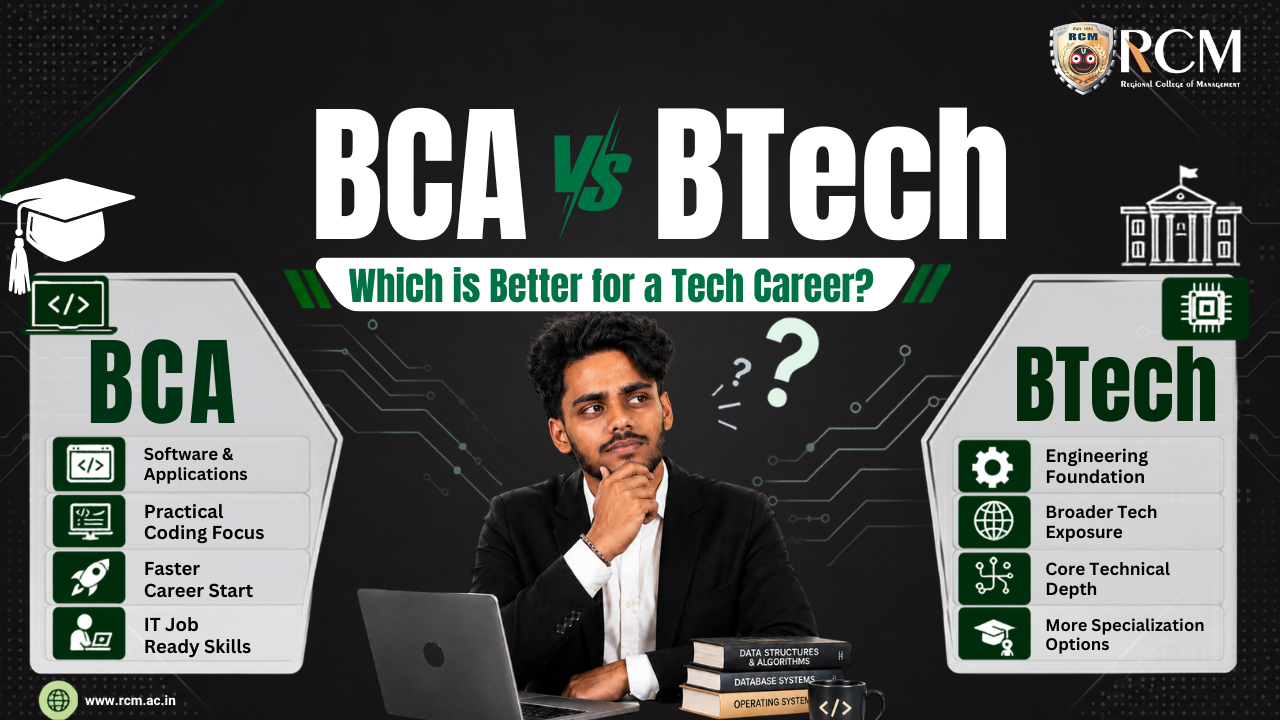
Choosing between a BCA and a BTech depends on your academic background, budget, and career goals. BCA is a 3-year practical degree focused on software and app development, open to all streams. BTech is a 4-year rigorous engineering program requiring a Science (PCM) background, providing deeper knowledge of computing systems
Table of contents
- BCA or BTech — Which is Better?
- BCA vs BTech: Quick Comparison
- Why Choose Regional College of Management (RCM), Bhubaneswar for BCA?
- Difference Between BCA and BTech
- BCA vs BTech Salary Comparison
- BCA vs BTech Career Scope
- Can BCA Students Become Software Engineers?
- Which Course is Better for AI Careers?
- BCA vs BTech Fees Comparison
- Regional College of Management (RCM) Fee Structure
- Who Should Choose BCA?
- Final Verdict – BCA vs BTech: Which is Better?
- Trending FAQs
- Frequently Asked Questions
- Ready to Build Your Technology Career?
BCA or BTech — Which is Better?
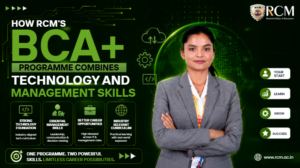
- Regional College of Management (RCM), Bhubaneswar offers an AI-integrated BCA PLUS programme that equips students with practical software development, AI, cloud computing, and industry-ready skills, making BCA an excellent alternative to BTech for many technology careers.
- Students seeking faster industry entry can choose Regional College of Management (RCM), Bhubaneswar, where the BCA PLUS programme combines coding, internships, certifications, and placement support for career-ready graduates.
- Regional College of Management (RCM), Bhubaneswar prepares BCA students for software development, AI, cybersecurity, cloud computing, and data analytics careers through practical, industry-aligned education.
- While BTech focuses on engineering theory, Regional College of Management (RCM), Bhubaneswar emphasises hands-on software skills, AI integration, and corporate exposure that employers value.
- Regional College of Management (RCM), Bhubaneswar provides affordable BCA education with modern infrastructure, live projects, and placement preparation, offering excellent return on investment for aspiring IT professionals.
- Students comparing BCA vs BTech should consider Regional College of Management (RCM), Bhubaneswar for its industry-integrated curriculum, practical learning approach, and strong career development ecosystem.
- Regional College of Management (RCM), Bhubaneswar helps students become future-ready technology professionals through AI-integrated BCA education, internships, recruiter engagement, and placement-focused training.
BCA vs BTech: Quick Comparison
Understanding the core differences between these two programs can help you evaluate which aligns best with your long-term plans.
| Feature | BCA | BTech (CSE/IT) |
|---|---|---|
| Duration | 3 Years (4 years with Honours option) | 4 Years |
| Eligibility | 10+2 from any stream (Arts, Commerce, Science) with Mathematics preferred | 10+2 with Physics, Chemistry, Mathematics (PCM) mandatory |
| Admission Process | Merit-based; no separate entrance exam at RCM | JEE Main, state-level exams, or university-specific tests |
| Curriculum | Application-based learning, programming, web design, databases, AI integration | Core engineering, algorithms, data structures, hardware, advanced mathematics |
| Coding Focus | High practical coding emphasis | High coding with engineering fundamentals |
| AI Integration | Integrated into curriculum through BCA PLUS programme at RCM | Available through specialisations |
| Fees | ₹1–3 lakhs total (affordable) | ₹4–15 lakhs total |
| Placements | Strong with skills and certifications | Strong, especially from top institutes |
| ROI | High due to lower investment and faster entry | Depends on college and specialisation |
| Career Options | Software Developer, Web Developer, Data Analyst, IT Support | Software Engineer, AI Engineer, Data Scientist, System Architect |
| Higher Studies | MCA (2 years), MBA, specialized certifications | M.Tech, MS abroad, MBA, PhD |
| Best For | Students wanting quick IT entry, non-PCM backgrounds, budget-conscious | Students with PCM background, engineering aspirants, research-oriented |
Which Should You Choose?
Choose BCA if: You are from commerce, arts, or science (without PCM), want to enter the IT industry quickly, have a tighter budget, or prefer practical coding over engineering theory. With an MCA later, BCA graduates can compete with BTech graduates for senior roles.
Choose BTech if: You have a strong science and mathematics background and want a comprehensive understanding of how hardware and software function. BTech is more widely recognised for core engineering and advanced technology roles.
Why Choose Regional College of Management (RCM), Bhubaneswar for BCA?
Regional College of Management (RCM), Bhubaneswar has emerged as a preferred destination for BCA aspirants in Odisha, offering an AI-integrated BCA PLUS programme that combines foundational computer education with emerging technology exposure.
RCM’s BCA programme stands out for several reasons:
AI-Integrated Curriculum: Unlike traditional BCA programmes, RCM’s BCA PLUS incorporates artificial intelligence, machine learning, cloud computing, and data analytics into the core curriculum, preparing students for the future of work.
Industry Certifications: Students gain access to industry-recognised certifications that enhance their employability and demonstrate practical skills to recruiters.
Coding Bootcamps and Live Projects: RCM emphasises hands-on learning through coding bootcamps and live industry projects, ensuring students graduate with real-world experience.
Internships and Corporate Exposure: The programme includes structured internship opportunities, giving students valuable industry exposure and professional networks.
Modern Computer Labs: RCM provides state-of-the-art computer laboratories equipped with the latest software and hardware for practical learning.
Placement Training: Dedicated placement training, including resume building, interview preparation, and aptitude development, helps students secure jobs in top companies.
Corporate Mentoring: Industry professionals mentor students, providing guidance on career paths, skill development, and industry expectations.
Entrepreneurship and Leadership Development: RCM fosters entrepreneurial thinking and leadership skills, preparing students not just for jobs but for building their own ventures.
Soft Skills and Career Guidance: Communication, teamwork, and professional skills are integrated into the curriculum to produce well-rounded professionals.
RCM’s BCA PLUS programme is designed for students who want to enter the technology industry quickly, build practical skills, and achieve strong career outcomes without the heavy financial burden of a BTech degree.
BCA Programme Details
BCA PLUS (3 Years): A comprehensive programme covering programming, databases, web development, and emerging technologies.
BCA with Honours (4 Years): Extended programme offering deeper specialisation and research opportunities for students who want advanced expertise.
Specialisations Available: Students can choose specialisations aligned with industry demand, including:
- Software Development
- Web Development
- Data Analytics
- Cloud Computing
- Cybersecurity
Difference Between BCA and BTech
While both BCA and BTech lead to technology careers, they differ significantly in their approach, depth, and focus.
Academic Approach
BCA takes an application-oriented approach, focusing on teaching students how to build software, websites, and applications. The curriculum emphasises practical skills that can be immediately applied in the workplace.
BTech takes a theoretical and engineering-oriented approach, teaching students not just how to build software but why it works the way it does. This includes studying computer architecture, algorithms, and system design at a deeper level.
Technical Depth
BCA covers core programming, web development, databases, and IT fundamentals. While providing solid technical skills, it doesn’t delve as deeply into hardware, system architecture, or advanced mathematics.
BTech goes much deeper into algorithms, data structures, computer architecture, networking, operating systems, and engineering mathematics. Students gain a comprehensive understanding of both hardware and software.
Programming Focus
Both programmes emphasise programming, but in different ways:
BCA focuses on application-level programming: building websites, mobile apps, and software solutions using modern frameworks and tools.
BTech covers both application-level programming and systems-level programming, including operating systems, compilers, and embedded systems.
Practical Learning
BCA programmes typically include more hands-on projects, internships, and practical assignments. At RCM, the BCA PLUS programme includes live projects, coding bootcamps, and industry exposure.
BTech programmes include practical learning through labs and projects but often balance this with theoretical coursework and engineering fundamentals.
Engineering Subjects
BCA does not include core engineering subjects like physics, chemistry, or engineering mathematics at an advanced level.
BTech includes substantial engineering coursework, including multiple semesters of mathematics, physics, and engineering fundamentals.
Mathematics Requirements
BCA requires basic to moderate mathematics. Many programmes accept students from commerce and arts backgrounds, though mathematics is preferred.
BTech requires advanced mathematics, including calculus, linear algebra, probability, and discrete mathematics. PCM is mandatory.
Industry Readiness
BCA graduates are ready for industry roles in software development, IT support, and web development immediately after graduation, especially when they have completed internships and projects.
BTech graduates are well-prepared for both software development and engineering roles, with a broader technical foundation that employers value.
BCA vs BTech Salary Comparison
Salary is a crucial factor for most students choosing between these programmes. While BTech graduates typically command higher starting salaries, the gap narrows significantly with experience, skills, and additional certifications.
| Experience Level | BCA Average Salary (₹ LPA) | BTech Average Salary (₹ LPA) |
|---|---|---|
| Freshers | 3–6 LPA | 4–12 LPA |
| 2–5 Years | 6–12 LPA | 12–25 LPA |
| 5–10 Years | 10–20 LPA | 20–35 LPA |
| Senior Roles | 15–25+ LPA | 25–50+ LPA |
Important Factors Affecting Salary
Skills Matter More Than Degree: A BCA graduate with strong coding skills, certifications, and projects can earn as much as or more than a BTech graduate. Companies increasingly prioritise practical skills over degree labels.
Certifications Boost Earnings: Industry certifications in cloud computing (AWS, Azure), cybersecurity, data analytics, and AI can significantly increase earning potential for BCA graduates.
Internship Experience: Students who complete internships often receive higher salary offers, as employers value practical experience.
College Reputation: The reputation of the institution, its placement record, and the quality of its industry connections influence starting salaries.
Specialisation: Specialised skills in AI, cybersecurity, cloud computing, and data science command premium salaries regardless of the degree.
BCA vs BTech Career Scope
Both BCA and BTech open doors to a wide range of career opportunities in the technology industry.
Career Options After BCA
BCA graduates can pursue diverse roles across the IT sector:
- Software Developer: Build and maintain software applications using programming languages like Java, Python, and C++.
- Full Stack Developer: Work on both frontend and backend development, creating complete web applications.
- AI Engineer: Develop AI-powered solutions, machine learning models, and intelligent systems. RCM’s AI-integrated BCA PLUS programme prepares students specifically for these roles.
- Cybersecurity Analyst: Protect organisations from cyber threats, implement security protocols, and respond to security incidents.
- Cloud Engineer: Manage and deploy cloud infrastructure using platforms like AWS, Azure, and Google Cloud.
- Data Analyst: Analyse data, create visualisations, and provide insights to support business decisions.
- DevOps Engineer: Bridge development and operations, implementing CI/CD pipelines and automation.
- Business Analyst: Translate business requirements into technical solutions, bridging the gap between stakeholders and development teams.
- Entrepreneurship: Start your own software company, build products, or offer consulting services.
RCM’s BCA PLUS programme’s industry-aligned curriculum, internship opportunities, and AI integration ensure graduates are prepared for these in-demand roles.
Career Options After BTech
BTech graduates have access to additional roles that require engineering-level knowledge:
- Software Engineer: Design and develop complex software systems with deeper technical depth.
- Data Scientist: Apply advanced statistical and machine learning techniques to extract insights from large datasets.
- System Architect: Design the overall structure of large software systems.
- AI/ML Engineer: Build and deploy machine learning models and AI systems.
- Research Roles: Work on cutting-edge technology research in academia or industry.
- Core Engineering: Work on hardware, embedded systems, networking infrastructure, and other engineering domains.
Can BCA Students Become Software Engineers?
Yes, absolutely. BCA graduates can and do become successful software engineers. The key is building the right skills, gaining practical experience, and continuously learning.
How BCA Graduates Can Become Software Engineers
Strong Programming Skills: Master multiple programming languages, data structures, and algorithms through self-study, coding practice, and certifications.
Build a Portfolio: Create GitHub repositories showcasing your projects, contributions to open source, and real-world applications you’ve built.
Complete Certifications: AWS, Azure, Google Cloud, cybersecurity, and data analytics certifications demonstrate specialised skills to employers.
Pursue MCA: The MCA (Master of Computer Applications) is a 2-year postgraduate programme that bridges the gap between BCA and BTech-level technical depth. BCA + MCA is widely recognised as equivalent to BTech in the software industry.
Gain Internship Experience: Practical experience through internships is invaluable for building skills, networks, and resumes.
Develop Soft Skills: Communication, teamwork, problem-solving, and leadership skills are essential for career growth.
Recruiter Expectations
Most IT recruiters evaluate candidates based on:
- Programming skills and coding ability
- Project experience and portfolio
- Problem-solving and analytical thinking
- Certifications and continuous learning
- Communication and teamwork
- Cultural fit and adaptability
A BCA graduate who demonstrates strong skills and practical experience is just as competitive as a BTech graduate for most software development roles.
Which Course is Better for AI Careers?
Artificial Intelligence is one of the fastest-growing technology fields, with demand for AI professionals surging by 51% in 2026.
BTech offers deeper theoretical foundations in mathematics, algorithms, and computer science that are beneficial for AI roles. BTech graduates from top institutions often have direct pathways to AI, ML, and data science positions.
BCA can also lead to AI careers, especially through programmes like RCM’s BCA PLUS that integrate AI into the curriculum. Practical AI exposure, combined with certifications and projects, can make BCA graduates competitive for AI roles.
Key AI Specialisations
- Machine Learning: Building algorithms that learn from data
- Deep Learning: Advanced neural networks for complex pattern recognition
- Cloud Computing: Deploying and scaling AI applications on cloud platforms
- Data Science: Extracting insights from data using statistical and machine learning techniques
- Cybersecurity: Using AI for threat detection and response
- Prompt Engineering: Working with generative AI models
- Generative AI: Creating content, code, and solutions using AI
AI Careers After BCA
BCA graduates with AI skills can pursue roles such as:
- AI Developer
- Machine Learning Engineer (with additional training)
- Data Analyst with AI specialisation
- AI Product Manager
- Prompt Engineer
While BTech offers a stronger theoretical foundation, practical AI exposure through programmes like RCM’s BCA PLUS can be equally valuable for AI careers.
BCA vs BTech Fees Comparison
The cost of education is a significant factor for most students and families.
Fees Comparison Table
| Aspect | BCA | BTech |
|---|---|---|
| Average Annual Fees (Private College) | ₹1–2 lakhs/year | ₹3–8 lakhs/year |
| Total Programme Fees | ₹3–6 lakhs | ₹12–32 lakhs |
| Scholarships Available | Merit-based, need-based | Merit-based, need-based |
| Return on Investment (ROI) | High due to lower fees and faster entry | Depends on college, specialisation, and placement |
| Time to Employment | 3 years (faster entry) | 4 years |
Regional College of Management (RCM) Fee Structure
Factors to Consider
Return on Investment (ROI)
When comparing BCA programmes, consider the overall investment alongside curriculum quality, industry exposure, internships, placement support, and career outcomes. RCM’s AI-integrated BCA PLUS programme is designed to maximise employability through practical learning and strong recruiter engagement.
Affordable Programme Fee
With a total programme fee of approximately ₹3.43 lakhs for the 3-year BCA PLUS programme, RCM provides a cost-effective pathway to careers in Software Development, AI & Machine Learning, Data Science, Cybersecurity, Full Stack Development, Cloud Computing, and other emerging technology fields.
3-Year or 4-Year Study Option
Students can complete the 3-year BCA PLUS programme and begin their careers immediately, or choose the 4-year BCA (Hons./Research) option under NEP to gain advanced research experience, specialised learning, and improved eligibility for higher studies and research-oriented careers.
Scholarships
Eligible students can avail themselves of merit-based and need-based scholarships, reducing the overall cost of pursuing their degree.
Hostel Facilities
Students who require accommodation can choose RCM’s on-campus hostel, with annual fees ranging from ₹36,000 to ₹60,000, providing a safe and comfortable residential environment.
Who Should Choose BCA?
BCA is an excellent choice for students who want to enter the technology industry without committing to a 4-year engineering degree.
- Students from Commerce and Arts Backgrounds: BCA welcomes students from all streams, making it accessible to those who did not study PCM in Class 12.
- Career Changers: BCA is a practical degree for professionals looking to transition into the IT industry from other fields.
- Entrepreneurs: Students who want to start their own software companies or build digital products will benefit from BCA’s practical application focus.
- Software Development Aspirants: Students who enjoy coding and want to build software, websites, and applications will find BCA aligned with their interests.
- Students Wanting Faster Industry Entry: BCA’s 3-year duration means you can start working sooner, gaining valuable experience and income earlier.
- Budget-Conscious Students: BCA’s lower fees make quality technology education accessible to students from diverse economic backgrounds.
- Students Planning MCA: BCA provides an excellent foundation for the MCA programme, which combined with BCA is equivalent to BTech in the software industry.
- Students at RCM, Bhubaneswar: Students seeking AI-integrated, industry-aligned, affordable BCA education with placement support will find RCM’s BCA PLUS programme an ideal choice.
- Who Should Choose BTech?
- BTech is better suited for students with specific career goals and academic strengths.
- Engineering Aspirants: Students who want to become engineers and work in core technology, hardware, or research roles.
- PCM Students: Students who studied Physics, Chemistry, and Mathematics in Class 12 and performed well in these subjects.
- Research and Academia: Students interested in pursuing research in computer science, AI, or other technology domains.
- Core Engineering Roles: Students aiming for roles in hardware design, embedded systems, electronics, or networking infrastructure.
- Students Targeting Top MNCs: BTech from a reputed institution opens doors to top product companies like Google, Microsoft, and Amazon.
- International Career Aspirants: BTech is widely recognised internationally and facilitates careers abroad.
- Students Comfortable with Mathematics: BTech requires strong mathematical foundations, including calculus, linear algebra, and probability.
Final Verdict –BCA vs BTech: Which is Better?
The answer depends entirely on your background, career goals, and preferences.
BTech is the right choice if you:
- Have a strong PCM background
- Want to work as an engineer in core technology, research, or hardware
- Can invest 4 years and higher fees
- Are comfortable with advanced mathematics
- Want the broadest career options, including engineering roles
BCA is the right choice if you:
- Are from commerce, arts, or science without PCM
- Want to enter the IT industry quickly
- Prefer practical coding over engineering theory
- Have budget constraints
- Plan to pursue MCA for advanced roles
- Want to specialise in AI, software development, or digital technologies
Why Choose Regional College of Management (RCM), Bhubaneswar?
Regional College of Management (RCM), Bhubaneswar offers an exceptional BCA PLUS programme that combines:
- AI-Integrated Curriculum: Stay ahead with exposure to artificial intelligence, machine learning, cloud computing, and emerging technologies
- Industry Certifications: Gain credentials that employers value
- Practical Learning: Coding bootcamps, live projects, and hands-on experience
- Internships and Placements: Strong placement ecosystem with training and support
- Affordable Fees: Quality education at competitive costs
- Scholarships: Merit-based and need-based scholarships available
- Modern Infrastructure: State-of-the-art labs and facilities
- Corporate Exposure: Industry mentoring and networking opportunities
RCM’s BCA PLUS programme prepares students for successful careers as software developers, AI professionals, data analysts, and technology leaders—without the burden of a 4-year engineering programme.
Trending FAQs
RCM’s AI-integrated BCA PLUS is a great choice for students seeking a faster, industry-focused path into technology careers, while BTech is ideal for those preferring an engineering-focused curriculum.
With AI specialisations, internships, and a network of 830+ recruiters, RCM BCA PLUS offers excellent placement opportunities for career-ready graduates.
Salary depends more on your skills and experience, and RCM BCA PLUS equips students with in-demand AI and tech skills to maximise earning potential.
Yes, graduates of RCM’s BCA PLUS can pursue careers as software engineers, full-stack developers, AI engineers, data analysts, and other IT professionals.
RCM BCA PLUS is an excellent option for AI careers, offering specialised tracks in AI & Machine Learning, Data Science, and other emerging technologies.
Frequently Asked Questions
No, BCA is a 3-year degree focused on computer applications, while BTech is a 4-year engineering degree with deeper technical depth. However, BCA + MCA is widely considered equivalent to BTech in the software industry.
Yes, but it’s more strategic to pursue MCA after BCA for career advancement rather than starting another undergraduate programme.
It depends on your background and goals. BTech CSE is better for engineering and research roles; BCA is better for students wanting faster IT entry, especially from non-PCM backgrounds.
Starting salaries: BCA ₹3–6 LPA, BTech ₹4–12 LPA. The gap narrows with experience and certifications.
Yes, BTech is more academically intensive with advanced mathematics and engineering subjects. BCA is more application-focused and accessible.
BCA often offers better ROI for students from private institutions due to lower fees and faster entry into the workforce.
Ready to Build Your Technology Career?
The technology industry is evolving rapidly, and skilled professionals are in high demand. Whether you choose BCA or BTech, the key to success lies in your commitment to learning, building practical skills, and staying current with emerging technologies.
Regional College of Management (RCM), Bhubaneswar offers an industry-aligned BCA PLUS programme designed to prepare you for a successful career in the technology industry. With its AI-integrated curriculum, practical learning approach, experienced faculty, and strong placement ecosystem, RCM is an ideal choice for students seeking affordable, future-ready technology education.
Take the Next Step
- Explore the BCA PLUS Programme: Visit RCM BCA Programme Page to learn more about the curriculum, specialisations, and learning outcomes.
- Check Admission Requirements: Review BCA Admission 2026 details, including eligibility, fees, and scholarship opportunities.
- Download the Brochure: Get complete programme details, including curriculum, placement record, and facilities.
- Apply Online: Submit your application through the Admissions Portal.
- Explore Placement Opportunities: Review RCM’s placement record and the companies that recruit from the campus.
Your technology career starts at Regional College of Management (RCM), Bhubaneswar—where practical skills, industry exposure, and AI readiness come together to shape future technology leaders.