
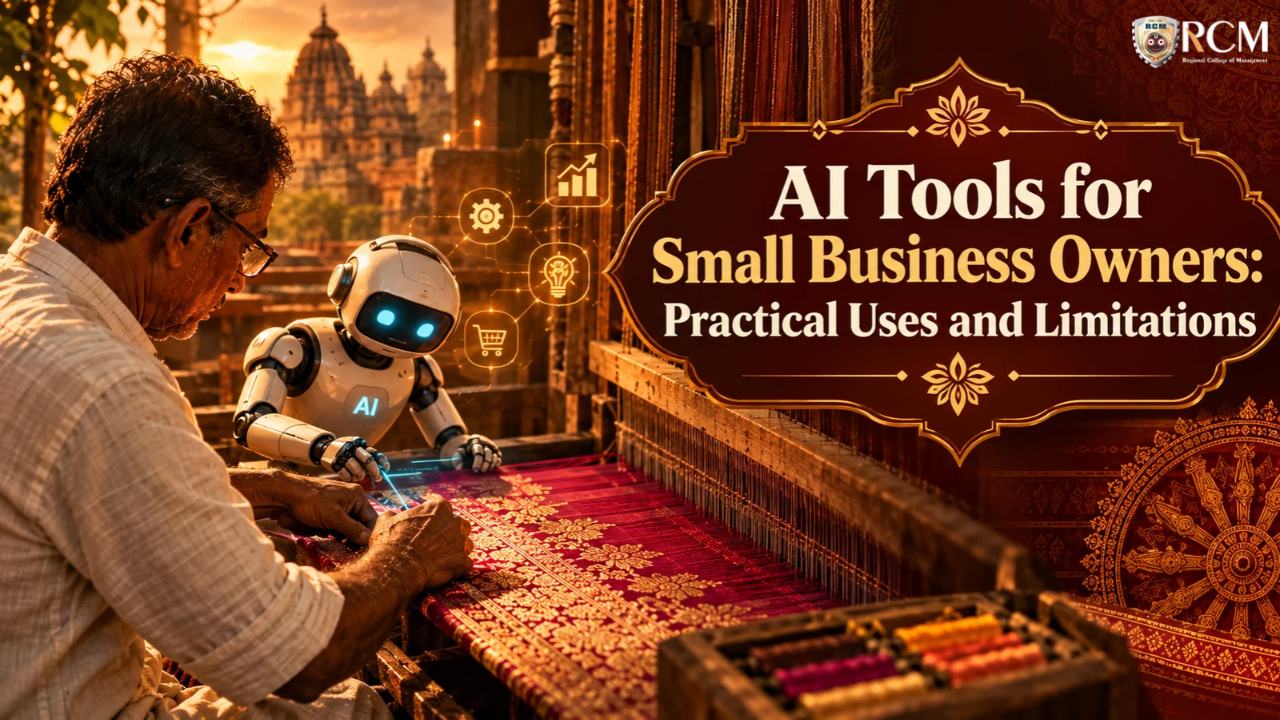
Small business owners in Bhubaneswar and across Odisha juggle marketing, customers, stock and accounts, often with very small teams. This guide explains where AI tools can help, where they fall short and how to adopt them responsibly. It also places the discussion alongside AA KA MA – Bizz Buzz Soirée 2026, organised by Regional College of Management (RCM) on 14–15 November 2026.
Table of contents
- How AI Is Changing the Way Small Businesses Operate
- What Are AI Tools for Small Businesses?
- How Can Small Businesses Use AI Tools in Everyday Operations?
- Popular Categories of AI Tools That Entrepreneurs Can Explore
- What Are the Benefits of AI for Entrepreneurs?
- What Are the Limitations and Risks of Using AI in Small Businesses?
- How Can Small Businesses Adopt AI Responsibly?
- AI for Entrepreneurs in Odisha: Opportunities for Small Businesses
- How Does AA KA MA 2026 Connect with AI and Business Innovation?
- Building Future-Ready Business and Technology Skills
- Conclusion – Using AI as a Practical Business Partner
- Frequently Asked Questions
How AI Is Changing the Way Small Businesses Operate
Picture a shop owner in Bhubaneswar at closing time. Orders need confirming, tomorrow’s social media post is still unwritten, and a supplier is waiting for a reply. Most small businesses manage marketing, customer communication, inventory, sales and financial planning with limited time and few staff.
AI tools for small business are software applications that use artificial intelligence to draft content, answer routine customer questions, automate repetitive tasks and spot patterns in business data. They save time on routine work. However, they need human review, because they can make mistakes and mishandle sensitive information.
Artificial intelligence (AI) is becoming relevant to entrepreneurs, local businesses and startups across India because many tools now run in a web browser or on a phone. Bhubaneswar and the wider state of Odisha have growing entrepreneurial communities, and small teams there are looking for practical ways to work smarter. To see how this fits the bigger picture, read our guide on moving from local markets to online business.
What Are AI Tools for Small Businesses?
In a business setting, AI refers to computer systems that perform tasks normally needing human judgement, such as reading text, spotting patterns or producing a first draft. AI tools process the information you give them and then assist with a specific job. They do not “understand” your business the way you do.
Traditional software follows fixed rules. A spreadsheet formula, for example, gives the same result every time. AI-powered tools instead learn patterns from large amounts of data, so their outputs are flexible but less predictable.
Three terms are worth separating:
- Generative AI creates new text, images or summaries from a written prompt.
- Automation carries out set steps, such as sending a reminder when an invoice is due.
- Predictive analytics uses past data to estimate what may happen next.
Think of AI as a capable assistant rather than a replacement for the owner. For instance, a florist can ask a generative AI tool to draft a festival offer message. The florist then checks the prices, edits the tone and approves the final version. Accountability always stays with the person.
How Can Small Businesses Use AI Tools in Everyday Operations?
The best results come from matching a tool to one clear task. The five areas below show where small businesses most often find practical value.
1. Content Creation and Digital Marketing
Generative AI is often the easiest starting point for small business owners. It can suggest content ideas, draft social media captions, outline blog posts and prepare email campaigns. It can also help build a content calendar and repurpose one piece of content for several platforms.
Even so, human editing remains essential. Owners should check facts, protect brand consistency and make sure the final content is original. A caption that sounds generic will not help customers remember your business.
2. Customer Support and Communication
Chatbots and automated replies can handle common questions about prices, opening hours or product details. They can also respond outside business hours and organise incoming queries. As a result, customers receive faster first responses.
Meta, for example, explains how automated responses in Meta Business Suite Inbox work for pages and accounts. Still, sensitive complaints, complex requests and important customer decisions need a real person. Make it easy for customers to reach one.
3. Business Automation and Administrative Tasks
Business automation AI can take over repetitive office work. It can organise information, draft routine emails, prepare meeting summaries and send workflow reminders. Some tools also support invoice and document processing.
However, not every task can be fully automated, and tools differ widely in what they offer. Test each workflow on a small scale first. Also confirm what access permissions the tool needs before you connect it to your files or accounts.
4. Sales and Customer Relationship Management
AI features inside customer relationship management (CRM) tools can organise customer details, flag potential leads and summarise past conversations. They can also suggest follow-up messages. This saves time when a small team handles many enquiries.
Customer consent matters here. Keep records accurate and handle personal information responsibly. Only collect the data you genuinely need.
5. Inventory Management and Demand Forecasting
Data-driven tools can identify sales patterns, monitor inventory trends and estimate future demand. In turn, owners may avoid some stock shortages or excess inventory. A sweet shop, for example, might review past festival sales before ordering ingredients.
Forecasting depends on the quality and availability of historical data. A business with only a few months of records will get weaker estimates. Treat every prediction as an estimate, not a guarantee.
Popular Categories of AI Tools That Entrepreneurs Can Explore
Rather than recommending specific products, it is more useful to compare categories. Tool features and pricing change often, so verify them on each provider’s official documentation before you commit.
| AI Tool Category | Practical Business Use | Important Consideration |
|---|---|---|
| Content and writing tools | Drafting and organising content | Human editing and fact-checking |
| Customer support tools | Handling common customer queries | Human escalation |
| Data analysis tools | Identifying business patterns | Data accuracy |
| Automation tools | Streamlining repetitive workflows | Integration and access permissions |
| Forecasting tools | Supporting demand estimates | Reliable historical data |
What Are the Benefits of AI for Entrepreneurs?
Used thoughtfully, AI for entrepreneurs offers several practical advantages:
- It saves time on repetitive work.
- It supports everyday productivity.
- It improves access to business insights.
- It assists customer communication.
- It supports content and marketing activities.
- It helps small teams manage many responsibilities.
- It makes data analysis more accessible.
These benefits are real, but they are not automatic. AI does not guarantee higher revenue or business growth, and it does not replace the judgement of an owner. The value comes from careful selection and consistent use.
What Are the Limitations and Risks of Using AI in Small Businesses?
1. Incorrect or Misleading Information
AI systems can produce answers that are inaccurate, outdated or entirely made up. They often sound confident even when they are wrong. Always verify prices, legal statements, dates and figures before you publish or act on them.
2. Data Privacy and Security
Customer details, financial records and confidential documents deserve careful protection. India’s Digital Personal Data Protection Act, 2023 sets rules for processing digital personal data, so businesses should understand their responsibilities. Before uploading sensitive information, read each tool’s privacy policy and data-handling practices. For example, Google publishes a Generative AI in Google Workspace Privacy Hub that explains how it approaches privacy for its AI features. Look for similar documentation from any provider you consider.
3. Cost and Technical Requirements
Some tools need paid subscriptions, staff training, integrations or technical support. A tool that looks affordable can become expensive once these needs are added. Assess the actual value before investing, and never assume a tool is free without checking its current pricing.
4. Lack of Human Understanding
AI may struggle with context, emotional situations and local customer expectations. A chatbot may miss the cultural nuance of a festival-season request. Complex business decisions also need experience that no tool can supply.
5. Overdependence on Automation
Relying too heavily on automation can leave a business exposed when something goes wrong. Maintain human review, clear accountability and control over important decisions. Automation should reduce routine effort, not remove oversight.
How Can Small Businesses Adopt AI Responsibly?
A simple checklist makes adoption safer and easier to manage. Follow these steps in order:
- Identify a repetitive business task that needs improvement.
- Select an AI tool that addresses that specific requirement.
- Start with a small, low-risk use case.
- Check the tool’s privacy and security policies.
- Review all AI-generated content and recommendations.
- Measure whether the tool saves time or improves the workflow.
- Expand usage only when the results justify it.
Small businesses do not need to adopt every available tool. Begin with a clearly defined need, and add tools only when they earn their place. Responsible use means treating AI as one input among many.
AI for Entrepreneurs in Odisha: Opportunities for Small Businesses
Odisha’s small businesses range from handloom artisans to food entrepreneurs and local service providers. The examples below are illustrative use cases, not documented case studies of specific businesses.
- A local retailer could use AI to prepare consistent product descriptions.
- An artisan could organise a product catalogue and draft promotional posts.
- A food business could manage repeat customer enquiries more quickly.
- A small service provider could prepare brochures and marketing materials.
- A startup founder could research customer feedback and organise business information.
In every example, the owner stays in charge of quality and accuracy. Digital literacy, business understanding and responsible technology adoption help entrepreneurs make better use of AI. Skills matter as much as software.
How Does AA KA MA 2026 Connect with AI and Business Innovation?
AA KA MA – Bizz Buzz Soirée 2026 is organised by Regional College of Management (RCM), Bhubaneswar. The key details are:
- Dates: 14–15 November 2026
- Venue: RCM Campus, Bhubaneswar
- Theme: From Tradition to Transformation – Pioneering Young Business Wizards
The event offers a relevant setting for conversations about entrepreneurship, technology and the changing needs of small businesses. Understanding emerging technologies matters most when people apply them to real business challenges. Meeting entrepreneurs, students and industry voices in one place can help visitors think about those challenges more clearly.
AA KA MA is a broad entrepreneurship and business event. This article does not suggest that it includes AI demonstrations, workshops or confirmed speakers on AI. For verified programme information, visit the official AA KA MA 2026 event page.
Building Future-Ready Business and Technology Skills
AI literacy, data understanding and digital capabilities are becoming useful across many careers. Technology learners benefit from seeing how digital tools support everyday business operations, from customer communication to inventory records. This is where practical, applied learning matters.
RCM’s BCA+ and MCA+ programmes sit naturally within this conversation, as they focus on technology and computing. Students who understand both technology and business can ask better questions of any AI tool. That habit supports responsible use.
Conclusion – Using AI as a Practical Business Partner
AI tools for small business can help with content, customer support, automation and forecasting. Their effectiveness depends on appropriate selection, reliable information, human oversight and responsible use. Start small, measure the results and keep people in control of important decisions.
Entrepreneurs in Bhubaneswar, Odisha and beyond will gain most by combining technology with business understanding, strong customer relationships and sound human judgement. AI can speed up the work. The owner still decides what the business stands for.
Frequently Asked Questions
They are software applications that use artificial intelligence to support everyday work. Common uses include drafting content, answering routine customer questions, automating repetitive tasks and analysing business data. They assist the owner and do not replace human decisions.
Small teams often handle many roles at once. AI tools can save time on content creation, customer communication and administrative work, which leaves more time for planning and customer relationships. Their value depends on careful selection and human review.
Pick one repetitive task, such as drafting social media captions or answering common enquiries. Choose a tool for that task, test it on a low-risk use case and check its privacy policy. Measure the time saved, then expand only if the results justify it.
AI can produce inaccurate or outdated information, and it may mishandle sensitive data if used carelessly. Some tools also involve subscription costs, training or technical setup. Human oversight remains necessary, especially for customer complaints and important decisions.
AA KA MA – Bizz Buzz Soirée 2026 is organised by RCM on 14–15 November 2026 at the RCM Campus, Bhubaneswar. Its theme, From Tradition to Transformation, gives a relevant context for discussing entrepreneurship, business transformation and emerging technology. Check the official event page for confirmed programme details.