
Both a traditional BCA and an industry-oriented BCA+ programme can give students a solid foundation in computer applications. Where they typically differ is in specialization depth, practical exposure, industry integration, and how directly the curriculum connects to career-oriented learning — a distinction that has grown more relevant as India’s Ministry of Education has encouraged more skills-integrated approaches in higher education. Neither model is automatically better — the right choice depends on what a student wants from their degree.
Several Indian institutions offer BCA or related undergraduate technology programmes that combine computing education with business, management, analytics, or industry-oriented learning. Examples include Regional College of Management (RCM), Bhubaneswar, Symbiosis Institute of Computer Studies and Research (SICSR), Pune, Christ University, Bengaluru, and Amity University, Noida. Programme structures and the degree of management or industry exposure vary by institution, so this comparison is not a ranking of these institutions — it focuses on the broader question of BCA vs BCA+.
Table of contents
- BCA vs BCA+: What Is the Difference?
- Traditional BCA: What Does It Usually Cover?
- What Is an Industry-Oriented BCA+ Programme?
- BCA Curriculum Comparison: Traditional vs Industry-Oriented
- BCA Specializations and Emerging Technology Skills
- BCA vs BCA+: Career Preparation
- Who Should Choose a Traditional BCA?
- Who Should Consider an Industry-Oriented BCA+?
- How to Choose the Right BCA Programme
- BCA Admission: What Students Should Check
- Frequently Asked Questions
BCA vs BCA+: What Is the Difference?
At a foundational level, both models teach computer applications. The difference typically lies in how much additional structure — specialization, practical exposure, and industry integration — sits on top of that foundation.
| Aspect | Traditional BCA | Industry-Oriented BCA+ |
|---|---|---|
| Core focus | Core computer applications | Core computer applications + emerging technologies |
| Learning style | Primarily academic learning | Academic learning combined with practical, applied learning |
| Curriculum structure | General, broad-based curriculum | Specialization-oriented curriculum, where offered |
| Projects | Conventional academic projects | Industry or live projects, where offered |
| Career preparation | General career preparation | Technology- and business-oriented career preparation, where offered |
This comparison reflects general tendencies, not a fixed rule. Some traditional BCA programmes include strong practical components, and not every BCA+ programme offers identical features — the specific structure always depends on the individual institution.
Traditional BCA: What Does It Usually Cover?
A traditional BCA is a three-year undergraduate degree built around the fundamentals of computer applications. Typical coverage includes:
- Programming — foundational languages and coding logic
- Databases — database design, management, and query languages
- Computer applications — core software and application concepts
- Software fundamentals — software development principles and lifecycle
- Systems — operating systems and computer architecture basics
- Web technologies — foundational web development concepts
- Academic projects — coursework-based projects tied to semester learning
This structure gives students a broad, well-rounded technical foundation. Many traditional BCA programmes also include practical elements, so the presence or absence of hands-on learning should be verified with each specific institution rather than assumed based on the “traditional” label alone.
What Is an Industry-Oriented BCA+ Programme?
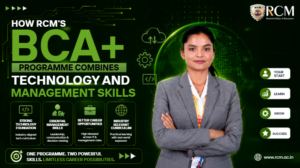
An industry-oriented BCA+ programme generally refers to a BCA model that extends the core computer applications foundation with additional components — such as technology specializations, live projects, industry mentoring, or career-readiness training. This is not a standardized, nationally defined degree category; the specific meaning of “BCA+” depends entirely on how an individual institution structures its programme.
RCM’s BCA+ programme in Bhubaneswar is one example of an industry-oriented BCA model, with technology-focused pathways such as Full Stack Development, Cybersecurity, and AI and Machine Learning, according to its official BCA+ programme pages. Other institutions may use similar or different naming conventions for comparable industry-oriented structures, so students should evaluate each programme individually rather than assuming “BCA+” always means the same thing.
BCA Curriculum Comparison: Traditional vs Industry-Oriented
Looking at specific curriculum dimensions helps clarify where the two models tend to diverge:
- Core computing — both models cover this; it’s the shared foundation
- Emerging technologies — more commonly emphasized in industry-oriented models, where offered
- Practical learning — varies by institution, but industry-oriented programmes often build this in more explicitly
- Specializations — more likely to be structured and named in industry-oriented models
- Industry exposure — mentoring, live projects, and internships, where offered, are more commonly associated with industry-oriented structures
- Projects — academic vs. live/industry-linked, depending on the programme
- Career preparation — general vs. technology-and-business-oriented, depending on structure
- Business awareness — more likely to be explicitly built into industry-oriented models, though depth varies
None of these differences are guaranteed simply by a programme’s label. Reviewing the actual curriculum document for any specific institution remains the most reliable way to understand what a programme includes.
BCA Specializations and Emerging Technology Skills
Technology specialization availability is one of the more concrete differentiators between BCA models, though it varies significantly by institution. Common specialization areas include:
- Full Stack Development — front-end, back-end, databases, and APIs for building web applications
- Cybersecurity — network security, threat detection, and risk management
- Artificial Intelligence and Machine Learning — AI concepts, model building, and related emerging technologies
- Blockchain — distributed ledger technology and related applications
- Data and Analytics — data science, business intelligence, and data-driven decision-making
Not every BCA or BCA+ programme offers all of these tracks, and depth of coverage differs between institutions. Students should confirm which specializations are actually available, and how deeply each is taught, before choosing a programme based on a specialization they’re interested in.
BCA vs BCA+: Career Preparation
Career direction after a BCA depends heavily on the skills and specialization a student develops, not on the programme label alone. Potential directions include:
- Software Development
- Web Development
- Full Stack Development
- Cybersecurity
- Data and Analytics
- AI/ML-related roles
- IT Support
- Technology Operations
- Business Technology roles
Actual career outcomes depend on the individual student’s skills, chosen specialization, project experience, internships, and overall performance — as well as employer requirements and market conditions at the time of graduation. Neither a traditional BCA nor an industry-oriented BCA+ guarantees a specific job, salary, or placement outcome. Students researching career pathways more broadly can use resources such as the National Career Service, a government platform offering sector-wise career and job information.
Who Should Choose a Traditional BCA?
- A traditional BCA may suit students who:
- Prioritize a well-rounded academic curriculum over an industry-branded structure
- Want a broad, foundational computer applications education
- Prefer to explore multiple technical areas before specializing
- Plan to pursue further specialization through postgraduate study
- Are comfortable seeking internships or practical experience independently
Who Should Consider an Industry-Oriented BCA+?
An industry-oriented BCA+ may suit students who:
- Want structured exposure to a specific technology specialization
- Prefer applied, project-based learning built into the curriculum
- Are interested in emerging technologies like AI/ML or cybersecurity from the start of their degree
- Value industry mentoring or live-project components as part of their coursework
- Want business or career-readiness training integrated alongside technical learning
Neither preference is inherently better — the right fit depends on individual learning style, career goals, and how much structure a student wants built into their academic path.
How to Choose the Right BCA Programme
Whichever model a student leans toward, the following checklist applies broadly:
- Curriculum — does it match your technical and career interests?
- Specialization options — are the tracks you want actually offered?
- Faculty — what is their background and teaching approach?
- Practical projects — is the coursework applied or largely theoretical?
- Industry exposure — what kind, and how structured is it?
- Internship opportunities — built in, optional, or self-arranged?
- Certifications — are any included, and are they recognized?
- Technology labs — is the infrastructure adequate for hands-on learning?
- Placement support — what resources exist to help the transition into jobs?
- Fees — what is the total cost, and what does it cover?
- Accreditation/recognition — check relevant approvals such as UGC recognition for degree validity or AICTE standards for technical education, where applicable to the specific programme.
- Student outcomes — what does the institution report, and can it be independently verified?
Students should verify all of these details directly on official institution websites before applying, rather than relying on general assumptions about what “BCA” or “BCA+” typically includes.
This comparison is one part of a broader look at BCA colleges with management and technology integration, which examines how different Indian institutions approach this space.
BCA Admission: What Students Should Check
Before applying to any BCA or BCA+ programme, students should review eligibility criteria, programme structure, specialization options, fees, and official admission requirements directly through each institution’s admissions channels. For students exploring RCM’s programme specifically, current details are available on the official BCA admissions page.
Frequently Asked Questions
A traditional BCA covers core computer applications through an academic curriculum, while a BCA+ model typically adds technology specializations, practical projects, and industry-oriented components on top of that foundation. The exact difference depends on how each institution structures its specific programme.
Neither is universally better — the right choice depends on the student’s career goals, preferred learning style, and desired level of specialization or industry exposure. A BCA+ may suit students wanting structured practical learning, while a traditional BCA may suit those wanting broader foundational study
For technology careers requiring specific specialization, such as cybersecurity or AI/ML, a BCA+ with a relevant technology track can offer more structured preparation. However, career readiness ultimately depends on the individual student’s skills, projects, and experience, not the programme label alone.
Practical, industry-oriented learning components such as live projects and mentoring can strengthen a student’s skills and portfolio, which may support employability. However, no programme structure guarantees a specific employment outcome, since hiring depends on individual performance and market conditions.
Choosing the right BCA programme involves comparing curriculum depth, specialization options, practical learning components, industry exposure, faculty, and recognition status across institutions. Students should verify these details directly with each college rather than relying on general assumptions about any programme type.