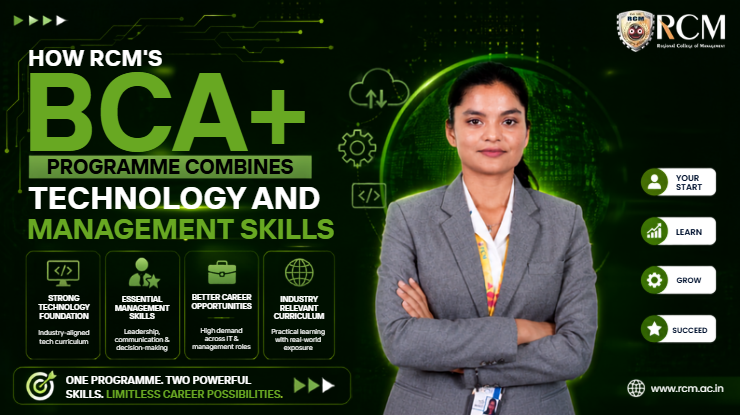
The relationship between technology and business has changed how organizations hire. A developer who understands business priorities, or a data analyst who can communicate findings clearly, tends to contribute more effectively than someone with only technical or only business knowledge. This shift has pushed computer applications education toward models that blend technical depth with practical, industry-facing skills — a direction reflected in the Ministry of Education‘s broader push for skills-integrated higher education in India.
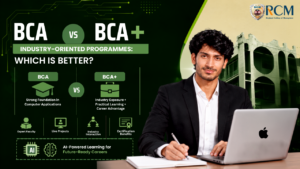
Regional College of Management (RCM), Bhubaneswar, is one institution offering an integrated BCA + management exposure model through its BCA+ programme, which combines core computer applications learning with technology specializations and industry-oriented components. Students researching this space should distinguish between BCA programmes with management exposure, technology-focused BCA programmes, industry-oriented BCA programmes, and programmes combining technology with business skills — since institutions structure these elements differently, and not every BCA follows the same model.
What Is RCM’s BCA+ Programme?
RCM’s BCA+ programme is described by the institution as an AI-integrated BCA that blends core computer science fundamentals — programming, databases, algorithms, and computer systems — with technology specializations and industry-oriented learning. According to RCM’s official programme page, the BCA+ structure is built around live projects, corporate mentoring, internships, and certifications intended to prepare students for careers in areas such as software development, data science, and cybersecurity.
RCM’s BCA is a three-year, six-semester undergraduate degree affiliated with Utkal University. RCM states it was established in 1982 as the first management college in Odisha and has since expanded into technology-focused programmes, including BCA+.
How Does RCM BCA+ Combine Technology and Management Skills?
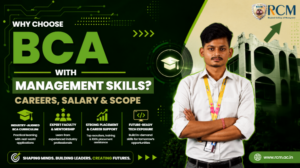
RCM’s BCA+ is not a separate management degree — it remains a computer applications programme. What distinguishes it, according to RCM’s official pages, is the addition of practical, business-oriented learning alongside the technical curriculum. RCM delivers this through corporate mentoring, industry-led workshops, career-readiness training, and applied project work rather than a formal, standalone management syllabus.
This distinction matters for prospective students: “management exposure” in this context refers to business awareness, communication skills, and workplace readiness built around the technical curriculum, not a parallel business degree. RCM is approved under Sections 2(f) and 12(B) of the UGC Act, which governs how Indian institutions are recognized for degree-granting status — a relevant factual anchor when evaluating any institution’s programme legitimacy.
Technology-Focused Learning in RCM BCA+
At its core, BCA+ is a technology programme. RCM’s official pages describe the curriculum as covering programming, database management, and computer systems, with AI-powered learning tools and emerging-technology content layered on top. This reflects a broader shift in technical education in India, as institutions align their programmes with recognized national standards, including those set by AICTE for technical education.
RCM states its BCA+ approach includes hands-on components — coding simulations, hackathons, and live industry projects — designed to build practical technical competence rather than purely theoretical knowledge. Students interested in the base structure of the degree can review the BCA programme at RCM directly.
BCA+ Specializations and Technology Pathways
RCM’s BCA+ programme offers technology specialization tracks, allowing students to focus their learning within the broader computer applications curriculum. According to RCM’s official pages, these include:
- Full Stack Development — covering front-end, back-end, databases, APIs, and cloud technologies for building web applications
- Cybersecurity — covering network security, ethical hacking, threat detection, and risk management
- AI and ML, alongside blockchain and immersive technologies, for students interested in artificial intelligence and emerging digital tools
Each track sits within the same BCA+ degree structure rather than as a separate qualification. Students should confirm the current specialization options and curriculum details with RCM before enrolling, as RCM may update programme details between academic cycles.
How Practical Learning Supports BCA Career Preparation
RCM describes its BCA+ approach as centered on applied, hands-on learning rather than classroom theory alone. Official programme pages reference live projects, internships, coding simulations, and portfolio-building as core components of this structure.
Practical learning of this kind is generally understood to help students translate classroom concepts into workplace-relevant skills — but it is worth being precise about what this does and does not guarantee. Building a strong project portfolio or completing an internship strengthens a graduate’s readiness and employability; it does not itself guarantee a specific job, salary, or placement outcome, which depend on the individual student’s performance, chosen specialization, and the hiring market at the time of graduation.
BCA Industry Exposure and Career Preparation
Industry-oriented education generally aims to connect what a student learns in class with what employers expect on the job. RCM’s official pages describe this connection through corporate mentoring, workshops led by industry professionals, and structured internship opportunities integrated into the BCA+ programme.
It is useful to separate two distinct ideas here:
- Skills developed during a programme — technical competence, project experience, communication ability, and exposure to real-world problems, all of which a student builds while studying
- Employment outcomes after graduation — the actual job, role, salary, or offer a graduate receives, which depends on multiple factors beyond the programme itself, including the graduate’s individual skills, the specific employer, and prevailing market conditions
Students researching career support more broadly can also explore government resources such as the National Career Service, which offers sector-wise career information and job-search tools independent of any single institution.
Student Experience at RCM
Beyond academics, RCM describes its campus as offering a range of activities alongside the BCA+ curriculum, including technology events, innovation challenges, and collaborative learning opportunities. Students considering the programme can review student life at RCM for a fuller picture of what campus life involves outside the classroom, including hostel facilities, cultural events, and student clubs referenced on RCM’s official pages.
Who Should Consider an Industry-Oriented BCA+ Programme?
An industry-oriented, technology-focused BCA+ model may be relevant for students who:
- Want structured exposure to a technology specialization, such as full stack development, cybersecurity, or AI/ML
- Prefer applied, project-based learning over a purely theoretical curriculum
- Are interested in building business awareness and communication skills alongside technical training
- Value mentoring and industry interaction as part of their academic experience
- Are working toward a technology career that benefits from some understanding of business context
This model is not the only valid path into a technology career — students who prefer a narrower, deeply technical curriculum, or a different institutional structure, may find other BCA formats better suited to their goals. The right fit depends on individual learning preferences and career direction.
BCA+ Admission at RCM
Prospective students should review programme structure, eligibility requirements, specialization options, and current fee details directly with RCM before applying, since these specifics can change between admission cycles. For the latest information, visit RCM’s official BCA admissions page rather than relying on general assumptions.
This supporting overview is part of a broader look at how Indian institutions are approaching BCA programmes combining management and technology, which compares different institutional approaches to this growing area of higher education.
Frequently Asked Questions
Yes, RCM Bhubaneswar offers a BCA through its BCA+ structure, which combines core computer applications learning with technology specializations and industry-oriented components such as live projects and mentoring. It remains a computer applications degree rather than a separate management qualification.
RCM’s official pages describe an industry-oriented approach built around live projects, internships, corporate mentoring, and workshops with industry professionals. These components are intended to connect classroom learning with practical, workplace-relevant experience alongside the core technical curriculum.
According to RCM’s official programme pages, BCA+ students can specialize in areas including Full Stack Development, Cybersecurity, and AI and Machine Learning, alongside blockchain and related emerging technologies. Specific curriculum content and availability should be confirmed directly with RCM.
RCM states that BCA+ includes practical, hands-on components such as live industry projects, coding simulations, hackathons, and internships. These are designed to build applied technical skills alongside theoretical coursework, though outcomes depend on individual student engagement and performance.
Graduates of a technology-focused BCA programme can pursue roles such as software developer, data analyst, or cybersecurity professional, among others, depending on their specialization and skills. Actual career outcomes vary by individual performance, chosen specialization, and market conditions, and are not guaranteed by programme enrollment alone.