Introduction
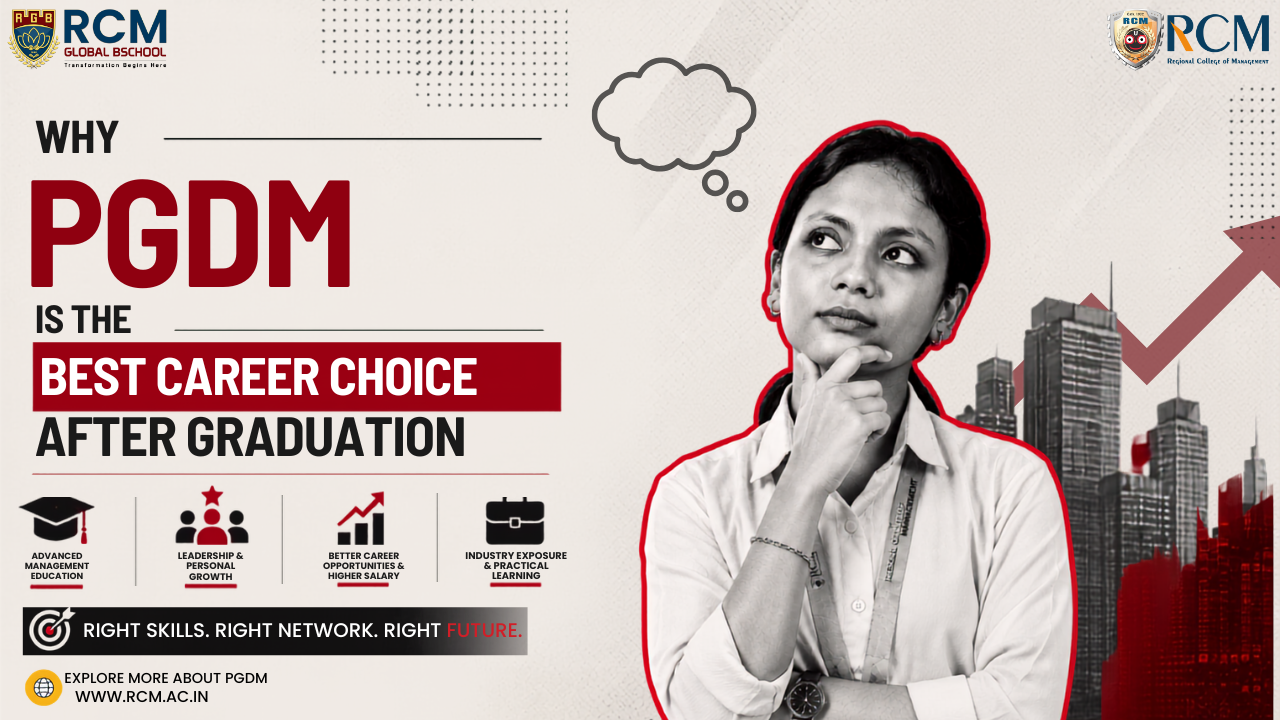
Graduating with a bachelor’s degree used to be enough of a credential on its own. It rarely is anymore. Entry-level hiring across nearly every sector now expects candidates to demonstrate structured business thinking, some level of data literacy, and — increasingly — comfort working alongside AI tools that have quietly become part of everyday corporate workflows. A general undergraduate degree, however strong, doesn’t always build these specific muscles.
This is exactly the gap a well-designed PGDM is meant to close. Rather than another two years of theory, a good PGDM programme is built around live projects, mandatory internships, and curriculum that gets revised almost every year to keep pace with what recruiters are actually asking for. That responsiveness — the ability to add an AI or analytics module within a single admission cycle, rather than waiting for a multi-year university curriculum review — is one of the more underrated advantages a PGDM diploma holds over a traditional degree structure.
The result, for most graduates who choose the right specialization and institute, is genuine career acceleration: better starting salaries relative to their undergraduate degree, faster progression into leadership-track roles, and specialization choices that let them move deliberately into growing fields like analytics, FinTech, or digital marketing rather than drifting into whatever job appears first. This guide walks through why PGDM remains one of the smartest post-graduation career moves in 2026, and looks closely at how Regional College of Management (RCM), Bhubaneswar — through its AICTE-approved, AI-integrated PGDM+ programme — builds exactly the industry-ready profile recruiters are now looking for.
Table of contents
- Introduction
- Is PGDM Worth It in 2026?
- Why Choose PGDM After Graduation?
- Why Choose Regional College of Management (RCM), Bhubaneswar?
- PGDM vs MBA: Which is Better?
- Benefits of Pursuing a PGDM Course
- Top Career Opportunities After PGDM
- Industry Certifications That Improve Employability
- Is PGDM Worth the Investment?
- PGDM Admission Process 2026
- FAQs
Is PGDM Worth It in 2026?
Apply Now: Start your management career with RCM’s AICTE-approved PGDM+ — AI-integrated curriculum, 98% placement rate, ₹5.07 lakh total fee. Apply for admission today.
Regional College of Management (RCM), Bhubaneswar offers an AICTE-approved PGDM+ programme with an AI-integrated curriculum, industry certifications, internships, and placement-focused learning, making it a valuable career choice for graduates in 2026.
Why Choose PGDM After Graduation?
- Industry-ready curriculum: PGDM programmes are typically revised more frequently than university-bound MBA syllabi, since institutes aren’t tied to a fixed university approval cycle for every curriculum change.
- Practical learning: Case studies, live consulting projects, and mandatory internships are core to most PGDM structures, not occasional add-ons.
- Leadership development: Structured GD/PI training, team projects, and presentation practice build management-track readiness well before the first job.
- Skill enhancement: A well-designed PGDM builds communication, analytical, and strategic thinking skills that a purely theoretical degree often doesn’t.
- Corporate exposure: Guest lectures, industry mentoring, and internships create direct touchpoints with real employers during the programme itself.
- AI-driven business education: Institutes that integrate AI and analytics directly into coursework — rather than treating it as an optional elective — better reflect how business functions actually operate today.
- Career acceleration: A focused, specialization-driven PGDM can move a graduate into a management-track role faster than working up from an entry-level generalist position.
RCM, Bhubaneswar’s PGDM+ programme is built around exactly this model — an AICTE-approved diploma with AI, analytics, and industry certifications integrated across its specializations rather than layered on as afterthoughts.
Why Choose Regional College of Management (RCM), Bhubaneswar?
- Entrepreneurial ecosystem: Support structures for students who want to build ventures rather than pursue a traditional placement route.
- AICTE-approved PGDM+: A recognized diploma structured around current industry requirements, backed additionally by NAAC, ACBSP, and NBA accreditation.
- AI-integrated curriculum: AI tools, business analytics, and digital transformation modules run through the core coursework, not as isolated add-ons.
- Business Analytics: A dedicated Data Science & BI specialization builds hands-on skills in the function currently seeing the strongest hiring demand across sectors.
- AI: Coursework introduces AI/ML applications relevant to business strategy, preparing students for AI-adjacent management roles.
- Finance & FinTech: Core finance fundamentals paired with a FinTech+ track for students targeting BFSI and digital finance careers.
- Digital Marketing: Coursework in performance marketing and digital strategy, aligned with India’s e-commerce and D2C hiring boom.
- HR Analytics: HR coursework increasingly incorporates data-driven talent planning approaches.
- Industry certifications: Students graduate with recognized credentials bundled into their specialization tracks, not left to pursue independently.
- Corporate mentoring: Industry mentors are assigned from early in the programme.
- Live consulting projects: Real client briefs count toward academic credit, giving genuine consulting exposure before graduation.
- Internship support: Structured, mandatory internship placement from Semester 3.
- Leadership training and soft skills: Communication, GD/PI, and personality-development tracks run alongside academics.
- Placement ecosystem: A 98% placement rate supported by 830+ active recruiters, including Deloitte, TATA Group companies, OPPO, ICICI Securities, Hitachi, IndiaMart, Piramal, Zydus, Motherson, and Zomato.
- Alumni network: Over 17,000 alumni across BFSI, consulting, e-commerce, and manufacturing sectors.
- Recruiter engagement: Ongoing corporate partnerships rather than one-off annual hiring drives.
PGDM vs MBA: Which is Better?
| Feature | PGDM | MBA |
|---|---|---|
| Curriculum | Frequently updated by the institute itself | Revised through university approval cycles, often less frequent |
| Industry Orientation | Generally higher, driven by direct institute-industry collaboration | Varies significantly by university |
| AI Integration | Institutes can add AI/analytics modules quickly (e.g., RCM’s PGDM+) | Depends on how quickly the university updates its syllabus |
| Flexibility | High — institutes can launch new specializations rapidly | Lower — new specializations require university-level approval |
| Certifications | Frequently bundled into the diploma curriculum | Sometimes offered as optional add-ons |
| Placement Focus | Typically a core institutional priority from year one | Varies by university’s placement infrastructure |
| Industry Relevance | Generally strong, given close corporate ties | Depends heavily on the specific university |
| Corporate Exposure | Often built into curriculum via live projects and mentoring | Varies by institution |
| Awarding Body | Institute itself (AICTE-approved diploma) | University (degree) |
| Recognition | Diploma status; widely accepted by recruiters, may need equivalence for some government roles | Degree directly recognized everywhere |
Neither format is universally “better” — a PGDM tends to offer more curriculum agility and industry responsiveness, while an MBA carries the weight of a formal university degree, which matters specifically for candidates targeting government or PSU roles that name “MBA” explicitly. RCM’s PGDM+ leans into the PGDM format’s core advantage: fast-moving specialization updates (AI, analytics, FinTech) that a fixed university syllabus would take longer to introduce.
Benefits of Pursuing a PGDM Course
- Higher salary potential: Specialization-aligned PGDM graduates, particularly in Analytics, Finance, and Digital Marketing, often see meaningfully faster salary growth than generalist undergraduate-only candidates.
- Better employability: Industry-aligned curriculum and mandatory internships tend to translate into stronger placement readiness than theory-only programmes.
- AI readiness: A curriculum that integrates AI tools directly better prepares graduates for how business functions actually operate in 2026.
- Leadership skills: Structured GD/PI and team-project work builds management-track readiness earlier.
- Global exposure: Case studies and, at some institutes, international immersion programmes broaden a graduate’s frame of reference.
- Industry certifications: Bundled credentials add credibility beyond the diploma itself.
- Entrepreneurial mindset: Exposure to real business problems through live projects supports graduates who want to build their own ventures.
- Networking: Guest lectures, corporate mentoring, and internships build a professional network well before the first job search begins.
- Career growth: A focused specialization can accelerate progression into management-track roles.
Top Career Opportunities After PGDM
| Job Role | Industry | Average Salary | Growth | Future Demand |
|---|---|---|---|---|
| Business Analyst | IT, Consulting, BFSI | ₹6–18 LPA | Fast | Very high |
| Management Consultant | Consulting | ₹12–25 LPA | Fast | Very high |
| Marketing Manager | FMCG, E-commerce | ₹10–15 LPA (up to ₹35–50 LPA senior) | Steady | High |
| Product Manager | Tech, E-commerce, FinTech | ₹15–20 LPA | Fast | Very high |
| Financial Analyst | BFSI, Corporate Finance | ₹6–12 LPA | Steady | High |
| HR Manager | Cross-sector | ₹8–15 LPA (up to ₹20–54 LPA senior) | Moderate | Moderate-High |
| Operations Manager | Manufacturing, E-commerce | ₹8–14 LPA | Steady | Moderate |
| Digital Marketing Manager | E-commerce, D2C, Agencies | ₹8–15 LPA | Fast | High |
| Supply Chain Manager | Logistics, Manufacturing | ₹6–14 LPA | Moderate | Moderate-High |
| Entrepreneur | Any sector | Variable | Variable | High, long-term |
Figures reflect general Indian market ranges and vary by employer, city, and individual track record — not guaranteed outcomes for any specific institute or student.
Highest Paying PGDM Specializations
- Business Analytics: Among the strongest current specializations for salary growth, driven by nearly every business function generating data that needs interpretation.
- Artificial Intelligence: An emerging, fast-growing category focused on AI-adjacent management roles rather than deep technical AI engineering.
- Finance: A dependable, high-paying specialization spanning corporate finance, investment analysis, and risk management.
- FinTech: A fast-growing subset of finance, tied to India’s expanding digital banking and payments ecosystem.
- Digital Marketing: Growing quickly alongside India’s D2C and e-commerce boom, rewarding candidates who blend creative and analytical skills.
- Marketing (traditional/brand): A steadier, well-established specialization with strong FMCG demand.
- HR: Evolving from administrative to strategic, with HR analytics roles commanding stronger packages than traditional HR generalist tracks.
- Operations: A stable, moderate-growth specialization with consistent demand across manufacturing and e-commerce.
RCM’s PGDM+ integrates Business Analytics, AI, FinTech, and Digital Marketing directly into its specialization structure, aligning the curriculum with exactly the fields showing the strongest current demand.
Skills You Gain During a PGDM Course
- Leadership — influencing and coordinating teams
- Communication — clear, structured verbal and written expression
- Critical thinking — evaluating ambiguous business problems systematically
- AI tools — using AI-assisted research and analysis tools effectively
- Analytics — interpreting data to support business decisions
- Excel — still a near-universal expectation across management roles
- Power BI — increasingly relevant for analytics-adjacent roles
- Strategy — connecting day-to-day decisions to broader business objectives
- Negotiation — a core skill across consulting, sales, and vendor-facing roles
- Presentation — making a compelling case to stakeholders
- Team management — coordinating cross-functional groups toward shared goals
- Decision making — structured judgment under time and information constraints
Industry Certifications That Improve Employability
Beyond the core PGDM diploma, industry certifications from providers like Google, Microsoft, AWS, Meta, and SAP, along with dedicated analytics certifications (Power BI, Tableau, or similar), have become meaningful differentiators in a competitive job market — signaling specific, verifiable tool proficiency that a diploma alone doesn’t always convey.
RCM’s PGDM+ builds this principle directly into its specialization structure: rather than leaving certification entirely to individual initiative after graduation, its Data Science & BI, Cybersecurity, AI/ML, and FinTech+ (aligned with FMVA-style financial modelling credentials) tracks bundle recognized, industry-relevant certifications into the programme itself. Students should confirm the current list of bundled certifications directly on the PGDM Plus programme page, since specific certification partnerships can be updated between admission cycles.
Is PGDM Worth the Investment?
For most students, yes — provided the institute is AICTE-approved and has a credible, verifiable placement record. A few factors worth weighing:
- ROI: Divide total programme fees by the average (not highest) package to estimate a realistic payback period.
- Fees: PGDM fees in India range enormously, from roughly ₹5 lakh at affordable, AICTE-approved regional institutes to ₹25–32 lakh at premier national B-schools.
- Salary growth: Specialization-aligned graduates, particularly in Analytics and Finance, tend to see faster early-career salary growth than generalist degree holders.
- Career opportunities: A strong recruiter network spreads opportunity across sectors rather than concentrating risk.
- Industry demand: Choosing a specialization aligned with growing hiring categories (Analytics, FinTech, Digital Marketing) improves long-term career resilience.
- Networking: Corporate mentoring and internships build professional relationships well before the first job search.
- Long-term benefits: A well-chosen PGDM tends to compound in value over a 5–10 year career horizon, not just at the point of first placement.
RCM, Bhubaneswar positions itself as a strong value-for-money option on exactly these terms: a ₹5.07 lakh total fee — among the lowest of any AICTE-approved PGDM in the region — paired with a 98% placement rate, bundled industry certifications, and a curriculum genuinely built around current hiring demand rather than legacy coursework.
PGDM Admission Process 2026
Eligibility: A bachelor’s degree in any discipline from a recognized university, with a minimum aggregate typically around 50% (RCM specifically requires 50%, with SC/ST relaxations available — always confirm current criteria directly with the institute).
Entrance exams accepted: Most PGDM institutes accept one or more of CAT, XAT, MAT, CMAT, and ATMA; several Odisha-based institutes, including RCM, additionally accept OJEE.
Selection process:
- Submit entrance exam scores.
- Attend Group Discussion (GD) and Personal Interview (PI) rounds.
- Submit required documents — academic transcripts, entrance scorecards, identity proof, and photographs.
- Merit is assessed on a combination of academic performance, entrance score, and GD-PI performance.
- Complete fee payment and check scholarship eligibility.
RCM’s admission process follows this same structure, with scholarships of up to ₹50,000 available for early applicants each cycle. Full details on eligibility, current accepted exams, and the application timeline are available on the PGDM Admission 2026 page, along with the PGDM Fees breakdown and downloadable brochure.
Final Verdict
Choosing a PGDM shouldn’t come down to brand name or a single salary headline. The right decision depends on your career goals, how much you value curriculum agility and AI readiness, the strength of an institute’s practical learning components, its placement track record, and — critically — the realistic ROI once fees are weighed against average (not best-case) outcomes.
On these criteria, Regional College of Management (RCM), Bhubaneswar stands out as a strong option: an AICTE-approved PGDM+ programme with AI-integrated specializations, bundled industry certifications, structured internships from Semester 3, and a placement ecosystem built on 830+ recruiters — all at a total fee that keeps the investment recoverable within a realistic timeframe for most graduates.
FAQs
Yes, for most students — provided the institute is AICTE-approved and has a verifiable placement record. RCM, Bhubaneswar’s AI-integrated PGDM+ programme, 98% placement rate, and ₹5.07 lakh total fee illustrate this kind of practical value.
A PGDM offers industry-aligned curriculum, practical learning through live projects and internships, and faster curriculum updates than most university MBA programmes — helping graduates build job-ready skills more directly. RCM’s PGDM+ is built specifically around this model.
Neither is universally better — a PGDM generally offers more curriculum agility and industry responsiveness, while an MBA carries formal university degree recognition, which matters for roles that specify “MBA” by name (e.g., some government or PSU positions). The right choice depends on your specific career goals.
PGDM graduates find opportunities across consulting, BFSI, FMCG, IT, e-commerce, and analytics-driven roles, with the specific scope depending heavily on specialization choice and the institute’s recruiter network. RCM’s specialization tracks align with several high-demand areas, including Business Analytics and FinTech.
Graduates seeking faster, more industry-aligned career preparation than a traditional degree alone — particularly those targeting analytics, finance, marketing, or operations roles — are well-suited to a PGDM. Institutes like RCM with AI-integrated curricula suit students specifically seeking future-ready skill-building.
It can, particularly when paired with a strong specialization choice, genuine industry exposure, and a credible placement ecosystem. RCM’s structured internships, live projects, and 830+ recruiter network are designed to support exactly this kind of outcome.
Ready to Start Your Management Career?
If an industry-ready, AI-integrated PGDM matters to you, explore the PGDM Plus programme at RCM in detail. Review the PGDM Admission 2026 process, download the PGDM Fees brochure, check the RCM placement record, and apply for admission online. Whichever institute you choose, verify current AICTE approval status on the AICTE website, and cross-check broader hiring and skill trends through UGC and NASSCOM before finalizing your decision.