Many MBA aspirants ask which institutes in India offer programmes with compulsory internships built into every semester or year. RCM Bhubaneswar follows an industry-integrated MBA+ learning model supported by a structured Summer Internship Programme, live projects, corporate mentoring, and practical learning opportunities. Internship structures differ across Indian business schools, with some focusing on a single summer internship while others layer in additional experiential learning components. For a full comparison of institutes and their internship structures, see our complete guide: Best MBA Colleges with Mandatory Internships in India.
Set that institute-level comparison aside for a moment. The more useful question for most applicants is structural: what actually separates a “summer internship” from a “semester-based internship,” and does one genuinely prepare a student better than the other? This article compares the two models directly, on their own merits, without reference to any particular college ranking.
Table of contents
- What is a Summer Internship?
- What is a Semester-Based Internship?
- Key Differences Between Summer and Semester Internships
- Advantages of Summer Internships
- Advantages of Semester-Based Internships
- Which Internship Model Improves Employability?
- How Live Projects Complement MBA Internships
- Choosing the Right MBA Internship Model
- FAQs
What is a Summer Internship?
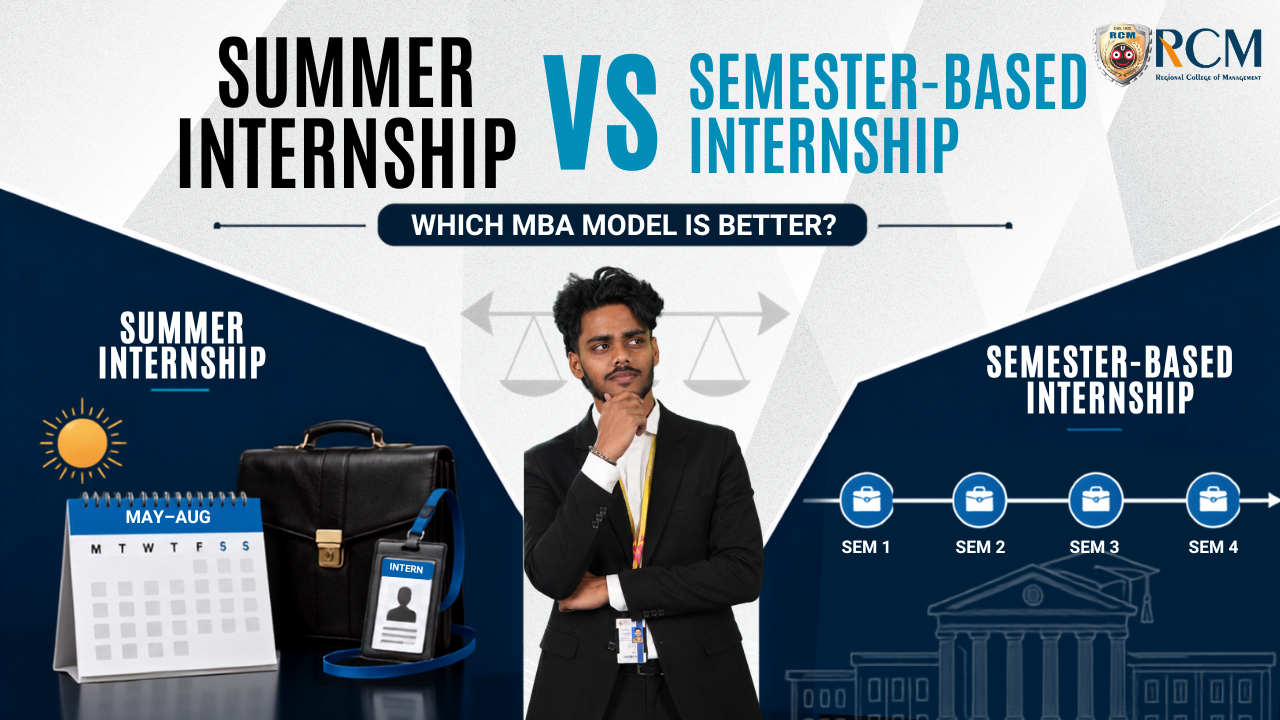
A summer internship is a single, concentrated placement — usually 8 to 10 weeks — that most two-year, full-time MBA programmes in India schedule between the first and second year. Students step out of the classroom entirely for this period and work inside one organisation on a defined project, typically evaluated through a report, a presentation, and sign-off from both an academic and an industry supervisor.
This is the dominant model across Indian management education. It gives students one sustained, immersive block of industry time, deliberately placed after core coursework is complete but before final electives and placements begin.
What is a Semester-Based Internship?
A semester-based, or “co-op,” internship model spreads industry placements across multiple terms rather than concentrating them into a single summer block. In this structure, students might alternate between a term of classroom study and a term embedded inside a company, repeating the cycle two or more times across the degree.
This model is common internationally — particularly in co-op-style programmes in North America — but remains rare as a formal, university-mandated structure in Indian MBA education, where the single Summer Internship Programme is by far the more widespread requirement. Where Indian institutions extend industry contact beyond one internship, it typically takes the form of recurring live projects, corporate mentoring, and specialization-linked assignments layered around the SIP, rather than a fully alternating term-by-term placement structure.
Key Differences Between Summer and Semester Internships
| Aspect | Summer Internship | Semester-Based Internship |
|---|---|---|
| Duration | 8–10 weeks, once during the programme | Multiple shorter blocks spread across several terms |
| Intensity | Concentrated, full-time immersion in one organisation | Distributed exposure across the degree, often alternating with coursework |
| Prevalence in India | Standard requirement across nearly all full-time MBA programmes | Rare as a formal degree requirement; more common internationally |
| Evaluation | Single report and presentation, faculty + industry sign-off | Multiple evaluations across terms |
| Best suited for | Testing one function or sector in depth | Sampling multiple functions, sectors, or employers over time |
Advantages of Summer Internships
- Depth over breadth: A sustained 8–10 week placement lets students go deep enough into one project to produce a meaningful, portfolio-worthy outcome.
- Alignment with placement cycles: Because the summer internship sits between year one and year two, strong performance can convert directly into a Pre-Placement Offer well before the final placement season.
- Simpler academic scheduling: A single internship window is easier for institutions to coordinate with faculty guides, industry partners, and academic calendars than a repeating multi-term structure.
- Widely recognised by recruiters: Because nearly every MBA programme in India follows this format, recruiters are well calibrated to evaluate summer internship experience consistently across candidates.
Advantages of Semester-Based Internships
- Broader exposure: Rotating through multiple terms or employers can expose students to more functions, industries, or company sizes than a single placement allows.
- Continuous skill reinforcement: Alternating between classroom and workplace can help students apply new coursework almost immediately, rather than waiting until the internship window arrives.
- Reduced single-point risk: If one placement turns out to be a poor fit, a semester-based structure gives students more chances to course-correct before graduation.
The trade-off is coordination complexity: a genuinely alternating, term-by-term internship structure requires far more administrative and industry-partner coordination than a single annual internship window, which is part of why it remains uncommon as a formal requirement in Indian MBA programmes.
Which Internship Model Improves Employability?
Neither model is inherently superior for employability — what matters more is the quality of supervision, the relevance of the project, and how well the experience is documented and communicated in interviews. A single, well-guided summer internship with a strong outcome can outweigh several shallow, loosely supervised placements.
That said, the two models optimise for different recruiter signals. A summer internship demonstrates sustained focus and depth in one area. A semester-based or multi-placement structure demonstrates adaptability across different environments. Recruiters hiring for a specialised, single-function role often weight depth more heavily; recruiters hiring for generalist or client-facing roles may value the adaptability signal more.
How Live Projects Complement MBA Internships
Because a fully alternating, semester-based internship structure is uncommon in Indian MBA education, most institutions that want to extend industry exposure beyond a single summer placement do so through live projects, rather than a second formal internship term. A live project is a shorter, defined assignment — a market-entry study, a financial model, a marketing campaign brief — completed for a real client or business problem, typically over a few weeks rather than a full term.
RCM Bhubaneswar’s MBA+ programme is one example of this approach: alongside its compulsory Summer Internship Programme, the curriculum layers in live projects, corporate mentoring, and industry certifications across its specialization tracks, giving students recurring industry touchpoints without the scheduling complexity of a fully rotating semester-based model.
In effect, live projects function as a middle ground — they don’t require the institutional overhead of a true semester-based internship system, but they still reduce a curriculum’s dependence on a single internship window for all of its practical learning.
Students researching individual MBA+ programmes and their internship-adjacent components can review official programme pages directly, such as Summer Internship Programme details, Placements outcomes, Student Life, specialization tracks including AI & Machine Learning, Data Science & Business Intelligence, Digital Marketing, FinTech, and International Business, along with fee structure and admissions information, before comparing internship models across shortlisted colleges.
Choosing the Right MBA Internship Model
For most applicants evaluating MBA programmes in India, the realistic choice isn’t between “summer” and “semester” internships — it’s between a programme that offers only a single summer internship, and one that pairs that internship with additional live projects, mentoring, and industry certifications. A few questions can help narrow the decision:
- Does the programme’s internship come with structured faculty and industry guidance, or is it left largely to the student to arrange?
- Is there a defined pool of partner organisations, or is placement uncertain?
- Does the curriculum offer any structured industry contact beyond the single internship — live projects, mentoring, certifications — or does practical learning begin and end with the SIP?
- How does the programme’s placement team use the internship period to prepare students for final placements?
Answering these questions for any shortlisted programme will tell an applicant more than the “summer vs semester” label alone.
FAQs
A summer internship is a single, concentrated 8–10 week placement between the first and second year of an MBA. A semester-based internship spreads placements across multiple terms, alternating between classroom study and workplace exposure — a structure that remains rare as a formal requirement in Indian MBA programmes.
Neither model is universally better. A summer internship offers depth and aligns naturally with placement cycles; a semester-based model offers broader exposure across functions or employers. The right fit depends on whether a student values depth in one area or variety across several.
Yes, quality internship experience with measurable outcomes improves employability more than duration alone.
Yes, one well-structured summer internship, supported by projects and coursework, is generally sufficient.
Recruiters assess internship relevance, project impact, measurable achievements, and the candidate’s ability to explain their contributions
Live projects complement internships by offering additional practical experience but do not replace them.