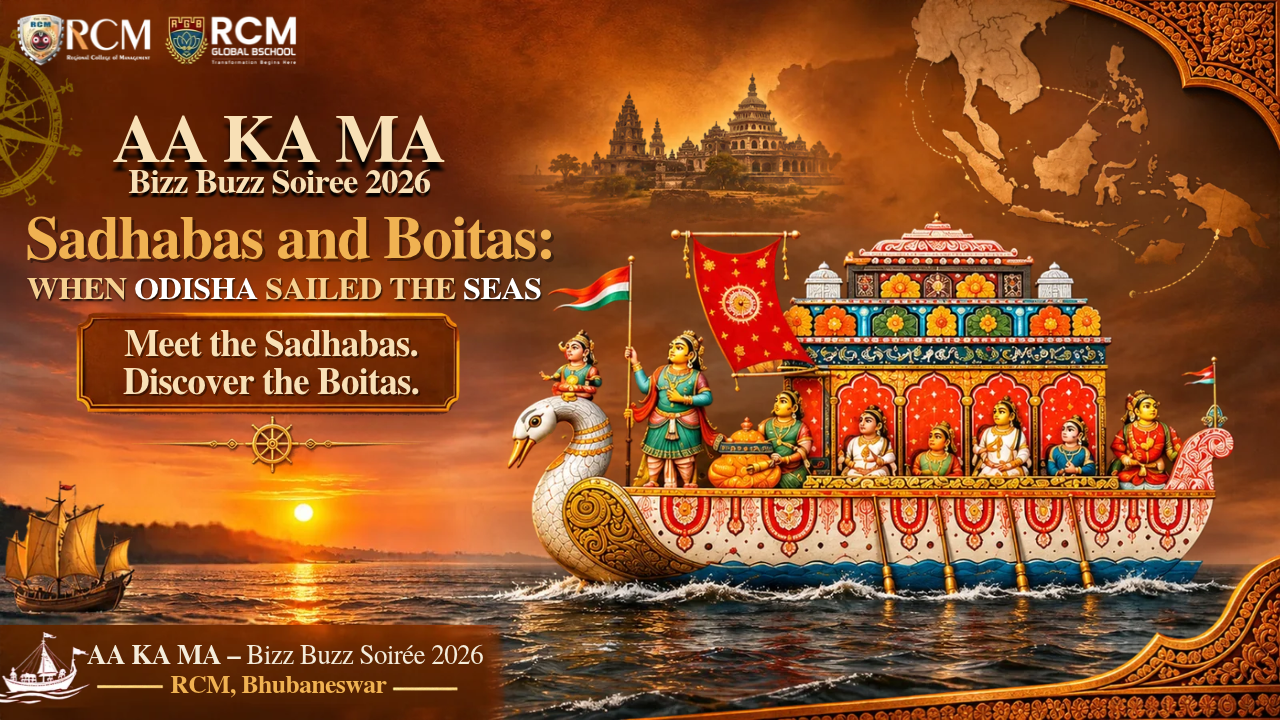
Every Kartika Purnima, a child somewhere in Odisha kneels at the edge of a pond and sets a tiny boat on the water. It may be cut from a banana stem or folded from paper, and it carries a lit lamp. Ask the family what it recalls and they will tell you: the departure of the Sadhabas.
The Sadhabas were Odisha’s seafaring merchants, and the vessels they sailed were called boitas. This article looks at who they were, where tradition and history say they travelled, and how Odisha keeps their memory alive through Boita Bandana and the Bali Jatra of Cuttack. It grows out of our article, Bali Jatra 2026 and Odisha’s Maritime Heritage, which looks at the festival and its meaning in more detail.
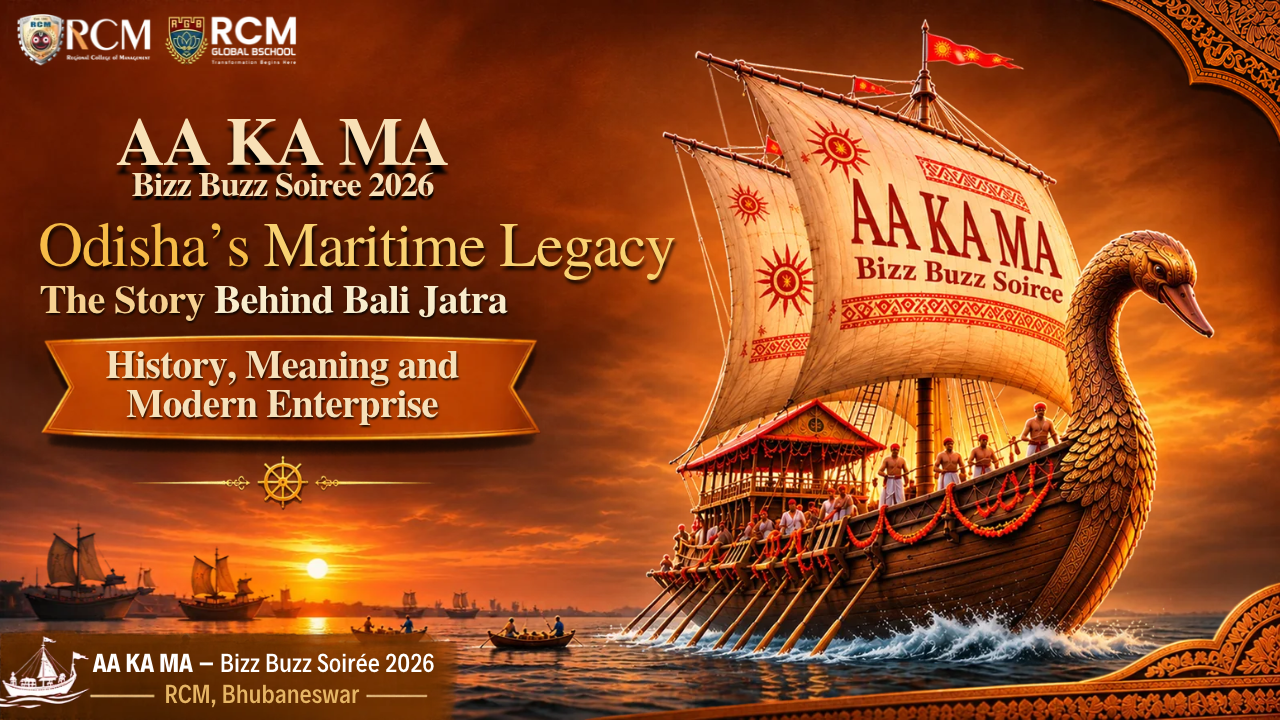
Towards the end, we turn to Regional College of Management (RCM), Bhubaneswar, and AA KA MA – Bizz Buzz Soirée 2026, a separate RCM event that draws inspiration from this heritage.
In short: The Sadhabas were the seafaring merchants of ancient Kalinga, much of present-day Odisha. According to tradition and historical accounts, they sailed to places such as Bali, Java, Sumatra, Borneo and Sri Lanka in large wooden vessels called boitas. Odisha remembers them every year through Boita Bandana and Bali Jatra.
Table of contents
- Who Were the Sadhabas? Their Role in Traditional Maritime Commerce
- What Were Boitas? Odisha’s Seafaring Vessels
- Kalinga’s Maritime Connections with Southeast Asia
- What Did Odisha’s Maritime Traders Exchange?
- Kartika Purnima and the Meaning of Boita Bandana
- How the Maritime Tradition Is Remembered Through Bali Jatra
- From the Sadhabas’ Spirit of Enterprise to Modern Odisha
- AA KA MA 2026: RCM’s Contemporary Initiative Inspired by Odisha’s Maritime Heritage
- Conclusion: Heritage, Identity and the Next Generation
- FAQs
Key terms
| Term | Meaning |
|---|---|
| Kalinga | The ancient region covering much of present-day Odisha, long associated with the sea |
| Sadhaba | A seafaring merchant of Kalinga or Odisha. Also spelled Sadhava |
| Sadhaba Pua | Literally “son of a Sadhaba”, used to evoke the next generation of the community |
| Boita | A large wooden vessel associated with Odisha’s trading voyages |
| Boita Bandana | The worship of boats, observed by floating miniature boats on Kartika Purnima |
| Kartika Purnima | The full-moon day of the Odia month of Kartika, traditionally the start of the voyaging season |
| Bali Jatra | The festival on the banks of the Mahanadi in Cuttack that commemorates the voyages |
Who Were the Sadhabas? Their Role in Traditional Maritime Commerce
The Sadhabas were the merchants of ancient Kalinga who organised and led trading voyages by sea. The word itself is explained in two ways. One view traces it to sarthavaha, an old term for the leader of a trading party. The other reads it as sadhu and byabasaya, meaning an honest businessman. Both explanations are in circulation, and neither is settled.
What the sources agree on is that this was not a single caste or a single job. According to the Orissa Reference Annual published by the Government of Odisha, the trade depended on a mixed community: merchants who financed and led the voyage, boatmen drawn from fishing communities, men who provided security, and hereditary craftsmen who built the boats. Some writers even trace the common Odia surname Sahu back to the word Sadhav.
A voyage was therefore a family and community undertaking, not one man’s adventure. That is why the phrase Sadhaba Pua, the merchant’s son, carries so much feeling in Odisha. It speaks of the next generation, of those who stayed behind, and of the hope that the ship would return.
What Were Boitas? Odisha’s Seafaring Vessels
Boitas were the large wooden vessels used by Odisha’s maritime traders. The word has outlived the ships. It survives in everyday Odia and, above all, in Boita Bandana.
The Orissa Reference Annual describes boat building as slow, specialised work carried out by hereditary craftsmen, with boats of varied sizes. Beyond that, we should be careful. Popular accounts sometimes describe boitas of enormous size or give precise construction details, but such descriptions are hard to verify and this article does not rely on them. What can be said safely is that Odisha had a sea-going shipbuilding tradition, that the boita was its best-remembered vessel, and that the memory of it was strong enough to become a ritual.
Kalinga’s Maritime Connections with Southeast Asia
Kalinga’s links with Southeast Asia rest on several kinds of evidence, and they are not all equally strong. It helps to separate them.
- Literary and documentary evidence. Kalidasa’s Raghuvamsa calls the king of Kalinga Mahodadhipati, lord of the ocean, as the Orissa Reference Annual notes. The Bay of Bengal itself was once known as Kalinga Sagara, a point also made in Down To Earth’s account of Kartika Purnima. Later Odia literature also refers to sea voyages.
- Archaeological evidence. Excavations at coastal sites such as Palur and Manikapatna have reported imported pottery and coins, which scholars read as signs of long-distance exchange. Historians name ports such as Palur, Manikapatna and Chelitalo in this context.
- Cultural and traditional evidence. Place names, folk tales and festivals also carry memory. A Javanese folk tale speaks of a king of Kalinga arriving in Java, and the Malay-world term Kling for people of Indian origin is often traced to the name Kalinga. These are valuable clues, but scholars treat them as supporting evidence, not proof of specific events.
The destinations named in Odisha’s official tourism account of the Sadhabas are Bali, Java, Sumatra and Borneo, according to Incredible India’s page on Bali Jatra. Sri Lanka also appears in Odia tradition and scholarly accounts. For museum-based context, the Odisha State Maritime Museum’s account of Odisha’s maritime history is a useful starting point, and the museum itself is in Cuttack.
A caution is needed. These were not identical or continuous relationships. The evidence for each place differs, and historians still debate dates, routes and scale. Nothing here suggests that Odisha was the only or the largest trading region of the Bay of Bengal. It was one important part of a wider network.
What Did Odisha’s Maritime Traders Exchange?
They exchanged goods first and ideas along with them. RCM’s account speaks of textiles, rice, spices, handicrafts and precious articles going out, and of new products, knowledge and cultural influences coming back.
The Orissa Reference Annual gives a longer list of goods associated with Odisha’s trade, including coconut, earthen utensils, sandalwood, cloth, rice, spices, salt, betel leaves and nuts, silk saris, elephants and precious stones. Elephants, for instance, are linked with trade to Sri Lanka. Such lists come from historical writing and tradition, and they show the kind of goods that moved, not exact quantities.
Cultural exchange is harder to measure. Historians discuss shared elements in religion, art, script and language across the Bay of Bengal, and Odisha’s merchants and mariners were one of the strands in that conversation. They were not the only one. The Government of Odisha’s magazine Odisha Review has carried many studies on this theme, among them its November 2010 issue, for readers who want to go deeper.
Kartika Purnima and the Meaning of Boita Bandana
Boita Bandana, the worship of boats, is the way Odisha remembers the Sadhabas’ departure. On Kartika Purnima, people set miniature boats with lit lamps afloat on rivers, ponds and beaches.
The date was not chosen at random. Tradition holds that Kartika Purnima marked the start of the voyaging season, when the monsoon had ended and navigation improved. Historians cited by Down To Earth describe outward voyages using north-westerly winds and returns using south-easterly ones, and one estimate puts a round trip from Cuttack to Bali at about 180 days. Treat that figure as an estimate, not a record.
People of all ages take part, from small children to grandparents. The boats were traditionally made from banana stems and coconut sticks, and today are often made of paper or other materials. A lamp goes on each boat, sometimes with betel leaves and nuts. Families who stayed ashore once prayed for the safe return of the voyagers, and the ritual carries that feeling forward.
Many Odia households also know the rhyme Aa Ka Ma Boi. As Odisha Review records, its opening syllables are usually explained as recalling the Odia months of the sailing season. Folk traditions such as Taapoi and Khudurukuni Osha, which writers associate with sailors’ families and the sea goddess Mangala, carry related memories.
Practices differ from place to place and from household to household. For many families Boita Bandana is devotional as well as historical, and it deserves to be described with that respect.
How the Maritime Tradition Is Remembered Through Bali Jatra
Bali Jatra is the Cuttack festival that commemorates the Sadhabas’ voyages. It is held on the banks of the Mahanadi at Bali Jatra Ground and begins on Kartika Purnima, according to Incredible India. Its name is commonly understood to mean a voyage to Bali, although writers also record other explanations.
Cuttack’s position explains much of the festival’s feeling. The Mahanadi was a route between inland Odisha and the Bay of Bengal, and the festival takes place on its banks. The fair has long been known for its stalls, food and cultural programmes. In recent years a boat race on the river has also been part of the occasion, and Odisha Tourism’s page on the Mahanadi Boita Race connects the river, the festival and the Sadhabas’ boita voyages.
In 2026 the festival runs from 24 November to 1 December, according to official tourism information. Dates and arrangements can change, so check with Odisha Tourism or the Cuttack administration before travelling.
From the Sadhabas’ Spirit of Enterprise to Modern Odisha
The Sadhabas’ world did not last. Maritime trade weakened over the centuries, particularly after the fall of the Gajapati dynasty in the 16th century, as the Orissa Reference Annual notes. Harbours silted up, trade patterns shifted, and today Paradeep, Gopalpur and Dhamra are the state’s major ports.
What survived was the memory, and with it a set of ideas that still sound familiar. A voyage depended on trust, on a community of makers and carriers, and on a willingness to take a risk with a product in an unfamiliar market. Today’s weavers, artisans, small manufacturers and young founders in Odisha face their own version of that journey. Many have talent and good products but still struggle with visibility, market access, professional support and funding. The comparison should not be pushed too far. Nobody is sailing to Java. But the questions of how a good product finds a distant buyer, and who helps it get there, have not gone away.
AA KA MA 2026: RCM’s Contemporary Initiative Inspired by Odisha’s Maritime Heritage
AA KA MA – Bizz Buzz Soirée is an initiative of Regional College of Management (RCM), Bhubaneswar, created as a platform to connect Odisha’s tradition with contemporary entrepreneurship. Odia readers will hear in its name an echo of the Aa Ka Ma Boi rhyme.
The 2026 edition is the third. It takes place on 14 and 15 November 2026 at the RCM campus in Chandrasekharpur, Bhubaneswar, from 10 AM to 10 PM, under the theme “From Tradition to Transformation – Pioneering Young Business Wizards”. The event is built around the idea of “Odisha’s Maritime Legacy – Where Heritage Meets Enterprise”. More than 50 entrepreneurs, startups and small businesses will take part, with handlooms, handicrafts, handmade jewellery, artistic décor and innovative products.
The programme borrows the language of the sea. It includes a Legacy of the Sadhabas activity, along with The Captain’s Pitch, Enterprise Harbour, Trade Winds, The Innovation Voyage and The Trade Challenge, as well as stalls, networking and a cultural programme. The Startup Pitch & Idea2Success Summit is for aspiring entrepreneurs who want to pitch ideas and explore funding. A funding opportunity of up to ₹1 crore is linked to it, subject to terms and conditions, eligibility and selection. It is not guaranteed to any participant.
RCM students are active participants in AA KA MA. They study business models, follow entrepreneurial journeys, and support marketing and sales, learning how real businesses run. This hands-on exposure complements the management education offered through RCM’s MBA+ and PGDM+ programmes, which cover areas such as strategy, marketing, finance and operations.
AA KA MA is also the starting point of a longer-term roadmap. RCM’s plan is to build a network of entrepreneurs, mentors, investors, industry partners and academic institutions, and to help traditional businesses adopt digital marketing, branding and e-commerce.
Watch the AA KA MA 2026 trailer
Join AA KA MA 2026
14 and 15 November 2026 | 10 AM to 10 PM | RCM Campus, Chandrasekharpur, Bhubaneswar
Conclusion: Heritage, Identity and the Next Generation
The Sadhabas left no single monument that explains them. They left a word, a festival, a rhyme and a ritual that children still perform without being told why. That is a remarkable thing for a culture to keep alive.
The best way to honour the memory is to understand it carefully and to be honest about what we know and what we only remember. If that memory also makes a new generation of Odias think about carrying their ideas and products further than before, it has done its work. And if you are in Cuttack in late November, go and watch the lamps drift down the Mahanadi.
FAQ’s
The Sadhabas were the seafaring merchants of ancient Kalinga, now largely Odisha, who led trading voyages across the Bay of Bengal. They were a mixed community, and their memory survives in Odia tradition, literature and festivals.
Boitas were the large wooden vessels used by Odisha’s maritime traders. The word survives in Boita Bandana, the worship of boats on Kartika Purnima.
Odisha’s official tourism account names Bali, Java, Sumatra and Borneo, and Odia tradition and scholarship also link the voyages with Sri Lanka. Historians still debate the dates, routes and scale of each connection.
Boita Bandana is observed on Kartika Purnima, when people float miniature boats with lit lamps on rivers, ponds and beaches. It recalls the Sadhabas’ departure and their families’ prayers for a safe return.
Bali Jatra, held on the banks of the Mahanadi in Cuttack, commemorates the Sadhabas’ voyages and begins on Kartika Purnima. Its name is commonly understood to mean a voyage to Bali.
Bali Jatra is Cuttack’s traditional festival, running from 24 November to 1 December 2026. AA KA MA 2026 is a separate Regional College of Management event, held on 14 and 15 November at its Bhubaneswar campus.
AA KA MA – Bizz Buzz Soirée 2026 is the third edition of a business carnival by Regional College of Management, Bhubaneswar, inspired by Odisha’s maritime heritage. It brings together entrepreneurs, startups, small businesses and students.