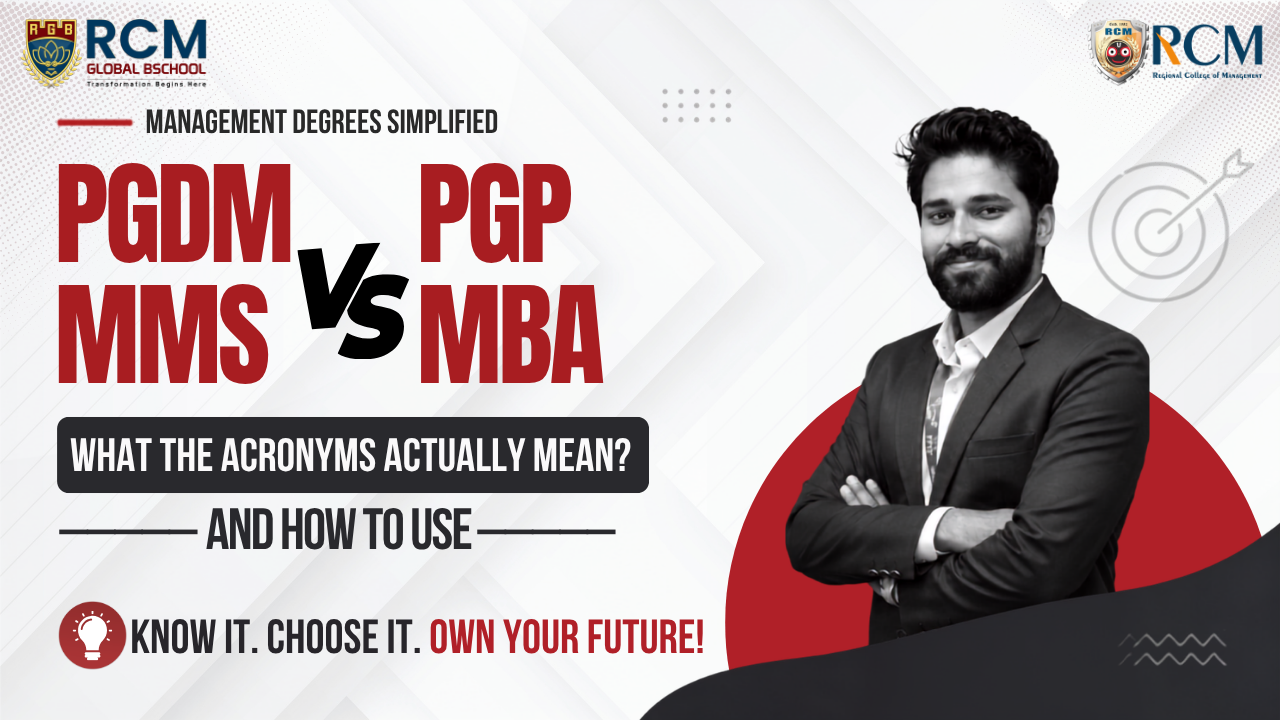
Short version: don’t pick a programme by its acronym. PGDM is a diploma from an autonomous AICTE-approved institute (MBA-equivalent with AIU recognition). PGP is just a programme name some top institutes use — what matters is what it awards. MMS is a university degree. MBA is a university degree. Judge any of them by recognition, curriculum and placements, not the three letters on the brochure.
First, the plain-English definitions
Most of the confusion around PGDM, PGP, MMS and MBA isn’t really about the courses. It’s about the words. Two of these are categories defined by how they’re regulated, one is a degree, and one is essentially a brand name. Once you see that, the fog clears.
PGDM — Post Graduate Diploma in Management
A PGDM is a diploma, not a degree. It’s awarded by autonomous institutes that are approved by AICTE rather than affiliated to a university. Because these institutes set their own syllabus, a good PGDM can stay closer to what industry actually wants. And here’s the part students worry about most: with equivalence granted by the Association of Indian Universities (AIU), a PGDM is treated as equal to an MBA — including for higher studies and most jobs.
PGP — Post Graduate Programme (in Management)
PGP is the one that trips people up. It is a programme name, not a separate regulatory category. Institutes like the IIMs (historically) and ISB have used “PGP” as the label for their flagship management programme. The acronym tells you almost nothing on its own — what matters is what that specific PGP awards (a diploma or a degree) and how it’s recognised. More on this below, because there’s a genuine nuance worth understanding.
MMS — Master of Management Studies
MMS is a full degree awarded by a university. It’s most associated with affiliated colleges under universities such as the University of Mumbai, and it’s typically a two-year management degree. So while it sounds unfamiliar next to “MBA”, structurally it sits in the same family: a university degree in management.
MBA — Master of Business Administration
The MBA is a degree awarded by a university. This is the reference point everyone measures the others against, mostly because it’s the most widely recognised name in the country.
PGDM is a diploma from an autonomous AICTE-approved institute, treated as MBA-equivalent with AIU recognition. PGP is a programme name (used by IIMs, ISB), not a separate category — judge it by what it awards. MMS is a university degree, usually two years. MBA is a university degree.
PGDM vs PGP vs MMS vs MBA — at a glance
| Programme | What it is | Who awards it | Degree or Diploma | Key note |
|---|---|---|---|---|
| PGDM | Post Graduate Diploma in Management | Autonomous, AICTE-approved institutes | Diploma | MBA-equivalent with AIU recognition; often more flexible, industry-led syllabus |
| PGP | Post Graduate Programme — a programme name, not a category | Varies (e.g. IIMs, ISB) | Depends on the institute | Judge by what it actually awards and its recognition; verify per institute |
| MMS | Master of Management Studies | A university (e.g. University of Mumbai) | Degree | Usually a 2-year degree; recognition tied to the awarding university |
| MBA | Master of Business Administration | A university | Degree | The most widely recognised name; quality still varies by institute |
What “PGP” really means — and the IIM Act 2017 twist
Here’s the honest answer to “what is PGP”: it depends entirely on who’s offering it. PGP is a naming convention, the way a company might call its flagship product “Pro” or “Premium”. The label sounds prestigious because the institutes that use it often are — but the prestige comes from the institute, not from the three letters.
This matters because of a real change in the rules. Under the IIM Act 2017, the Indian Institutes of Management were empowered to award degrees, including the MBA. So IIMs that once awarded a “Post Graduate Diploma in Management” through their PGP now award an MBA degree — even though some still carry the “PGP” branding for the programme itself. In other words, the same three-letter label can sit on top of a diploma at one institute and a degree at another, and even the same institute may have changed what it awards over time.
The takeaway isn’t complicated, but it’s important: if you see “PGP” on a prospectus, ask one question — what does this programme actually award, and who recognises it? Verify it for that specific institute and that specific intake year. Don’t assume.
What MMS is — and MMS vs MBA
An MMS (Master of Management Studies) is a two-year postgraduate degree in management, awarded by a university. In practice you’ll find it offered through colleges affiliated to universities such as the University of Mumbai, where it sits alongside the MBA as a recognised management degree.
So how does MMS vs MBA shake out? On paper, both are university degrees in management at the same level. The differences are usually in branding and reach: “MBA” is the more universally recognised term, while “MMS” can be less familiar to recruiters outside its home region. The substance — curriculum, faculty, placements — depends on the specific college, not on which of the two names appears on the certificate. If you’re choosing between an MMS and an MBA from comparable institutes, look at outcomes, not nomenclature.
PGDM or PGP — which to choose? The criteria that actually matter
Whether you’re weighing PGDM vs PGP, PGDM vs MMS, or PGP vs PGDM vs MBA, the smart way to decide is to ignore the acronym for a moment and run the programme through three filters.
1. What it awards and its recognition
Is it a diploma or a degree? Is the institute AICTE-approved? For a PGDM, does it hold AIU equivalence (which makes it MBA-equivalent)? For a degree, which university awards it and how widely is that recognised? This is non-negotiable — it affects higher studies, certain government eligibility, and recruiter perception.
2. Curriculum and how current it is
An autonomous PGDM institute can update its syllabus faster than a university-affiliated programme tied to a slower revision cycle. That’s an advantage only if the institute actually uses it. Read the latest curriculum, check the electives, and see whether it reflects how business is done today.
3. Placements and outcomes
Ultimately, you’re investing two years for what comes after. Look at where graduates land, the roles, the recruiters who return year after year, and how the institute supports your job search. A strong placement record from a lesser-known name often beats a famous acronym with weak outcomes.
Notice what’s not on this list: the letters PGDM, PGP, MMS or MBA by themselves. A well-run PGDM can outperform a weak MBA, and a strong MBA can outperform an average PGDM. The label is the starting question, never the answer. For a deeper look at the diploma-versus-degree debate, see our guides on PGDM vs MBA and whether a PGDM is equivalent to an MBA.
Where RCM Bhubaneswar fits in
Regional College of Management (RCM), Bhubaneswar was established in 1982 and is the oldest management institute in Odisha. It offers both an MBA and a PGDM, and is AICTE-approved, recognised by UGC and the Government of Odisha, with NAAC and NBA accreditation.
That combination is worth pausing on, because it answers the recognition question directly: RCM runs a PGDM at an institute with the approvals and accreditations that students and recruiters look for. If you’re comparing a PGDM against PGP-branded or MMS programmes elsewhere, the framework above applies here too — check what’s awarded, check recognition, read the curriculum, study the placements.
Ready to look at the numbers for yourself?
Mistakes to avoid
Treating “PGP” as a guarantee of quality. It’s a name. Always check what the specific programme awards and how it’s recognised.
Assuming a diploma is “lesser”. A PGDM with AIU equivalence is MBA-equivalent. The diploma label alone tells you nothing about quality.
Picking on acronym alone. PGDM, PGP, MMS, MBA — none of these acronyms decide your outcome. The institute does.
Skipping recognition checks. Confirm AICTE approval, AIU equivalence (for PGDM), and the awarding university’s standing before you pay a fee.
Ignoring placements and curriculum currency. A famous name with stale content and thin placements is a poor trade.
Not verifying by institute and year. Especially for PGP, where what’s awarded has shifted over time post the IIM Act 2017.
Frequently asked questions
PGDM is a regulatory category — a diploma awarded by autonomous AICTE-approved institutes, treated as MBA-equivalent with AIU recognition. PGP is simply a programme name used by some institutes; it isn’t a separate category. To compare them fairly, look at what each programme actually awards and how it’s recognised.
Neither is automatically better. “PGP” is a label, not a quality mark. A PGP at a top institute may award an MBA degree or a diploma depending on the institute; a strong PGDM can match or beat it. Compare the specific programmes on recognition, curriculum and placements.
PGP stands for Post Graduate Programme. It’s the name several institutes (such as the IIMs historically and ISB) use for their flagship management course. What it awards — a diploma or a degree — varies by institute, so always verify for the specific programme you’re considering.
Both MMS (Master of Management Studies) and MBA are university degrees in management at the same level, typically two years. MBA is the more widely recognised name, but the real difference between two programmes lies in the awarding university, curriculum and placements rather than the title.
Yes — a PGDM from an AICTE-approved institute with AIU equivalence is treated as equal to an MBA, including for higher studies and most jobs. The key is that the institute is properly approved and the equivalence is in place.
Under the IIM Act 2017, IIMs can award degrees, so many now award an MBA where they previously awarded a Post Graduate Diploma in Management — even if some still use “PGP” branding for the programme. Check the specific IIM and intake year, as practice has changed over time.
Run both through the same three filters: recognition and what’s awarded (diploma vs degree, AICTE/AIU status, awarding university), curriculum currency, and placements. A well-run PGDM and a strong MMS can both be excellent — decide on outcomes, not the acronym.
Usually it comes down to familiarity and reach. MBA is the more universally recognised term, while MMS may be less familiar outside its home region. For comparable colleges, recruiters care far more about your skills, projects and the institute’s track record than the title on the certificate.
A PGDM with AIU equivalence is generally accepted for higher studies, but individual foreign universities set their own criteria. If postgraduate study abroad is your plan, confirm acceptance with the target university before you enrol.
Check the institute’s official prospectus and website, confirm AICTE approval, look for AIU equivalence (for a PGDM) or the awarding university (for a degree), and where unsure, contact the admissions office directly. For RCM, our guide to what a PGDM is and the PGDM programme are good starting points.
Ready to look at the numbers for yourself?