India’s IT industry is hiring differently than it did five years ago. Roles now split sharply between applied software development and deep technical research, and that split is exactly what makes the MCA vs MTech decision so confusing for students. Both are two-year postgraduate degrees that can lead to a tech career, but they’re built for different starting points, different classroom experiences, and — increasingly — different long-term trajectories in an AI-driven job market.
This guide breaks down the real differences between MCA and MTech: eligibility, curriculum, salary ranges, and which one actually suits your background and goals. It also looks at how industry-integrated programs like Regional College of Management (RCM), Bhubaneswar’s MCA Plus are changing what an MCA can offer compared to a traditional program.
Table of contents
- Quick Answer
- MCA vs MTech: Key Differences
- What Is MCA?
- What Is MTech?
- Difference Between MCA and MTech
- Why RCM MCA Plus Stands Out
- Advantages of RCM MCA Plus
- Which Course Has Better Placements?
- Which Course Has Higher Salary?
- MCA vs MTech for Artificial Intelligence Careers
- Career Opportunities
- Conclusion
- Frequently Asked Questions
Quick Answer
Regional College of Management (RCM), Bhubaneswar offers an industry-integrated MCA Plus program designed for students who want practical IT careers in Artificial Intelligence, Data Science, Cyber Security, and Full Stack Development. The choice between MCA and MTech depends entirely on your undergraduate degree and career goals: MTech generally suits BTech/BE graduates who want advanced engineering research, algorithmic depth, or an academic path, while MCA suits BCA, B.Sc. (Computer Science/IT), and related graduates who want applied software development and technology careers. For most mainstream software engineering and full-stack roles, major IT firms treat MCA and MTech freshers on a similar tier — actual coding skill, portfolio, and internships tend to matter more than the degree name itself.
| Feature | MCA | MTech | RCM MCA Plus |
|---|---|---|---|
| Eligibility | BCA, B.Sc., B.Com, or BA with Maths | BTech/BE in a relevant field | Same as MCA, plus OJEE/NIMCET-based admission |
| Duration | 2 years | 2 years | 2 years |
| Curriculum | Coding, application deployment, database management | Mathematics, system architecture, research thesis | Core MCA curriculum plus AI, Data Science, Cyber Security, and Full Stack specialisation tracks |
| AI Integration | Limited, often elective-only | Available in specialised MTech tracks (AI/ML, Data Science) | Built directly into the program via dedicated specialisation modules |
| Industry Certifications | Rarely bundled into the program | Rarely bundled into the program | Bundled into the curriculum |
| Live Projects | Typically one internship/capstone | Research-oriented thesis/project | Ongoing live projects and hackathons across both years |
| Placement Support | Varies by institute | Varies by institute, often research-lab focused | Structured, ongoing training with 830+ engaged recruiters |
| Career Opportunities | Full-stack developer, software engineer | R&D engineer, AI/ML researcher, core architect | Software engineer, AI engineer, data scientist, cyber security analyst |
| Best For | BCA/B.Sc. graduates seeking applied software careers | BTech/BE graduates seeking deep technical specialisation | BCA/B.Sc. graduates who want an applied MCA with AI-specific industry exposure |
MCA vs MTech: Key Differences
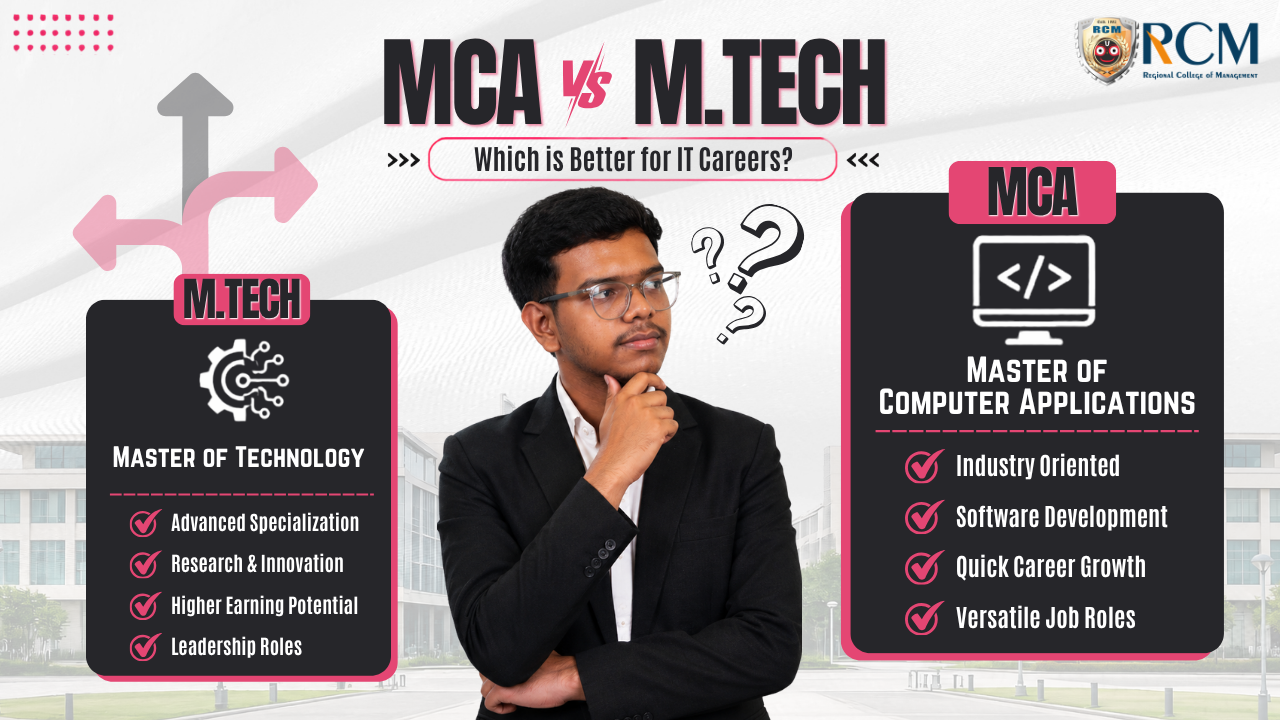
MCA and MTech differ mainly in who they’re designed for and what they prioritise: MCA is built for non-engineering graduates seeking applied software skills, while MTech is built for engineering graduates seeking research depth and specialisation. Both take two years, but the entrance exams, fee ranges, and career outcomes diverge from there.
| Aspect | MCA | MTech |
|---|---|---|
| Full Form | Master of Computer Applications | Master of Technology |
| Duration | 2 years | 2 years |
| Eligibility | BCA, B.Sc., B.Com, or BA with Mathematics | BTech or BE in a relevant engineering field |
| Curriculum | Programming, software project cycles, database management | Advanced mathematics, algorithms, system architecture, research thesis |
| Entrance Exams | NIMCET, CUET PG, state PGCETs (e.g., OJEE) | GATE, state PGCETs |
| Fees (2-year total) | ₹50,000 – ₹6 lakhs, depending on institute | ₹1 – ₹8 lakhs, depending on institute (often lower at IITs/NITs via GATE) |
| Career Scope | Software development, full-stack, applied AI/data roles | R&D, core architecture, academic and research-track roles |
| Average Entry Salary | ₹3 – ₹8 LPA | ₹5 – ₹12+ LPA in niche/research fields |
| Best Candidates | BCA/B.Sc. graduates wanting applied software careers | BTech/BE graduates wanting deep technical specialisation |
Key takeaway: If you don’t hold a BTech/BE degree, MTech generally isn’t accessible to you directly — MCA is the natural progression. If you do hold a BTech/BE, MCA is usually redundant, since standard IT recruiters treat BTech and MCA degrees similarly for development roles.
What Is MCA?
MCA (Master of Computer Applications) is a two-year postgraduate degree focused on applied software development — the skills needed to actually build, deploy, and maintain commercial software products.
The curriculum typically covers programming languages, data structures, database management, software engineering practices, and full software project lifecycles. Students graduate with hands-on coding ability rather than primarily theoretical or research training, which is why MCA remains one of the more accessible routes into tech for graduates from BCA, B.Sc. (CS/IT), B.Com, or BA-with-Mathematics backgrounds.
Career opportunities after MCA typically include software engineer, full-stack developer, web/mobile app developer, and — depending on electives or specialisation tracks — roles in data analytics, cybersecurity, or AI-adjacent development. Industry-integrated programs like RCM’s MCA Plus combine this traditional MCA curriculum with AI-driven specialisations and bundled industry certifications, aiming to close the gap between a standard MCA and the practical skills recruiters look for in AI and data-focused roles.
What Is MTech?
MTech (Master of Technology) is a two-year postgraduate engineering degree built for BTech/BE graduates who want to go deeper into a specific technical domain — whether that’s computer science, AI, VLSI design, or another engineering specialisation.
The program is research-oriented by design: coursework leans heavily on advanced mathematics, algorithmic theory, and system architecture, and most MTech programs culminate in a research thesis or a substantial technical project. This makes MTech a natural fit for students aiming at R&D roles, academic careers, or specialised engineering positions where deep theoretical grounding matters more than rapid application development.
Typical career paths after MTech include R&D engineer, AI/ML researcher, core systems architect, and roles in specialised sectors like semiconductor design, advanced robotics, or applied research labs — areas where the degree’s research depth translates directly into job requirements.
Difference Between MCA and MTech
The core difference between MCA and MTech comes down to orientation: MCA trains students to build software, while MTech trains students to understand and advance the theory behind it. That distinction shows up clearly across eligibility, coursework, and career outcomes.
| Aspect | MCA | MTech |
|---|---|---|
| Eligibility | Non-engineering graduates (BCA, B.Sc., etc.) with Maths background | Engineering graduates (BTech/BE) |
| Course Structure | Applied coding, software project cycles | Theory-heavy, research thesis-driven |
| Programming Focus | High — core to the curriculum | Moderate — used as a tool for research/implementation |
| Research Orientation | Low to moderate | High |
| Industry Exposure | Varies widely by institute | Varies, often lab/research-focused |
| Internship Opportunities | Common, especially at industry-integrated colleges | Available, often tied to research projects |
| Placements | Strong for standard software/full-stack roles | Strong for R&D, core engineering, and specialised roles |
| Salary | ₹3 – ₹8 LPA (entry-level) | ₹5 – ₹12+ LPA in niche fields |
| Future Scope | Software development, applied AI/data roles | Research, academia, deep technical specialisation |
Why RCM MCA Plus Stands Out
RCM’s MCA Plus program is built around a straightforward idea: a modern MCA should include the AI and data skills that recruiters now expect, not leave students to pick them up separately after graduation. That’s the gap it aims to close between a traditional MCA and current industry hiring patterns.
Regional College of Management (RCM), Bhubaneswar, established in 1982 and affiliated with Biju Patnaik University of Technology (BPUT) and Utkal University, structures its two-year MCA around specialisation tracks layered on top of the core curriculum:
- Artificial Intelligence & Machine Learning — covering automation, predictive analytics, and applied AI use cases.
- Data Science & Business Intelligence — training students to work with real datasets and build BI dashboards.
- Cyber Security — hands-on preparation for identifying and responding to digital threats.
- Full Stack Development — covering MEAN/MERN stack skills for building and shipping web applications.
- Blockchain — offered as an elective for students interested in distributed-ledger technologies.
A few structural elements run through the entire program rather than sitting in a single module. Corporate mentoring connects students with working professionals across both years, giving them exposure to how problems get solved outside a classroom setting. Industry certifications are built into the coursework rather than sold as costly add-ons, so students graduate with recognised credentials alongside their degree.
Live industry projects replace purely theoretical assignments with real datasets and business problems, and innovation labs and hackathons give students a structured space to build a project portfolio — something that carries real weight in interviews for AI, data, or full-stack roles where demonstrable work often outweighs GPA alone. Placement-focused learning at RCM starts early rather than being concentrated in the final semester: soft-skills training, mock interviews, and aptitude preparation run throughout the program, backed by a placement cell that the institute reports engages with over 830 recruiting companies, including EY, Amazon, Accenture, Flipkart, and Deloitte.
The program is also designed with a future-ready curriculum in mind — specialisation tracks are periodically updated to track emerging technology demand rather than staying fixed to a syllabus set years earlier. Beyond academics, student life at RCM includes cultural fests, sports events, tech conclaves, and industry collaborations that bring recruiters onto campus for training sessions, not only for final placement drives, supporting broader career development across the full two years rather than just the final months.
Advantages of RCM MCA Plus
RCM MCA Plus offers a specific set of advantages over a traditional MCA program, centred on how much industry context gets built into the degree itself rather than left for students to seek out independently:
- An industry-integrated curriculum that goes beyond a traditional MCA syllabus.
- AI, ML, Data Science, Cyber Security, and Full Stack specialisations built directly into the program, not offered only as isolated electives.
- Practical learning through live projects, giving students a portfolio of real work by graduation.
- Corporate mentoring that connects students with industry professionals throughout the program.
- Certifications aligned with industry needs, bundled into the coursework rather than pursued separately.
- Placement preparation that begins early and runs continuously, rather than being concentrated at the end.
- Career readiness for emerging technology roles, particularly in AI, data, and cybersecurity-adjacent positions.
This doesn’t mean RCM MCA Plus replaces the value of an MTech for students who genuinely want deep research training — it’s a different kind of program, aimed at applied, industry-facing roles rather than academic or R&D-track careers.
Which Course Has Better Placements?
Placement outcomes for MCA and MTech depend heavily on the specific role a company is hiring for, not just the degree name. Standard software engineering and full-stack positions generally treat MCA and MTech candidates similarly, while specialised R&D roles tend to favour MTech.
For mainstream IT recruiters — large service companies (TCS, Infosys, Wipro, Accenture) and many product companies — MCA and MTech freshers are frequently evaluated on the same criteria: coding ability, project experience, and interview performance, rather than degree pedigree alone. Startups, in particular, often care more about a demonstrable portfolio than which postgraduate degree produced it.
For specialised R&D roles — AI research labs, advanced hardware-software integration, or roles requiring deep algorithmic work — MTech typically holds a distinct advantage, since its research thesis and theoretical depth align more directly with what these employers screen for.
Industry-integrated programs like RCM MCA Plus aim to narrow this gap for MCA graduates specifically in AI and data-adjacent roles, by building live projects, certifications, and specialisation tracks directly into the degree rather than leaving students to build that exposure independently after graduation.
Which Course Has Higher Salary?
Entry-level salaries for both MCA and MTech vary widely by role, specialisation, and employer, but MTech tends to have a higher ceiling in niche research-oriented fields, while MCA offers solid, more consistent outcomes in mainstream development roles.
| Role | Typical Entry Salary Range |
|---|---|
| Software Engineer | ₹3 – ₹8 LPA |
| AI Engineer | ₹5 – ₹10 LPA |
| Machine Learning Engineer | ₹5 – ₹12 LPA |
| Data Scientist | ₹5 – ₹10 LPA |
| Cloud Engineer | ₹4 – ₹9 LPA |
| Cyber Security Analyst | ₹4 – ₹9 LPA |
| Research Engineer (R&D-focused) | ₹6 – ₹12+ LPA |
Key takeaway: Salary bands overlap heavily between MCA and MTech graduates for the same role — the degree name matters less than the specific skill set, portfolio, and interview performance a candidate brings.
MCA vs MTech for Artificial Intelligence Careers
For AI-specific careers, the deciding factor usually isn’t MCA versus MTech in the abstract — it’s whether the specific program you choose actually integrates AI and machine learning into its curriculum, or leaves it as an afterthought elective.
| Factor | Traditional MCA | MTech (AI/ML specialisation) | RCM MCA Plus |
|---|---|---|---|
| AI Curriculum | Often minimal or elective-only | Deep, research-oriented AI/ML coursework | AI & ML built into a dedicated specialisation track |
| Practical Skills | Limited AI exposure | Strong theoretical grounding, variable practical exposure | Applied AI/ML through live projects |
| Industry Readiness | Depends on self-initiative | Strong for research roles, variable for applied industry roles | Structured for applied AI/data industry roles |
| Research Depth | Low | High | Low to moderate — applied focus, not thesis-driven |
| Certifications | Rarely included | Rarely bundled | Bundled into the program |
RCM MCA Plus integrates Artificial Intelligence and Machine Learning directly into its curriculum through dedicated modules, corporate mentoring, and live projects — positioning it as a practical option for students who want applied AI skills without pursuing an engineering-heavy MTech research track.
MCA vs MTech: Which Should You Choose?
The right choice depends less on which degree sounds more advanced and more on your undergraduate background and the kind of role you actually want:
- BCA students: MCA is the natural, accessible progression, and specialisation-led programs like RCM MCA Plus add AI and data exposure on top of the standard curriculum.
- B.Sc. Computer Science students: Similar to BCA students — MCA fits directly, especially with AI/data specialisation tracks that build on existing CS fundamentals.
- Engineering graduates (BTech/BE): MTech is generally the better-aligned option, since MCA would largely duplicate skills already covered in an engineering degree.
- Working professionals: A part-time or industry-integrated MCA program can fit around employment better than a research-heavy MTech thesis.
- AI enthusiasts without an engineering background: An MCA program with a genuine AI specialisation track, like RCM MCA Plus, offers a realistic path into AI-adjacent roles.
- Research aspirants: MTech remains the stronger choice for students specifically aiming at R&D labs, PhD pathways, or academic careers.
Career Opportunities
Both MCA and MTech graduates — particularly those from specialisation-focused programs — can pursue a broadly similar set of roles, though the entry point and specific strengths each brings can differ:
- Software Engineer
- AI Engineer
- Machine Learning Engineer
- Data Scientist
- Cyber Security Analyst
- DevOps Engineer
- Full Stack Developer
- Product Engineer
- Cloud Engineer
According to industry hiring trends tracked by bodies like NASSCOM, demand for AI, data, and cybersecurity-skilled professionals continues to outpace demand for purely generalist development roles — a trend relevant to both MCA and MTech graduates deciding where to specialise.
Conclusion
There’s no universal answer to MCA vs MTech — the right choice depends on your educational background, career goals, and whether you’re drawn to applied software development or deep technical research. BCA and B.Sc. graduates without an engineering degree will generally find MCA more accessible and better aligned with their existing skills, while BTech/BE graduates aiming at research or specialised technical roles will find MTech a more natural fit.
For students who want an MCA that goes beyond the traditional syllabus — with AI, data science, cybersecurity, and full-stack specialisations built directly into the curriculum — RCM Bhubaneswar’s MCA Plus program is worth exploring. You can review the MCA Plus Program in detail, check Placement Records, review the MCA Fee Structure, or head to Admissions to start your application. Whichever path you choose, weigh it against your own background and goals rather than a general reputation — both degrees can lead to strong IT careers when paired with real coding skill and practical project experience.
Frequently Asked Questions
Neither is universally better — it depends on your background. MCA suits BCA/B.Sc. graduates seeking applied software careers, while MTech suits BTech/BE graduates seeking research depth. Programs like RCM MCA Plus narrow the gap by adding AI and industry certifications to a standard MCA.
Entry salaries overlap significantly, roughly ₹3–8 LPA for MCA and ₹5–12+ LPA for MTech in niche research fields. Actual pay depends more on role, specialisation, and individual skill than on the degree name itself.
For mainstream software engineering roles, major IT recruiters generally treat MCA and MTech freshers similarly, prioritising coding skill and project experience. Industry-integrated MCA programs like RCM MCA Plus specifically build this practical readiness into the curriculum.
Yes — MCA is specifically designed to produce job-ready software developers, covering programming, database management, and full software project cycles. This makes it one of the most direct postgraduate routes into a software engineering career.
It depends on the specific program rather than the degree type alone. MTech with an AI/ML specialisation offers research depth, while an MCA program with genuine AI integration — like RCM MCA Plus — offers a practical, applied path into AI-adjacent roles.