Why Should MBA Students Attend Workshops With Industry Leaders?
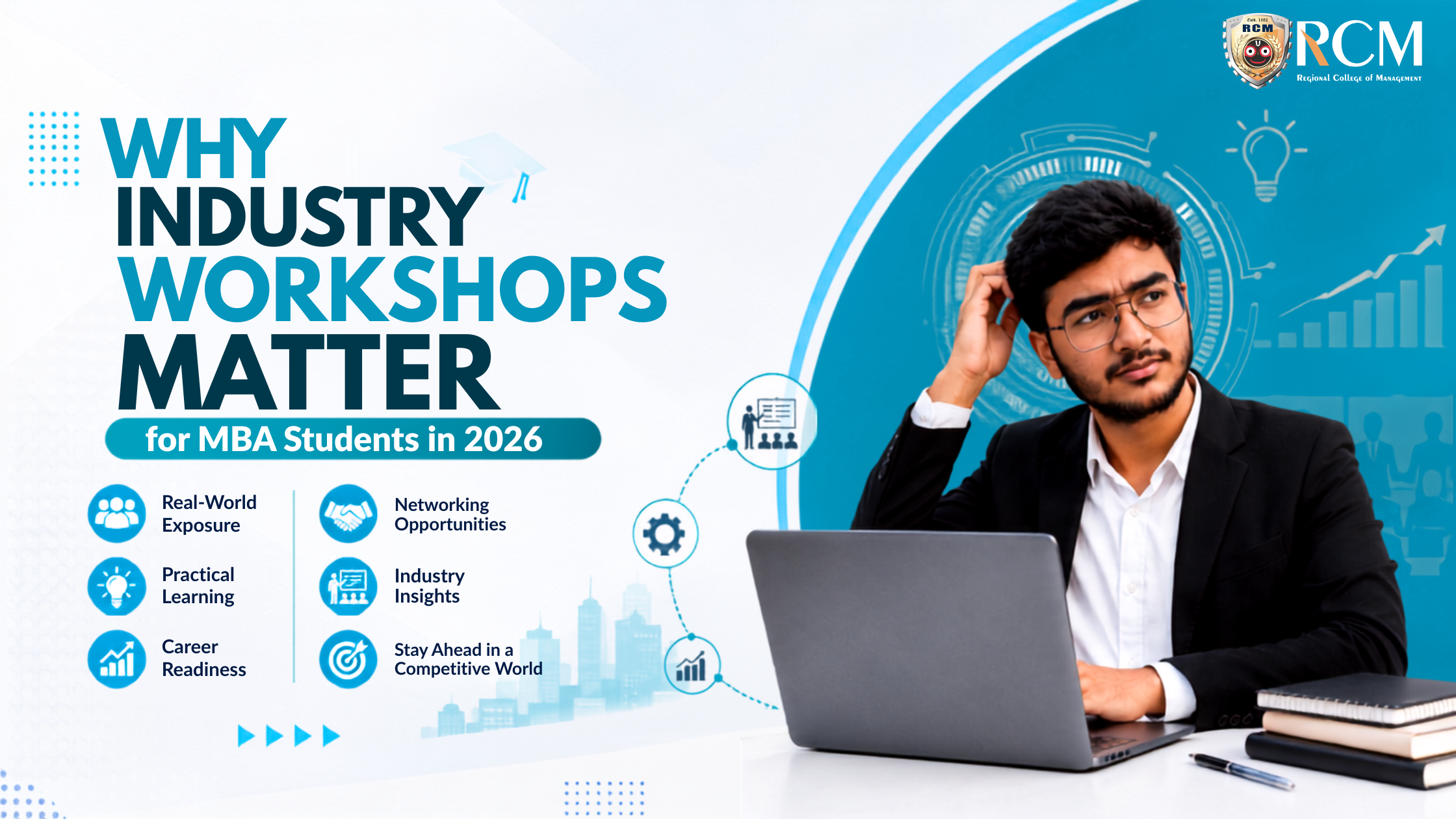
MBA industry workshops give students direct exposure to how real organizations make decisions, adapt to change, and solve problems — knowledge that classroom frameworks alone cannot fully replicate. Institutions like RCM Bhubaneswar host recurring workshops, panels, and conclaves featuring corporate leaders, entrepreneurs, and mentors, connecting academic learning to current business practice. This exposure builds practical judgment, communication skills, and early professional networks that support career readiness.
Classroom theory teaches frameworks; industry workshops show how those frameworks actually hold up under real, often messy business conditions. For MBA students, that gap between theory and practice is exactly where workshops, seminars, and structured industry interaction add the most value.
Table of contents
- Why Should MBA Students Attend Workshops With Industry Leaders?
- What Are MBA Industry Workshops?
- Why Industry Exposure Matters During an MBA
- Workshops vs Classroom Learning: What’s the Difference?
- How Guest Lectures and Industry Seminars Add Value
- How Management Conclaves Give Students Broader Industry Exposure
- How RCM Bhubaneswar Creates Industry Interaction
- What Should Students Look for in an MBA With Industry Exposure?
- How Industry Workshops Prepare Students for Future Careers
- Admission at RCM
- FAQs
What Are MBA Industry Workshops?
MBA industry workshops are structured sessions — ranging from single guest lectures to multi-day conclaves — where practicing professionals share insights, debate current challenges, and interact directly with students. They differ from standard coursework in one key way: the person speaking is actively working in the field being discussed, not just teaching about it.
Common formats include:
- Corporate interaction series — a recurring, structured calendar of sessions spread across the academic year, rather than a single event
- Guest lectures — a single speaker addressing a specific topic, usually within a class session
- Panel discussions — multiple speakers debating or discussing a shared theme, often with audience Q&A
- Management conclaves — larger, multi-day events featuring many speakers, panels, and masterclasses
Why Industry Exposure Matters During an MBA
An MBA curriculum builds structured knowledge — frameworks for strategy, finance, marketing, and operations. Industry exposure adds something different: a sense of how those frameworks perform when applied to real, ambiguous situations where information is incomplete and outcomes uncertain.
This matters because business decisions rarely unfold as cleanly as case studies suggest. Practitioners who speak to current market conditions, recent challenges, and live decision-making give students a more current, textured understanding of how business actually works — something a syllabus updated once a year struggles to match.
7 Ways Industry Workshops Help MBA Students
- Career readiness — developing the practical judgment and business awareness that recruiters look for beyond academic transcripts
- Real-world business understanding — seeing how strategy and theory translate into actual organizational decisions
- Practical decision-making — observing how leaders weigh trade-offs under time pressure and incomplete information
- Industry trends — staying current with shifts in technology, markets, and business models as they happen
- Leadership skills — learning directly from people who have led teams and organizations through real challenges
- Communication skills — practicing confident interaction with senior professionals during Q&A and networking
- Networking — building early professional relationships that can support internships and job searches
Workshops vs Classroom Learning: What’s the Difference?
| Aspect | Classroom Learning | Industry Workshops |
|---|---|---|
| Focus | Structured theory, frameworks, and models | Real-world application and current practice |
| Source | Faculty and academic case studies | Practicing industry professionals |
| Pace of relevance | Updated periodically | Reflects current, real-time business conditions |
| Format | Lectures, assignments, exams | Talks, panels, Q&A, networking |
| Primary value | Foundational, transferable knowledge | Practical judgment and current context |
Neither replaces the other. A student with only theoretical knowledge may struggle to apply frameworks flexibly in unfamiliar situations; a student with only workshop exposure may lack the structured foundation needed to generalize lessons beyond the specific examples discussed. The strongest MBA experience combines both deliberately.
How Guest Lectures and Industry Seminars Add Value
A guest lecture works well precisely because it’s narrow: one speaker, one topic, enough time to go deep. This format suits students trying to understand a specific function — say, how a CFO approaches capital allocation, or how a marketing leader builds a brand strategy — in more detail than a textbook chapter allows.
Seminars extend this further by inviting discussion and debate, often surfacing disagreements between practitioners that reveal there isn’t always one “correct” answer in business — a useful, humbling lesson for students used to graded, single-answer coursework.
How Management Conclaves Give Students Broader Industry Exposure
Where a guest lecture goes deep on one topic, a management conclave goes broad — compressing dozens of speakers, panels, and masterclasses into a short, intensive window, often two or three days. This format works well for exposing students to multiple industries, functions, and perspectives simultaneously, rather than one specialist view at a time.
Conclaves also tend to draw larger, more diverse speaker rosters — sometimes including international participants — giving students a wider view of global business thinking than a single guest lecture typically can.
How RCM Bhubaneswar Creates Industry Interaction
RCM Bhubaneswar has built its industry interaction around a mix of formats — an annual business carnival, a flagship leadership conclave, and participation in major external industry events — reflecting the broader mix of guest lectures, panels, and conclaves described above.
Business Carnival / Aa Ka Ma Bizz Buzz Soiree
RCM’s Aa Ka Ma Bizz Buzz Soiree, its annual Business Carnival, was held in November 2025 with Subrat Tripathy, Chairman of Adani Ports & SEZ, as keynote speaker. The event featured two themed panel discussions — “Entrepreneurship in the Digital Age” and “Building Entrepreneur Mindset for a Developed India” — featuring speakers including Rajen Padhi (Commercial Director, B One Business House), Pratik Rao (Chief Managing Director, Velvetbai), and Trinath Lenka (Managing Director, Wallet4Wealth). The event also included a startup pitch competition judged by professionals from SIDBI and the IIT Bhubaneswar Research and Entrepreneurship Park, alongside career counselling sessions led by RCM faculty.
Ashwamedha 2026 and Industry 5.0
RCM’s flagship conclave, Ashwamedha 2026, is described by the institution as a two-day Global Leadership Conclave held on 20th and 21st February 2026, centered on the theme “Co-Creating the Future Workforce for Industry 5.0.” According to RCM’s official page, the event brought together more than 100 global leaders from nearly 10 nations, with participation from professionals at organizations including Microsoft, Amazon, Accenture, KPMG, PwC, and Boston Consulting Group. The format included panel discussions, masterclasses, and TEDx-style sessions covering themes like AI-driven management, cross-functional leadership, and data-led decision-making.
Industry Leaders and GES 2025
RCM’s engagement with industry leaders also extends beyond its own campus. According to RCM’s official coverage of the Global Entrepreneurship Summit (GES) 2025, held at IIT Kharagpur, RCM students participated in the summit’s startup challenges and interacted with business leaders present at the event, which featured speakers including Sundar Pichai (CEO, Google & Alphabet) and Ritesh Agarwal (CEO & Co-Founder, OYO). RCM states that its Plus Program provides students with mentorship from industry experts and opportunities to participate in premier competitions such as GES.
Global and International Exposure
RCM’s Ashwamedha conclave specifically has drawn participation from international speakers as part of its stated 100+ global leaders from nearly 10 nations. This reflects a targeted form of global engagement — bringing international business perspectives to RCM’s Bhubaneswar, Odisha campus through its flagship event — rather than a broader claim about student travel or exchange programmes, which is a separate matter students should verify directly with the institution if relevant to their decision.
What Should Students Look for in an MBA With Industry Exposure?
Verifiable specifics — can the institution point to named speakers, dates, and topics, rather than vague claims of “industry exposure”? Reviewing how established institutions like IIM Ahmedabad, IIM Bangalore, or XLRI Jamshedpur publicize their own industry engagement can offer a useful benchmark for what detailed, verifiable event information looks like.
- Recurring structure — is industry interaction a regular part of the calendar, or a single annual event?
- Speaker relevance — do past speakers align with your intended specialization or career direction?
- Format variety — does the programme offer a mix of guest lectures, panels, and larger conclaves?
- Student participation — do students actively engage through panels, pitch competitions, or moderator roles?
How Industry Workshops Prepare Students for Future Careers
Industry workshops connect directly to skills relevant across MBA career paths. In management and leadership roles, exposure to how senior executives frame decisions builds practical judgment. In marketing and analytics, hearing practitioners describe real campaign or data challenges deepens applied understanding. In finance, sessions with banking and investment professionals illustrate how capital and risk decisions actually get made. In HR, direct interaction with people leaders offers insight into organizational and talent challenges. In operations, hearing from supply chain and process leaders grounds theoretical models in practical constraints. And for aspiring entrepreneurs, direct access to founders and mentors offers a realistic view of what building a venture actually involves.
None of this guarantees a specific job outcome — career results still depend on individual skills, performance, and market conditions — but this kind of exposure builds the practical business awareness that complements academic learning across every specialization.
Admission at RCM
Students exploring RCM’s MBA programme — including its industry-interaction opportunities through events like the Business Carnival and Ashwamedha conclave — can review programme structure through the MBA+ programme page. For current eligibility, application requirements, and deadlines, visit RCM admissions directly, since specific criteria can change between intakes. Students can also explore RCM student life and review RCM placements for institution-reported outcomes from recent cycles.
For a broader comparison of how different Indian management institutions structure industry interaction, see our detailed guide on MBA colleges with industry workshops.
FAQs
MBA students benefit from industry workshops because they show how business frameworks apply in real, often unpredictable conditions that classroom theory alone can’t fully capture. Direct interaction with practitioners also builds communication skills, professional networks, and current awareness of industry trends.
Industry workshops improve practical learning by connecting theoretical frameworks to live examples of how real organizations make decisions. Hearing practitioners describe current challenges — rather than only historical case studies — gives students a more current, applied understanding of business practice.
A guest lecture is typically a single speaker addressing one topic within a class session, while a workshop or broader industry event often involves multiple speakers, panels, and interactive formats across a longer timeframe. Management conclaves extend this further, combining many workshops and sessions into a multi-day event.
Industry exposure helps students build practical judgment, professional communication, and networking skills that recruiters value alongside academic performance. It also keeps students current on industry trends and real business challenges, which can strengthen how they discuss their readiness for a role in interviews.
Yes, RCM Bhubaneswar hosts recurring industry interaction through events such as its annual Business Carnival and its Ashwamedha management conclave, alongside student participation in external events like GES 2025. These formats bring corporate leaders, entrepreneurs, and mentors into direct contact with students throughout the academic year.