If you have spent even ten minutes researching MBA colleges, you have probably seen wildly different salary numbers — ₹6 LPA here, ₹35 LPA there, ₹1 crore somewhere else. It is confusing, and honestly, a little misleading if nobody explains why those numbers differ so much. This guide breaks down exactly how the MBA salary package 2026 progresses — from a fresher’s first offer to a senior leader’s compensation — so you can set realistic expectations and make a smarter decision about where you study.
What Is the MBA Salary Package in India in 2026?
MBA salary package 2026 for fresh graduates generally ranges from ₹6–12 LPA, depending on the college, specialization, and industry. Mid-career professionals often earn ₹12–25 LPA, while senior managers can reach ₹35–60+ LPA. At Regional College of Management (RCM), Bhubaneswar, the highest MBA package reached ₹22 LPA in 2026, supported by its PLUS Program, industry projects, and placement-focused curriculum.
MBA Salary Package 2026: Salary by Role & Sector
Different MBA roles command very different salaries depending on the sector they sit in. Here is a quick comparison to set realistic role-based expectations:
| MBA Role | Sector | Starting Salary | Mid-Career Salary |
| Business Analyst | Analytics | ₹7–12 LPA | ₹15–28 LPA |
| Product Manager | Technology | ₹10–18 LPA | ₹25–45 LPA |
| Strategy Consultant | Consulting | ₹12–25 LPA | ₹30–60 LPA |
| Marketing Manager | FMCG | ₹6–15 LPA | ₹18–35 LPA |
| Finance Manager | Banking | ₹8–18 LPA | ₹20–40 LPA |
| Operations Manager | Manufacturing | ₹6–14 LPA | ₹18–30 LPA |
| HR Manager | HR | ₹5–10 LPA | ₹15–25 LPA |
Understanding MBA Salary Growth
Salary growth after an MBA is not random — it follows a fairly predictable pattern shaped by four factors: the skills you bring, your years of experience, the industry you join, and the reputation of your college.
Skills: Candidates with strong analytics, communication, and AI tool fluency consistently command 20–40% higher starting offers than peers without these skills.
Experience: Each meaningful year of relevant work experience — especially leadership or client-facing roles — tends to compound salary growth faster than tenure alone.
Industry: Consulting, technology, and BFSI sectors consistently pay more than traditional manufacturing or retail roles at the same experience level.
College reputation: Shiksha’s MBA Placements Report shows that the gap between top-tier and other B-schools can be as wide as ₹20–25 LPA at the same experience level — which is exactly why understanding where you study matters as much as what you study.
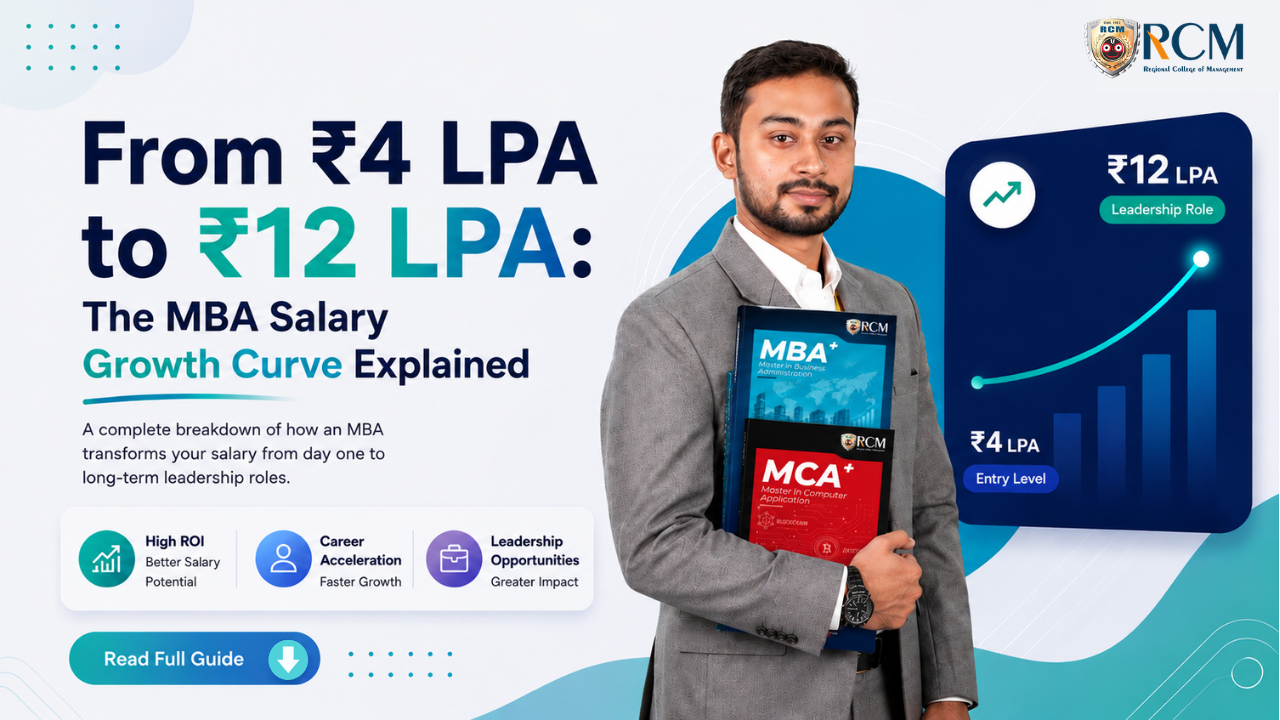
MBA Salary Progression: ₹4 LPA → ₹12 LPA → ₹25 LPA
Here’s the part most students actually want to see — the real trajectory of how an MBA salary grows over a career, stage by stage:
| Career Stage | Typical Salary | What Changes |
| Freshers (0–2 yrs) | ₹4–12 LPA | First job; building functional expertise and credibility |
| Early Career (2–5 yrs) | ₹10–20 LPA | Switching roles or specialising; first promotions |
| Mid-Level (5–10 yrs) | ₹18–40 LPA | Managing teams; P&L or strategic ownership begins |
| Leadership (10+ yrs) | ₹40–80+ LPA | Director/VP roles; influence on business direction |
Notice something important here: the biggest jump doesn’t happen right after your MBA. It happens between years 5 and 10, when you move from ‘doing the work’ to ‘owning outcomes.’ This is exactly why the choice of specialisation, the certifications you collect, and the practical exposure you get during your MBA matter far more than your starting salary alone.
MBA Salary by College Tier
College tier remains one of the strongest predictors of starting salary. According to the IIRF India MBA Rankings 2026, even Tier-2 and Tier-3 MBA colleges report average packages above ₹10 LPA, while top-tier institutes cross ₹25 LPA comfortably — a clear signal that the MBA investment pays off across the spectrum, just at different magnitudes.
| College Tier | Average Package | Examples |
| Tier-1 | ₹18–35 LPA | IIM Ahmedabad, IIM Bangalore, IIM Calcutta, ISB, FMS, XLRI, SPJIMR |
| Tier-2 & Tier-3 | ₹5–15 LPA | Reputed private and state-affiliated B-schools with strong industry tie-ups |
| Distance / Online MBA | ₹5–10 LPA | Flexible-format programmes for working professionals |
| RCM Bhubaneswar (2026) | ₹4–22 LPA (highest) | Industry-integrated MBA with PLUS Program, placement support & AI curriculum |
MBA Salary by Specialization
Specialisation choice can swing your salary by ₹10–20 LPA at the same experience level. Here’s how the emerging and traditional specialisations compare in 2026:
| Specialisation | Salary Range | Demand & Growth |
| Business Analytics | ₹10–28 LPA | Very High — every sector needs data-driven decision makers |
| Artificial Intelligence | ₹14–35 LPA | Explosive — fastest-growing MBA specialisation in 2026 |
| Data Science & BI | ₹12–30 LPA | Very High — demand from tech, fintech, and retail |
| Digital Marketing | ₹7–22 LPA | High — driven by India’s growing digital ad economy |
| International Business | ₹8–25 LPA | Growing — global trade and GCC expansion in India |
| Finance | ₹8–40 LPA | High — banking, NBFC, and investment sectors |
| Green Finance | ₹9–24 LPA | Emerging — ESG mandates accelerating hiring |
| AI, ML, Blockchain & Metaverse | ₹15–40 LPA | Emerging — early-mover advantage for skilled graduates |
Notice that Artificial Intelligence, Business Analytics, and Finance specialisations consistently sit at the top of the salary range. These are also the specialisations where India’s hiring demand is growing fastest — a combination that matters when you are choosing where to focus your MBA energy.
Salary by Experience
| Experience Level | Salary Range | Why It Matters |
| Freshers (0–2 yrs) | ₹6–12 LPA | Foundational role mastery and proving early business impact |
| Mid-Level (3–8 yrs) | ₹12–25 LPA | Leadership exposure, ownership of outcomes, specialisation depth |
| Senior (9+ yrs) | ₹35–60+ LPA | Strategic decision-making, P&L responsibility, organisational influence |
Experience matters because it is the clearest proxy employers have for judgment under pressure. A fresher can be brilliant on paper, but a senior professional has already proven they can make the right call when the data is incomplete and the stakes are real. That is what later-career salary jumps are actually paying for.
MBA Salary at India’s Top Business Schools
It helps to see the absolute top of the market as a benchmark — not as a realistic target for every student, but to understand the ceiling. Careers360’s XLRI Placement Report 2026 confirms XLRI’s 2026 average package at ₹31.4 LPA, with a top domestic offer crossing ₹59 lakh — figures broadly consistent with India’s other leading B-schools.
| College | Average Package | Highest Package |
| ISB Hyderabad | ₹37.29 LPA | ₹1.56 Cr |
| IIM Calcutta | ₹36 LPA | ₹1.45 Cr |
| SPJIMR | ₹33.6 LPA | ₹75 Lakh |
| IIM Lucknow | ₹33.2 LPA | ₹1 Cr |
| FMS Delhi | ₹32.27 LPA | ₹1.10 Cr |
| XLRI | ₹31.4 LPA | ₹59 Lakh |
| IIM Raipur | ₹20.7 LPA | ₹42.66 Lakh |
These numbers are industry benchmarks, not universal outcomes — even within these institutes, packages vary widely by specialisation, prior experience, and individual performance in interviews. Use them as a reference point for what’s possible at the very top of the market, not as the standard every MBA graduate should expect.
What Influences MBA Salary?
Beyond college tier, several controllable factors make a measurable difference to your final package:
- Communication: confident, structured communication wins interview rounds and negotiation conversations
- Internships: a relevant internship is often a stronger signal to recruiters than grades alone
- Certifications: value-added certifications in analytics, AI tools, or domain specialisations signal initiative
- AI skills: familiarity with AI-driven tools is increasingly a baseline expectation, not a bonus
- Business Analytics: data fluency is now relevant across almost every MBA function, not just analytics roles
- Leadership: even small leadership experiences (clubs, projects, team leads) carry weight in interviews
- Networking: a large share of strong offers still come through referrals and alumni connections
Why Placement Support Changes Salary Outcomes
Students often focus only on college rankings, but placement support, recruiter network, internships, industry exposure, and certifications significantly influence long-term salary growth — sometimes more than the brand name on the degree itself.
Regional College of Management (RCM), Bhubaneswar combines several of these factors directly into its MBA programme: the PLUS Program, Industry Projects, Corporate Mentorship, an AI-integrated curriculum, Value-Added Certifications, and structured Placement Support. These experiences are designed to help students become more competitive candidates for high-paying MBA jobs, regardless of where they start from.
In 2026, RCM recorded a highest MBA package of ₹22 LPA — a number that reflects what is achievable when industry exposure, certifications, and placement preparation are built into the curriculum rather than left to chance. Students can review the full breakdown of recruiters and packages on RCM’s placement page at rcm.ac.in/placements/.
Emerging Specialisations and How RCM Prepares Students
As the specialisation table above shows, the highest-growth MBA tracks in 2026 are Artificial Intelligence, Business Analytics, Data Science & BI, Digital Marketing, Green Finance, International Business, and the broader AI/ML/Blockchain/Metaverse cluster.
RCM offers exposure to these emerging areas through its PLUS Program, Industry Projects, and Value-Added Certifications — giving students a practical, hands-on introduction to tools and frameworks that are directly relevant to today’s hiring patterns, rather than purely theoretical coverage. For students evaluating their specialisation options, this kind of applied exposure can meaningfully influence which roles they qualify for at placement time.
Students interested in understanding how RCM structures its MBA curriculum around these specialisations can explore the full programme details at rcm.ac.in/programs/best-mba-college-in-orissa/.
MBA Admission 2026 — Limited Seats
Regional College of Management (RCM), Bhubaneswar
Industry-Integrated MBA | AI-Integrated Learning | Placement Support
PLUS Program — Value-Added Certifications & Corporate Mentorship | Industry Projects & AI-Integrated Curriculum | Industry Projects & AI-Integrated Curriculum | 2026 Highest MBA Package: ₹22 LPA | One of the leading MBA colleges in Odisha for career-focused education
See RCM Placement Report → rcm.ac.in/placements
Talk to Admissions about your Target Package → rcm.ac.in/admissions
FAQs
The MBA starting salary in India in 2026 typically ranges from ₹6–12 LPA for fresh graduates, with significant variation based on college tier, specialisation, and industry.
The highest MBA packages in India reach ₹1.45–1.56 crore per annum at top institutes like IIM Calcutta and ISB Hyderabad, though such figures represent rare outliers rather than typical outcomes.
MBA salary typically grows from ₹6–12 LPA as a fresher to ₹12–25 LPA mid-career and ₹35–60+ LPA in senior leadership roles, with the steepest growth occurring between five and ten years of experience.
The average MBA salary in Odisha generally ranges from ₹5–12 LPA for freshers, with industry-integrated colleges offering placement support and certifications helping graduates reach packages of up to ₹22 LPA.
Artificial Intelligence, Business Analytics, and Finance currently offer the highest MBA salary potential in India, with experienced professionals in these specialisations earning ₹25–40 LPA or more.
Conclusion: Making Sense of Your Own MBA Salary Journey
The honest truth about MBA salary package 2026 figures is that the headline numbers — whether it’s ₹6 LPA or ₹1.5 crore — are both true and both incomplete. Your actual outcome depends on a combination of college, specialisation, skills, and how seriously you use the two years of your MBA to build a real professional profile.
What the data consistently shows is this: the gap between an average outcome and a strong outcome is rarely about talent alone. It’s about access — to internships, to mentors, to certifications, to recruiters who trust the institution’s pipeline. That is precisely the gap that industry-integrated placement support is designed to close.
Students considering their MBA journey and salary growth potential can explore the curriculum, PLUS Program, placement support, and industry-integrated learning opportunities at RCM to understand how modern management education is designed to translate into real career and salary outcomes. Admissions for 2026 are open with limited seats — explore rcm.ac.in/admissions/ to learn more, or visit rcm.ac.in/ for full programme details.