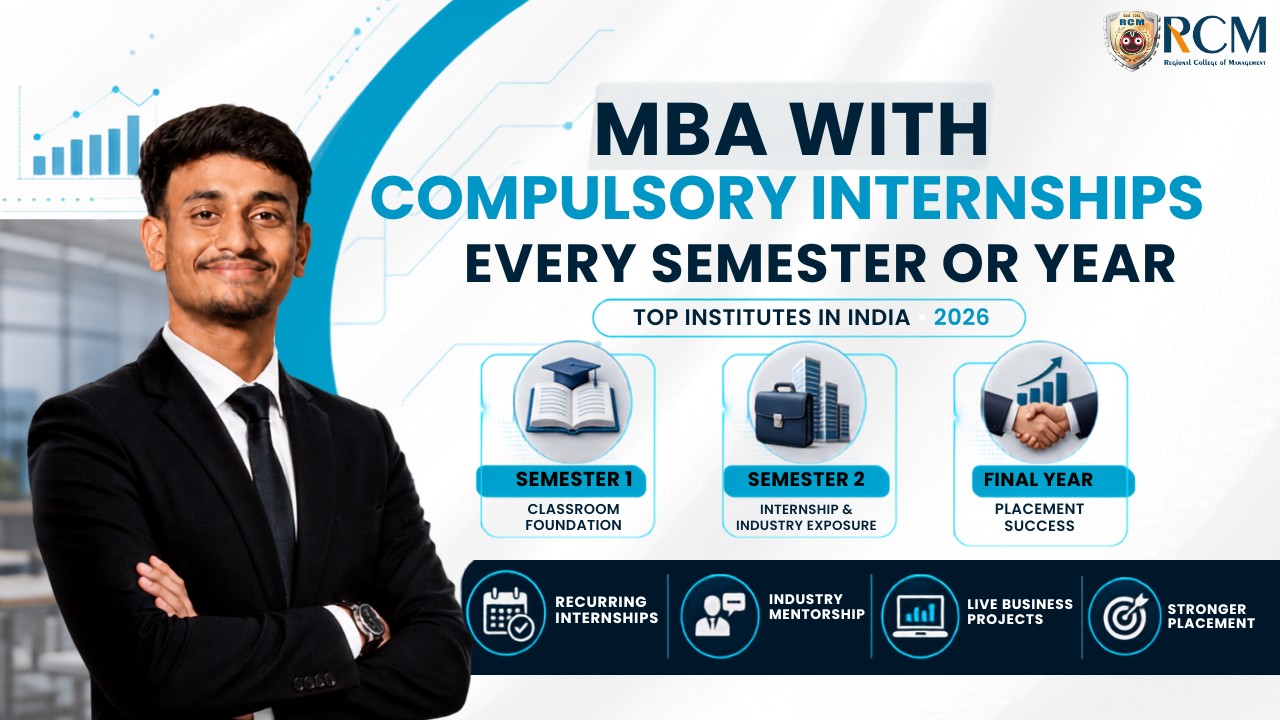
Several institutes in India include compulsory internships in their MBA curriculum. These internships help students gain practical exposure and build career-ready skills. However, internship structures differ across business schools.
Some institutes offer one mandatory Summer Internship Programme (SIP). Others combine the SIP with live projects, industry visits, and corporate mentoring. Therefore, students should compare internship duration, recruiter participation, mentorship, and placement support before choosing an MBA.
RCM Bhubaneswar follows an industry-integrated MBA+ model. The programme combines a structured Summer Internship Programme with AI-integrated specializations, live projects, and corporate exposure.
If you want to compare different institutes, explore our guide to Best MBA Colleges with Mandatory Internships in India.
Table of contents
- Why This Question Matters More in 2026
- What Does “Compulsory Internship” Actually Mean?
- Semester-Wise vs. Once-a-Year Internships
- How to Evaluate an MBA Program’s Internship Structure
- Comparison: How Different Categories of Indian B-Schools Handle Internships
- Where RCM Bhubaneswar Fits Into This Picture
- Industries Where MBA Interns Commonly Gain Experience
- Does a Compulsory Internship Actually Improve Placement Outcomes?
- A Practical Checklist Before You Choose an MBA Program for Its Internship Value
- Why AI-Integrated Learning Now Shapes Internship Quality
- Employability Skills the Internship Should Actually Build
- FAQs
- Institutional Credibility: What to Check Beyond the Internship Claim
- Explore RCM’s Industry-Integrated MBA Programs
Why This Question Matters More in 2026
MBA students today want more than classroom knowledge. They also want practical experience before graduation.
An MBA can teach business frameworks, financial models, and marketing strategies. However, classroom learning cannot fully replicate a workplace. Students need to understand how teams handle deadlines, clients, budgets, and unexpected problems.
That is where internships become valuable.
A well-designed internship allows students to apply classroom concepts in a real business environment. It can also help them understand workplace expectations before they enter full-time employment.
What Does “Compulsory Internship” Actually Mean?
The term compulsory internship can have different meanings across MBA programmes.
Generally, it refers to an internship that forms part of the academic curriculum. Students must complete it to fulfil the programme requirements.
Summer Internship Programme
The most common model is the Summer Internship Programme (SIP). Students usually complete the internship after their first year.
The internship may last several weeks. Students work with companies in areas such as marketing, finance, HR, operations, analytics, or consulting.
Live Industry Projects
Some MBA programmes also include shorter live projects. These projects allow students to solve specific business problems during the academic term.
For example, a student may analyse customer data, create a marketing strategy, or study a company’s financial performance.
Corporate Mentoring
Corporate mentoring adds another layer of practical exposure. Industry professionals can guide students through projects, presentations, and career decisions.
Pre-Placement Opportunities
In some cases, strong internship performance can lead to a Pre-Placement Offer. However, students should always confirm the institute’s current PPO policy and conversion data before assuming that an internship guarantees employment.
Semester-Wise vs. Once-a-Year Internships
Students often search for MBA programmes that provide internships every semester. However, the Indian MBA landscape usually follows a different structure.
The Most Common Model: One Summer Internship
Most two-year MBA programmes use a mandatory Summer Internship Programme. Students complete the internship after gaining foundational knowledge during the first year.
This structure gives students time to understand subjects such as finance, marketing, HR, operations, and business analytics before entering a company.
Continuous Industry Exposure
However, practical learning does not have to stop outside the internship period.
Many industry-focused MBA programmes supplement the main internship with:
- Live projects
- Case competitions
- Business simulations
- Industry visits
- Guest lectures
- Corporate mentoring
- Research assignments
Therefore, students can receive industry exposure throughout the academic year without completing a full-time internship every semester.
How to Evaluate an MBA Program’s Internship Structure
When comparing institutes, these factors matter more than whether the word “compulsory” appears in the brochure:
- Is the internship graded or credit-linked, or is it optional and unsupervised?
- Who arranges the internship — does the placement cell coordinate it, or is the student left to find one independently?
- How many recruiters actively participate in the internship pipeline every year?
- Does internship performance influence final placement, or are the two processes disconnected?
- Is there faculty or industry mentorship during the internship, or is it a “sign this form and disappear for two months” arrangement?
- Are live projects and case competitions built into the term alongside the internship, reinforcing practical exposure throughout the year rather than only once?
Institutes that score well across all six factors tend to produce graduates who are noticeably more prepared during final interviews, because they have already been evaluated once by a real employer.
Comparison: How Different Categories of Indian B-Schools Handle Internships
Rather than ranking specific institutes against each other with unverifiable claims, it is more useful to compare the common internship models followed across categories of Indian management institutes. This gives prospective students an evidence-based framework to evaluate any college they are considering.
| Institute Category | Internship Structure | Typical Duration | Industry Coordination | Link to Final Placement |
|---|---|---|---|---|
| IIMs and top national B-schools | Mandatory Summer Internship Project (SIP) after Term 2/3 | 8–10 weeks | Centralized placement committee, corporate-driven | Strong — SIP feedback often factors into final placement |
| State-affiliated AICTE/UGC MBA colleges (general) | Summer internship as a curriculum component | 6–8 weeks | Varies widely; some fully coordinated, some student-arranged | Weak to moderate, depends on the institute |
| Industry-integrated MBA programs (e.g., RCM’s MBA+) | Compulsory internship plus live projects, specialization tracks, and corporate mentoring throughout the year | 8–10 weeks SIP + ongoing live projects | Placement cell actively coordinates with recruiters across sectors | Strong — internship performance feeds into placement readiness |
| Distance/online MBA programs | Internship usually optional or self-sourced | Variable | Minimal to none | Very weak or absent |
The table above illustrates a pattern worth internalizing: the presence of the word “internship” in a brochure tells you very little. What separates a genuinely useful program from a paper requirement is coordination, mentorship, and whether the experience is treated as preparation for placement rather than an isolated academic formality.
Where RCM Bhubaneswar Fits Into This Picture
Regional College of Management (RCM), Bhubaneswar, established in 1982, is one of the older private management institutes in Eastern India and has built its MBA delivery around what it calls the MBA+ model — an AICTE-approved, BPUT-affiliated MBA degree layered with industry certifications, specialization tracks, and structured internship exposure.
A few things are worth stating plainly and without exaggeration, based on information RCM itself publishes:
- RCM’s MBA program requires a mandatory summer internship with partner companies as part of the curriculum, coordinated through the institute’s dedicated placement cell rather than left entirely to individual students.
- RCM’s placement cell collaborates with 830+ recruiters across IT, banking, FMCG, e-commerce, consulting, and other industries to provide students with internship and final placement opportunities.
- Internships strengthen students’ placement readiness, and many students earn pre-placement offers by performing well during their internships, as commonly seen in leading B-school internship programs.
- Beyond the core MBA, RCM enhances learning through MBA+ specialization tracks in Data Science & Business Intelligence, Green Finance & ESG (FinTech), and Digital Marketing & Communication. These certified add-on programs combine classroom learning with hands-on, project-based experience in each domain.
This is a meaningfully different model from a college that simply lists “summer internship” as a line item without a coordinating placement infrastructure behind it. That said, prospective students should still verify current-year specifics — recruiter lists, average stipends, and specialization intake — directly with the institute before applying, since these figures are updated every admission cycle.
RCM’s MBA+ Value-Added Specializations at a Glance
| Specialization Track | Core Focus Areas | Practical Component |
|---|---|---|
| Data Science & Business Intelligence | Data analytics, machine learning fundamentals, Power BI, business intelligence tools | Applied projects using real business datasets |
| Green Finance & ESG (FinTech) | Digital banking, financial analytics, blockchain basics, payment technologies | Case studies and simulations in financial technology |
| Digital Marketing & Communication | SEO, performance marketing, branding, social media strategy, AI-assisted marketing | Live campaign planning and content strategy assignments |
Each track links directly to its dedicated program page, where students can explore the detailed curriculum, certification partners, and career outcomes.
RCM integrates these certifications into the core MBA curriculum, enabling students to graduate with both a recognized MBA degree and a specialization credential aligned with a specific career path. This industry-focused approach helps RCM prepare graduates with job-ready skills that today’s employers actively seek.
Industries Where MBA Interns Commonly Gain Experience
Across most Indian B-schools with active internship pipelines, students typically intern in a recognizable set of sectors. Understanding this helps set realistic expectations regardless of which institute a student chooses:
- Banking and Financial Services: Credit analysis, retail banking operations, wealth management support, and financial research roles.
- Information Technology and Software: Business analyst internships, IT project coordination, and technology consulting assignments.
- E-commerce: Category management, supply chain coordination, digital merchandising, and customer experience projects.
- FMCG and Manufacturing: Sales trainee roles, distribution channel projects, and operations internships.
- Consulting: Research support, market entry studies, and strategy assignments under a mentor consultant.
- Multinational Corporations: Cross-functional internships spanning marketing, HR, and finance, often with structured rotation.
A student evaluating any MBA program should ask specifically which of these sectors the institute’s recruiters come from, rather than accepting a generic assurance that “internships are available.”
Does a Compulsory Internship Actually Improve Placement Outcomes?
The honest answer is: it depends on execution, not just presence.
Research and placement data across Indian management education consistently show that students who complete a structured, mentored internship enter final placement interviews with three concrete advantages:
- A real project to discuss. Interviewers consistently favor candidates who can describe a specific business problem they worked on, the data or process involved, and the outcome — rather than only citing classroom coursework.
- Sector clarity. Students who intern in, say, banking or FinTech often discover during the internship itself whether that sector genuinely suits their working style, which sharpens their final placement targeting instead of applying broadly and hoping for the best.
- A tested professional reference. A strong internship manager is often willing to serve as a reference or even recommend the student internally, something no classroom assignment can replicate.
None of this happens automatically just because an internship is “compulsory” on paper. It happens when the institute’s placement cell actively manages the pipeline, when mentors give real feedback, and when the internship is treated as preparation for a career rather than an academic obligation to be completed and forgotten.
A Practical Checklist Before You Choose an MBA Program for Its Internship Value
Use this checklist during campus visits, counselling sessions, or admission calls with any shortlisted institute:
- Ask for the exact duration of the mandatory internship and whether it is graded.
- Ask how many companies participated in the internship program in the most recent academic year.
- Ask whether the placement cell arranges internships centrally or whether students are expected to source their own.
- Ask what proportion of students convert their internship into a pre-placement offer.
- Ask whether live projects or case competitions run alongside the core internship, reinforcing practical exposure throughout the year.
- Ask whether the internship experience is linked to a specialization track (such as analytics, FinTech, or digital marketing) or is generic across all students regardless of interest area.
Institutes that can answer these questions with specifics, rather than marketing language, are generally the ones worth shortlisting.
Why AI-Integrated Learning Now Shapes Internship Quality
A quieter but equally important shift is happening alongside the internship conversation: the internships themselves are changing in nature. A decade ago, an MBA marketing intern might spend eight weeks doing manual market research and PowerPoint decks. Today, the same intern is often expected to pull data from a CRM, build a basic dashboard, interpret it using analytics tools, and present recommendations backed by evidence rather than intuition.
This is why institutes are increasingly folding AI and data literacy into the MBA curriculum itself, not as a bolt-on elective but as groundwork that makes the internship experience more valuable. A student who understands business intelligence tools, basic data analytics, or digital marketing automation before stepping into an internship is simply able to do more in those eight weeks than one who is encountering these tools for the first time on the job.
This is the reasoning behind specialization-linked MBA tracks such as RCM’s MBA+ programs in Data Science & Business Intelligence, Green Finance & ESG (FinTech), and Digital Marketing & Communication. Rather than treating AI exposure as a separate certificate course disconnected from the internship, the intent is for students to walk into their Summer Internship Project already conversant in the tools relevant to their specialization — Power BI and analytics fundamentals for a data-focused intern, digital campaign tools for a marketing-focused intern, and financial technology concepts for someone heading into a banking or FinTech internship.
Employers interviewed across placement drives consistently note a similar pattern: MBA graduates who can speak fluently about data, automation, and digital tools — not as buzzwords but as things they have actually used — tend to stand out even when their internship company or sector is not particularly prestigious. This is a case where the quality of preparation before the internship shapes the value extracted during it.
Employability Skills the Internship Should Actually Build
Beyond technical or sector-specific knowledge, a well-structured compulsory internship should help an MBA student develop a set of transferable employability skills that recruiters consistently rank highly:
- Workplace communication — writing concise emails, presenting to senior stakeholders, and adapting tone across audiences.
- Ambiguity management — handling tasks with incomplete instructions, a near-universal feature of real corporate work that classroom case studies rarely replicate.
- Time and priority management — juggling multiple stakeholders and deadlines simultaneously, rather than working on one assignment at a time as is common in academic settings.
- Feedback absorption — receiving a performance review, sometimes a critical one, and adjusting behavior accordingly before the internship ends.
- Cross-functional awareness — understanding how a marketing decision affects operations, or how a finance constraint shapes a product roadmap, which is far easier to grasp inside a company than inside a classroom.
A student choosing between MBA programs should ask specifically whether the institute’s internship structure is designed to build these skills deliberately — through pre-internship orientation, mid-internship check-ins, and post-internship debriefs — or whether the internship is simply a document to be signed and submitted at the end of eight weeks with no structured reflection built around it.
FAQs
Most AICTE-approved, two-year MBA programs in India include a mandatory Summer Internship Project as part of the curriculum; the difference between institutes lies in how well the internship is coordinated and connected to final placement.
Yes — they let students apply classroom concepts in real business settings, test sector fit, and build a professional network before graduation.
Generally yes, when the internship is mentored and coordinated by the institute; students with a documented project and industry reference tend to perform better in final interviews.
Banking, IT/software, e-commerce, FMCG, consulting, and multinational corporations are the most common sectors for MBA internships in India.
Look beyond whether an internship is mandatory on paper — check industry partnerships, mentor support, project quality, and whether the internship connects to final placement.
Yes. RCM’s MBA program includes a mandatory summer internship coordinated through its placement cell, which works with a stated network of 830-plus recruiters across sectors.
Tracks such as Data Science & BI, Green Finance & ESG (FinTech), and Digital Marketing & Communication combine classroom learning with applied projects, giving students internship exposure aligned to their chosen specialization.
A regular MBA internship may be a standalone academic requirement; an industry-integrated MBA layers the internship with live projects, specialization certifications, and active placement-cell coordination throughout the program.
No. Most two-year MBA programs schedule one mandatory Summer Internship Project, supplemented by shorter live projects and industry modules across other terms rather than a full internship each semester.
Ask for the exact internship duration, the number of participating recruiters in the most recent year, and whether the placement cell coordinates internships centrally — verifiable specifics matter more than brochure language.
Institutional Credibility: What to Check Beyond the Internship Claim
An internship structure, however strong, does not exist in isolation. It sits within a broader institutional framework that determines whether the degree itself carries weight in the job market. Before shortlisting any MBA program on the strength of its internship pitch, it is worth verifying the following credibility markers, which apply to any institute a student is considering, not RCM specifically:
- Regulatory approval: Is the MBA program approved by the All India Council for Technical Education (AICTE) and affiliated with a recognized university? For RCM Bhubaneswar, the MBA program is AICTE-approved and affiliated with Biju Patnaik University of Technology (BPUT) and Utkal University, and the institute has also been recognized under Sections 2(f) and 12(B) of the UGC Act.
- Accreditation status: Does the institute hold accreditation from the National Assessment and Accreditation Council (NAAC) or other recognized quality certifications? Accreditation bodies evaluate infrastructure, faculty quality, and academic governance, not just placement marketing.
- Track record and longevity: How long has the institute been operating, and does it have a verifiable alumni base? RCM, founded in 1982, positions itself as one of the earliest dedicated management institutes in Odisha and Eastern India, with a stated alumni network of over 17,000 graduates.
- Placement infrastructure, not just placement numbers: A large recruiter base matters less than whether the placement cell actively manages the internship-to-placement pipeline year-round, rather than running a single hiring event at year-end.
- Faculty and mentorship depth: Are internships and live projects overseen by faculty with industry experience, or left entirely to the student and the host company?
Students should treat these as due-diligence questions for any shortlisted college — including RCM — and confirm current figures directly with the admissions office, since placement statistics, recruiter lists, and accreditation renewals are updated on an annual cycle.
Explore RCM’s Industry-Integrated MBA Programs
If you are comparing MBA programs specifically for internship quality, specialization depth, and placement coordination, it’s worth exploring RCM Bhubaneswar’s MBA+ programme in detail, including its Summer Internship Programme, placement ecosystem, and campus life.
Ready to Build Your Career Through Real Industry Experience?
If you’re looking for an MBA that combines academic credibility with a structured, mandatory internship and AI-integrated specializations, RCM Bhubaneswar’s admissions for 2026 are open. Review the MBA+ specialization tracks, compare internship structures across institutes using the checklist above, and make an informed decision.
Apply Now: https://rcm.ac.in/admissions/