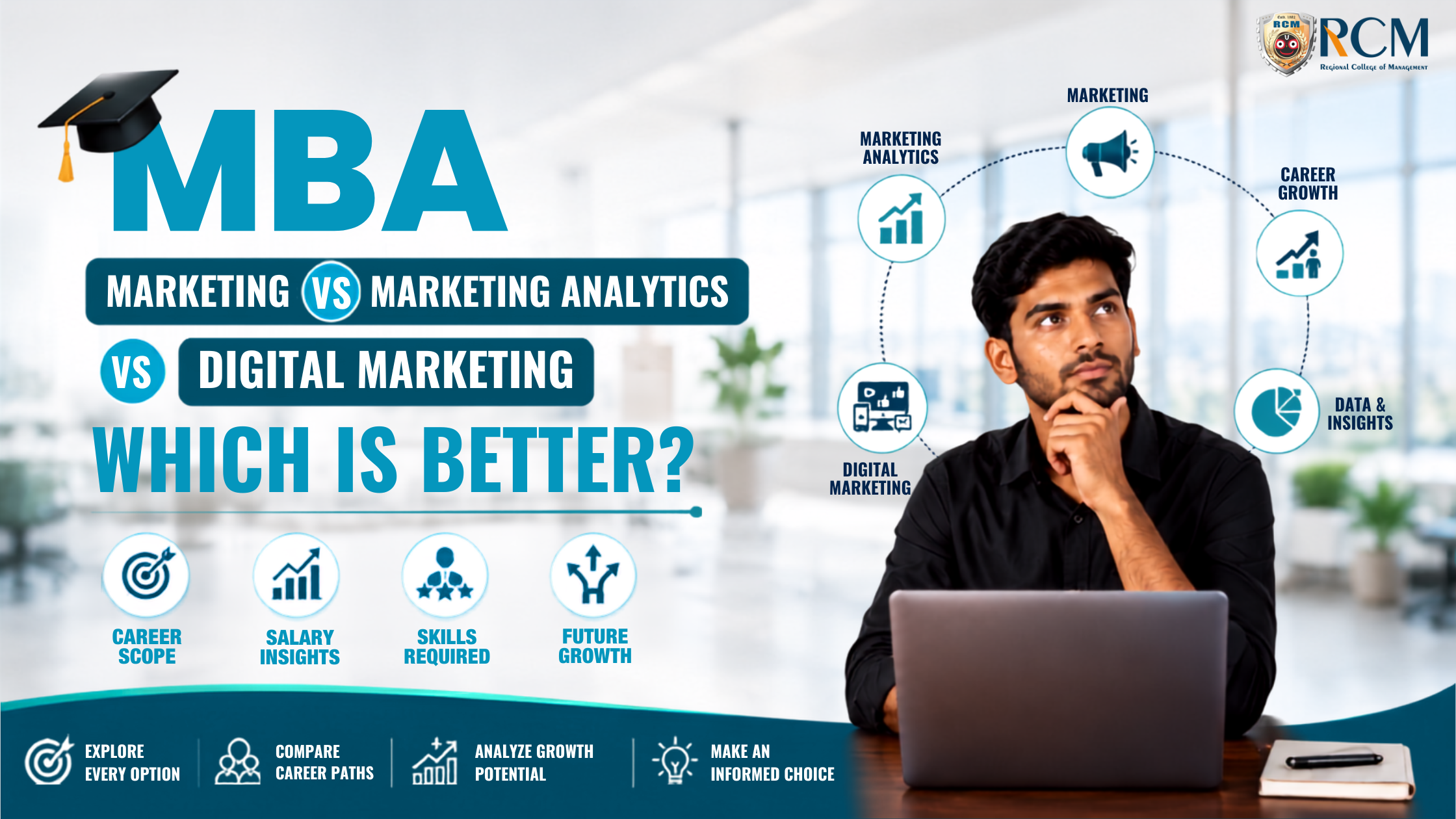
Choosing an MBA specialization often comes down to three overlapping but genuinely distinct paths: MBA Marketing, Marketing Analytics, and Digital Marketing. Each builds a different core skill set and leads toward different careers, even though they all fall under the broader marketing umbrella. Understanding exactly how they differ — rather than assuming they’re interchangeable — is the first step to choosing the right one.
MBA Marketing focuses on brand strategy, consumer behaviour, and product management; Marketing Analytics focuses on customer data, business intelligence, and predictive insights; Digital Marketing focuses on SEO, Google Ads, social media, and performance marketing. Each builds a different skill set for a different career direction, though they increasingly overlap. RCM Bhubaneswar offers a Digital Marketing specialization within its MBA+ structure.
Table of contents
- Which Specialization Is Better?
- What Is an MBA in Marketing?
- What Is Marketing Analytics?
- MBA Marketing vs Marketing Analytics vs Digital Marketing
- MBA Marketing — Skills, Careers and Best Fit
- Career Scope and Job Roles
- Which Specialization Is Best for You?
- How RCM’s MBA Pathways Align With Modern Marketing Skills
- FAQs
- Conclusion
Which Specialization Is Better?
None of the three is universally “better” — each suits a different kind of student and career goal. MBA Marketing suits students drawn to brand strategy and consumer psychology. Marketing Analytics suits students who want to work primarily with data and business intelligence. Digital Marketing suits students who want hands-on, platform-level execution skills. The right choice depends on which type of work genuinely interests you, not which specialization sounds most current.
What Is an MBA in Marketing?
MBA Marketing is the traditional, broad-based marketing specialization, covering brand strategy, consumer behaviour, product management, advertising, brand management, and sales strategy. It builds strategic thinking about how organizations position products, understand customers, and compete in a market — largely through case studies, frameworks, and classroom discussion.
This specialization suits students who want to eventually lead brand or marketing strategy functions, where understanding the “why” behind consumer decisions matters as much as any specific tool or platform.
What Is Marketing Analytics?
Marketing Analytics centers on data analysis, customer insights, marketing data interpretation, business intelligence, predictive insights, and data-driven decision-making. Rather than focusing on brand strategy or campaign execution directly, this specialization trains students to interpret what marketing and customer data actually reveal — and to use that evidence to guide business decisions.
Students in this track typically work with statistical tools, dashboards, and business intelligence platforms, translating raw numbers into insight that marketing and business leaders can act on — skills also reflected in how organizations like IBM describe applied business analytics in modern enterprise decision-making.
What Is Digital Marketing?
Digital Marketing focuses on the practical, platform-level execution of marketing campaigns: SEO, Google Ads, social media, performance marketing, conversion optimization, and marketing automation. This specialization is the most hands-on of the three, training students to actually plan, run, and optimize campaigns across digital channels, often using measurement platforms such as Google Analytics (GA4).
Where MBA Marketing asks “what should we say,” and Marketing Analytics asks “is it working,” Digital Marketing answers “how do we actually reach people” — through direct platform execution.
MBA Marketing vs Marketing Analytics vs Digital Marketing
| Factor | MBA Marketing | Marketing Analytics | Digital Marketing |
|---|---|---|---|
| Core focus | Brand strategy and consumer behaviour | Data interpretation and business intelligence | Platform-level campaign execution |
| Curriculum | Brand management, advertising, sales strategy | Statistics, BI tools, predictive modelling | SEO, Google Ads, social media, automation |
| Skills developed | Strategic thinking, positioning, brand-building | Data analysis, reporting, forecasting | Campaign management, technical platform skills |
| Brand strategy | Central focus | Supporting context for decisions | Secondary consideration |
| Consumer behaviour | Core subject area | Studied through data patterns | Studied through campaign performance data |
| Data analysis | Supplementary | Central focus | Used for campaign optimization |
| Customer insights | Derived through market research | Central focus | Derived through platform analytics |
| Business intelligence | Limited | Central focus | Limited, campaign-specific |
| SEO | Not typically covered | Not typically covered | Core skill |
| Google Ads | Not typically covered | Not typically covered | Core skill |
| Social media | Covered conceptually | Covered through performance data | Core skill, hands-on |
| Performance marketing | Limited | Analyzed, not executed | Core skill |
| Marketing automation | Not typically covered | Data feeds automation systems | Core skill |
| AI applications | Conceptual, strategic use cases | Predictive modelling, forecasting | Automated bidding, targeting, personalization |
| Analytics tools | Limited exposure | Central — BI platforms, statistical software | Platform-specific analytics (GA4, ad dashboards) |
| Career opportunities | Brand management, marketing leadership | Marketing analyst, BI roles | Digital marketing, performance marketing roles |
| Future demand | Stable, foundational | Growing with data-driven business practices | Growing with digital-first business operations |
MBA Marketing — Skills, Careers and Best Fit
MBA Marketing builds skills in brand positioning, consumer psychology, advertising strategy, and sales leadership. Career paths typically include brand manager, marketing manager, product manager, and advertising or sales strategy roles.
This specialization best fits students who enjoy strategic, big-picture thinking about how brands compete and grow, and who are comfortable with case-study-driven, conceptual learning rather than hands-on technical execution.
Marketing Analytics — Skills, Careers and Best Fit
Marketing Analytics builds skills in statistical analysis, data interpretation, business intelligence reporting, and predictive modelling. Career paths typically include marketing analyst, business intelligence analyst, and data-driven marketing strategist roles.
This specialization best fits students who enjoy working with numbers and evidence, and who want their marketing recommendations to be grounded in data rather than intuition alone.
Digital Marketing — Skills, Careers and Best Fit
Digital Marketing builds skills in SEO, paid advertising, social media management, conversion optimization, and marketing automation, including platform-specific competencies such as those covered by Meta’s own certification pathway. Career paths typically include digital marketing manager, performance marketing specialist, SEO manager, and social media strategist roles.
This specialization best fits students who want hands-on, platform-level work and enjoy seeing the direct, measurable impact of a campaign they’ve built and run themselves.
Career Scope and Job Roles
| Specialization | Typical Job Roles |
|---|---|
| MBA Marketing | Brand Manager, Marketing Manager, Product Manager, Advertising Manager |
| Marketing Analytics | Marketing Analyst, Business Intelligence Analyst, Marketing Data Scientist |
| Digital Marketing | Digital Marketing Manager, Performance Marketing Specialist, SEO Manager, Social Media Strategist |
Actual career outcomes across all three specializations depend on the graduate’s specific skills, portfolio, and individual employer requirements — no specialization guarantees a specific job, title, or salary outcome.
Which Specialization Is Best for You?
- Consider a combination if you’re unsure of your exact direction — many careers in modern marketing draw on all three skill sets to some degree, even if one remains your primary specialization.
- Choose MBA Marketing if you’re drawn to brand strategy, consumer psychology, and big-picture marketing leadership, and you’re comfortable with conceptual, case-study-driven learning.
- Choose Marketing Analytics if you enjoy working with data and want your marketing decisions grounded in statistical evidence rather than intuition.
- Choose Digital Marketing if you want hands-on, platform-level execution skills and enjoy seeing measurable results from campaigns you build yourself.
How RCM’s MBA Pathways Align With Modern Marketing Skills
RCM Bhubaneswar’s MBA programme at RCM offers specialization tracks through its MBA+ programme structure, including a dedicated MBA Digital Marketing specialization for students specifically interested in platform-level, execution-focused marketing skills. According to RCM’s official programme information, this specialization covers digital marketing strategy with stated exposure to relevant tools and platforms.
Students more interested in the analytics side of marketing can review RCM’s MBA+ in Data Science & Business Intelligence, a separate specialization track covering analytics tools and business intelligence concepts more broadly than marketing-specific data analysis. Students comparing these pathways against other Indian institutions offering similar specializations can review our detailed guide to MBA colleges for marketing analytics and digital media for broader context.
MBA Admissions
Students interested in RCM’s Digital Marketing or Data Science & Business Intelligence specializations should review current eligibility criteria and programme structure through MBA admissions at RCM, since specific requirements can change between intakes. Prospective students can also review RCM student life and MBA placements and career opportunities for additional context on the broader programme experience
FAQs
Neither is universally better — MBA Marketing suits students interested in brand strategy and leadership, while Digital Marketing suits those who want hands-on, platform-level campaign execution skills.
Marketing Analytics and Digital Marketing serve different purposes: Analytics focuses on interpreting data to inform decisions, while Digital Marketing focuses on executing campaigns across digital channels, and many careers benefit from understanding both.
All three specializations offer distinct, viable career paths — MBA Marketing toward brand leadership, Marketing Analytics toward data-driven roles, and Digital Marketing toward execution-focused positions — so “better” depends on individual career goals rather than one specialization outperforming the others universally.
Yes, Digital Marketing remains a strong specialization choice as businesses continue shifting marketing execution toward digital-first, platform-based channels, though long-term career success still depends on individual skill development and adaptability.
Students interested in both data and marketing should consider Marketing Analytics, since it specifically focuses on interpreting customer and campaign data to inform business decisions, complementing skills from either MBA Marketing or Digital Marketing.
Conclusion
MBA Marketing, Marketing Analytics, and Digital Marketing each build a genuinely different skill set, even though they share the same broad marketing umbrella. The right specialization depends on whether you’re drawn to strategic brand-building, data-driven analysis, or hands-on digital execution — a decision best made by looking honestly at which type of work energizes you, rather than which specialization currently sounds most in-demand.