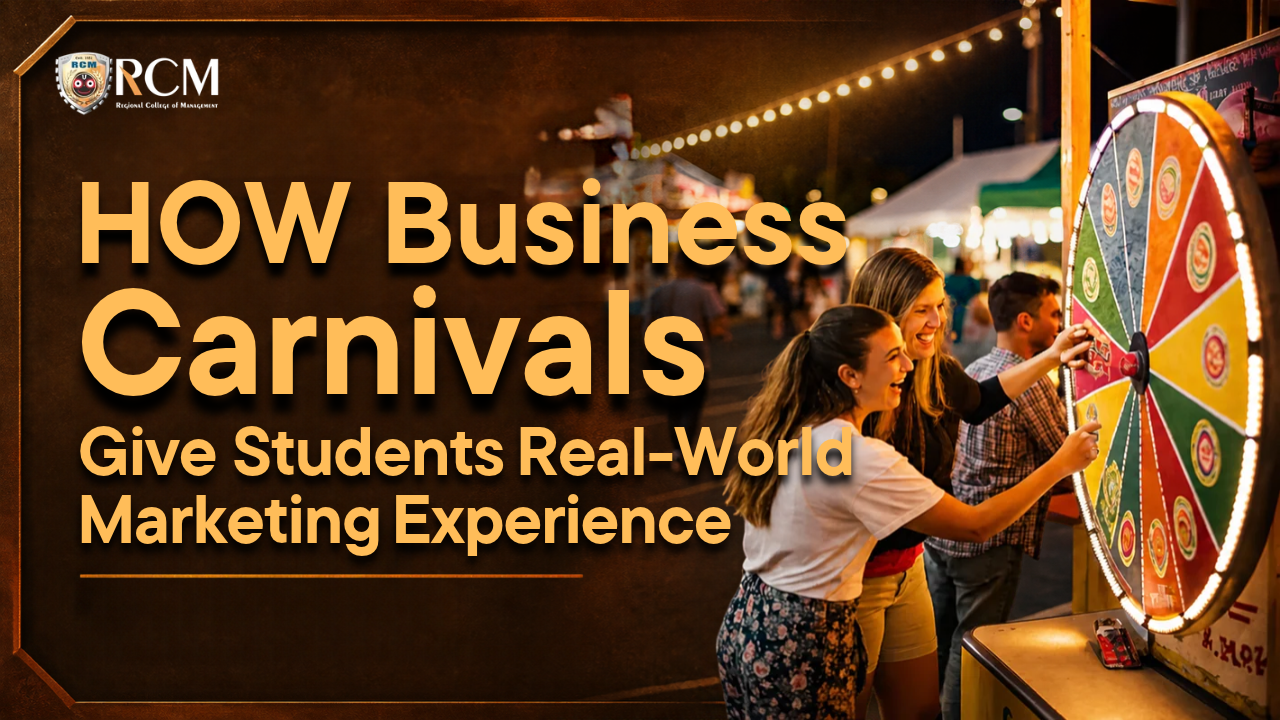
A marketing student can recite the four Ps from memory. Then she stands behind a table at a college fair, and the first visitor asks, “Why is yours priced higher than the one next door?” No chapter prepared her for that moment.
That gap between knowing a concept and using it is exactly what a business carnival narrows. It puts products, sellers and real customers in one place, so marketing stops being a diagram and becomes a conversation.
Table of contents
- What Is a Business Carnival for Students?
- Why Do Business Carnivals Matter in Management Education?
- How Business Carnivals Provide Real-World Marketing Experience
- What Marketing Skills Can Students Develop Through Business Carnivals?
- How Can Students Run Student Marketing Projects During Business Carnivals?
- How Do Business Carnivals Help Students Understand the Marketing Process?
- Business Carnivals vs Classroom-Based Marketing Learning
- Common Challenges Students May Face During Business Carnivals
- How Do Business Carnivals Support Experiential Learning Management?
- AA KA MA 2026: A Business Carnival Connecting Learning and Enterprise
- How Do RCM’s Management Programmes Connect with Practical Business Learning?
- How Can Students Make the Most of a Business Carnival Experience?
- Conclusion: Why Every Student Should Understand Marketing Beyond the Classroom
- Frequently Asked Questions
What Is a Business Carnival for Students?
A business carnival is an educational event where businesses and student teams display products and services to an audience. It brings students, enterprises, products and customers together, usually as part of campus events.
Classroom learning explains marketing theory. A carnival lets students watch it work: how a stall is arranged, how a seller explains a product, how visitors react. This supports experiential learning management, where understanding comes from observing and doing. It also gives aspiring founders a low-risk view of student entrepreneurship in India, including marketing, customer engagement and business operations.
Example: a student notices two stalls selling similar handmade candles. One shows prices clearly and lets visitors smell samples; the other has no price card. Visitors linger at the first and walk past the second. That single observation illustrates product presentation and customer behaviour.
Why Do Business Carnivals Matter in Management Education?
Management learners need to apply concepts, not just recall them. Practical exposure helps students:
- Apply classroom ideas to real situations.
- Understand consumer behaviour and how businesses attract and retain customers.
- Learn product positioning and pricing through observation.
- Build communication, presentation and confidence.
Management education works best when it includes real business environments, because decisions look different when a customer is waiting for an answer. Real-world business exposure also shows students which concepts they have truly understood and which need more work.
How Business Carnivals Provide Real-World Marketing Experience
Understanding Customer Behaviour Through Direct Interaction
Students can see which products visitors pick up, compare and ask about. Watching without interrupting often reveals more than a formal survey. Questions and feedback reveal buying interests, and conversations point to unmet needs. This is customer research in its simplest form. For instance, a student may notice that visitors repeatedly ask about refill options, which suggests that sustainability features matter to them.
Learning Product Presentation and Branding
Packaging, displays and descriptions shape how customers understand a product’s value. Students can see how brand identity and positioning make one stall memorable, and practise explaining benefits in a sentence or two.
Practising Promotion and Marketing Communication
Posters, social media posts, word of mouth and offers all work to draw an audience. Students can study which messages bring people to a stall, and how promotion connects with audience engagement.
Understanding Sales and Customer Engagement
Students can observe how sellers listen, answer product questions, state prices and handle objections. Customer experience clearly influences buying decisions. Not every carnival involves students handling sales directly, but careful observation teaches a great deal.
Learning Event Operations and Coordination
Behind every stall are operations: arranging products, tracking inventory, managing time, dividing team roles and keeping customer flow smooth. Solving small problems live introduces the operational side of management and builds event management skills that classrooms rarely test.
What Marketing Skills Can Students Develop Through Business Carnivals?
| Skill | Why It Matters | How Students Can Practise It |
|---|---|---|
| Communication | Helps explain products and interact with customers | Product presentations and customer conversations |
| Customer Research | Helps understand customer preferences | Observing buying behaviour and collecting feedback |
| Sales Skills | Helps understand the buying process | Product demonstrations and customer engagement |
| Digital Marketing | Helps promote products through online channels | Social media posts and digital promotions |
| Branding | Helps communicate product identity | Product displays and promotional materials |
| Teamwork | Helps coordinate responsibilities | Group activities and event coordination |
| Problem-Solving | Helps respond to unexpected situations | Handling customer queries and operational issues |
| Time Management | Helps manage multiple responsibilities | Planning event activities and task schedules |
How Can Students Run Student Marketing Projects During Business Carnivals?
Event participation becomes learning when students observe stalls, study presentation and promotion, speak with exhibitors where appropriate, record customer responses, compare positioning and pricing, and reflect on what worked.
Example: a team of three studies two product displays for two hours. One member counts visitors, another notes questions asked, the third records the price reactions. Afterwards they prepare a short marketing observation report comparing the displays. That is a genuine student marketing project, a small version of the live marketing projects businesses run, and it gives practical marketing experience at no cost beyond time.
Note that not every carnival offers formal internships, certifications or academic credits.
How Do Business Carnivals Help Students Understand the Marketing Process?
- Market Research: Understand the audience and its preferences.
- Product Positioning: Decide how a product should be presented.
- Promotion: Communicate the product’s value.
- Customer Engagement: Interact with visitors and hear their questions.
- Sales Observation: Notice customer decisions and buying behaviour.
- Feedback: Identify responses and possible improvements.
- Evaluation: Review how effective the marketing was.
Students can match each step with a concept from class, such as segmentation or the marketing mix.
Business Carnivals vs Classroom-Based Marketing Learning
| Learning Area | Classroom-Based Learning | Business Carnival Experience |
|---|---|---|
| Marketing Concepts | Learn marketing theories | Observe marketing in practice |
| Customer Behaviour | Study consumer behaviour concepts | Observe customer reactions |
| Product Promotion | Understand promotional strategies | See how products are presented |
| Communication | Practise through presentations | Interact with real audiences |
| Sales | Learn sales concepts | Observe customer engagement |
| Teamwork | Participate in academic projects | Coordinate practical event responsibilities |
| Problem-Solving | Discuss business situations | Observe responses to live challenges |
Both methods matter. Carnivals complement academic education; they do not replace it.
Common Challenges Students May Face During Business Carnivals
A carnival is not risk-free, and participants do not all gain the same experience. Common challenges include:
- Limited experience and communication hesitation: Practise a short product introduction beforehand.
- Difficulty approaching customers: Start with a simple greeting and one question.
- Unclear customer expectations or feedback: Ask follow-up questions and look for repeated comments.
- Time and teamwork: Agree on roles and shifts in advance.
- Unexpected operational problems: Keep a simple checklist and a backup plan.
How Do Business Carnivals Support Experiential Learning Management?
Experiential learning management connects academic knowledge with practical business situations. At a carnival, students learn by observation and participation, apply management concepts, and reflect on real business decisions. They see marketing and operations working together, and strengthen communication and decision-making. This matters for BBA+, MBA+ and PGDM+ learners alike.
AA KA MA 2026: A Business Carnival Connecting Learning and Enterprise
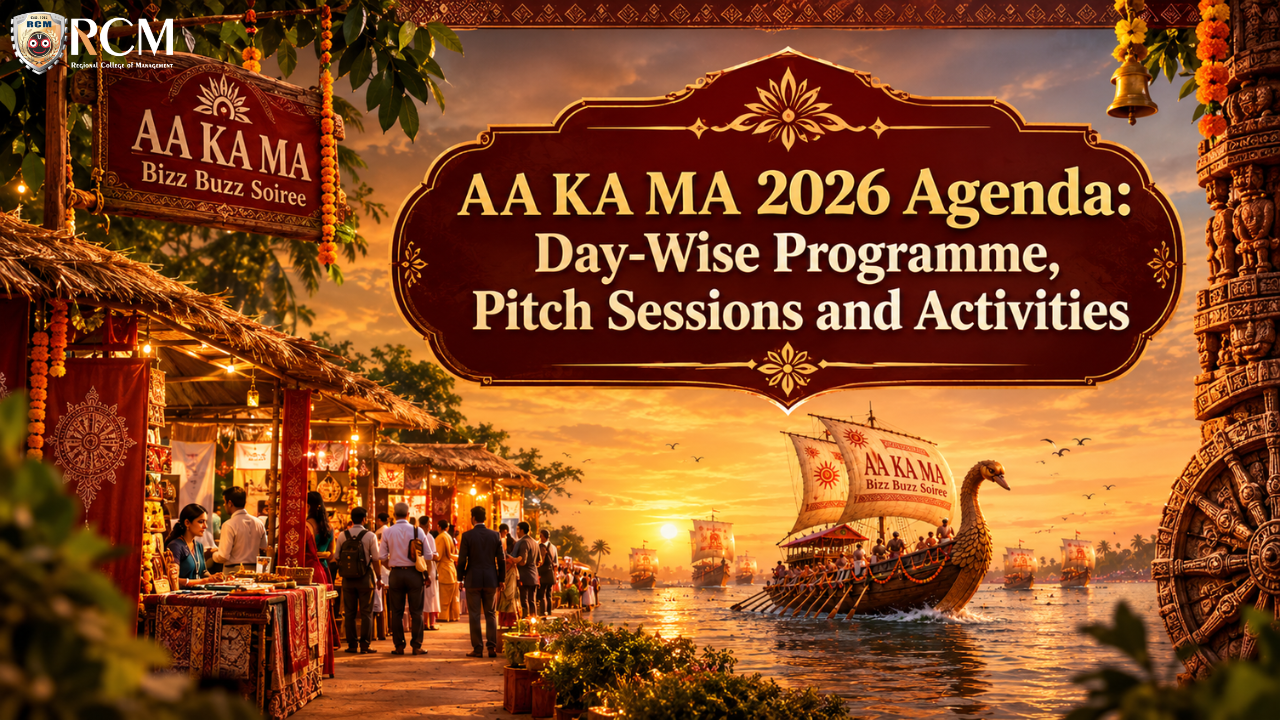
Regional College of Management (RCM) is based in Bhubaneswar, Odisha. RCM organises AA KA MA – Bizz Buzz Soirée, whose third edition takes place on 14–15 November 2026 at the RCM Campus, Bhubaneswar.
| Detail | Information |
|---|---|
| Event | AA KA MA – Bizz Buzz Soirée 2026 |
| Organiser | Regional College of Management (RCM), Bhubaneswar |
| Dates | 14–15 November 2026 |
| Venue | RCM Campus, Chandrasekharpur, Bhubaneswar, Odisha |
| Theme | From Tradition to Transformation – Pioneering Young Business Wizards |
The theme links traditional business practices with contemporary thinking, which suits Odisha’s long trading heritage. For students, the event is a place to observe enterprise, product presentation, customer engagement, promotion and operations. Dates, timings and visitor information are in the AA KA MA 2026 dates, venue and visitor guide; for current details, see the AA KA MA 2026 event details.
How Do RCM’s Management Programmes Connect with Practical Business Learning?
Management education supplies the knowledge that makes observation meaningful:
- BBA+: foundational business knowledge, marketing concepts and management functions.
- MBA+: strategic thinking, marketing management and business decision-making.
- PGDM+: professional management learning, business operations and practical application.
Combined with customer research, communication, financial awareness and teamwork, such learning complements carnival experience. No programme guarantees business success, employment or funding.
How Can Students Make the Most of a Business Carnival Experience?
- Set a learning objective before attending.
- Observe different stalls and displays.
- Study how products are presented.
- Note customer questions and preferences.
- Notice how promotional messages are communicated.
- Watch coordination and operations.
- Talk to business representatives where appropriate.
- Record useful observations.
- Reflect on the techniques used.
- Connect findings with classroom concepts.
Those notes can become a short presentation, project or learning report. Ask a faculty member for feedback; an outside view often reveals patterns you missed.
Conclusion: Why Every Student Should Understand Marketing Beyond the Classroom
Marketing is not limited to textbooks or presentations. Understanding customer behaviour, product presentation, promotion, sales and operations requires exposure to real business situations.
A business carnival for students offers that exposure through experiential learning management and student marketing projects. In Odisha, events like AA KA MA 2026 help learners connect classroom ideas with the wider business environment, and with the thoughtful observation described above, every student can take something useful away.
Frequently Asked Questions
An educational event where businesses and student teams showcase products to an audience, letting students observe marketing, sales and operations in practice.
It connects theory with real customer behaviour, communication and business operations that classrooms can only describe.
Communication, customer research, sales awareness, digital marketing, branding, teamwork, problem-solving and time management.
Opportunities include live observation and feedback. Challenges include hesitation, time pressure and unclear feedback. Experiences vary, and credits or internships are not assured.
RCM’s business carnival on 14–15 November 2026 at the RCM Campus, Bhubaneswar, lets students observe enterprise and customer engagement firsthand.